 |
|
Hi you,
I’m writing to you this Sunday from a very rainy Southern California. Every grocery store I passed yesterday looked like a scene from an apocalyptic movie, with long lines and huge crowds, and everyone buying two of everything in anticipation of Hurricane Hilary. I did my part, stocking up on mezcal and bacon, and all morning I’ve been sweeping out the rain gutters near my home alongside a few neighbors.
The weather keeps getting more intense, but thanks to filming Season 2 of America Outdoors with Baratunde Thurston, my PBS series, I’ve got plenty of rain gear. We’re getting close to the premiere on Wednesday September 6 at 8 p.m. ET and 7 p.m. CT. Stay tuned for upcoming screening events. Meanwhile, check out the new teaser and my list of 10 recommended things that appeared in the New York Times arts section today. I’ve also been busy on the podcasting circuit talking about A.I. and tech, the power of connecting with nature, and the value of interpreting “citizen” as a verb. A few recent favorites include: The Rich Roll Podcast, Doing Well, Feeling Fine, and Puck’s own The Powers That Be.
Here’s what else is grabbing my attention lately:
- It’s the 50th anniversary of hip-hop, which means lots of celebrations, memorials, and coverage. The Ringer has a great conversation with Dr. A.D. Carson, associate professor of hip hop at the University of Virginia, who’s also a dope rapper in his own right.
- I’m cautiously celebrating a legal victory in Montana where sixteen young people successfully sued the state, alleging that Montana’s energy policies violate their constitutional right to a “clean and healthful environment.”
- I’m getting a lot of joy from the satirical cultural investment services newsletter. The creators describe it as “late capitalism's finest analysis of cultural assets for the discerning gentrifier,” providing the highest in clout R.O.I. Their “sell” recommendation on kale is actually worth reading.
|
| And now, for the main event… |
 |
| Trump Fatigue & the Slow Arc of Justice |
| A fourth indictment of the former president doesn’t appear to be moving the needle on public opinion. But it is finally providing an accounting, if not accountability, of Trump’s most pernicious crimes. |
|
|
|
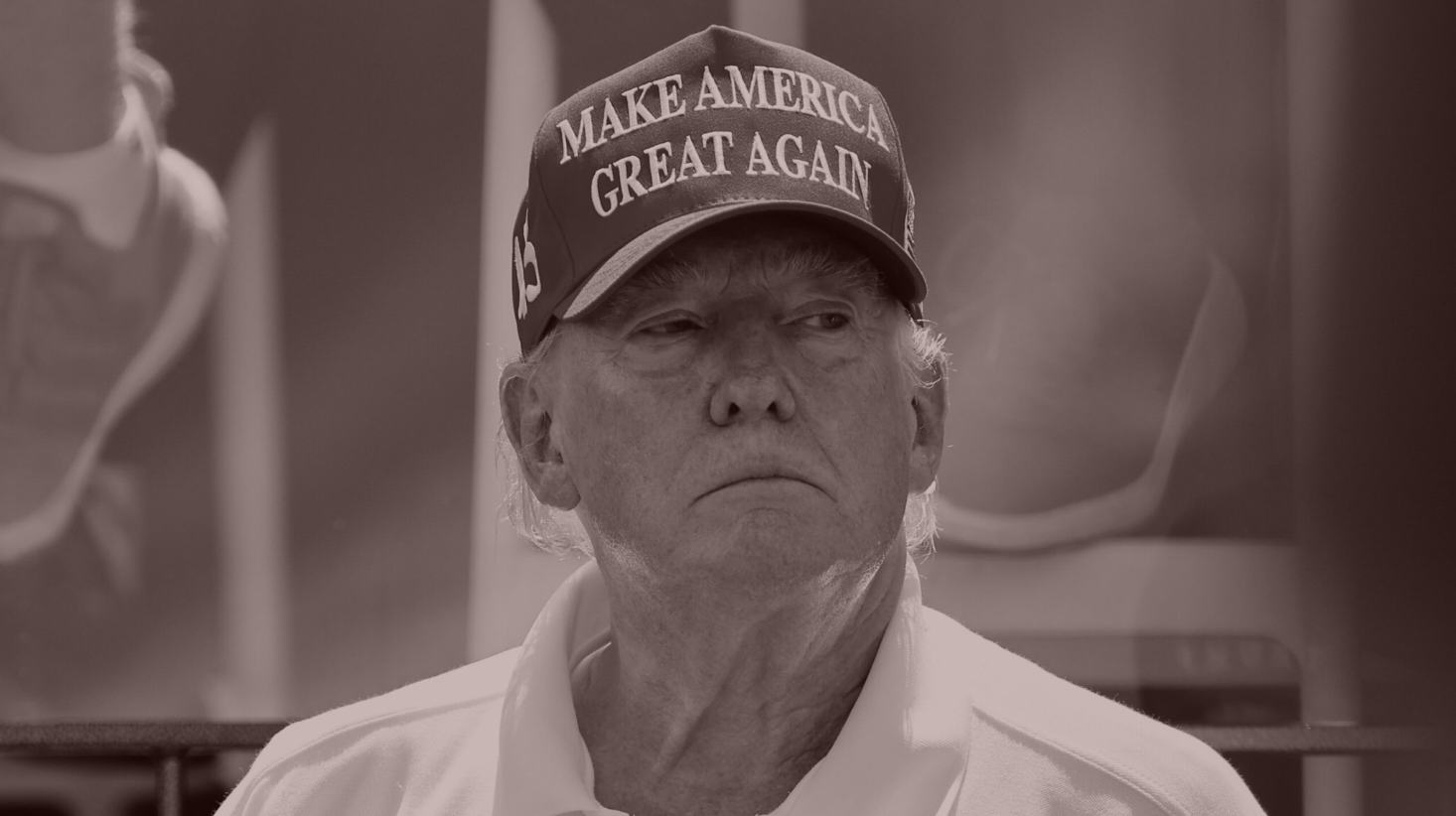
| You’ve heard by now that former president Donald Trump is facing 91 felony charges in four separate criminal indictments. Take a moment. Breathe. Let that sink in. Like many Americans, I was raised to feel a healthy skepticism towards the U.S. political system, its representatives, and the myriad ways that power is used, abused, and flows asymmetrically through our government. The cliché notions that “all politicians lie” and that “all presidents break the law” are baked into our culture. But on a day-to-day basis, do we imagine that our politicians, no matter how unscrupulous or cynical, are committing actual, criminal, go-to-prison crimes? Crimes that result in a trip down to the local courthouse? Nah.
Yet here we are, with a former president entering and exiting courthouses across the country. He’s getting arraigned, pleading not guilty, and awaiting trial dates like someone on Law & Order (or like the estimated one in three Americans who have some type of criminal record). It’s beyond disappointing—after all, presidents are supposed to represent the best of what our country has to offer—and so we should find it utterly and completely surreal.
But for some reason, the news doesn’t seem to be sinking in with your average American. While slightly more than half of registered voters say Trump should be indicted for trying to overturn the 2020 election, the most grievous of his four recent indictments, only about 20 percent of Republicans feel the same way. And I admit, I’ve found myself becoming numb to the news, myself. How can that be, when we’re living through what will surely be one of the crazier chapters in some middle schooler’s future U.S. History textbook? (Well, maybe not in Florida.)
Five years ago, back when Bob Mueller was indicting Trump’s associates and spotlighting a trail of criminal breadcrumbs that suggested Russian interference in the 2016 election, culminating in the Mueller Report, I downloaded the PDF and read it word for word. I made elaborate visual diagrams and live tweeted my process; I listened to the “Trump, Inc.” podcast and was glued to MSNBC looking for clues, vindication, or comeuppance. People across the country sported “It’s Mueller Time” t-shirts, and drank greedily in his honor. I knew the names of multiple Russian oligarchs, for god’s sake! Oleg Deripaska! (That one is forever lodged in my brain for whatever reason.) But now, I’ve largely ignored the coverage of these multiple, concurrent, criminal cases involving the former president.
I’m not alone in this, and I have a few theories as to why. First, I’m not sure if we’re learning anything new about Trump, who, for all his personal and political defects, is perhaps the most transparent president in our history. Indeed, the majority of the evidence against Trump is already a matter of public record, having been reported in the Times or the Post or simply posted online by Trump himself. We already knew about the Stormy Daniels hush money payments, the nuclear secrets stashed in a Mar-a-Lago bathroom, the insurrectionist efforts culminating in Jan 6, and his flagrant attempts to overturn election results in Georgia and elsewhere. The courts are late to the party, and most voters have a set view of Trump, so the indictments aren’t really moving the needle on public opinion. But the relatively muted public response goes deeper than a simple lack of surprise that our most indictable president ever got himself indicted multiple times. |
|
|
| It’s not that Americans are apathetic; we’re simply tired. Poll after poll shows that voters are tuning out the news because they’re “frustrated” with politics; they’re “extremely worried” about the direction of the country but “exhausted” by the prospect of a Trump-Biden rematch. I’m tired, too.
One reason I haven’t been as engaged with the latest cycle of Trump indictments, frankly, is that I’m still recovering emotionally and psychologically from the first Trump presidency. No, I wasn’t targeted by his barbaric ICE immigration policies or his wannabe goon squad, otherwise known as the Proud Boys. But I’m still in a state of exhaustion, even after the 941 days since he left office. What’s more, I’m pre-exhausted by his possible return, which wouldn’t happen for another 500 days or so. If this is simply the intermission before a second Trump term, I’d like to conserve my energy.
I don’t think our exhaustion is driven primarily by a lack of caring but rather by a lack of accountability. For many, Trump’s political rise and presidency was defined by the moral failure of institutions from the R.N.C. to the Department of Justice to speak out or take action when they had the chance. Trump wasn’t stopped by Mueller, Rachel Maddow or Michael Wolff, nor has he been brought down by lawsuits, tabloids, protests, or angry op-eds, Joe Biden or a 3.5 percent unemployment rate. And we already know not to expect any sort of condemnation from Ron DeSantis.
Now, with dueling state and federal indictments for his actions surrounding January 6—let’s call it what it was, an attempted coup—there’s a sense that, maybe this time, Trump will finally be forced to answer for his crimes; a last chance to hit the brakes on a crazy train threatening to crash into the station (our democracy) or careen sideways off a cliff, with all of us on board. |
|
|
| There is a great deal riding on the prosecutors, and judges, who will be overseeing the charges against Trump in New York, Florida, Washington D.C., and Georgia. These will be difficult cases to make, regardless of their merits, due to the unprecedented nature of the alleged crimes and the unique status of the alleged criminal. Never before has this country experienced the indictment of a former president who is also campaigning to return to the White House, setting up the horrific prospect of a major party nominee being sentenced to jail, or of a president attempting to pardon himself. For the first time ever, we may see two forms of American democracy at odds, in the jury room and at the ballot box.
Nevertheless, there is already a sort of poetic justice at work, especially in Fulton County, Georgia, a seat of Black political power that Trump specifically attempted to disenfranchise by applying overt pressure on government authorities to discard legal ballots, and asking Secretary of State Brad Raffensperger “find” him 11,780 votes. Georgia, after all, has been trending left for several cycles, partly due to demographic changes, but also thanks to on-the-ground political organizing by groups like the New Georgia Project, founded by Stacey Abrams. Many can and have taken credit for Biden’s narrow victory in Georgia in 2020, but it’s undeniable that Black people—and Black women in particular—deserve the most credit. And so it’s fitting that a Black woman prosecutor, Fani Willis, is now seeking to hold him accountable despite the threats rolling in.
Amid the present chaos, many seem to have forgotten that election workers are not political appointees or active partisans, but rather part of the infrastructure of democracy. Wandrea “Shaye” Moss and her mother Ruby Freeman were two such workers in Georgia during the 2020 election, and later testified before the House Jan. 6 Committee. Trump, Rudy Giuliani, and their allies (“co-conspirators,” in the language of the indictment) targeted Moss and Freeman, accusing them of interfering with ballots and “passing around USB ports as if they are vials of heroin or cocaine.” In fact, they were ginger mints, but the damage was done. Moss and her family were threatened with racial violence. People showed up at her grandmother’s home.
To better understand the intensity of that moment, I spoke with Nsé Ufot, who assumed leadership of the New Georgia Project after Abrams, and knows Georgia voting better than almost anyone. “Being doxxed as a working class, single Black woman who lives alone was one of the most terrifying experiences in my organizing career,” she told me. And of course, the terror inflicted on Moss, Freeman, Ufot and others was not unique to 2020, but merely the latest entry in a long history of political bullying and intimidation, with tactics including racial terror, lynchings, poll taxes, voter suppression, and so much more.
But that bullying and intimidation has consistently been met with efforts to stand up for democracy, often by those whose participation is most suppressed. Over text, Ufot noted that while most 2020 campaigns opted to operate virtually, “I deployed 1,100 staffers and thousands of volunteers across the state looking like beekeepers to engage millions of young Georgians and voters of color in high quality, face-to-face convos…. It is not hyperbolic to say that Black voters, through their overwhelming participation, beat back a (wait for it…) vast right wing conspiracy to steal an election.”
Her bold efforts in Georgia reminded me of other would-be victims of racially-motivated campaigns to exclude folks from society, and my mind went to Antron McCray, Yusef Salaam, Raymond Santana, Kevin Richardson, and Korey Wise. Formerly known as The Central Park Five, these men were wrongfully convicted in an infamous 1989 case involving the assault and rape of a female jogger in Central Park. Their convictions were vacated in 2002; today they’re known as The Exonerated Five. At the time, Trump was a New York City socialite and real estate clown playing with his father’s money, and he took out full page ads calling for the death penalty against those then-children. He has never apologized.
Last week, Raymond Santana posted the following to his Instagram account regarding Rudy Giuliani, who was charged, along with Trump and 17 others, in the Georgia case: “This man was directly responsible for breaking families apart in the ’90’s for youth accused and locked up in the system… If he is found guilty he should know what hard time is after all the hard time he has put on so many families.” Just like Trump, Giuliani has long used the legal system to charge, smear, sue, deport, and attempt to incarcerate his enemies, and it’s finally coming full circle. How ironic that the man who popularized the use of racketeering and conspiracy charges (known as RICO) to go after organized crime, is now the target of a RICO case himself? |
| A Conspiracy Against Democracy |
|
| If anything, what the indictments truly emphasize is that Trump was never a solo act. The key word “conspiracy” appears often across three of the four indictments. There’s one major allegation in the Florida documents case, three in the D.C. federal election case, and five in the Georgia election case. I’m not a lawyer (you can read my colleague Eriq Gardner for more credible legal interpretations), but I know that, in a basic sense, conspiracy involves two or more people agreeing to commit a crime. They don’t have to succeed—they just have to make a legitimate attempt to achieve their goal. The allegedly wide-ranging, collaborative effort to keep Trump in office seems to have involved multiple lawyers across several states, local election officials, violent extremists, and of course, Trump himself, all pulling in the same dangerous direction. If that’s not a “conspiracy,” what is?
When I spoke with Ufot, she offered her personal account of what she saw in Georgia: “Sitting elected officials from Georgia and elsewhere forged documents, saying Trump won and submitted them without irony. They recruited 545 alternate electors. They copied voter rolls and ballots… Rudy came to Georgia peddling his lies and captured airtime, energy, and resources in order to steal an election.” In other words, at best, Trump and his cronies were unwitting beneficiaries of a scheme to overturn a legitimate election and return Trump to the White House. But let’s be honest, how likely is that? And at worst—and this is what the prosecution in Georgia will try to prove—they were the engine behind it all, willfully and cynically undermining the democratic process, which also happened to initiate a violent assault on the Capitol. If the latter, there must be consequences, otherwise other would-be autocrats will surely try again.
This “democracy” thing we’ve been trying in the United States for the last two and a half centuries has always been an experiment. It’s never been threatened more in the modern era than it is today, but it’s worth remembering that democracy will never be totally secure unless greed is scrubbed from the human temperament. Nothing we should bet on. But in order to have a shot at preserving and strengthening our democracy, we must actively participate in the electoral system, remain vigilant against political power grabs, and truly cherish the glory of self-governance. These indictments against a former president are merely a test within a broader, more meaningful test. Let’s make sure we do everything we can to pass it. |
|
|
|
| FOUR STORIES WE’RE TALKING ABOUT |
|
|
|
|
|
 |
|
|
|
Need help? Review our FAQs
page or contact
us for assistance. For brand partnerships, email ads@puck.news.
|
|
You received this email because you signed up to receive emails from Puck, or as part of your Puck account associated with . To stop receiving this newsletter and/or manage all your email preferences, click here.
|
|
Puck is published by Heat Media LLC. 227 W 17th St New York, NY 10011.
|
|
|
|