Hello and welcome back to The Best & The Brightest. I’m Leigh Ann
Caldwell.
It was great seeing so many of you last night at our Puck Live event presented by the Modern Ag Alliance, where my partner Abby Livingston interviewed Rep. Glenn “GT” Thompson, the Republican chair of the House Agriculture Committee. Thompson discussed what he’s hearing from farmers in his rural district about tariffs, immigrant workers, the MAHA report, and more. In typical Puck fashion, the event featured fab drinks, glamorous people,
and a location with phenomenal sunset views over the Potomac. Abby will have more on all that later this week.
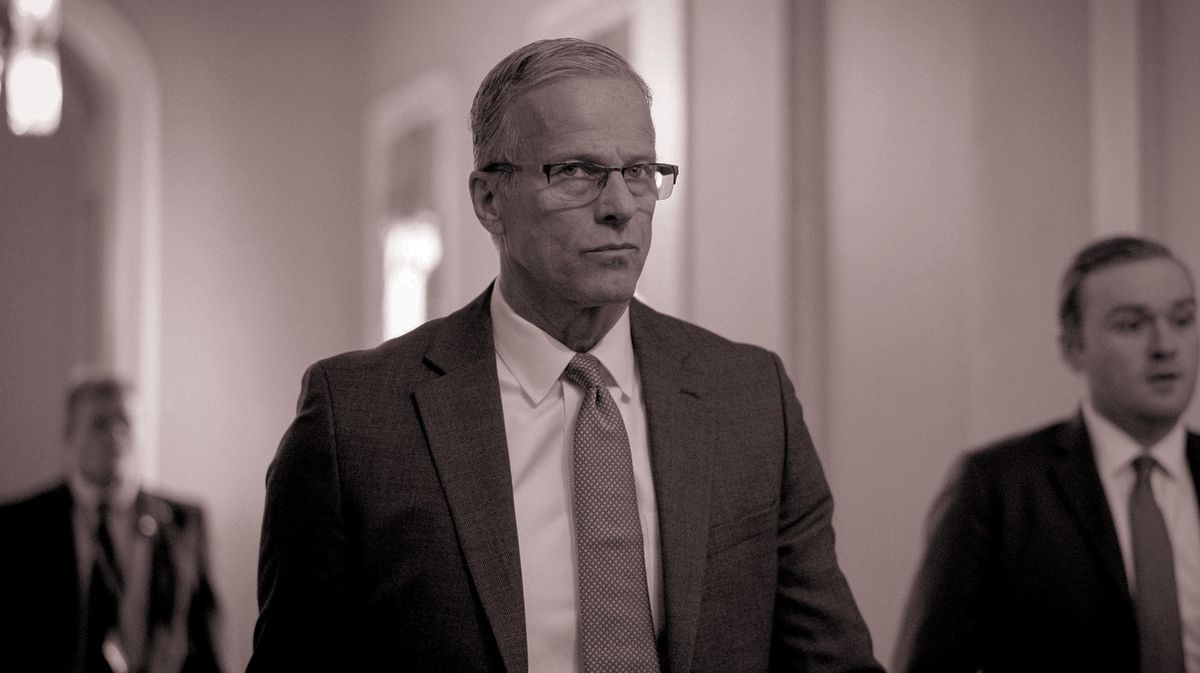
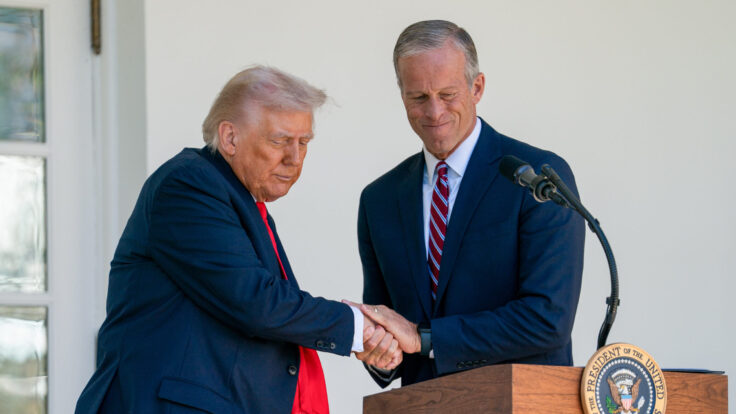
Meanwhile, I’m back at the Capitol, where there’s a lot of nervous energy in the building. Today, I take a look at Senate Majority Leader John Thune, who is facing his biggest tests yet: a potential government shutdown, growing midterm headwinds, and, of course, an administration that is seeking to make Congress obsolete.
But first… |
- Murkowski
for gov?: There’s mounting speculation among political insiders in Alaska that Sen. Lisa Murkowski is considering running for governor in 2026, two Republicans have told me. Murkowski was asked about the rumors at a news conference in Alaska last month and didn’t quite shoot down the idea, saying, “Where I’m at right now is more than a full-time job.” Not exactly a Shermanesque statement.
Naturally, the chatter is worrying some Republicans in Washington, who
figure it wouldn’t look great if yet another lawmaker left Congress to run for governor. But it would hardly be surprising if Murkowski was restless in the saddle. She’s increasingly at odds with her party in the age of Trump, and has described feeling “afraid” of retaliation from the White House. Murkowski has built a unique
independent brand, weaving together a coalition of moderate Republicans, independents, and centrist Democrats, which has been a successful path for her in Alaska. But her reluctant vote for the One Big Beautiful Bill, despite scoring carveouts for Alaskans, has tanked her approval ratings in the state, according to a recent poll. (Murkowski’s office didn’t respond
to a request for comment.)
Former Democratic Rep. Mary Peltola is considering a run for governor, too, as I’ve reported in this space, and would be the clear favorite, according to a different poll.
(Peltola and Murkowski, both on the ballot in 2022, backed each other in a rare cross-party endorsement, perhaps further complicating a run for governor.) Meanwhile, Alaska Gov. Mike Dunleavy is reportedly planning to run against Murkowski for Senate—or whoever is in the race at that point—in 2028. - The Epstein pressure cooker: It was an incredible scene outside the Capitol today as about a dozen victims of Jeffrey Epstein shared their stories with the media. Among them was Marina Lacerda, who spoke publicly for the first time about dropping out of high school to work for Epstein from the
ages of 14 to 17. “I had no way out until he told me I was too old,” she said. The victims questioned why their allegations had not been made public, and they called on Congress and the Trump administration to release any and all documents related to Epstein. Reps. Thomas Massie, Ro Khanna, and Marjorie Taylor Greene, who stood solemnly alongside the victims, praised each other for setting partisanship aside to demand more transparency from the
Justice Department.
Of course, this was precisely the sort of spectacle that many Republicans had been hoping to avoid. The Massie-Khanna discharge petition already has 206 of the 218 signatures it needs to advance, including four Republicans: Reps. Nancy Mace, Lauren Boebert, Greene, and Massie. If all 212 Democrats sign—and they’re expected to—they’ll need only two more Republicans for it to move forward. The White House has been calling Republicans and
encouraging them not to sign on, according to various media reports.
Meanwhile, House Speaker Mike Johnson has been working overtime to help Trump make the Epstein issue go away. The House Oversight Committee released more than 33,000 pages of Epstein-related materials obtained via a subpoena last night, although ranking member Robert Garcia said that none of the information was new. Johnson also put forward his own, but much weaker, resolution to give
Republicans an alternative to joining with Massie.
|
|
|
Republicans are lurching toward an explosive showdown with Democrats, the public, and each
other over the president’s so-called pocket rescissions. How the Senate majority leader handles the blowback, and a looming government shutdown, could impact the midterms and the future of Congress itself. |
|
|
It’s looking to be a September from hell for John Thune, who has, until now, managed to
maintain his preternaturally jovial demeanor despite repeated tests in his eight long months as Senate majority leader. Perhaps that’s because, in nearly every instance in which President Trump has forced him to either defend the institution’s constitutional role or acquiesce to the expansion of executive power, he’s mostly chosen the latter.
But now, things are coming to a head: The White House is setting up an even larger clash with Congress over
appropriations, Democrats are making noise about a possible shutdown, and Republicans are divided over how to fund the government, which will start to run out of money in just 27 days. Thune is still trying to negotiate a short-term extension with the White House and Speaker Mike Johnson to give the normal appropriations process more time to work via the passage of multiple separate funding bills. “I think that’s the best way to be able to fund the government,” Thune told me and
other reporters this morning. When I asked if he’ll be able to persuade the White House, he said, “Well, we’ll see.” Trump is currently pushing for a so-called “clean” C.R., an extension of government funding that runs into at least early 2026. Alas, Thune won’t have much of an ally in Johnson, who will probably do whatever Trump wants.
Even after that argument is settled, there’s no guarantee that Democrats will play ball to keep the government open: They’re furious, and funding
votes in the Senate—which require a bipartisan 60-vote threshold—are one of the vanishingly few places they have any leverage. Further complicating matters, Russ Vought, director of the Office of Management and Budget, has made it clear he thinks the president can cancel (or “impound”) congressionally appropriated money at will—and it’s quite possible he’ll soon try to do just that.
Indeed, the White House has fueled this looming confrontation in recent days by
trumpeting Trump’s “historic” so-called pocket rescission—a unilateral clawback of congressionally appropriated funds so close to the end of the fiscal year that it automatically goes into effect absent congressional action—to eliminate $4.9 billion worth of “woke, weaponized, and wasteful
spending.” This practice, per the congressional watchdog Government Accountability Office, is illegal, and I’m told by senior Republican aides that members are frustrated by it, even if they don’t disagree with the specific funding cuts.
Some Republicans think that this nearly $5 billion rescission—which is relatively modest in the context of $1.8 trillion in annual
discretionary spending—is just the beginning. Marc Short, who served as chief of staff to Vice President Mike Pence during Trump’s first term, predicted that the administration will try to cancel yet more funding in the fall without congressional approval, via impoundment, setting up a potentially major legal challenge on executive authority. In fact, Short told me he believes that is precisely why the administration is pushing for a C.R. that would
extend spending levels set under President Biden. In other words, as Short put it, “Give us the C.R. because we’re going to impound the funds later.” (The Office of Management and Budget did not comment on any future impoundment plans, instead pointing me to a 1975 letter from the G.A.O. that says pocket rescissions are legal.) |
So Thune is in a tricky spot. Obviously he’s not looking for a war with Trump, who is still popular with the
base. But if Congress doesn’t block the current pocket rescission, the Trump administration could argue in court that their acquiescence was tantamount to acceptance. And in the process, Thune would also essentially be acceding to the total abrogation of Congress’s constitutional spending authority, rendering the institution irrelevant. In addition to the obvious historical ramifications, that decision could also have real political ramifications for his party in the
midterms.
The average voter is unlikely to head to the polls spitting mad about pocket rescissions, of course, but the G.O.P. majority hinges on the continued participation of increasingly disillusioned incumbents, such as Susan Collins, who is pissed off about the degradation of the appropriations process and pocket rescission, which she has called “a clear violation of the law.” Thune is working hard to ensure she feels there’s still power and influence atop the
Appropriations Committee, and that she doesn’t simply shrug her shoulders and retire.
If Collins does decide to call it quits, though, the entire Republican majority is at grave risk. Republicans are well aware that if Collins doesn’t run, Democrats are likely to win the seat she will vacate in Maine. And while she has yet to announce her plans, it’s clear that she has become immensely frustrated with her job, giving the 72-year-old lawmaker little incentive to spend another six
years in Washington. Thune has emphasized to the president how important it is to keep Collins in office, a senior Republican aide said, and persuading the president to respect the appropriations process is part of that conversation.
Thune, of course, isn’t just responsible for passing Republican policy—he’s also tasked with making sure Republicans win in 2026. Alas, even if Collins decides to run again, the Senate Republicans’ political operation is already on a losing streak that could
imperil the G.O.P. majority in November. On Monday, Senator Joni Ernst announced that she would not seek reelection in Iowa, joining another relatively young colleague, Sen. Thom Tillis of North Carolina, in calling it quits. Iowa won’t be as competitive as North Carolina, where Democrats have a real chance at taking back the seat, but it’s almost always easier—and certainly less expensive—to run an incumbent. Then on Tuesday, Sen. Cory Gardner
announced that he was stepping down as head of the Senate Leadership Fund, the Senate Republican super PAC, to run the Internet and Television Association, a position that comes with a multimillion-dollar salary. Gardner’s pivot leaves Senate Republicans without a prominent fundraiser and sharp political mind headed into a tough midterm season.
Meanwhile, what should have been a layup in Texas is turning into a mess of a primary between Sen. John Cornyn and state A.G.
Ken Paxton, which will potentially cost Republicans tens and maybe even hundreds of millions of dollars. There have also been major recruiting failures, especially Brian Kemp in Georgia and Chris Sununu of New Hampshire, both of whom have declined to run for Senate. Why run, after all, just to submit to the indignities of a decreasingly powerful job? “It’s going fucking terrible,” a senior Republican aide said of the party’s political
side. And it’s up to Thune to make it less terrible. |
|
|
Join Emmy Award-winning journalist Peter Hamby, along with the team of expert journalists at Puck, as they let you in on the
conversations insiders are having across the four corners of power in America: Wall Street, Washington, Silicon Valley, and Hollywood. Presented in partnership with Audacy, new episodes publish daily, Monday through Friday. |
|
|
Unique and privileged insight into the private conversations taking place inside boardrooms and corner offices up and down Wall
Street, relayed by best-selling author, journalist, and former M&A senior banker William D. Cohan. |
|
|
Need help? Review our FAQ page or contact us for assistance. For brand partnerships, email ads@puck.news. You received this email because you signed up to receive emails from Puck, or as part of your Puck account associated with {{customer.email}}. To stop receiving this newsletter and/or manage all your email preferences,
click here. |
Puck is published by Heat Media LLC. 107 Greenwich St, New York, NY 10006 |
|
|
|