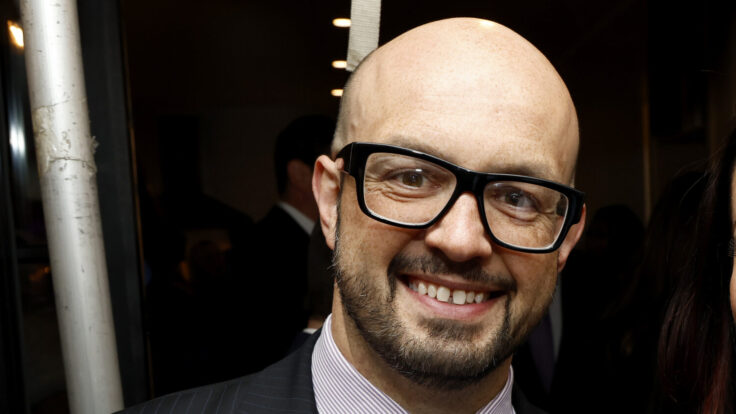
Hello and welcome back to The Best & The Brightest and happy Original Sin rollout week. I’m Leigh Ann Caldwell, your cruise director.
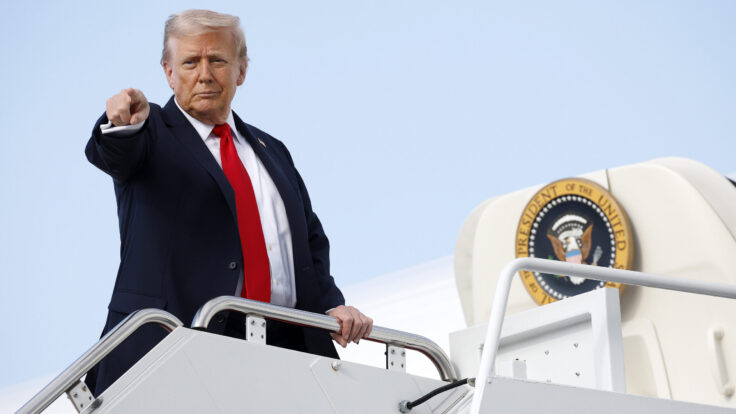
Today, Trump once again welcomed a world leader into the Oval Office, only to humiliate him. The guest this time, of course, was South African President Cyril Ramaphosa, whom Trump suggested was approving the killing of white South African farmers—pulling on a political thread that my partner Julia Ioffe surfaced last week. Between this performance and the very public dressing down of President Zelensky, I wonder if world leaders will start to think twice before visiting.
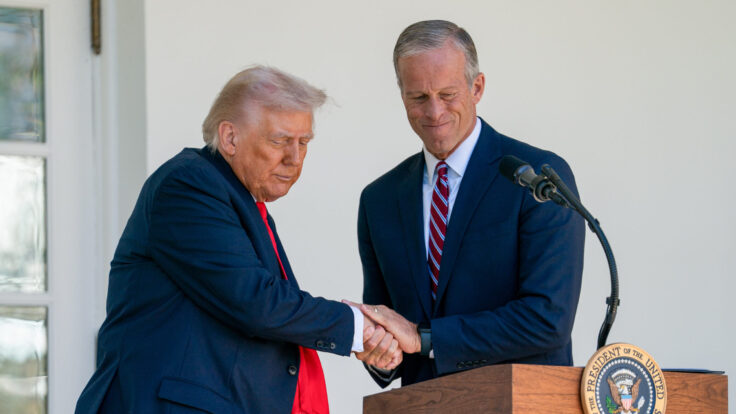
Anyway, today I’m writing about the so-called “Big, Beautiful Bill” (now a proper noun!), or BBB— tout court. As Speaker Mike Johnson and Trump work to get it over the finish line in the House today, we’ll look ahead to the pitfalls the bill faces in the Senate. While House passage is a significant development, many challenges remain before the president can sign it into law.
But first…
|
- Thune’s “nuclear” option: Senate Republicans are set to overrule the parliamentarian—the authoritative, nonpartisan interpreter of the upper chamber’s rules. It’s an extremely rare action, which has both sides extremely defensive about it. For their part, Republicans tell me that this maneuver is both necessary and institutionally benign. Meanwhile, Democrats are lambasting it as a major breach of precedent. Naturally, both parties are exaggerating.At issue is a California rule mandating that all new cars sold in the state be electric by 2035. The Biden administration approved the rule, which Republicans want to overturn because they are opposed to mandates, electric vehicles… and California (kidding! Kind of…). Elizabeth MacDonough, the Senate parliamentarian, advised Republicans that the Government Accountability Office determined that it’s not a federal rule, and thus not subject to congressional review. Rather than back off, Republicans have moved to overrule her.
Doing this can create an opening to justify larger changes to Senate rules down the road, though Senate Majority Leader John Thune called the electric-car mandate a “novel and narrow issue,” and said overturning it wouldn’t set a precedent or make any difference to Senate rules. On the Senate floor, Minority Leader Chuck Schumer called out Republicans for “going nuclear to appease the fossil fuel industry, and at the same time erode away the institution they profess to care about.”
Privately, some Republicans didn’t necessarily disagree, and they’ve struggled over what to do in closed-door meetings. Former Majority Leader Mitch McConnell, who has been an outspoken opponent of efforts to change Senate rules of late (except, of course, when he changed them to more easily confirm Supreme Court judges), spoke in support of overturning the rule, which changed the tenor of the conversation for his party.
The fact that Democrats are crying foul, however, is pure hypocrisy. After all, they tried to get rid of the filibuster in the last Congress, and would have been successful had Joe Manchin and Kyrsten Sinema not broken ranks. Schumer himself was promising to revisit the issue on the campaign trail last year, vowing to eliminate the 60-vote threshold to pass legislation if Democrats won the Senate, House, and White House.
|
|
|
Disney has been bringing happiness to families and communities for over a century, and continues to be a powerful economic contributor.
Here’s how: With more than $30 billion in investments in U.S. parks, Disney is creating nearly ten thousand jobs.
Explore Disney’s Impact
|
|
|
- R.I.P.: Rep. Gerry Connolly, the jovial, kind lawmaker from Northern Virginia, who was a fierce advocate for federal workers, has died from cancer. His death triggers an election within the next 30 days to replace him as ranking member of the House Oversight Committee, a position he won just five months ago. Rep. Jasmine Crockett might jump in and, if so, will likely have to overcome factions within the caucus that still favor the old system of seniority and others turned off by her aggressive, in-your-face tactics. (My partner Abby Livingston wrote an excellent analysis of the race earlier this month.) Rep. Ro Khanna, however, who was considering a run, has surprisingly decided against it. “I have great respect for [Maryland Rep.] Kweisi Mfume,” he told me, referring to another likely candidate. “I would have run, but deferred to him out of my respect and admiration for his wisdom and leadership.”Mfume’s office hasn’t officially said he’s running, but an announcement is expected shortly. (No one wants to jump the gun on the day of Connolly’s death.) The race could be a crowded one, even though Rep. Alexandria Ocasio-Cortez is still expected to opt against a second try for the position.
|
|
|
|
As the House speaker struggles to find “equilibrium” in his conference between the deficit cutters and the SALT-cap raisers, he faces a potentially even more complicated problem down the line: the Senate.
|
|
|
|
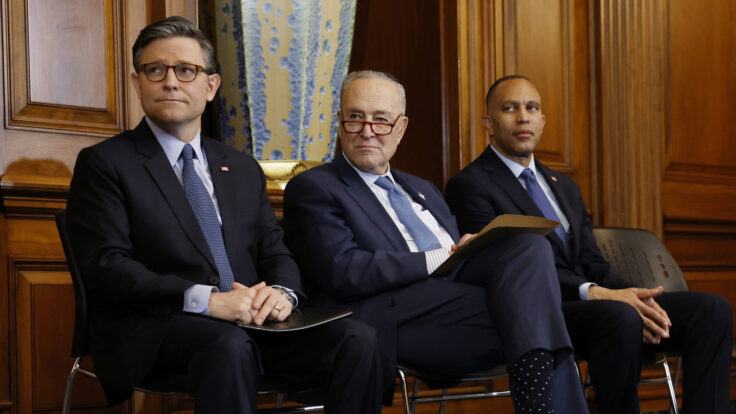
Yesterday, during Mike Johnson’s address to Republican senators at their weekly closed-door lunch, the House speaker spoke candidly about the biggest challenge facing the now officially named “One Big, Beautiful Bill”: the cap on the state and local tax deduction, a.k.a SALT. According to a person in attendance, Johnson described the difficulty in finding the “equilibrium” to satisfy blue-state Republicans, who are demanding a higher cap to provide tax relief for their high-income constituents—which adds hundreds of billions of dollars to the cost of the bill—and the hard-line conservatives demanding deficit reduction.
Johnson’s specific mention of the SALT cap was part of his broader plea to Senate Republicans to change the bill as little as possible once it reaches their chamber. In many ways, Johnson is telegraphing his anxieties. Even if President Trump can help him push the bill through the House today, tomorrow or in 10 days, the controversy won’t go away when the bill hits the Senate.
|
|
|
Disney has been bringing happiness to families and communities for over a century, and continues to be a powerful economic contributor.
Here’s how: Since 2017, Disney has nearly doubled spending on film and television content, and is spending $23B in FY25.
Explore Disney’s Impact
|
|
|
|
Republican representatives from New York, New Jersey, and California have held their ground in demanding a higher cap. When the Ways and Means Committee offered to triple it, from $10,000 to $30,000, SALT Republicans objected—mystifying even Democrats who thought it was a pretty good deal. This group also refused when Trump privately called out Hudson Valley Rep. Mike Lawler, one of the staunchest advocates of lifting the cap, and publicly pressured the SALT caucus yesterday to take a deal of a $40,000 cap for the next four years. Although Trump told Republicans in a closed-door meeting yesterday morning that SALT won’t affect their reelections, the relevant Republicans clearly disagree. It would be hard to face voters if they fail. Plus, both Lawler and Rep. Elise Stefanik are considering running for New York governor, and securing a huge tax cut would go a long way in the blue state.
Indeed, this is one issue the blue-state Republicans are consistently serious about. In the 2017 Tax Cuts and Jobs Act, which instituted the SALT cap to help pay for the corporate and individual rate cuts, 11 of the 12 Republicans who voted against the bill (including Stefanik) came from the SALT states. Now, as Republicans work to extend those cuts, SALTers have optimized their leverage.
After all, if the party does fail to extend the tax cuts, the SALT cap disappears when the bill expires at the end of the year—a pretty good incentive for the SALT caucus to walk away. And if they do balk, Johnson wouldn’t have the votes. So the SALT Republicans have managed to get themselves a satisfactory deal that would increase the cap from $10,000 to $40,000 for incomes under $500,000 for the next decade, with modest increases for inflation. Predictably, the conservatives aren’t on board, and are resistant to the deal over the increased cost of the bill.
Hence Johnson’s quest for equilibrium, which is hard enough in the House. But the SALTers will have a lot less sway in the Senate, which has no appetite for raising the cap and could strip or severely reduce any such provision in their version of the bill. There are no Republican senators representing those highly taxed blue states. “No Senate member has the kind of concerns about SALT tax that the House has, and that the speaker has to deal with,” Republican Whip John Barrasso told reporters today. Now, perhaps the hard-liner negotiation and the rejection of the $30,000 cap suggests that it is the real goldilocks number. But the SALTers are going to have to dial up every Senate Republican contact they have—which I’m guessing is not many.
“The House is going to do what it needs to do to get to 218 [votes], and we’ll do what we need to get to 51,” one senior Republican Senate aide told me. In other words: The House is gonna House, and the Senate is gonna Senate, and resolving those differences is going to be even more complicated than the negotiations unfolding now.
|
|
While SALT might be the most problematic part of the House bill for the Senate, it’s not the only one. Indeed, there’s a long list of items in the House bill that Senate Republicans disagree with, which is why Johnson trekked across the Capitol yesterday to try to curry some favor. Johnson’s speech was received… but then largely dismissed. The Senate, after all, has its own dynamics, and no use for lectures from across the Rotunda—especially since Senate Republicans largely think the House’s one-bill approach was a mistake to begin with.
|
|
|
|
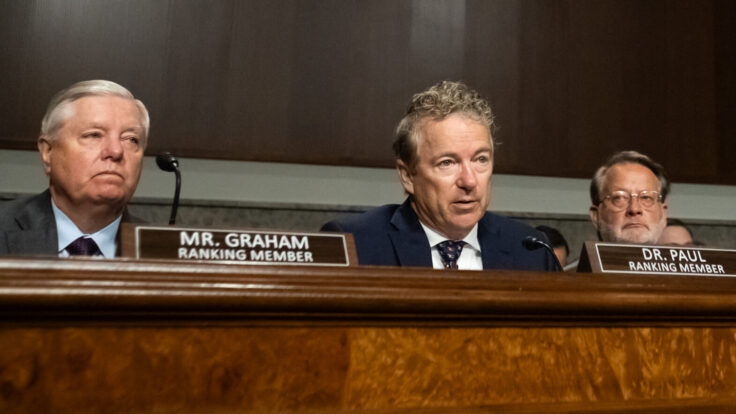
Sen. Ron Johnson, who wants to cut $5 trillion worth of spending in the bill, was among those unconvinced by Johnson’s presentation. “The fact of the matter is, we’re just not solving this [debt] problem,” he told reporters. Sen. Rand Paul was irritated, too, saying the speaker suggested that conservatives “just have to live with” raising the debt limit by $4 trillion, the most it has ever been increased at any one time. “I’m one conservative that won't live with that,” Paul told me. Trump, of course, doesn’t care about the deficit, and tells lawmakers that his tariffs—the same ones he is ostensibly negotiating away—will help pay for the $3.7 trillion cost of the bill, something that also terrifies plenty of Republicans.
Senators and aides offered up a litany of other complaints, too. The House prioritized Trump’s tax agenda, including the “Make It in America” tax credit and full factory expensing, both provisions meant to incentivize investment and manufacturing in the U.S. But they will cost up to half a trillion dollars over four years, nearly double what the Senate is comfortable spending on them. Trump’s influence will surely matter in the Senate, but not to the same degree as it does in the House, where Johnson desperately needs the president’s help in unifying his fractured conference.
The Senate also wants to protect some of the renewable energy tax credits from the Biden-era Inflation Reduction Act, since many red states are reaping economic benefits from renewable projects. This includes Georgia, where Senate Republicans hope to pick up a seat this cycle from incumbent Democrat Jon Ossoff. They also want to protect nuclear energy tax credits, which the House considered, as well as carbon sequestration credits.
Meanwhile, the Senate has divisions of its own. On Medicaid, for example, many Republicans, including Senate Finance Committee chair Mike Crapo and Health, Education and Labor Committee chair Bill Cassidy, support freezing the Medicaid provider tax, a provision that will save billions of dollars. Opponents such as Josh Hawley, however, call the policy a “sick tax” that will increase costs on rural hospitals and levy new fees on Medicaid recipients who can’t afford it. Hawley, in fact, has been frustrating his colleagues because of how aggressively and publicly he’s crusaded against Medicaid cuts. “He has more aggressive talking points about it than Democrats at this point,” one G.O.P. aide said.
Republicans will likely push this over the finish line eventually—though it’s still far from clear in what form. After all the “one big bill” marketing, there’s now renewed chatter about splitting it into two—an extension of the tax cuts, followed by spending cuts and increases to border security and defense—which is what Senate Majority Leader John Thune wanted all along. For the moment, it remains very much a backup plan.
At this point, after all, Republicans can’t even agree on the fiscal impacts of the bill: Most of them insist that it cuts the deficit, while conservatives (along with official estimates, including that of the nonpartisan Congressional Budget Office) say it adds $3.7 trillion over 10 years. “Republicans own this year’s debt,” said Paul. “They’re going to own next year’s debt.”
|
|
|
|
Join Emmy Award-winning journalist Peter Hamby, along with the team of expert journalists at Puck, as they let you in on the conversations insiders are having across the four corners of power in America: Wall Street, Washington, Silicon Valley, and Hollywood. Presented in partnership with Audacy, new episodes publish daily, Monday through Friday.
|
|
|
|
Unique and privileged insight into the private conversations taking place inside boardrooms and corner offices up and down Wall Street, relayed by best-selling author, journalist, and former M&A senior banker William D. Cohan.
|
|
|
Need help? Review our FAQ page or contact us for assistance. For brand partnerships, email ads@puck.news.
You received this email because you signed up to receive emails from Puck, or as part of your Puck account associated with . To stop receiving this newsletter and/or manage all your email preferences, click here.
|
|
Puck is published by Heat Media LLC. 107 Greenwich St, New York, NY 10006
|
|
|
|



_01JV4Z37KEHNPJCDB06MZXJWTA.png "Disney")
_01JV4Z34W72BJER4GXC7PHH9RY.png "Disney")

_01JV4YY3YKK5JG7YZT23W7S98M.png "Disney")
_01JV4YY63TFMRNXWFFY3PBNV6R.png "Disney")

_01JVN115KW6ZGM52B6TWRNGAMC.png "Disney")