Happy Tuesday and thanks, as always, for supporting Puck and being a subscriber.
Today, I’m sharing some inside reporting from the world of Silicon Valley megadonordom: Peter Thiel’s speech to a major G.O.P. donor summit; Barack Obama’s hush-hush visit to Palo Alto and the offices of Laurene Powell Jobs; and an intriguing idea in the world of science funding from Eric Schmidt’s philanthropy that probably isn’t going to happen, but should.
If you have a friend or a colleague who you think would enjoy these notes or give them a leg up at their job, they can sign up right here to start receiving the free version of The Stratosphere—or gift them a full subscription by emailing fritz@puck.news.
SPONSORED BY HULU 
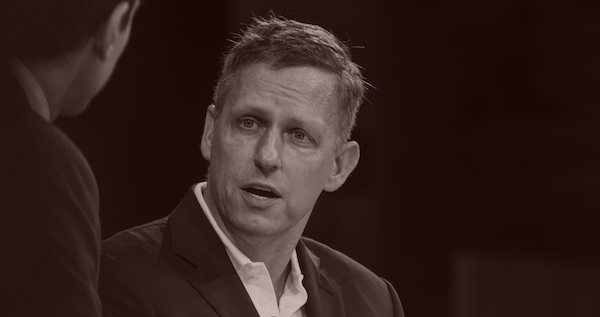
The latest inside reporting on Thiel’s political maneuvering, Obama’s private visit with Laurene’s Emerson Collective, an intriguing idea from Eric Schmidt’s team, and Yuri Milner’s Russia statement. Peter Thiel, who usually prefers to let his money talk for him, spoke up over the weekend to give the hard pitch for Blake Masters before some of the Republican Party’s biggest donors. Masters, Thiel’s protégé and one-time co-author, has yet to gain real traction in Arizona’s crowded G.O.P. Senate primary. And Thiel, who stepped down from the Facebook board earlier this month in part to focus on his own Trump-inspired political projects, is the most powerful asset that he’s got.
Thiel was a keynote speaker at the Club for Growth summit at the famed Breakers resort in Palm Beach, according to an agenda shared with me by Documented, a watchdog group. The headline of Thiel’s speech was “Containment Is Not Enough,” but despite the ominous title, Thiel’s primary mission was to sell his fellow donors on Masters, who spoke just before Thiel in the Mediterranean Ballroom. (Shortly afterward, Masters traveled to New York for a Monday night fundraiser at Empire Steak House hosted by billionaire heiress AJ Catsimatidis and others, according to another invite I saw.)
The Club’s annual conference has been a traditional stop on the G.O.P. money trail, particularly during the shadow primary that precedes the Republican presidential nominating contest, but also during competitive off years, such as the expensive primary that Masters faces in Arizona. Masters took in a $10 million super PAC commitment from Thiel last year, but money alone hasn’t been enough to boost Masters to the front of the pack ahead of the August election. (It could have been worse: Doug Ducey, the state’s Republican governor, did say last week that he wouldn’t run.) It’s probably only a matter of time until Thiel arrives back in Arizona pushing another wheelbarrow of cash.
In the meantime, Thiel has been sharing some of his own political celebrity with Masters, who served as Thiel’s right-hand man at Thiel’s family office and foundation for years. He has been pitching Masters as a conservative but free-thinking political outsider—perhaps not unlike Donald Trump. “There’s the evil party—the Democrats, [and] the stupid party—the Republicans,” Thiel said of Masters at a fundraiser last week in Florida, per the Times’ Shane Goldmacher. “In some ways, [Masters] doesn’t fit naturally into either party.”
ADVERTISEMENT 
Money. Romance. Tragedy. Deception. Hulu’s limited series “The Dropout,” the story of Elizabeth Holmes (Amanda Seyfried) and Theranos, is an unbelievable tale of ambition and fame gone terribly wrong. How did the world’s youngest self-made female billionaire lose it all in the blink of an eye?
Obama x Emerson
While Thiel was in Florida, Barack Obama quietly snuck into Silicon Valley on Sunday for some private meetings, including with Laurene Powell Jobs. Obama spent time at the headquarters for Emerson Collective, Powell Jobs’ for-profit philanthropy-cum-family office, and at her house, about a mile away in Palo Alto.
Obama’s trip to the Bay Area hasn’t been reported elsewhere, but the drop-in makes total sense. Obama, now a cross-platform talent and media producer, has been deepening his relationships across Silicon Valley since leaving the White House, from Netflix to Spotify to Jeff Bezos to Andreessen Horowitz. And Powell Jobs—a prominent Democratic donor, philanthropist, and majority owner of The Atlantic—has become an increasingly important player in Obama’s post-presidency, too. As I reported in October, Emerson and L.P.J. played host when Obama visited Silicon Valley last summer to learn more about disinformation campaigns, a passion project of his after leaving the White House. There are few business leaders with more influence in the rarefied, overlapping worlds of tech, art, politics and media than L.P.J. While I don’t know what Powell Jobs’ team and Obama discussed this past weekend, it’s safe to say they have plenty to kibitz about: they share interests in education and immigration reform, in civic activism and even professional basketball.
Obama may be a private citizen these days, but the backstory of how this meeting came to my attention reveals just how much cloak-and-dagger maneuvering goes into even casual get-togethers with the former president. A tipster spotted Palo Alto cops and security personnel in front of Emerson’s offices, just off of University Avenue, around 1 p.m. Palo Alto police later confirmed to me that it was Obama and his Secret Service detail. A second tipster happened to be driving around the neighborhood, near the old Jobs house, and saw a bunch of black S.U.V.s, a military chopper overhead, and a few cars from California Highway Patrol, which offers protective service details for visiting dignitaries like Obama. Aides to Obama and L.P.J. declined to comment, as did a representative for the California Highway Patrol, who bewilderingly told me I would have to file a public-records request to obtain even basic information about the detail they provided. (Sigh.)
ADVERTISEMENT 
Building the Next Blue Meridian
A quick scoop for the philanthropy in-crowd who wants to know what is trending among the powers that be: There has been an intriguing, very exploratory idea floated by some people at Schmidt Futures, Eric and Wendy Schmidt’s main philanthropic network, to launch a new vehicle focused on innovation and scientific research, and to recruit other funders to back it. The idea, I’m told, would be to use the model of Blue Meridian Partners—the mega-philanthropy that has pooled billions of dollars in capital from the likes of Bill Gates and Sergey Brin to tackle poverty—to start a complementary organization that applies the same logic and structure to a new philanthropic portfolio, one that perhaps could similarly offer advisory services or co-funding opportunities for particular research fields.
To be clear, I am told that the idea did not progress beyond limited conversations from Schmidtworld—all talk, no movement. There is no plan of action now, and I’m told it probably isn’t going anywhere. But I think it should—or someone should do something similar. When you talk to mega-philanthropists or their aides, as I do daily, about what keeps them from getting big gifts out the door, you’ll hear about two major hold-ups: 1) The lack of shovel-ready projects that can accept a big deposit of cash; and 2) The lack of coordination between major donors. Over the last few years, there has been a rush to build up networks and organizations that function as philanthropic intermediaries. Some of it is being pushed by consultants pitching vaporware, but there also have been meaningful projects like Blue Meridian, that have been wildly successful at building infrastructure and coordinating fundraising from industry heavyweights. Even one gazillionaire cannot fix, say, the pay equity gap.
Did Yuri Just Say Something About Ukraine?

You received this message because you signed up to receive emails from Puck.
Was this email forwarded to you?
Sent to {{customer.email}}
Interested in exploring our newsletter offerings?
Puck is published by Heat Media LLC.
For support, just reply to this e-mail. For brand partnerships, email ads@puck.news |


SHARE