Hello, and welcome back to The Best & The Brightest, your daily political dispatch from Puck. It’s
foreign policy Thursday and I’m Julia Ioffe, still absolutely reeling from receiving the news that my forthcoming book, Motherland, is a finalist for the National Book Award. The book isn’t even officially out until October 21, about two weeks from now, so imagine my surprise! (To put it mildly.) If you haven’t yet,
preorder it! That’s the best, most helpful thing you can do for an author.
Tonight, the world turns its attention to the Middle East, where President Trump claims to have secured a lasting end to the war in Gaza, and Washington notes the return of presidential son-in-law
Jared Kushner as informal Middle East envoy. Recall that Kushner, along with his wife, Ivanka, forswore politics after January 6 briefly made the family brand toxic—and rendered the couple social outcasts. But, hey, Washington has a notoriously short memory, especially when it comes to the powerful.
As for the ceasefire, color me hopeful but skeptical. I don’t trust Bibi Netanyahu or Hamas, having agreed to a first-phase deal for a
ceasefire and release of hostages, to abide by the proposed second-phase agreements. What political incentive does either of them have for ending the war? Will Hamas really disarm and give up power in Gaza? Will Bibi really walk away from plans to annex the enclave and tell the messianic nutters in his coalition to pound sand? Only time will tell.
But while everyone is distracted by Trump’s diplomacy overseas, the American military is still grappling with what the president has been
asking it to do at home: police American cities. In tonight’s newsletter, I speak to retired and active-duty military officers who are struggling with the legality and wisdom of doing so. “We have the most stable military-civilian relationship in the history of the world,” one retired military judge advocate told me. “And we’re fucking with the edges of it right now.”
But first… |
|
|

| Abby Livingston
|
|
- The
latest midterm tea leaves: Democrats in competitive Senate races so far have posted some monster fundraising hauls in the third quarter. Most notably, incumbent Georgia Sen. Jon Ossoff has now brought in eight figures in three successive quarters, with $12 million in donations over the past three months, and reports $21 million cash on hand. Other Dems are also looking flush: North Carolina’s Roy Cooper raised $10.8 million in his maiden
quarter, while in Texas, two Dems facing off in their party’s Senate primary also picked up millions, with James Talarico raising $6 million to Colin Allred’s $4 million.
Elsewhere, Maine Gov. Janet Mills announced a run for Senate this week, but she faces a formidable primary opponent in the buzzy oysterman Graham Platner, who raised $3.2 million in a mere six weeks. Also of note in competitive Senate primaries,
Haley Stevens edged out the Democratic field in Michigan—raising $1.9 million to Abdul El-Sayed’s $1.75 million and Mallory McMorrow’s $1.65 million. Finally, Chris Pappas raised $1.8 million in his New Hampshire Senate bid.
On the House side, several Dem contenders easily crossed the million-dollar mark, including Maine’s Jared Golden, Iowa’s Christina Bohannan (who is challenging
Republican Mariannette Miller-Meeks), and Pennsylvania’s Janelle Stelson (who is after Scott Perry’s seat). Connecticut offered some intriguing results in the realm of Democrats’ generational warfare, as Hartford Mayor Luke Bronin announced he’d raised $1.2 million in a mere two months in his challenge against 77-year-old incumbent John Larson, who has been in office since 1999. Larson posted $800,000—a serious
amount, though it’s never good when an incumbent gets outraised.
Republican numbers have been harder to come by, but there are some standouts in that field as well. Ossoff’s Senate seat is a key pickup opportunity for Republicans, and their primary field is crowded, which usually means donors are dispersed. Even so, Mike Collins raised just shy of $2 million, while Derek Dooley raised $1.8 million. Iowa’s Senate race became perhaps more competitive with
the retirement of incumbent Joni Ernst, though it still leans Republican. In any case, G.O.P. candidate Ashley Hinson raised $1.7 million and has $4 million in cash on hand. On the House side, New York’s Mike Lawler, a top Democratic target as one of three Republicans representing a district Kamala won in 2024, posted a good quarter by raising $1.1 million.
|
|
|
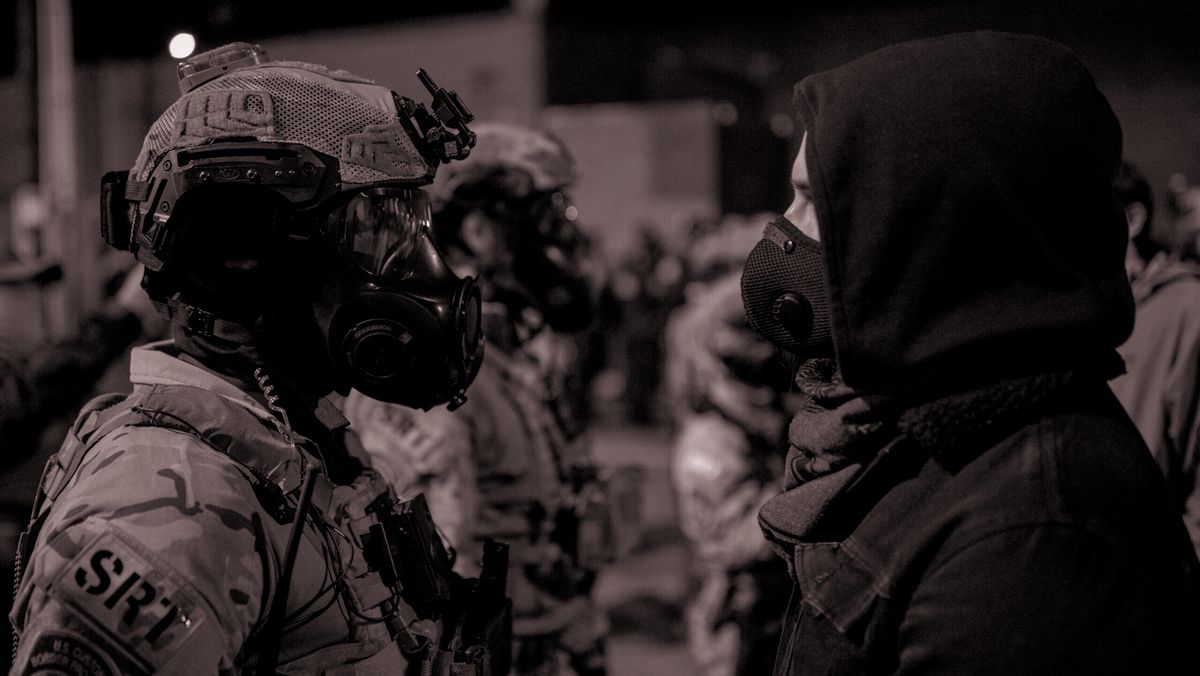
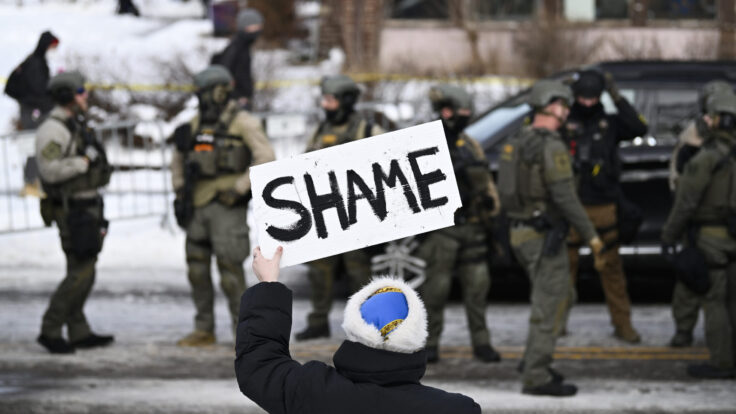
As Trump masses troops outside blue cities in the name of protecting federal properties,
current and former members of the military grapple with the question of which orders are legal—and resent being dragged into the muck of politics. |
|
|
If the Trump presidencies have offered the nation an advanced civics class—on rescissions,
the Emoluments Clause, Title 32—some of the thorniest coursework has been assigned to the military. During the past several months, Trump has repeatedly sent members of the armed forces, including the National Guard and the Marines, to patrol Democratic-run cities like D.C. and L.A. So far, challenges to these deployments have mostly played out in the courts. But as more National Guard troops gather outside Chicago, Portland, and soon, Memphis, current and former military officers are
also grappling with what this means for them. Like members of so many American institutions, they have found themselves wondering: Can the president really do that?
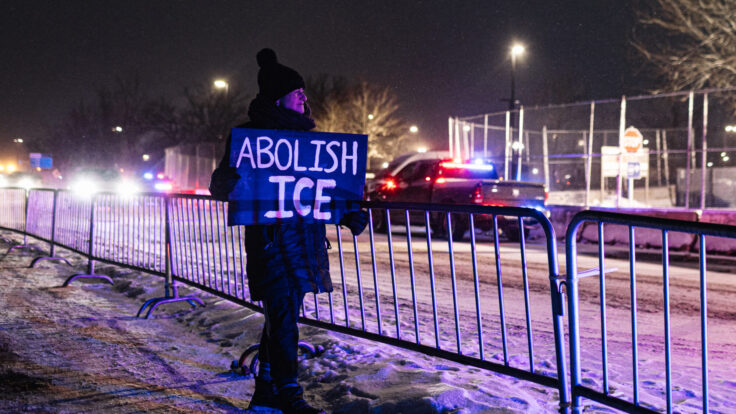
Some are convinced that the domestic deployments of troops—ostensibly to protect federal property, although there have been no mass civil disturbances, or to accompany ICE, despite the objections of local officials—are not legal. “Of course it’s completely illegal,” a retired three-star Army general told me. “Everyone
can see the photos coming out of Portland. Nobody believes [what Trump is saying about the city].”
But that raises a thornier issue. If a member of the military believes an order to be illegal, they are duty-bound not to obey it. But who in the chain of command is supposed to stand up and say that they will not comply? If the chairman of the joint chiefs and the four-star generals don’t say anything, are more junior people supposed to? Where does the buck stop? And what happens when it
does?
Military disobedience is rare, in part, because it’s a strictly hierarchical organization. “You start from the presumption that the order is lawful,” a retired judge advocate told me. “It’s the only way a military can function. You don’t do a de novo determination on every order.” In other words, trying to affirmatively prove the legality of every single order at every single point in the chain of command would result in paralysis.
Meanwhile, on an individual level,
the duty to disobey an illegal order creates a burden that’s noble in theory but crushing in practice. “The only way to test it is to stand up to the full pressure of the system,” the retired judge advocate explained. “You say it’s illegal—and that’ll be reviewed at your court-martial. That’s the equivalent of a felony trial.” The military is full of deeply principled people. But the requirement that any dissenting individual might have to defend their decision before a military court, and
potentially go to jail, the retired judge advocate said, “creates a powerful incentive for obedience.” |
So far, of course, there is little agreement that Trump’s current troop deployments are illegal.
Challenges to the deployments in Chicago and Portland, among others, are still winding their way through the courts. But given the wide berth this Supreme Court has given Trump, there is a general expectation that they will be allowed to go forward. “I’m 100 percent positive that this administration, with this Supreme Court, will find a legal justification,” said an active-duty officer, who, like most of the military, leans conservative.
The retired judge advocate agreed. “These are
lawful orders,” he said regretfully, despite his personal distaste for the president’s policies. “The Marines in L.A. were unnecessary, but it was not unlawful. I didn’t see anything there that triggered Posse Comitatus concerns,” he said, referring to the Posse Comitatus Act.
That 1878 law, born of the end of Reconstruction—another moment of vicious national backlash to progress on racial equality—limits the use of military force domestically. But the text of the statute, as even the
liberal Brennan Center has noted, is incredibly vague and broad. (“You can drive trucks through the Posse Comitatus Act,” the active-duty officer pointed out.) It also has many exceptions, including the invocation of the Insurrection Act, which is itself
quite broad and open to interpretation and abuse. “Sections 252 and 253 allow the president to deploy troops without a request from the affected state, even against the state’s wishes,” the Brennan Center explained.
“Section 252 permits deployment in order to ‘enforce the laws’ of the United States or to ‘suppress rebellion’ whenever ‘unlawful obstructions, combinations, or assemblages, or rebellion’ make it ‘impracticable’ to enforce federal law in that state by the ‘ordinary course of judicial proceedings.’” And there are still more sections—and exceptions.
Any one of the exceptions could be exploited by the president. Mick Mulroy, a former Marine who was a deputy secretary of
defense during Trump’s first term, told me he disagreed with the deployments. But he noted that John F. Kennedy invoked the Insurrection Act to make American troops enforce orders to desegregate Ole Miss and the University of Alabama. Legally speaking, Trump could try to claim that power too.
Either way, the retired judge advocate pointed out, the administration doesn’t necessarily need to take that step so long as troops are technically only protecting federal officers,
like ICE agents. “So long as they’re not engaged in the enforcement of law itself, they can free up the police from certain tasks to allow the police to perform their functions,” he said. The president’s opponents, he added, “are confusing illegality with their preferences. I prefer that this shit isn’t happening either. But so far, I have seen nothing unlawful.” On the other hand, he warned, missions can creep. “You can quickly go from permissible tasks to impermissible tasks.” |
“Blood Makes
the Grass Grow”
|
“Not unlawful” does not mean desirable or even palatable, however. “It’s bullying and political signaling
that wasn't necessary to restore order,” the retired judge advocate said. But the difference between can and should is often lost on an administration bent on pushing the system to the limits—and then some. As the retired general pointed out, “You’re obligated to carry out lawful orders, even if they’re stupid.”
There are practical reasons, in addition to the moral ones, that the military doesn’t need to do the police’s job in Portland or Chicago, Mulroy pointed out: “We
have the most capable police forces in the world.” Even if protests against ICE weren’t peaceful in those cities, he noted, “You have police departments in small towns that are equipped with everything that the U.S. Marine or a soldier from the 101st Airborne Division would have. The question then becomes: Why do we need the military to do this?”
All the military sources I spoke with, regardless of their politics, were aligned against the domestic deployments—these missions
weren’t why they joined, and not what they trained for. “This is not what the military is for,” said one senior Pentagon official. “It’s not for turning weapons on fellow Americans.”
“You don't join the Marines to hand out M.R.E.s or to stand around on street corners,” one retired Marine officer told me. (“I’m not a liberal,” he made clear.) “That’s not what you train for. You’re hearing, ‘Blood makes the grass grow! Kill, kill, kill!’ in bayonet training, and then you send them
to a U.S. city? It’s a really disturbing optic.”
As the active-duty officer noted, there’s a “dissonance” in hearing Secretary of Defense Pete Hegseth’s constant messaging about “lethality” along with constant deployments to American cities. “It’s all very symbolic and designed to piss people off,” he said. “I hate being in this conversation.” He had been trained to follow orders, to execute difficult, complex tasks. “And I’ll do those things. But I am not happy about
doing civilian law enforcement shows of force to make people feel bad.”
In the longer term, the cost could be much greater than bad feelings. Many people were worried about lasting damage to the image of the military as an institution that is scrupulously apolitical and willingly subordinate to civilian control—“the guardian of the republic,” as the active-duty officer said. This is the subject of rigorous training from a recruit’s first days in Officer Candidate School, and watching a
civilian commander-in-chief push their institution into domestic politics creates a bind that is deeply, constitutionally uncomfortable. “The muck of politics is not where we belong,” said the officer, some of whose peers had been deployed to a U.S. city. “I’m worried that we’re eating the seed corn of the credibility that the military has for short-term political goals that are unwise.”
“We have the most stable military-civilian relationship in the history of the world,” the judge
advocate told me. “And we’re fucking with the edges of it right now.” |
That’s all from me, friends. I’ll see you back here next week. Until then, good night. Tomorrow will be
worse.
Julia |
|
|
Join Puck’s chief political columnist, John Heilemann, as he roams the corridors of power and influence in America on this
twice-weekly interview show, taking you beyond the headlines with the people who shape our culture: icons and up-and-comers, incumbents and insurgents, moguls and machers in the overlapping worlds of politics, entertainment, tech, business, sports, media, and beyond. The conversations are rich and revealing, unrehearsed and unexpected… and reliably impolitic. A Puck-Audacy joint, new episodes drop every Wednesday and Friday. |
|
|
Unique and privileged insight into the private conversations taking place inside boardrooms and corner offices up and down Wall
Street, relayed by best-selling author, journalist, and former M&A senior banker William D. Cohan. |
|
|
Need help? Review our FAQ page or contact us for assistance. For brand partnerships, email ads@puck.news. You received this email because you signed up to receive emails from Puck, or as part of your Puck account associated with {{customer.email}}. To stop receiving this newsletter and/or manage all your email preferences,
click here. |
Puck is published by Heat Media LLC. 107 Greenwich St, New York, NY 10006 |
|
|
|