{{ 'now' | timezone: 'America/New_York' | date: '%b %d, %Y' }} |
|
|
|
Welcome back to The Varsity. I’m John Ourand, writing today from
Washington, D.C., the sports capital of America 250, where the UFC’s White House event will take place in a couple of weeks, and IndyCar arrives in August. Alas, D.C. didn’t get any World Cup games, but FIFA and Freedom 250 will set up “fan zones” on the National Mall where tourists can watch the matches. If you attend, keep an eye out for Marchand and his vuvuzela.
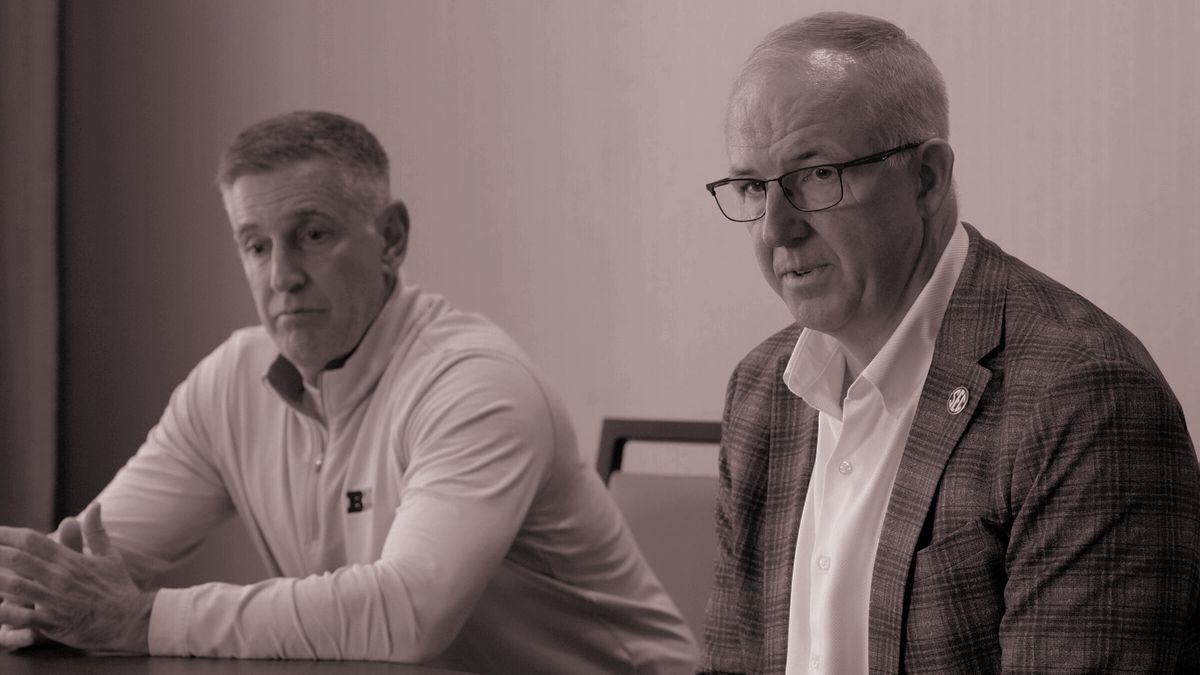
In tonight’s issue, I take stock of the rivalry between college sports’ two biggest conferences, the SEC
and Big Ten, and the two men who run them, Greg Sankey and Tony Petitti. While the spring has seen a spicy—or what counts for spicy in sports business circles, anyway—back-and-forth over College Football Playoff expansion, it’s clear that the two need to be aligned more often than not as college athletics navigates this historically turbulent period. As usual, Thursday’s private email is available exclusively to Inner Circle members, so upgrade
here.
Before we begin, a quick shout-out to Matt Volk, the person most responsible for putting my mug on TV twice a week. Volk is leaving NESN after three years to run the NBA’s local media business—a big job considering all the headwinds facing R.S.N.s these days. When he officially starts on June 22, I expect him to begin pressuring Amazon, ESPN, and NBC to find a
good timeslot for a sports business vodcast.
Pod alert: I’m previewing the World Cup this weekend with Dan Helfrich, the C.O.O. of U.S. Soccer, who will stop by The Varsity to reveal how soccer can take advantage of all the interest surrounding the tournament this summer. Also, make sure to listen to yesterday’s podcast, where Wolfe Research’s
Peter Supino explained Wall Street’s view of the sports rights marketplace.
Also mentioned in this issue: Pat McAfee, Eric Shanks, Adam Silver, Cathy Engelbert, Don Garber, Don Rea, Gary Bettman, Bruce Meyer,
Jimmy Pitaro, A-Rod, Dana White, Greg Olsen, Ernie Johnson, Mike Tirico, Josh Krulewitz, Rob Manfred, Sean Diffley, and more. |
Player of the Week: Pat McAfee
|
The Knicks’ four-game sweep meant that ESPN was stuck with a primetime hole to fill last night.
Enter Pat McAfee, who produced a show that included interviews with Adam Silver, Rob Manfred, Gary Bettman, Don Garber, Cathy Engelbert, and Dana White. Viewership numbers aren’t out yet, but who really cares, considering the interviews have already been aggregated by all the usual suspects. |
Down to the J.V.: Rob Manfred & Bruce Meyer
|
I’m not going to get into the specifics of MLB’s proposal to the players’ union, but commissioner
Rob Manfred officially put a hard salary cap on the table. The P.A., under the guidance of interim executive director Bruce Meyer, is certainly going to reject it. These guys aren’t close at all; World War III is around the corner. |
- World Cup winners: Obviously, Fox and NBC’s Telemundo are primed to be the biggest winners from the FIFA World Cup. Fox, in particular, is expected to bring in more than $500 million in revenue and clear $100 million in profit, per a report from Morgan Stanley’s Sean Diffley. But the report also highlighted other companies that should benefit, including TKO, which is seeing huge demand at On Location, its hospitality group. “Experiential hospitality sales
ended the 1Q at more than two times any previous World Cup program in history and are firmly on track to meet/exceed expectations,” Diffley wrote. “Their ability to deliver profits during the World Cup will be a test to measure the potential success of the 2028 L.A. Olympics after a disappointing Paris and Milan Olympics.”
Also, keep your eyes on Roku, which added Fox One as a premium subscription on The Roku Channel earlier this week. According to Diffley, this will create opportunities
“for monetization as viewers subscribe to the services to watch World Cup matches.” - Ratings lunacy: Here’s a small sample of the many ratings-focused headlines that hit my inbox today: “CBS Sports Delivers Most-Watched Final Round of CJ Cup Byron Nelson in 22 Years” … “Colorado Avalanche–Vegas Golden Knights Delivers Most-Viewed Western Conference Final Game 3 Since 2002” … “ESPN Scores Most-Watched NCAA Softball Regionals on Record” … “Fox Delivers
Most-Watched UFL Game Since League Started in 2024” … “Second-Most-Watched Indianapolis 500 Since 2012” … “All-Time Highs for NASCAR on Prime.”
Basically, if you’re not setting some sort of viewership record these days, given all the changes in the way Nielsen counts its viewers, you’re going to be fetching me my sancerre after brushing off my tuxedo jacket. And while all the Nielsen changes may be providing a more accurate measurement, it makes comparisons to previous years
essentially meaningless. - Elon’s revenge: The Sports Emmys have always been one of the most maligned events on the industry calendar—a two-to-three-hour self-congratulatory snoozefest held in New York City. I have a soft spot for the awards themselves, which allow relatively anonymous behind-the-camera types to actually get recognition. But I stopped attending the event about a decade ago.
However, I always pay attention to Josh
Krulewitz’s X account during the Sports Emmys. Every year, ESPN’s comms chief updates his feed with all of the winners, whether they’re from ESPN or not. But after two hours on Tuesday, Krulewitz went dark after about 50 posts. What happened? “X has limits on the number of times you can post per day, and I exceeded it,” he said the next day. “Who knew?”
For the record, ESPN took home 10 awards and Fox had nine, including Emmys for its coverage of the World Series, MLB All-Star
Game, and AL playoffs. NBC’s Sunday Night Football won for best live sports series. Also, Mike Tirico won for play-by-play, Greg Olsen for analyst, Ernie Johnson for studio host, and A-Rod for studio analyst. You can find a full list of winners here.
|
|
|
|
The commissioners of college sports’ two biggest conferences have thrown a stray
shot or two at each other this spring over the College Football Playoff. But as just about everyone acknowledges, they both know they’ll have to be much more aligned to tackle the myriad issues they face. |
|
|
|
As gas prices spike and the war in Iran continues unabated, a seemingly silly verbal pissing match
has engulfed the sports media business over the fate of the phenomenally lucrative—if slightly controversial—and ever-evolving 12-team College Football Playoff. SEC commissioner Greg Sankey catalyzed the feud months ago when he declined to support a push to expand the field to 24 teams. About a week and a half ago, Big Ten commissioner Tony Petitti sat with reporters at his conference’s spring meeting in Southern California and used the forum to
advocate for that expansion. Petitti said that his conference schools have had “zero conversation” about expanding the CFP to 16 teams—a thinly veiled dig at Sankey, who supports the smaller expansion plan. Sankey followed up a week ago by noting that the Big Ten actually pushed for a 16-team tournament last year. “Positions seem to change a lot,” he said.
This is hardly the stuff of diss tracks, but these comments appeared to give voice to the tensions between the two most
powerful officials in college sports. They also coincided with whispers of discord between the two men on consequential issues over the past several months—not only CFP expansion, but also the role of private equity in collegiate athletics. Moreover, the apparent dispute was taking place following several years of absolute anarchy in college sports: the profusion of N.I.L. money and gambling apps, exorbitant coach comps, and a near-total reconstruction of our notion of student-athletes. How can
college sports survive this chaos if its two largest entities can’t work together?
Sure, I would love to dish about the personality conflicts between the two. But according to nearly a dozen sports executives who have dealt with both guys, the tensions are based on corporate rather than personal disagreements. After all, Sankey and Petitti represent constituencies that are pursuing different agendas. “Look, there’s definitely a rivalry there, but they agree on a lot,” one media executive
told me, citing a common desire for rules governing N.I.L. and the transfer portal. Meanwhile, according to another executive, “The fact is that Tony has a much more collegial set of schools that want to work together. Greg has a different management issue, so he just takes things slower and wants to get all of his boxes checked. Tony just goes much faster.”
The tensions—or “philosophical differences,” as a couple of people called them—extend beyond Petitti and Sankey to their media
partners. ESPN, which holds not only SEC rights but also the CFP games, is perfectly content with the status quo, and would support Sankey’s recommendation to expand to 16 teams. In the network’s view, an expanded playoff with 24 teams has the potential to devalue both regular-season games and the CFP itself, which has been marred by many early-round blowouts—a trend that would likely continue if the field expanded. By adding potentially noncompetitive early-round CFP games that will
run into NFL windows, too… quelle horreur!
Fox, a Big Ten rights-holder, wants to see the CFP expanded all the way to 24 teams, just like Petitti. The network believes the regular season has already been devalued, particularly early in the season, when bigger teams typically schedule cupcakes. (Week 0 sounds more like a light beer than an actual scheduling event.) Two of Ohio State’s first three games this season are against Ball State and Kent State—cupcakes that
sandwich a Week 2 rematch with Arch Manning’s Texas.
Other examples abound: Fox’s featured game on September 19 is Kent State at Ohio State—a game that Ohio State will be favored to win by more than five touchdowns. “In some ways, it feels like Tony and Greg are just the proxies for the real war between Fox and ESPN,” one college sports veteran said. |
But perhaps there is an even larger battle taking place. College football is the
second-most-popular sport on American broadcast, after the NFL, and it’s trying to marshal similar mojo. As regular Varsity readers know, the pro league has most of the leverage in its relationship with media partners, which it deploys in limitless ways. During its schedule release earlier this month, the Shield dictated which games went to which networks—and when they would be played. In college, those decisions mainly come from the networks—at least for now. It actually behooves Fox and ESPN
to align on these issues, mainly as a way to hold off competition. “What’s happening now is Fox and ESPN are using college football and their commissioners as a way to keep the streaming guys out,” one college insider said.
Sources said the two commissioners recognize the state of play in their way. “There’s much more cooperation and collaboration between Greg Sankey and Tony Petitti and [Fox Sports C.E.O.] Eric Shanks and [ESPN chairman] Jimmy
Pitaro than has been previously reported,” said one media executive. “They’re getting together and talking much more often to try and reach a compromise.”
Still, nobody expects the CFP expansion question to be answered soon. ESPN has a clause in its CFP contract that any expansion of the 2027 tournament needs to be decided by December, so there’s time. “Don’t get fooled by all the public posturing,” a media executive told me. “It’s not like they’re standing on opposite sides of
the fence, staring at each other and not communicating. Right now, there’s differing philosophical opinions of the right thing to do. They’ll find a compromise.” |
On PGA chaos: “PGA of America president terms are only two years, so Don
Rea was on his way out anyway. For all the golf podcasts out there, Rea was a content gold mine. His early pressers last year at the PGA Championship were hilarious. They obviously had tried to media-train him, and he awkwardly picked up about 15 percent of it and applied that knowledge haphazardly.” —A sports business executive
On Apple and F1: “I have to believe that 99.9 percent of all preexisting F1 fans are infuriated at what F1 has become on Apple TV.
(Myself included!) During the first three races this year, the screen was blue unless you had OLED televisions. My QLED from a couple years ago did not show the colors accurately—I don’t have the same issue on any other show. When it was around, F1 TV was an amazing deal, and I desperately miss it. Now, if you want to watch Sky Sports commentary outside the races, you can do it live or never again. The replay is gone. I’d merrily go back to paying $89/annum if it meant going back to what existed
before.” —A Varsity subscriber
On the NBA and NHL sweeps: “How many ad sales dollars do you think ESPN lost with two sweeps: Avs versus Golden Knights and Cavs versus Knicks?” —A sports media veteran
On The Varsity’s drink of choice: “Varsity readers don’t seem to defend sancerre nearly enough. I bet it’s served at Camden Yards. And it’s great when you’ve sat in your backyard, toes in the grass on a nice summer evening, secretly sipping a
nice cool glass. Or maybe just straight out of the bottle.” —A media industry professional who knows a good vintage when she sees it |
Have a great weekend. See you all on Monday.
John |
|
|
|
Puck founding partner Matt Belloni takes you inside the business of Hollywood, using exclusive reporting and insight
to explain the backstories on everything from Marvel movies to the streaming wars. |
|
|
|
Ace media reporter Dylan Byers brings readers into the C-suite as he chronicles the biggest stories in the industry:
the future of cable news in the streaming era, the transformation of legacy publishers, the tech giants remaking the market, and all the egos involved. |
|
|
|
Need help? Review our
FAQ page or contact us for assistance. For brand partnerships, email ads@puck.news.
You received this email because you signed up to receive emails from Puck, or as part of your Puck account associated with {{customer.email}}. To stop receiving this newsletter and/or manage all your email preferences, click here. |
Puck is published by Heat Media LLC. 107 Greenwich St., New York, NY 10006 |
|
|
|
|