|
Welcome to Dry Powder. I’m Bill Cohan.
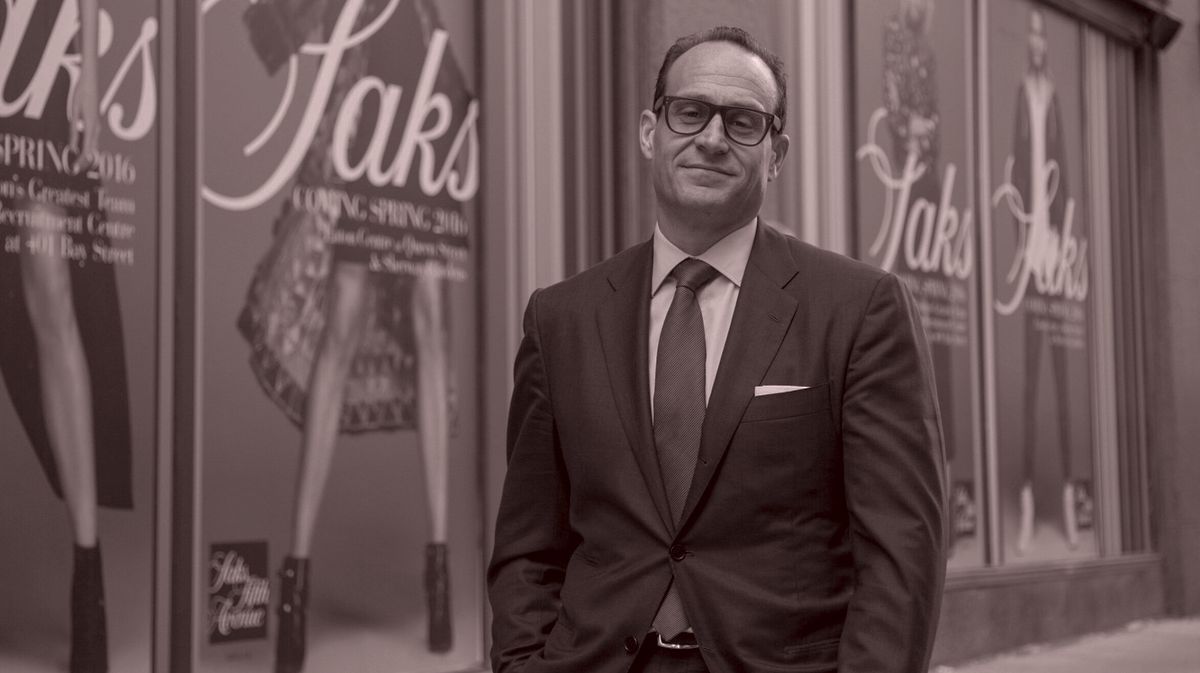
It’s now an open question on Wall Street whether Saks Global, which acquired the department store Neiman Marcus in December for $2.7 billion, will be able to make its first, roughly $120 million interest payment to its bondholders at the end of June. In today’s issue, a close look at this looming and remarkable possibility.
But first…
|
- A Puck podcast P.S.A.: If you’re not caught up on recent episodes from Puck’s daily podcast, The Powers That Be, last week offered a bounty of fantastic conversations: Eriq Gardner swung by to dissect the latest moves from Trump’s pugnacious F.C.C. chairman, Brendan Carr; Julia Ioffe offered an update on the Ukraine peace negotiations; John Ourand explained the bake-off for the NFL Draft rights; Leigh Ann Caldwell revealed the plight of Democrats on K Street; and Jon Kelly dug into Netflix’s Q1 earnings. Meanwhile, there were other great episodes from Lauren’s Fashion People podcast, John’s The Varsity, Dylan’s The Grill Room, and John Heilemann’s Impolitic. I encourage you to tune in.
|
|
|
 |
Leigh Ann Caldwell |
|
The G.O.P.’s Big, Beautiful Headache
|
- Congress is returning from a two-week recess and jumping straight into a critical phase of Trump’s “one, big beautiful bill” of tax and spending cuts. House and Senate committee staff and leadership have been chiseling away at the policy while their bosses were away, and the relevant House committees are scheduled to meet starting Tuesday to hammer out the details.We could know soon what will be included and what will be cut: Medicaid benefits? Biden-era tax incentives for renewable energy? Perhaps most importantly for blue states: Will they increase the cap on the state and local tax deduction (SALT), and by how much? To $20,000? Or more? No Senate Republicans represent SALT-impacted states, so raising the cap is primarily a fixation of Republican House members from New York and New Jersey, and a couple from California.Other known unknowns: Will they actually cut $1.5 trillion in spending? (The president is calling for cuts totaling only $1 trillion, while the Senate has mandated just a few billion.) And who will give Speaker Mike Johnson the biggest headache: The hardline budget hawks in the Freedom Caucus? The centrists who worry about cutting too deeply? The single-issue SALT defenders? The Senate?
Remarkably, I’m also told that some conservative groups are taking the chatter about a tax on millionaires very seriously, and that Trump’s remark to Time that he “love[s] the concept” of taxing the wealthy did not alleviate any of those concerns—even though the president also said he didn’t want it to be used against him politically.
Most Republicans agree that it’s a political loser for them, since the one defining throughline of the party has been its opposition to tax increases. Now, conservative business groups may need to start reaching out to members to keep them in line. (“Congress needs to get its fiscal house in order, but it must do so by tightening its own belt, not by forcing American taxpayers to tighten theirs,” Richard Stern of the Heritage Foundation told me. “Punishing those who provide for others and create jobs is a recipe for failure.”) As I reported a few weeks ago, the fact that Republicans are even talking about this is extraordinary, even if it will never happen.
|
|
|
|
A close look at whether Saks Global, several months after acquiring Neiman Marcus for $2.7 billion, can make its initial $120 million-ish interest payment to bondholders at the end of June.
|
|
|
|
The plot continues to thicken at Saks Global. At last check, the $2.2 billion publicly traded Saks senior secured bond, due 2029, which pays 11 percent interest, is now trading at 67 cents on the dollar and yielding 22 percent. This is not a good situation for bondholders, who have watched the bond lose a third of its value in the four months since it was issued last December as part of Saks’ $2.7 billion acquisition of Neiman Marcus. Nor is it good for the company itself—which, of course, has a roughly $120 million interest payment due on the bonds at the end of June.
Many on Wall Street are wondering whether Saks will even be able to make that first interest payment on the bonds, by the way, or whether the company will have to buy some time with its creditors by starting restructuring conversations. I’m told that both Moelis & Co. and PJT Partners are angling to find a way to represent Saks, should the company decide that it needs to cut a deal with its creditors. A spokesman for Saks firmly denied this, saying the company has not heard from either firm. In any event, the company has arranged to meet with its bondholders tomorrow to discuss where things stand right now, and has pledged to issue a press release afterward.
|
|
|
|
A MESSAGE FROM OUR SPONSOR
|
Across the country, Walmart is investing in products made, grown or assembled in America through their commitment to U.S. manufacturing. In fact, over two-thirds of the products Walmart buys come from U.S.-based small and medium-sized businesses, like Athletic Brewing in Milford, CT. Since working with Walmart in 2021, Athletic Brewing has opened a new brewery and hired over 200 employees. Across America, Walmart's commitment to U.S.-made products is supporting job creation and strengthening communities.
Learn more about Walmart's impact.
|
|
|
It’s rare, of course, for companies not to be able to make the first interest payment on money borrowed in connection with a large acquisition. But it does happen. Back in 1989, for instance, the now-vaunted Blackstone Group invested $330 million in the leveraged buyout of Edgcomb Steel, a steel distribution company. It was the firm’s third-ever deal, and the company went bankrupt before it could make its first interest payment.
There have been a fair amount of recent Saks updates, aside from the questions about the forthcoming first interest payment, that are probably influencing its bonds to continue to trade lower. Among them: Saks’ decision to close a fulfillment center in Tennessee, axing some 450 jobs; the impending closure of Saks Fifth Avenue’s Union Square store in San Francisco on May 10; and Saks’ decision to create what is known as a FILO credit facility—“first-in, last-out”—as part of its existing $1.8 billion asset-based lending facility, or ABL. These are in addition to the bombshell that the company dropped on Valentine’s Day, as my partner Lauren Sherman has dutifully noted, when it stretched its vendor payment window from 30 days to 90 days. This week, Lauren reported that factoring companies that do business with Saks are charging higher fees for their services. All of these decisions are suggestive of the fact that the company is doing whatever it can to conserve money. Creditors, understandably, get nervous when companies take steps to hoard cash.
|
|
Part of the problem with the Saks-Neiman deal stems from the promises the company made in its bond prospectus last December. Jefferies, the lead underwriter, sold the $2.2 billion bond issue, which had been increased in size from $2 billion supposedly because of strong investor demand. At that time, I’m told, Saks Global projected that it would have $707 million of pro-forma adjusted EBITDA for 2025 as a result of the deal with Neiman Marcus. (Pro-forma adjusted EBITDA, ugh!)
By then, of course, the company had something like more than $4 billion in debt—including the $2.2 billion bond, a $1.25 billion commercial mortgage-backed security secured by the Saks flagship store on Fifth Avenue, and whatever would be drawn on the ABL facility, which I’m told is roughly $700 million out of the available $1.8 billion that Bank of America provided. (BofA was also one of the underwriters of the bond issue.)
But the people I’ve spoken with recently on Wall Street are skeptical that Saks Global will be able to achieve the $707 million of pro-forma adjusted EBITDA. Part of the reason for the skepticism, in some quarters, stems from Saks’ claim that it would achieve some $350 million of “run-rate” synergies from the merger—meaning that half of its projected adjusted EBITDA would come from cost savings—and that another $137 million would be derived by something Saks is calling an “inventory liquidity adjustment.” This latter adjustment is an out-there concept, whereby the company is claiming that, had the company had more inventory to sell in its stores last year, it would have generated another $137 million of EBITDA. That’s creative, but it’s also akin to a hedge fund saying that, had it hired another portfolio manager who had bought Nvidia stock in 2023, the fund would have made a fortune.
One creditor I spoke to put the run-rate EBITDA number closer to $55 million for 2025, not $707 million. But who knows, for sure? Saks Global is a private company controlled by a bunch of investors, including the entrepreneur Richard Baker, the Rhône Group, Amazon, Salesforce, and Authentic Brands. Even though the bonds are publicly traded, Saks does not release any financial information publicly about its recent performance.
|
|
|
|
A MESSAGE FROM OUR SPONSOR
|
Across the country, Walmart is investing in products made, grown or assembled in America through their commitment to U.S. manufacturing. In fact, over two-thirds of the products Walmart buys come from U.S.-based small and medium-sized businesses, like Athletic Brewing in Milford, CT. Since working with Walmart in 2021, Athletic Brewing has opened a new brewery and hired over 200 employees. Across America, Walmart's commitment to U.S.-made products is supporting job creation and strengthening communities.
Learn more about Walmart's impact.
|
|
|
|
Indeed, the company declined to answer my specific questions about its performance year-to-date and the claims it made in the bond prospectus. Instead, it shared this statement with me: “In this period of economic uncertainty, driven by tariffs and the threat of further trade restrictions, we are prudently evaluating opportunities to strengthen our balance sheet and further bolster liquidity,” including the ABL/FILO facility. The statement went on to extol the company’s strategy for “capturing significant synergies, improving inventory flow, which is currently approaching fiscal 2023 levels, and establishing new payment terms to reset the working capital model.” As a result, the Saks spokesperson concluded, “we remain confident in our strategy and our ability to successfully navigate through the current dynamic macro environment.”
|
|
Part of the problem here, of course, is that the financial markets have very little information about the company’s performance in the wake of the Saks-Neiman merger. According to the prospectus, revenue at Saks has declined more than 10 percent a year for the past few years, and there’s a bunch of necessary maintenance and capital expenditures that have been deferred. In the absence of clarity, worried bondholders sell first and ask questions later. But the looming concern for them is that $120 million interest payment due June 30. Perhaps the meeting the company has scheduled for tomorrow with bondholders will clear up some of these questions.
With around $1 billion of liquidity still available in the ABL facility, Saks could possibly draw the money it needs to make the June interest payment from that line of credit. But that facility is supposed to be used to buy inventory—it’s an asset-based lending facility, after all—and not to make interest payments on bonds secured by Saks’ real estate beyond the flagship Fifth Avenue store, which is secured by the CMBS issue. It’s conceivable, I guess, that Bank of America could approve the use of the ABL facility to make an interest payment on bonds that it helped underwrite, but that hardly would send a warm and fuzzy signal to the market.
Jefferies, I’m told, recently came out with a research report arguing that the bonds it just underwrote for Saks last December are a buy at current prices. Its buy recommendation is premised on the idea that the Saks real estate securing the bond, away from the flagship Saks store on Fifth Avenue, is more than sufficient to cover the $2.2 billion of bonds. But many of these stores are in malls across the country that would be tough to use for anything other than a department store, and if a forced sale were required in the event of bankruptcy or liquidation, it might be challenging to get the values that Jefferies is arguing are there. Plus, one investor told me, “for the biggest bull to be saying, ‘Hey, well, it’s a creditworthy debtor, because if you have to liquidate, you’ll be okay’? That’s kind of like saying, ‘You know, Dave is a good tenant for me to have in my apartment. If he can’t pay, we’ll chop his body open and steal his kidneys.’ Maybe that’s true, but that’s not promising, if that’s where you’re going.”
Jefferies declined to comment, but a person familiar with the December bond offering told me that the Saks-Neiman real estate values were what was used to sell the bonds in the first place, and the 11 percent coupon was a big relative yield in a hot bond market. Still, the market is far worse today than it was when the bonds were originally sold because of the tariff mishegas, general consumer nervousness, and a growing impatience with the Saks turnaround story.
Anyway, who knows where this is headed, but it sure is getting interesting. According to S&P Global, some 188 “large” U.S. companies filed for bankruptcy during the first quarter of 2025, marking the largest number of corporate bankruptcy filings in the U.S. in 15 years. For those who celebrate, that’s a 35 percent increase from the 139 filings during the first quarter of 2024. “Companies, particularly those with weaker balance sheets, continue to face challenges as debt matures and needs to be refinanced at higher interest rates than at the time of issuance,” S&P wrote in an April 10 report. Look out below.
|
|
|
|
The ultimate fashion industry bible, offering incisive reportage on all aspects of the business and its biggest players. Anchored by preeminent fashion journalist Lauren Sherman, Line Sheet also features veteran reporter Rachel Strugatz, who delivers unparalleled intel on what’s happening in the beauty industry, and Sarah Shapiro, a longtime retail strategist who writes about e-commerce, brick-and-mortar, D.T.C., and more.
|
|
|
|
Finally, a media podcast about what’s actually happening in the media—not the oversanitized, legal-and-standards-approved version you read online. Join Dylan Byers, Puck’s veteran media reporter, as he sits down with TV personalities, moguls, pundits, and industry executives for raw, honest, sometimes salacious conversations about the business of media and its biggest egos. New episodes publish every Tuesday and Friday.
|
|
|
Need help? Review our FAQ page or contact us for assistance. For brand partnerships, email ads@puck.news.
You received this email because you signed up to receive emails from Puck, or as part of your Puck account associated with . To stop receiving this newsletter and/or manage all your email preferences, click here.
|
|
Puck is published by Heat Media LLC. 107 Greenwich St, New York, NY 10006
|
|
|
|


_01JSFJ6EJAKCJ9XR5V251QW12X.png "Walmart")