{{ 'now' | timezone: 'America/New_York' | date: '%b %d, %Y' }} |
|
|
|
Hi, and welcome back to Line Sheet. I just got back from a stand-up dinner at the Gucci archive here in
Florence to conclude Fête de la Kering (my name, not theirs), the group’s first Capital Markets Day in four years. I’ll have an expansive report on Kering soon, but today I’m sharing five important takeaways from the proceedings in Florence. I’ve also got some fashion media updates regarding the future of The Cut and New York magazine, as well as Glamour, Allure, and Self. (R.I.P.) And you’ll find a quick explainer on why Tory
Burch bought out one of her investors.
To make this Inner Circle issue extra special (be sure to trade up here), Malique “Malique@puck.news” Morris is back with the inside story on what’s really happening with Nike’s turnaround. (Yesterday, Malique
broke the news that the sneaker giant’s newest collaborator is Our Legacy, and there’s so much more where that came from.)
Tomorrow on Fashion People, my guest is architect-designer-decorator Raf de Cárdenas, the creative mind behind many of the retail stores you’ve shopped, from
Skims’s New York flagship to the newly refreshed Piaget on Place Vendôme. We talked about Raf’s life in fashion and beyond, from working at Calvin Klein in the 1990s to what inspired him to move from designing clothes to rooms. He also revealed what the most power-y publicist Amanda Silverman was like in high school. And he convinced me to buy a pair of Free Lance boots on Vestiaire. Jen Brill is also praised. A great episode,
really. Listen here and here.
Mentioned in this issue: Karlie Kloss, The Cut, Luca de Meo, John Donahoe, Glamour, Jay Penske, Skims, Elliott
Hill, Mark Parker, Jim Bankoff, Byron Trott, Big Red Boots, Simeon Siegel, David Haskell, Emily Sundberg, Sam Barry, and more… |
Five Quick Notes From Fête de la Kering…
|
The luxury group’s first Capital Markets Day in four years, and the first run by new C.E.O. Luca de
Meo, was singular on many levels. De Meo—who spoke for literal hours—invited media as well as buy-side and sell-side analysts to Florence, the birthplace of Gucci, to hear his unflinching assessment of the business and what it will take to truly turn it around. (He’s dubbed the project ReconKering. Get it? Like reconquering.)
The feedback from journalists and analysts was mixed. Pretty much everyone likes and respects de Meo. But not everyone is sure that his plan will
work, even if everyone wants it to. I’ll have more soon. For now, here’s what was most interesting: |
- The name of the game is profitability, not size. De Meo refuses to give revenue guidance, focusing instead on gains. His big promise? Double operating margin in the mid-term.
- There are no current plans to sell McQueen, but… De Meo was sometimes uncomfortably honest about Kering’s underperforming businesses, including McQueen and Brioni, and said the group has not managed smaller brands well in the past: “All the brands must
be profitable, otherwise, I will eject them from the system.” Step one: applying his new operational model—focused on efficiency at the group level, and product understanding at the brand level—to each house.
- Executives will be bonused, in part, on the “desirability” of the brands they work on. And “desirability” will be determined, in part, by third-party analysis.
|
|
|
|
A MESSAGE FROM OUR SPONSOR |
Once just another sales channel, wholesale has become a strategic engine for sustainable growth. The 7th edition of
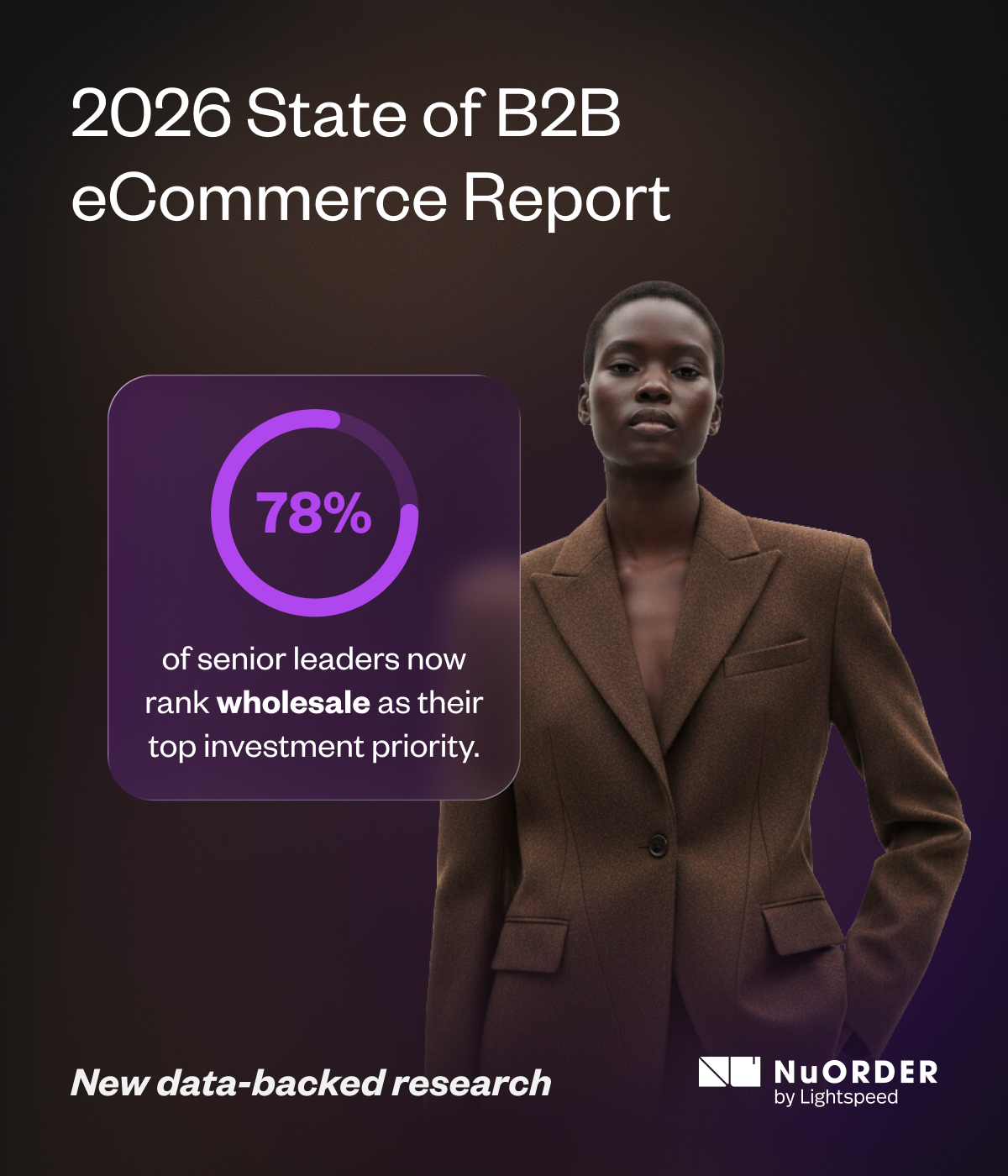
NuORDER’s State of B2B eCommerce Report shows why 2026 is a turning point from reactive uncertainty to operational discipline. According to a survey of 200 brands, the shift is real. They are focusing on margin protection, tighter distribution, and more intentional partnerships, with 67% now using sell-through data and 78% doubling down on wholesale as their top investment.
Download the full report. |
|
|
|
- On M&A, the company will continue to invest, but mostly upstream. Today, de Meo also announced an investment in Icicle, the Shanghai-founded brand that anchors a larger group, acknowledging the increasing importance of Chinese brands to the region. De Meo also referred to Valentino, which is currently majority-owned by Mayhoola, as “deep luxury,” indicating that he sees a place for the Roman house in the broader brand portfolio (which he wants to feel wholly complementary,
not like a random private equity play). But he also acknowledged its current business challenges and didn’t commit to acquiring the whole company, which Kering can do as early as 2029.
- On everything else… Gucci still has a China perception problem, but is beloved in the U.S. … Saint Laurent is underpenetrated in China and in daywear—and menswear! It’s a huge opportunity, in my opinion. … Bottega Veneta has an “incredibly low level of EBIT.” …
Hard luxury will become a far bigger portion of the group’s sales in the next five years. … And de Meo is confident his common-sense plan will work. “I already did this,” he said. More from me on “this” soon!
|
Three (Other)
Things You Should Know…
|
- The Tory Burch sitch: Yesterday, Bloomberg reported that Tory Burch was looking to buy back General Atlantic’s stake in her namesake business for $346 million. I wasn’t totally shocked by the news; Burch has publicly stated that she has no interest in selling the business and likes the private structure. Owning the firm outright would offer her complete autonomy—General Atlantic presumably has some negative rights, even if they
are a passive investor in the current capital structure—but there were two pieces of this pursuit that needed to be further investigated.
First, why would General Atlantic, which first invested in 2012, want to exit at this stage? Even if the partners are inclined to bow to the wishes of a founder—this sort of economic chivalry can be a useful talking point for future deals—this would hardly constitute a booming exit for the firm. However, G.A. benefited when Burch bought out Tresalia
Capital in 2018, and she has also been paying her investors dividends for years. BDT & MSD Partners, Byron Trott’s merchant bank that has owned stakes in everything from The Row to Skims, has retained its stake in the business, but it’s likely that Burch will buy them out, too, during the next decade. (She’s the Ralph Lauren of her generation, and views control as an ultimate luxury.)
But even if Burch wants a simpler cap table, why does she want
to lever up her business? After all, that’s not a small amount of debt for a company that generates in the vicinity of $2 billion a year in sales. I’m told that the board believes they’re not overleveraging, especially given how they’ve managed their debt in the past. Anyway, Tory Burch is the actual success story of her generation. - Who will buy New York magazine? And what will happen to The Cut?: On Wednesday, my
fantasy football teammate Dylan Byers reported on Vox Media’s ongoing sale of New York magazine and its far more profitable podcast network. Dylan noted some potential buyers for the magazine itself, including trade-rag king Jay Penske, who already owns 20 percent of the
business.
According to Dylan, there was also chatter that Karlie Kloss was interested in buying the fashion-and-style vertical for Bedford Media, her small portfolio of brands that currently includes i-D and Life magazine. (When is Life launching, by the way?) In the end, as a source close to Kloss told me, it was only a rumor. While The Cut is the most independent and fully formed of the New York mag brandettes, and is
one of the last pieces of fashion media with real authority, it doesn’t work without New York. Its strongest editors and writers often work on both, creating a healthy tension. Plus, spinning it out would require adding costs—sales, growth, marketing, ops—that would put excess pressure on the business. New York’s current strategy works, in part, because the mother ship can synergize those back-end efficiencies.
Also, why would Vox Media make a complex deal even more
bespoke? The Cut is a major source of revenue for the entire publication; there’s a reason that New York magazine editor-in-chief David Haskell goes to so many fashion shows, and it’s not only because he’s a Sacai fan. I guess that Jim Bankoff & Co. will do what they have to do to sell off these assets, but it’ll be much harder to sell New York without The Cut.
|
|
|
|
A MESSAGE FROM OUR SPONSOR |
Wholesale growth isn’t the goal anymore. Profit is. According to 200 senior brand leaders, chasing volume is
out. Control is in. In fact, 54% are focused on cost reduction and protecting margins, tightening distribution and choosing partners more deliberately. This disciplined approach to growth protects brand equity as much as revenue. It’s why 78% now rank wholesale as their top investment.
Download the 2026 State of B2B eCommerce Report: Wholesale Reengineered. |
|
|
|
- The
Glamour of it all: Amid the news that Self was folding (reported first by Emily Sundberg over at Feed Me), Glamour global editorial director Sam Barry announced she was leaving her post. Apparently, Condé Nast was trying to sell Glamour, but I guess that wasn’t possible? (Too bad Karlie Kloss wasn’t interested in that title.) Crazy
to think that Glamour used to be the most profitable magazine in the Condé Nast portfolio. It’s been a while, though, since it’s had a reason to exist. The end of Self is likely just the beginning of the end for Glamour, and for Allure,too.
|
And now, here’s Malique on Nike… |
|
|
|
After a years-long decline, Nike is fighting to get back to its performance roots with a
burst of creativity—including an Our Legacy collab and a new Alphafly. But the latest innovations also make clear how far Nike has drifted from the days when it had a visionary, design-focused leader at the helm. |
|
|
|
On an earnings call last month, Nike C.E.O. Elliott Hill admitted what analysts already
knew: The sneaker giant’s turnaround has taken a long time to gain traction. In the latest quarter, revenues were flat year over year at $11.3 billion, while net profits dropped 35 percent. Since Hill returned in October 2024, cutting short his retirement, the stock is down more than 40 percent.
The sneaker giant’s problems have been extensively well-documented. In short, Nike pivoted too hard into D.T.C. with little to no margin upsides, and then flooded the market
with overhyped styles that the company couldn’t sell. By the time Nike made its belated return to wholesale, it had lost shelf space, and mindshare, to newer and cooler brands like Hoka and On.
Now, however, it appears that Nike’s renewed focus on running shoes, its original bread and butter, may be paying off. Nike’s revenue from running styles grew 20 percent year over year in the first half of fiscal 2026, aided by new releases like the Nike Mind, the woo-woo style that taps sensory
receptors in the feet, and the reintroduction of the Vomero Premium. Next up, Nike is going all in on the upcoming World Cup in June, with a new release of its Mercurial cleats and increased presence in soccer-related specialty retailers—and, as I reported yesterday, there’s a collab with Our Legacy in the works. I’m also told that a long-awaited
Alphafly 4 is set for a 2027 release. (A Nike spokesperson declined to comment.)
Much of the credit is due to Mark Parker, the former Nike chief executive who stepped down in 2020 but now serves as executive chairman and remains active in creative decisions. In 2023, Parker worked closely on a new version of the Pegasus, a franchise he originally oversaw in 1983, and ultimately postponed the launch until the updates were to his liking, according to two former insiders.
When the new Pegasus 41 was released in June 2024, three months behind schedule, it nearly sold out—reviving the sneaker’s reputation in running circles, according to one of the insiders. |
|
|
|
But Parker’s creative interventions also make clear how far Nike has drifted from the days in which it had a
visionary, design-focused leader at the helm. “Part of what made Mark Parker so good at his job, and helped him accelerate the company in the 2010s and the late 2000s, was this focus on technical wizardry and products that make you smile,” said a sneaker industry veteran familiar with Nike’s inner workings. Alas, Parker was succeeded by John Donahoe, an outsider who prioritized data-driven insights over product innovation—and, some insiders argue, exited too many key product and
merchandising executives. Hill, for his part, has been pegged as more of a sales guy than a product person—despite his prior role as president of consumer and marketplace, which gave him “significant oversight of product strategy and innovation,” according to a Nike spokesperson.
Of course, Hill returned to a much weaker company than the one he’d briefly left. On Nike’s most recent earnings call, Hill acknowledged that sell-through at wholesale is “not yet where we want
them to be,” and that drooping sales in China—down 7 percent in the third quarter, projected to drop 20 percent in the current quarter—aren’t helping. Converse sales were down 35 percent, too. But it’s not all bad news: As veteran retail analyst Simeon Siegel pointed out, Nike’s sales in North America have actually been growing over the last three quarters, after falling 9 percent for fiscal 2025. The question, Siegel added, is whether the rebound will spread to the
rest of the business. |
Some inside Nike attribute the longer-than-desired turnaround to the company’s arduous
product-development pipeline. Sources told me that Nike’s “design community” includes nearly 1,000 people across the business, and that any given product can take 12 to 18 months to come to fruition—from pitch decks and rounds of sketching through management and budget approvals to athlete testing.
That extended lead time isn’t likely to help Nike in China, where increasingly discerning consumers are gravitating toward premium niche players like Hoka and On, as well as homegrown
labels like Xtep and Li-Ning—which, according to one former Nike insider, offer comparable style and functionality at much lower price points. And while Nike remains heavily reliant on existing models for newness, even in the high-performing running category, one industry veteran noted that the core running community is “immune to that kind of cool-guy marketing” that the brand has coasted on when pushing recycled styles.
Others argue that Nike is, at the very least, introducing
some innovation. A retail buyer pointed to the 3D-printed versions of the Air Max 1000—widely released last August after a limited drop in November 2024—as well as the 95000, released last October. This person also likened the Nike Mind to MSCHF’s viral Big Red Boot, from 2023, in its ability to capture the zeitgeist. In today’s hyper-casual environment, where bulky, oblong-shaped mules and slides are commonplace, the buyer added, “It would make sense that the shoe of the future is
something that looks less of a sneaker and more of something that you would put on while you’re on your phone or playing Fortnite.”
Nike may be too large to match the nimbleness of those upstarts, but that doesn’t mean it can’t be more concise in its messaging. “They’re the victims of their own lore,” the retail buyer told me. “When they’ve been around for that long, they have so many different stories to tell.” Time will tell whether Hill & Co. can settle on one that
resonates.
|
No reading list today. Until tomorrow,
Lauren
P.S.: We use affiliate links because we are
a business. We may make a couple bucks off them. |
|
|
|
Need help? Review our FAQ page or contact us for assistance. For brand partnerships, email ads@puck.news. You received this email because you
signed up to receive emails from Puck, or as part of your Puck account associated with {{customer.email}}. To stop receiving this newsletter and/or manage all your email preferences, click here. |
Puck is published by Heat Media LLC. 107 Greenwich St., New York, NY 10006 |
|
|
|
|