 |
|
I’m Bill Cohan, welcome back to Dry Powder.
|
|
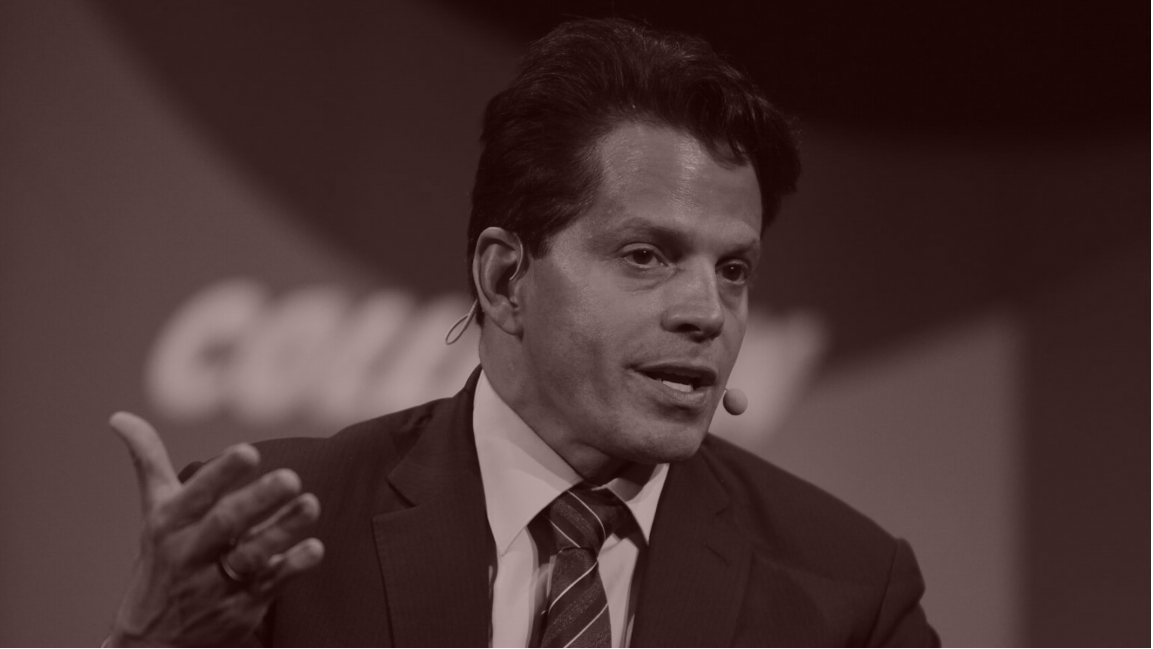
With the third week of Sam Bankman-Fried’s criminal trial underway, I decided to call up S.B.F.’s one-time friend and business partner, Anthony Scaramucci, a.k.a. The Mooch, for his unique perspective on the case and its troubled defendant. As expected, The Mooch delivered, spilling remarkable insights from their time working together and comparing the whole affair to a “Shakespearian tragedy.”
Also, a quick thank you to everyone who showed up in New York last night, at the historic Hotel Chelsea, for a magnificent and fun event co-hosted by Puck and our partners at Bully Pulpit Interactive, attended by the likes of Andrew Bleeker, Ben Coffey Clark, Scott Mulhauser, along with representatives from Blackstone, the NFL, Google, Warner Bros. Discovery, and more. It was, as always, a pleasure to discuss our business, and the future of media and politics, alongside my talented partners. We’re looking forward to the next one.
|
|
|
| He may not be at the federal courthouse in downtown Manhattan, but Anthony Scaramucci, a.k.a. The Mooch, has had a front-row seat on the narrative arc of what has become the tragic spectacle of Sam Bankman-Fried. Early on, The Mooch’s hedge fund-of-funds, SkyBridge Capital, made a small investment in FTX, S.B.F.’s crypto exchange. It was, for a time, a mutually beneficial relationship. In September 2022—two months before the S.B.F. denouement—FTX Ventures, the company’s investment arm, agreed to buy a 30 percent stake in SkyBridge for $45 million, valuing SkyBridge at $150 million, and giving S.B.F. an option to buy up to 85 percent of SkyBridge after three years at a higher price.
That fall, as I have previously documented, The Mooch opened his Rolodex to S.B.F., hosting him at various meetings with Middle East potentates, including M.B.S., in Saudi Arabia, and M.B.Z., in the United Arab Emirates. S.B.F. was on the hunt for additional equity for his failing empire and The Mooch, unaware of the holes in the FTX balance sheet, was more than happy to introduce him to his rich friends. As I have also previously reported, The Mooch was in the Bahamas, in early November 2022, at the invitation of Joe Bankman, as his son’s world was crumbling around him in real time. When The Mooch realized how bad things had become, he returned to his home in New York City, and watched as the S.B.F. fiction was revealed.
So how is The Mooch feeling about his one-time friend and business partner now that S.B.F. is on trial, literally for his life? Somewhat surprisingly, The Mooch has some empathy for S.B.F. and what he’s going through. He told me that friends of his at venture capital firms who invested in FTX, and got hosed, want to see him “burned at the stake” and “just completely roasted and fried,” but The Mooch was more thoughtful, as is his style. “I see the human tragedy here,” he told me. “It’s heartbreaking to me.”
He continued, “I’m sitting here. I lost money. I’ve been shamed by this. It certainly hurt my reputation, at least, in the short term, perhaps long term with certain people. But I’m looking at it as a human tragedy. And I’m looking at an overmedicated young man. It’s almost Shakespearean.” |
|
|
| The Mooch’s theory of the case is that S.B.F. had emotional issues growing up—high I.Q., but also a form of attention deficit disorder—that his parents tried to remedy with medications, hoping to get him “quote unquote normal” and “more highly efficient or high-operating” and ended up creating “a Frankenstein” who “ran amuck.” Court filings show that S.B.F. has long used prescription medication to curb his chronic depression, and his lawyers recently asked for an adjournment, due to his inability to take a third dose of Adderall midday, during court, which the judge denied. (Legal experts believe this could become part of an argument on appeal.)
The Mooch explained to me how S.B.F. stayed in his room, all day, every day, playing video games until he was 18 years old. This is obviously hyperbole, but close to accurate. Virtually every profile of Bankman-Fried includes the anecdote of how he played “League of Legends” throughout a pitch meeting with investors from Sequoia Capital when FTX was raising its Series B. (Sequoia gave him $214 million anyway.) He did the same thing with Anna Wintour, according to Michael Lewis’s new book, Going Infinite, playing “Storybook Brawl” during a conversation about attending the Met Gala, which he later snubbed.
He was distractible, to be sure, but also largely disconnected from the world of people around him. In another scene from Going Infinite, S.B.F. writes to Caroline Ellison, then the C.E.O. of Alameda, that “In a lot of ways I don’t really have a soul… in the end there’s a pretty decent argument that my empathy is fake, my feelings are fake, my facial reactions are fake.” The Mooch said a friend of his once asked what it must have been like for Gabe Bankman-Fried, Sam’s brother, to grow up on the Stanford campus as an only child.
Given his troubled childhood, The Mooch’s theory continued, S.B.F. wanted to “show everyone he was king of the world,” but that even as he was embarking on that goal, he still had this “disassociated video game going on in his head” where he was going “to play the eccentric, t-shirted, Corolla-driving guy to fit the narrative of what I think is going to work in this sort of post-woke culture” that S.B.F. believed we were in. He said that as a result, the eccentric genius in the t-shirts and cargo shorts won over the media, investors and congressmen—all of whom couldn’t get enough Sam Bankman-Fried, The Mooch included. “I genuinely liked him,” he told me. “I’ve never shied away from that.”
But, he said, at some point S.B.F. needs to face the reality of what he did. (Or, as The Mooch put it, “If there’s a window open and you hear a clippety-clop, it’s a horse, not a zebra.”) After all, he continued, it’s hard to imagine that a defense strategy premised on professional indifference and blaming others is going to work for him, especially when four other top FTX/Alameda executives—Ellison, Gary Wang, Ryan Salame, and Nishad Singh—have all pleaded guilty.
“I find it to be heartbreaking,” The Mooch continued. “It’s like if Mary Shelley got married to Sophocles, this would be the tragedy that they would write together. There’s a Frankenstein component of this, which was made through the medicine that his parents and his psychotherapist or psychiatrists gave him and then there’s this classic Sophoclian tragedy of someone who’s trying to shoot the moon, and willing to break all of societal norms and all of the society’s laws to do it.”
And yet, The Mooch isn’t angry, not even after the value destruction at SkyBridge, whose biggest fund lost 39 percent last year on its FTX and crypto bets. “I’m supposed to be mad about this, and I’m supposed to be, you know, ‘burn him at the stake,’ but I guess I see it as a parent. I’m looking at it like, ‘Okay, this guy’s old enough to be my son. How could he and his family, who seemed like a fairly upstanding family, how could they get this so wrong?’” (Risa Heller, a spokesman for Joe Bankman and Barbara Fried, declined to comment.) |
|
|
| Upon reflection, The Mooch said he fell for S.B.F.’s quirky charm and the idea of how FTX was going to change Wall Street. “This is a young, earnest kid,” he said. “He had a brilliant vision. You and I have talked about this. He had a brilliant vision, about tokenizing assets and creating a 21st century exchange.” He mentioned how our two major trading exchanges—the New York Stock Exchange and the Commodities Exchange—were created in the late 18th century and the late 19th century, respectively. “This was going to transform the way we do business,” he continued. “He was creating a wireless exchange.”
But what the Mooch said he missed about S.B.F., as did so many others (but not everybody), was that he believed Sam wanted not only acceptance of the world that had rejected him, but perhaps also to subliminally get back at that society—not unlike the way Trump ran for president, perhaps in part, to get back at all the people who didn’t accept him in Manhattan society or at their fancy country clubs. (This psychological parallel, of course, comes from the guy who infamously served in Trump’s White House for 11 days.) “He was a very smart guy,” The Mooch said about S.B.F. (not Trump). “He is a smart person, but what you missed was the chip on his shoulder. What you missed is, ‘I grew up depressed as a loner.’And so this is a manifestation of retribution. This is a manifestation of revenge. I’m going to get back at the world. I’m going to take out on the world what I didn’t have back in the day.” He said that Sam was “missing the morality chip.”
He said that he agreed with Michael Lewis that FTX was actually a “successful” business, or was on its way to becoming a successful business. He said that if S.B.F. had just conceded that he blew it at Alameda and made a series of terrible investments—although some, like his stake in A.I. firm Anthropic, may actually work out to be worth more than he paid for them—and just closed up the hedge fund and focused on continuing to make FTX a leading crypto exchange, the story may have ended up very differently. “If Sam was a moral, ethical guy, he could have created a business,” he continued. “And let’s say, he would have been at the age of 30 worth two, three, $400 million, not $16 billion. And so I think Michael is right, and he’s getting ridiculed for it, but there was an idea there and there was a business. It was destroyed by the illicit behavior. And it got destroyed by the amorality. But that amorality comes from his belief that society has been mean to me. And it’s made me unhappy and so I’m going to inflict some of that pain that I have felt on society.”
As evidence, The Mooch pointed me to what S.B.F. had prepared to say to Congress last December, had he not been arrested instead. In the last bullet point, S.B.F. was going to say, “The last few months have been difficult enough for everyone that it feels unremarkable to me, in comparison, that I need to put on the official Congressional record that I am, and for most of my adult life have been, sad.” (S.B.F. has unequivocally maintained his innocence.)
The Mooch said that while all the public relations people have advised the other venture-capitalists and money-men who invested in FTX to keep quiet, he’s defied them by speaking up about S.B.F. when asked about him. “If I can save one person from it not happening to them, then me talking about it, no matter how bad it makes me look, is worth it,” he said. “But I also have five children, so I have to explain to them, ‘If you’re going to be a risk-taker, it’s okay to make mistakes and get things wrong.’ I got Trump wrong. I got Sam wrong. But I did get a lot right over the course of my life. And it’s been a very wonderful, wide-ranging life because I’ve been willing to take the risks.”
In the end, though, for The Mooch, there’s no getting around the tragedy of S.B.F. “If you told me he committed suicide, it wouldn’t surprise me,” he concluded. “Now the flipside is, I don’t think he’s going to. But it wouldn’t also surprise me if he did. Because, you know, there’s nothing about this that you could say you’d be surprised about any more, could you?” |
|
|
|
| FOUR STORIES WE’RE TALKING ABOUT |
|
|
|
|
|
 |
|
|
|
Need help? Review our FAQs
page or contact
us for assistance. For brand partnerships, email ads@puck.news.
|
|
You received this email because you signed up to receive emails from Puck, or as part of your Puck account associated with . To stop receiving this newsletter and/or manage all your email preferences, click here.
|
|
Puck is published by Heat Media LLC. 227 W 17th St New York, NY 10011.
|
|
|
|