Hi, and welcome back to Line Sheet. In today’s extra-insidery issue, I’ve got the scoop on the future of
once-super talent agency group Great Bowery, and, of course, all your noms for GQ editorial director that are fit to publish—plus more on the exit of Dior Americas president Alexandra Winokur and her successor. Rachel Strugatz also pops in with details on a shake-up at Makeup by Mario. For the main event, I’m taking a look at Capri, the supergroup that never was, and how mastermind John Idol tripped up.
Think I
could go one day without mentioning Saks Global? Think again! Tomorrow on Fashion People, my guest is the incomparable Bill Cohan, author of Puck’s Dry Powder, to discuss where we’re at—and where we’re headed—with this story. Listen here and here.
Mentioned in this issue: John Idol, Versace, Bernard Arnault, François Pinault, LVMH, Michael Kors, Raf Simons, Pieter Mulier, Matthieu Blazy, Chanel, Donatella, Jonathan Anderson,
GQ, Adam Baidawi, Jimmy Choo, Hannah Colman, Makeup by Mario, Alicia Valencia, Alessandro Valenti, and many more… |
Four Things You
Should Know…
|
|
|

| Rachel Strugatz
|
|
- The Makeup by Mario
exit: I started hearing late last year that recruiters were actively approaching a number of seasoned beauty executives to step into the top operational spot at Makeup by Mario, as longtime global president Alicia Valencia would be quietly stepping down. And indeed, Valencia—who helped start the brand with makeup artist Mario Dedivanovic back in 2020—finally announced her departure today. (My understanding is that she was ready to
retire in Miami so she could spend time with her grandchild.) Valencia was certainly instrumental in building one of the most important makeup brands of the last decade, but the industry has changed a lot since 2020. Makeup by Mario is at an interesting crossroads––and this next year is crucial.
|
|
|
- Dior’s
executive… recalibration: Yesterday, an executive in Paris DM’d me, noting that the recent creative director changes have resulted in dozens of high-level executive changes, too, which are being underreported. Sure, although I doubt that Dior Americas president Alexandra Winokur’s departure had much to do with Jonathan Anderson’s arrival. Not really. It probably had more to do with the typical span of these regional roles: She’d been there for a
tough two years, and it was time for both sides to move on.
But there has been some underappreciated executive shuffling in the hopes of getting Dior back on track. At the mother ship, former Givenchy C.E.O. Alessandro Valenti has moved over to Dior to run the commercial operations, creating a bit of a domino effect. Meanwhile, Winokur’s replacement is Charlotte Holman Ros, a beauty exec who’s been running the
North American division of the Dior beauty biz for the past five years. These gigs are not rocket science—the idea is to be the eyes and ears for Paris—but nonetheless, Holman Ros is hardcore and likes to win, so we will see…
|
|
|
A MESSAGE FROM OUR SPONSOR |
|
|
- Great
Bowery never so great: I hear from multiple sources that Great Bowery, a creative talent agency supergroup, sold a few months back to a consortium of investors. Originally, I was told that Andreas Roell’s investment firm, Evros Group, purchased the roll-up for something like $300,000 (and I assume equity). However, Roell isn’t the only party involved. David Stern, now Great Bowery’s operating partner, also has a stake, and there seem to be
others.
When reached by email, Stern said he couldn’t comment on the sale price, but that $300,000 was “highly speculative.” Perhaps, but consider the business model. Formed by Hollywood agent (with a Hollywood name) Matthew Moneypenny in 2014, Great Bowery was an attempt to leverage the imagemakers—stylists, photographers, artists—often neglected by traditional agencies. But the company, which includes Trunk Archive, CLM, Streeters, and several other firms, has been
through several iterations after its founder left in 2017, just three years into the experiment. The reality is that these are not bad businesses, they are just small businesses (and shrinking further, thanks to A.I.), and roll-ups rarely work without achieving true scale. Stern seemed hopeful for this iteration, though. - Let the GQ job games begin: At this point in the GQ head editor race, it seems to be deputy global
editorial director Adam Baidawi’s gig to lose. After all, he would continue the vision of Will Welch, the beloved and successful outgoing editor, and likely placate advertiser concerns. He’s also British, well-educated, apparently has good taste (I’ve yet to verify), and has a model-influencer life partner. My one nit, unfortunately, is that he is not cool. And while that is not a requirement, he will at least need to have a real point of view, because this
isn’t a title that Condé Nast chief content officer Anna Wintour wants to manage. She liked Welch so much, in part, because he made her life easier.
The other internal frontrunner is fashion writer Sam Hine, who is cool, but does not have the requisite experience—though that hasn’t stopped these guys before. At the very least, Condé should avoid hiring an inflatable-editor type, like Glamour’s Sam Barry, who works her
butt off promoting the brand but is incapable of conferring any authority or creating a brand that stands for something. (It’s really, mostly, not her fault.)
The good news is that I’ve heard Wintour is casting a wide net. Other thoughts, beyond the ones I mentioned on Tuesday (Esquire editor Michael Sebastian, Cosmo editor Willa Bennett, Highsnobiety’s Noah Johnson, WSJ.’s Sarah Ball),
are T’s Nick Haramis, the former editor of Interview, who supposedly met with the company for the Vanity Fair job (he’s cute, smart, nice, and likeable); another person suggested Matthew Whitehouse, formerly of The Face; and others have mentioned New York magazine’s Erik Maza, who is a great editor and headline writer, but I’m not sure he has the presence to run such a glossy magazine. Also,
the Chris Black idea may not be such a joke. He’s smart, and a great marketer and packager, which is a lot of what an editor has to be.
Finally, someone else nominated Kevin Sintumuang, a GQ alum who is the editorial director of Outside. “He’s smart and well-rounded, if they wanted to go in a broader men’s lifestyle direction,” they said, adding that he’s good with advertisers. That’s the most important thing, right?
Anyway, if you want the job, you should go for it, because this is far from over.
|
And now on to the main event… |
|
|
After redefining the affordable luxury category, Capri C.E.O. John Idol tried to create an
American-based alternative to LVMH—a roll-up of high-end brands, some healthier than others, to compete on supply chain logistics and marketing. But after the jettisoned merger with Tapestry and the sale of Versace, the unwinding of his would-be empire is filled with industry lessons. |
|
|
Over the past few months, I’ve often thought of a conversation I had with Capri C.E.O. John
Idol, in 2019, shortly after he had overpaid $2.1 billion for Versace—a price that represented 2.5x revenue at the time, and 22x EBITDA. And yet the money itself seemed almost immaterial to Idol, who had recently picked up WAG shoe brand Jimmy Choo for $1.2 billion, and appeared well on his way to a manifest destiny of creating a mini LVMH-style supergroup of luxury brands based in the U.S. After years of playing a pivotal role in the development of the
accessible luxury market—the province of $200 handbags—Idol said that he foresaw pure luxury as the way forward. “We felt that the luxury market will have the longest sustained growth over the next 20 to 30 years,” he told me at the time.
Back then, I agreed with him, but I didn’t quite know if
he’d pull it off. The pure-play luxury industry was predicated on a supply chain that Idol didn’t know, and a marketing concept he didn’t seem to fully comprehend. In retrospect, the whole Uncle Sam LVMH pitch was also a bit facile—nice spin for investors, but a talking point that underestimated the difficulty of what Arnault and Pinault had accomplished by meticulously collecting accretive businesses and extracting their value. Nonetheless, Idol
believed he could do it, and his confidence was palpable. |
|
|
A MESSAGE FROM OUR SPONSOR |
|
|
Idol, who cut his teeth at Ralph Lauren, has a sort of bulldog reputation. He had also somewhat outflanked
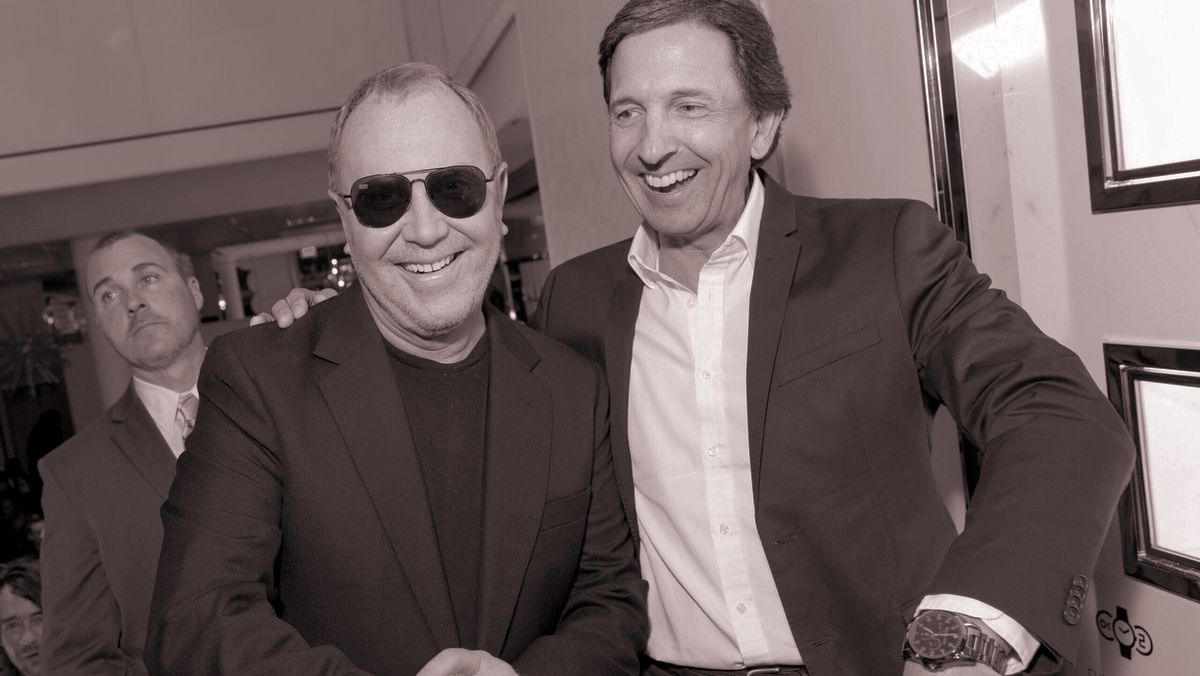
LVMH before. Idol’s own ascent was paved, in large part, by his ability to pounce after Arnault fired Michael Kors from Celine and divested from his namesake brand in 2003. Backed by investors Lawrence Stroll and Silas Chou, Idol saw an opportunity in Arnault’s arrogance, and built what was once a tiny ready-to-wear business into one of the pillars of what would become known as the accessible luxury business—combining the price-value
equation offered by, say, Coach with the high-fashion marketing of a runway brand. In December 2011, Michael Kors went public with a market valuation of $3.6 billion, far more than analysts projected. Idol made Kors the richest designer of his generation, and didn’t do poorly for himself, either.
Of course, success is rarely ever enough for the truly successful. By 2017, accessible luxury was on the wane. Luxury goods had become pop culture currency; teenagers had traded their Coach and
Michael Kors bags for Louis Vuitton and Gucci. Idol wasn’t the only one to notice the trend. Before him, Coach tried to move further upmarket by hiring Loewe designer Stewart Vevers, and everyone remembers when PVH hired Raf Simons, Pieter Mulier, and Matthieu Blazy to refashion Calvin Klein. The problem, of course, was that none of these companies had the infrastructure to truly move upmarket. Coach quickly course corrected,
keeping Vevers but using the online outlet channel to rebalance the business. PVH shut down the designer channel. Idol purchased Jimmy Choo, and burned the boats in his pursuit of empire-building. Two years later, he acquired Versace. |
Looking back, though, Idol was sort of late to the game. Kors was waning, and he saw Versace as a
potential growth engine, turning it profitable in just two years. The problem was that he tried to fit Versace into the Kors model, rather than adapting his operating plan to build on the brand’s popularity and potential. A long-neglected business, Versace has incredible brand awareness but is fundamentally decentralized. It could have become the Chanel of Italy, but that sort of transformation would have required brand sensitivity and a sophisticated analysis of its cultural positioning—foreign
concepts to Idol, who fancies himself a European sophisticate but is more of a Seventh Avenue garmento.
Anyway, many within the business not aligned with Idol’s vision were quickly cast aside. Donatella Versace, whom Idol promised something he couldn’t deliver, was marginalized. Meanwhile, Idol never hired executives who were strong enough to influence his strategy. Yes, he’s given Jimmy Choo C.E.O. Hannah Colman a good amount of agency—perhaps because he
knows less about the category. But virtually every other C.E.O. who has passed through the group, from Jonathan Ackeroyd to Emmanuel Gintzburger and Cedric Wilmotte, was viewed as an Idol yes-person.
The ultimate example of this was Josh Schulman, who was hired to succeed a nearing-retirement Idol and turn around Kors in March 2020. But by the time Schulman arrived at Capri, Kors was experiencing the pandemic bump, and
Idol wanted to stick around, searching for that one last deal. Schulman was fired after about six months with approval from the board, who sided with Idol amid an upswing in the stock price. Their apology gift was a severance package worth $8 million and a shortened noncompete. Schulman is now enjoying a successful run as the C.E.O. of Burberry.
That final deal, of course, would come in the form of Tapestry, home of Coach, Kate Spade, etcetera. Previous Coach C.E.O.s had been interested
in purchasing Kors, but it was only Joanne Crevoiserat who was willing to pay such a rich price. When that eventually fell apart over somewhat specious anti-trust concerns, Idol took the first step to unwind his empire. He sold Versace to Prada Group, which is now charged with sifting through that decentralized mess. (The real estate holdings alone may make it worth it in the end.) |
|
|
What will happen to the rest of Capri? Jimmy Choo is probably a fairly easy sell to private equity, or a
mid-level strategy group. Kors, though, is trickier. Idol would love to sell it, of course, but he will also want the best deal for his longtime partner, who remains a significant shareholder in the business. “He is as loyal to Kors as Kors is loyal to him,” one executive put it. In the end, though, the Kors ready-to-wear collection is barely a business, even if it’s still masterfully designed by its namesake. The most likely buyers are ABG, which tried to extract Marc Jacobs from LVMH last
year, or G-III, which bought Donna Karan International from LVMH almost a decade ago—the true sunset of the affordable luxury market Idol created. |
Debtwire is reporting that Saks Global’s potential Chapter 11 bankruptcy filing may be in Houston. (Neiman
Marcus, of course, is headquartered in Dallas.) The outlet notes that “the Southern District of Texas has one of the busiest bankruptcy courts in the U.S., ranking second to Delaware in both total Chapter 11 filings and pending cases, accounting for 20.8 percent of tracked filings according to Debtwire data.”
[Debtwire]
The Jalou family, which ran L’Officiel for decades, is accusing its Hong Kong–based owners of “fraudulently running the publication into the ground.”
[The Times]
Former Marni designer Francesco Risso is launching a Uniqlo collab and has been made the creative director of Fast Retailing’s GU brand. [Vogue]
This 2004
interview with Michael Kors, which took place right after he was ousted from Celine, is amazing. Every person who works in the fashion industry should read it. [WWD]
David Obadia, the C.E.O. of Sporty & Rich, is out.
[WWD]
I like this tea set, designed in the 1990s by François Bauchet and reissued by the magazine Tools.
[Tools Editions via T magazine]
For anyone who thinks designer appointment speculation is a new phenomenon, check out this 2003 blog post. [British Vogue] |
Until tomorrow,
Lauren
P.S.: We use affiliate links because we are a business. We may make
a couple bucks off them. |
|
|
Puck founding partner Matt Belloni takes you inside the business of Hollywood, using exclusive reporting and insight to explain the
backstories on everything from Marvel movies to the streaming wars. |
|
|
The industry’s go-to source for unflinching reporting on the trillion-dollar business of artificial intelligence - perhaps the single most
important technology of our time. Ian Krietzberg, the powerhouse journalist behind The Deep View, delivers twice-weekly insights into the latest dealmaking and breakthroughs in A.I., and how the intersecting worlds of finance, entertainment, media, and politics are being transformed in its wake. |
|
|
Need help? Review our FAQ page or contact us for assistance. For brand partnerships, email ads@puck.news. You received this email because you
signed up to receive emails from Puck, or as part of your Puck account associated with {{customer.email}}. To stop receiving this newsletter and/or manage all your email preferences, click here. |
Puck is published by Heat Media LLC. 107 Greenwich St., New York, NY 10006 |
|
|
|