{{ 'now' | timezone: 'America/New_York' | date: '%b %d, %Y' }} |
|
|
Hello, and welcome back to The Best & The Brightest, your daily political dispatch from Puck. It’s
foreign policy Thursday and I’m your host, Julia Ioffe.
It’s five days until Motherland—now officially a National Book Award finalist—finally drops! I’m so excited and so grateful to all my Puck partners for shouting out the book in their newsletters. But guess what? Along with a book launch
come book events! If you’re in D.C., don’t miss me in conversation with the legendary Sabrina Tavernise at Politics & Prose (the Connecticut Avenue location) on Tuesday, October 21, at 7 p.m. If you’re a New York City resident, catch me and my very first boss, David Remnick, kibitzing about the book and all things Russia at the
92nd Street Y on Thursday, October 23, at 7:30 p.m. If you’re joining either event, come say hi! It’s always so nice to meet Puck people in the wild.
Tonight, we dig into a few surprising happenings in the realm of foreign policy, including Melania Trump’s foray into Russia diplomacy, Rep. Anna Paulina Luna’s own favor to the Russian
Foreign Ministry, and Donald Trump coming around to the least America First idea of all: regime change.
But first… |
- Another
perfect phone call: This afternoon, Trump had yet another “productive” call with Vladimir Putin, one day before the president is set to meet with Volodymyr Zelensky to discuss giving him Tomahawks. And, wouldn’t you know it, Trump and Putin are going to meet again, this time in Budapest. It’s incredible that Putin was able to talk Trump into
another meeting, given that the last one yielded exactly zero results, either for Trump or for peace in Ukraine. Just last week, deputy foreign minister Sergei Ryabkov said that “the strong momentum created in Anchorage … has been largely exhausted.” But as Trump himself admitted, Putin praised his work to negotiate a ceasefire in Gaza—something that people have been dreaming of “for centuries”—and tempted him with money to be made in Russia. A prediction: Budapest will
be much like Anchorage. Lots of pomp and circumstance, lots of back-patting and talk of “root causes.” When the dust settles, though, Trump will once again realize that Putin hasn’t agreed to anything.
|
|
|
What Section 453 really means
Section 453 doesn’t block lawsuits or give blanket immunity to pesticide
companies.
Section 453 ensures labels are based on the EPA’s safety assessment under their guidelines and keeps companies accountable when they break these.
Explore more about Section 453 here |
|
|

| Abby Livingston
|
|
- Incumbents in trouble:
Campaign finance reports are in, and they show a number of incumbents in battleground races getting outraised by their challengers—usually the first warning sign for a sitting member. It’s especially noteworthy at this point in the election cycle, when challengers are often fighting for donor dollars in crowded primary fields.
The signals are especially glaring for four House Republican incumbents in competitive races, according to National Journal’s
fundraising chart. Democratic challengers outraised Republican incumbents in Arizona, Iowa, and Pennsylvania districts, as well as North Carolina’s 11th—a reach district where Jamie Ager raised $340,000 to Republican Rep. Chuck Edwards’s $100,000. Perhaps most notably, Democrat Christina
Bohannan raised $1.1 million in hopes of a rematch with Republican Rep. Mariannette Miller-Meeks, who raised $800,000 in her bid to hold on to Iowa’s 1st district. And Democrat Janelle Stelson raised $1.2 million to Republican Rep. Scott Perry’s $650,000 in what would be another rematch to represent Pennsylvania’s 10th.
The Republicans who outpaced Democratic incumbents all self-funded their campaigns to a significant degree, so
it’s harder to draw conclusions from the dollar figures. Still, these sums will make certain reps uncomfortable—in North Carolina’s 1st district, for instance, Republican Sandy Roberson raised $1.3 million, which included a $1 million candidate loan, compared to Democratic Rep. Don Davis’s $560,000. In Nevada’s 3rd district, Republican Aury Nagy raised $1 million (nearly all of it was self-funded) to Democratic Rep. Susie Lee’s
$610,000. Another million-dollar self-funder was Scott Mandel, in Texas’s 34th, where Democratic Rep. Vicente Gonzalez raised $440,000.
On the Senate side, three Republican incumbents got outraised. Democratic former Sen. Sherrod Brown smoked Republican Sen. John Husted, raising a
reported $8 million to his $3.8 million. Susan Collins of Maine and John Cornyn of Texas also saw themselves outraised, with Graham Platner raising $3.2 million to the Maine incumbent’s $1.9 million. (Democratic Gov. Janet Mills entered the race after the
latest fundraising deadline.) Cornyn faces challenges to his left and right; Ken Paxton bested the incumbent’s $910,000 campaign haul by posting $1.3 million himself, while Democratic challengers Colin Allred and James Talarico raised $4.1 million and $6.3 million, respectively. Still, Cornyn is expected to have an assortment of support from ancillary committees and PACs, and should have plenty of financial support heading into the election
year.
|
|
|
And now on to the main event… |
|
|
A purported breakthrough in Russian diplomacy comes from a surprising place. Plus, Moscow
scores an apparent intelligence coup via a U.S. congresswoman, and Trump warms up to regime change. |
|
|
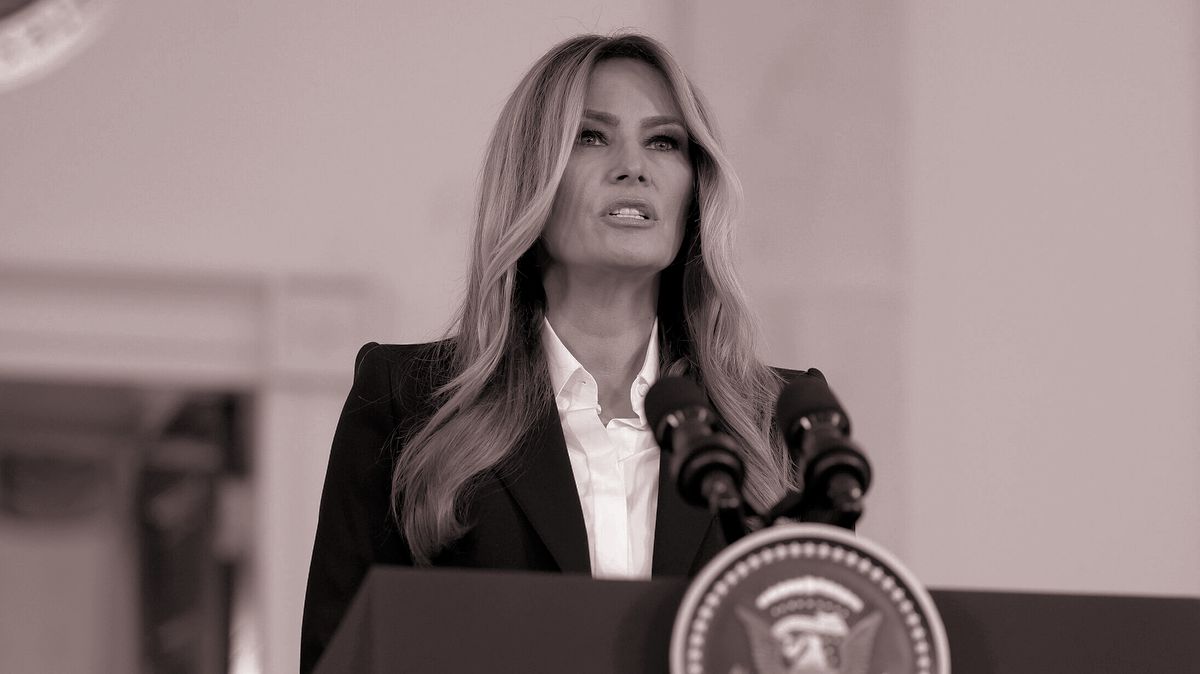
Last Friday afternoon, with a shut-down Washington emptying out for the long holiday weekend, first lady
Melania Trump walked through a set of double doors to address the White House press corps. She had an announcement: For the last two months, she’d been speaking to Vladimir Putin. In fact, Melania said, she had an “open channel” to the Russian president.
Their communication began in August, she said, when she asked her husband to pass a letter to the
Russian president at their meeting in Anchorage. The missive was a plea on behalf of the thousands of Ukrainian children who, according to Ukrainian authorities, independent experts, and the U.N., have been kidnapped by Russia, given to Russian families (or placed in Russian orphanages), and had their Ukrainian identities erased. The kidnappings led the International Criminal Court to issue an arrest warrant for Putin and his ombudswoman for children’s rights, Maria
Lvova-Belova. Luckily for Putin, the U.S. doesn’t recognize the jurisdiction of the I.C.C., so he didn’t risk arrest when he showed up to meet Trump in Alaska. Instead, he got a letter from Mrs. Trump. |
|
|
Why glyphosate is backed by regulators worldwide For 50 years, glyphosate-based products have been approved by regulators in the U.S., EU, Canada, Japan and more. Bayer stands behind these findings, and Section 453 reinforces these science-based processes, keeping labels reliable and consistent. Learn more about Section 453 here |
|
|
Putin deftly seized the opportunity to build a relationship with the first lady—who, as President
Trump has told the press, was the person reminding him after every phone call with Putin, that, for all his niceties, the Russian president was still bombing Ukrainian cities every single day. Why not use the first lady’s own demands to neutralize her as the naysayer in Trump’s ear?
And so, just as news was breaking that Trump might
send Tomahawks to Ukraine, Melania came out and made news of her own: She had gotten Russia to release eight Ukrainian children. It was only eight out of thousands, sure, and one of the children was reunited with her family in Russia, but it wasn’t nothing. Eight is more than zero. The first lady had something to show for her open channel, and to her haters: her own skill as a dealmaker in a dealmaking family. (A spokesperson from the first lady’s office said he had no new information for me
at this time.)
Putin got a lot, too. The first lady, speaking from the White House, was no longer referring to “kidnapped” Ukrainian children. Instead, she said they had been idiopathically “displaced.” Russia wasn’t trying to cleanse them of their Ukrainian identity; in fact, Moscow was speaking to her “in good faith” and giving her lots of detailed information on the children—all of which, she said, checked out. She also acknowledged the Russian line that many of the children at issue
weren’t children at all: They’d turned 18 since being “displaced,” and now they were no longer minors subject to Moscow’s ability to return them.
Speaking to a Russian newspaper, Sergey Lavrov, the Russian foreign minister, praised the first lady for finally understanding “what is really going on with these children,” rather than parroting what he called the Ukrainian
government’s “propaganda.” This was a modest victory for Putin, but a victory nonetheless. As Trump rededicates himself to ending the war in Ukraine now that Gaza’s solved, perhaps Melania won’t be quite as skeptical of the Russian side as she once was. And perhaps, tonight, after Trump’s latest “productive” phone call with Putin, she’ll agree that the Russian president is an honest negotiator after all. |
Anna Paulina Luna, the Republican representing Florida’s 13th district, raised eyebrows
again this week by declaring on X that “the ambassador from Russia to the United States will be hand delivering the @GovernmentRF’s findings on who assassinated J.F.K. to my office.” She subsequently asked the National Archives to upload the whole 350-page dossier to their site, but the archives declined, citing the government shutdown. Instead, she
announced she would take the file to the Substack of J.F.K. assassination investigator Jefferson Morley. Given that the dossier was presented by the Russian government and is said to be authored by the K.G.B., every word should be read with a
massive dose of skepticism.
Back in the day, the intelligence services of a foreign adversary would’ve had to work a lot harder to get their narrative—perhaps with some divisive Easter eggs nestled throughout—into the American discourse. These days, the Russians can just hand a congresswoman an exclusive gift that happens to coincide with the birthday of her slain friend and
mentor, Charlie Kirk, and she’ll make plans to post the entire thing, unredacted. So not only is she injecting the stuff directly into the conversational bloodstream and the official American historical record, she’s also lending it her legitimacy as a congresswoman. (Her office didn’t immediately respond to a request for comment.) |
|
|
That Luna is still considered fairly fringe is beside the point, especially since the distinction between the
far right and the Republican mainstream is very much without a difference. Love her or hate her, Luna is a duly elected official belonging to the dominant political party of the United States. You can be sure that someone is selling this back home in Moscow as a success deserving of a promotion. |
A Change
on Regime Change
|
On Wednesday, Trump publicly confirmed
reporting in the Times that he had authorized the C.I.A. to conduct covert action in Venezuela. (“Not so covert, huh,” snarked a former senior agency official.) The also-not-so-covert goal of this directive, nominally about stopping drug trafficking, is ousting Nicolás Maduro, Venezuela’s socialist dictator. Regime change,
the discredited fixation of neoconservatives during the Bush years, is back.
Trump, of course, was among the first Republican presidential candidates to declare that the U.S. had made a generational mistake by getting bogged down in foreign wars in the Middle East—a rupture that ultimately reoriented the party. But while Trump’s base has embraced isolationism, its real ideology is Trump and whatever Trump thinks. And his own view on the merits of regime change are highly
dependent on the specific country and whether he likes the person leading it. Back in the summer, as Secretary of Defense Pete Hegseth was taking pains to insist that U.S. strikes on Iranian nuclear facilities were not about regime change, Trump jumped online to muse that, actually, a
little regime change wouldn’t be so bad. “It’s not politically correct to use the term,” he admitted on Truth Social, “but if the current Iranian Regime is unable to MAKE IRAN GREAT AGAIN, why wouldn’t there be a Regime change??? MIGA!!”
Recognizing Trump’s ideological flexibility—as well as how openly he’s been lobbying for a Nobel Peace Prize—the actual winner of the honor, Venezuelan opposition leader María Corina Machado, dedicated hers to the American president.
Machado, who by all accounts won her country’s last presidential election before Maduro stole it and forced her into hiding, would be the most obvious beneficiary of the latter’s ouster, so why not get on Trump’s good side now?
Trump has also been very clear about his leadership preferences elsewhere in Latin America, and has not been shy about using the muscle of the U.S. government to push them. Brazil’s former President Jair Bolsonaro, known as the Brazilian Donald
Trump, was just sentenced to 27 years in prison for trying to hold on to power in ways nearly identical to Trump’s 2020 gambit, down to his supporters storming Congress. But Trump likes and sympathizes with him, so his administration has sanctioned a Brazilian Supreme Court justice, as well as his wife, for his alleged efforts “to weaponize courts, authorize arbitrary pre-trial detentions, and suppress freedom of expression.” More recently, Trump announced that the U.S. Treasury would bail out Argentina’s floundering economy—but only if its right-wing,
cosplaying, Trump-loving president, Javier Milei, wins the election. “That’s blatant election interference, given that it’s apparently contingent on Milei’s party winning,” said a former senior State Department official who worked Western Hemisphere Affairs.
It’s ironic that Trump—who rose to
power in part by channeling the exhaustion with the interminable foreign entanglements of the Global War on Terror—has lately warmed up to the most entangling intervention of all: deposing a sovereign government overseas. And it’s especially ironic that he’s looking to topple governments in regions—Latin America, Iran—where America-sponsored regime change has previously led to decades of bloodshed, torture, and instability. But Trump has never claimed to be a student of history.
Besides, maybe this time will be different. |
That’s all from me, friends. I’ll see you back here next week. Until then, preorder
Motherland!
Julia |
|
|
Join Emmy Award-winning journalist Peter Hamby, along with the team of expert journalists at Puck, as they let you in on the
conversations insiders are having across the four corners of power in America: Wall Street, Washington, Silicon Valley, and Hollywood. Presented in partnership with Audacy, new episodes publish daily, Monday through Friday. |
|
|
The industry’s go-to source for unflinching reporting on the trillion-dollar business of artificial intelligence - perhaps the
single most important technology of our time. Ian Krietzberg, the powerhouse journalist behind The Deep View, delivers twice-weekly insights into the latest dealmaking and breakthroughs in A.I., and how the intersecting worlds of finance, entertainment, media, and politics are being transformed in its wake. |
|
|
Need help? Review our FAQ page or contact us for assistance. For brand partnerships, email ads@puck.news. You received this email because you signed up to receive emails from Puck, or as part of your Puck account associated with {{customer.email}}. To stop receiving this newsletter and/or manage all your email preferences,
click here. |
Puck is published by Heat Media LLC. 107 Greenwich St, New York, NY 10006 |
|
|
|





_01K77C0D9VDDGVNNP1DBKASPB4.jpg "Bayer")