Welcome back to Wall Power’s Inner Circle. I’m Marion
Maneker.
Female artists are undeniably gaining ground in the art market, and tonight, I’ll share some numbers to prove it. After getting an early look at a new report from ARTDAI, I have data on the performance of 42 female artists from the 20th century at auction over the past 20 years. The results are impressive.
Up top, Phillips continues to press its Patek Philippe advantage. Plus: The Warhol portraits of Brigitte Bardot commissioned
by O.G. playboy Gunter Sachs are having a moment on the market.
Also mentioned in this issue: Richard Avedon, Clare McAndrew, Yayoi Kusama, Joan Mitchell, Georgia O’Keeffe, Agnes Martin, Louise Bourgeois, Barbara Hepworth, Claude Lalanne, Yves Saint Laurent, Helen Frankenthaler,
Tamara de Lempicka, and many more…
Before we get started, here are a few items coming to auction… |
-
The Phillips Patek Philippe encore: Phillips’s watch division, Bacs & Russo, has announced a pink gold Patek Philippe Ref. 2499 watch with an estimate of $3 million for its May 30-31 sale in Hong Kong. The Patek is one of only four ever made and has additional characteristics that render it unique. It previously sold in 2014 for just under $2.7 million. The Hong Kong sale will take place just weeks after Phillips auctions another ultra-rare Patek Philippe in Geneva, that one with a high
pre-auction estimate of nearly $6.4 million.
- Elvis’s comeback guitar: In an online sale running from tomorrow until April 23, Sotheby’s will sell a guitar that Elvis Presley played during his 1968 comeback special on NBC. The cherry red Hagstrom Viking II electric guitar is estimated at $1 million.
|
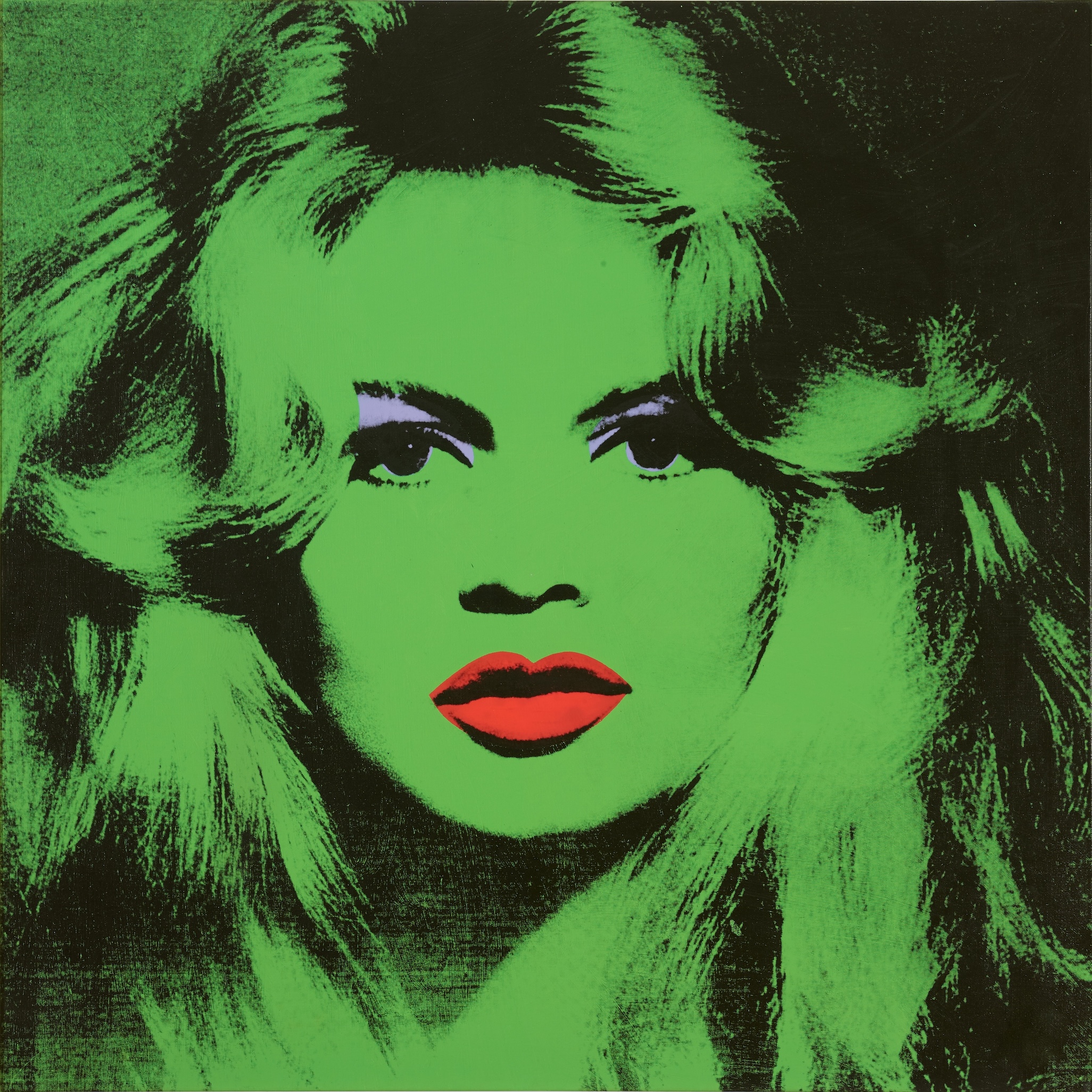
Andy Warhol, Brigitte Bardot (1974). Photo: Courtesy of Sotheby’s |
Last November, the Andy Warhol market stirred with the sale of the artist’s 1974 portrait of
Brigitte Bardot for $16.6 million—a significant jump from the high mark of $11.6 million set a dozen years prior. Naturally, the result has brought another version of the painting to market: Sotheby’s will sell an emerald green Bardot with bright red lips, estimated at $14 million, in its May contemporary art sale.
Gunter Sachs, the heir to the Opel fortune and Bardot’s third husband, had commissioned eight of these works from Warhol five years
after their divorce. It wasn’t a casual commission, either. Warhol used a Richard Avedon photograph that Sachs had selected, and—as if to underscore the fact that Warhol was allowing Sachs to meddle in his process—the works were created in a size (nearly 48 inches square) that did not fit with the rest of the artist’s production. Gunnar Sachs, Gunter’s son, is the consignor of the work.
Five of the eight works have been auctioned publicly: Gunter himself
sold the first one in 2006 for $3 million; the next year, a deep purple version (also with red lips) sold for $10.5 million; in 2009, a duller, pale-blue-and-lavender version made under $3 million; then, in 2012, a brighter red-and-yellow Bardot sold for $4.7 million. (That’s the one that sold again in November for $16.6 million.) Since the works are priced in two tiers—the cadmium red lips paintings were priced significantly higher—that sale actually set up the $11.6 million price of a
blue Bardot with red lips in 2014, a previous record. That’s where this new offering enters the story.
Now that the red-and-yellow work has resold for more than three times its previous price, we have to wonder: Will collectors continue to value the red-lipped Bardots at a significant premium? If so, we could see some real bidding here.
Now, let’s look at the market for female artists… |
|
|
|
Achieving something close to gender parity in the art market has been an
excruciatingly slow process. But as new data from our friends at ARTDAI reveals, female artists of the past 100 years are slowly but surely closing the gap. |
|
|
|
At long last, female representation in the art market seems to be approaching the gender
composition of the world itself. Economist Clare McAndrew illustrated that progress when she pointed out in her recent report that primary art galleries are now approaching gender parity: Women account for 45 percent of artists represented, up from 35 percent in 2018. Unfortunately, sales value has to catch up. The work of female artists made up only 37 percent of the sales value last year, up from 28 percent in 2018.
Those numbers are signs of progress, obviously, but
they may not give much comfort to those who would like to see the market respond faster. To further complicate the picture, McAndrew’s survey data shows that female artists constitute a larger proportion of the business of smaller dealers—those with annual turnover under $250,000—than they do of the largest galleries with turnover of more than $10 million. In the smaller-gallery tier, women make up 55 percent of the artists and 43 percent of the sales value, compared to 35 percent of the artists
and 27 percent of the sales value of the largest-gallery tier. One hopes that the work being sold by smaller dealers will rise in visibility, cultural resonance, and market value over time—and ultimately begin to reflect gender parity. But is that simply a hope?
A new report from ARTDAI, a preview of which I managed to peek at, suggests that the upward trend in female representation is playing out in the secondary market. Work created by female artists is getting more valuable, and more
of it is selling than ever before. These numbers are encouraging but still a little frustrating, because while the secondary market is very large, it’s also quite slow to reflect change. Art becomes more valuable as a result of numerous individual decisions, which we compile and call “market forces.” Those forces seem to be moving in the direction of gender parity, but there’s no guarantee this trend will continue—and meanwhile, the market remains historically skewed toward the production of
works by male artists. |
Since ARTDAI shared their data with me, I could make my own assessment of these trends.
Looking at the auction results from 2005 to 2025 of 42 female artists from the 20th century, one can easily see growth. In 2005, sales for all 42 artists totaled $24 million. In 2025, the same 42 artists saw $466 million in sales—a 20-fold increase in 20 years. The average price per work for these artists went from $11,500 in 2005 to $146,500 in the same period—an increase of nearly 13 times. And the sell-through rates at auction also got consistently higher.
Just to give you a
sense of how the market for those 42 female artists is developing: In 2010, only six had total auction sales surpassing $5 million, and only three sold more than $10 million. In 2025, 16 of those artists sold more than $5 million at auction, and three sold more than $50 million—and 2025 was a slow year in the auction market. In 2022, an admittedly peak year, 17 of those 42 artists sold more than $5 million at auction, with one selling more than $120 million in that year alone. And, in 2023, 17
sold more than $5 million at auction, with two of them reaching totals over $100 million.
There are a number of different ways to look at this data. Here are the top artists by total sales between 2005 and 2025: |
-
Yayoi Kusama accounted for 19 percent of all the sales, with $988 million in total volume and a top price of $10 million.
- Joan Mitchell had $972 million in sales, making up 18 percent of the total, and a top price of nearly $28 million.
- Georgia O’Keeffe sold $479 million for a 9 percent share of the total, with a top price of $44 million.
- Agnes
Martin reached 7 percent market share, with $381 million sold and a top price of nearly $18 million.
- Louise Bourgeois sold $368 million worth of art for 7 percent of the total, with a top price of almost $33 million.
- Barbara Hepworth came in at $294 million, or 6 percent, with a top price of $10.5 million.
- Claude Lalanne sold $264
million for a 5 percent market share, with a $5.2 million top price—which will likely go up substantially when the mirrors she made for Yves Saint Laurent get sold later this month.
- Helen Frankenthaler sold $253 million throughout the period, making up 5 percent of the market, and achieved a top price of nearly $7.9 million.
- Tamara de Lempicka reached $246 million, or 5 percent,
and peaked at $21 million for a single painting.
- Bridget Riley sold $150 million for 3 percent market share, with a top price of more than $5.8 million.
- Frida Kahlo sold $145 million publicly, or 3 percent of the total, but the top price was nearly $55 million.
- Leonora Carrington had $101 million in sales, or 2 percent of the total, with a top
price of $29 million.
- Lee Krasner saw $100 million in auction sales, or 2 percent market share, and hit a top price of $9 million.
|
In addition to these 13 artists, there are a number of others whose work is similarly valuable but
thinly traded. (This isn’t uncommon—several male artists have low auction volume but can achieve high value for their work when it does come up.) Vija Celmins is a good example: When ARTDAI created five-year cohorts to smooth out the data, Celmins consistently appeared among the artists with the highest average prices. In the period between 2011 and 2015, her average price was $1.25 million; by the 2021-25 period, it had risen to $3 million. Ruth Asawa had
an average price of nearly $1 million between 2016 and 2020, and Lee Bontecou had an average price of $1 million between 2021 and 2025.
Another cohort of artists includes Gertrude Abercrombie, Lynne Drexler, Olga de Amaral, Etel Adnan, Miyoko Ito, Dorothea Tanning, and Faith Ringgold, who have all set new records in the past two or three years, even as
the market has turned downward—suggesting that the growth in value for women artists from the 20th century is far from over. |
That’ll do it for now. I’ll see you back here on Friday. I just walked out of the preview of the
Acquavella show of Matisse. It’s wild!
’Til then,
M |
|
|
|
Puck founding partner Matt Belloni takes you inside the business of Hollywood, using exclusive reporting and insight
to explain the backstories on everything from Marvel movies to the streaming wars. |
|
|
|
Ace media reporter Dylan Byers brings readers into the C-suite as he chronicles the biggest stories in the industry:
the future of cable news in the streaming era, the transformation of legacy publishers, the tech giants remaking the market, and all the egos involved. |
|
|
|
Need help? Review our
FAQ page or contact us for assistance. For brand partnerships, email ads@puck.news.
You received this email because you signed up to receive emails from Puck, or as part of your Puck account associated with {{customer.email}}. To stop receiving this newsletter and/or manage all your email preferences, click here. |
Puck is published by Heat Media LLC. 107 Greenwich St., New York, NY 10006 |
|
|
|
|