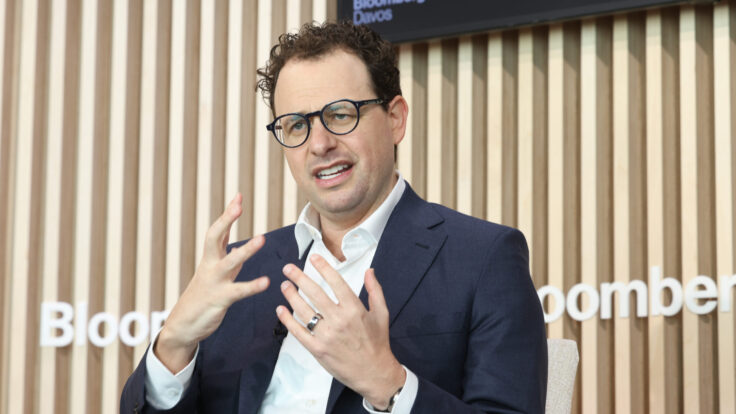
Welcome to The Hidden Layer. I’m Ian Krietzberg, fresh off a fantastic talk with
the wonderful folks at U.C. Santa Barbara about A.I., media, neuroscience—all the fun stuff. I have to say, I was struck by the students’ engagement and especially their discernment regarding the industry. Maybe the kids are alright after all.
Now I’m on to HumanX in San Francisco—more on that in a forthcoming issue. Today, we’re delving into the war in Iran and its impact on the critical A.I. infrastructure that’s being stood up in the Middle East. Plus, news and notes on some major new
startup acquisitions, an ICE lawsuit, and fresh A.I. employment questions.
Also mentioned in this issue: Dmitri Alperovitch, Sam Winter-Levy, Leah Frazier, Charles Harry, Justin Sherman, Torsten Slok, and more…
Let’s get into it… |
Three Things You
Should Know…
|
- An
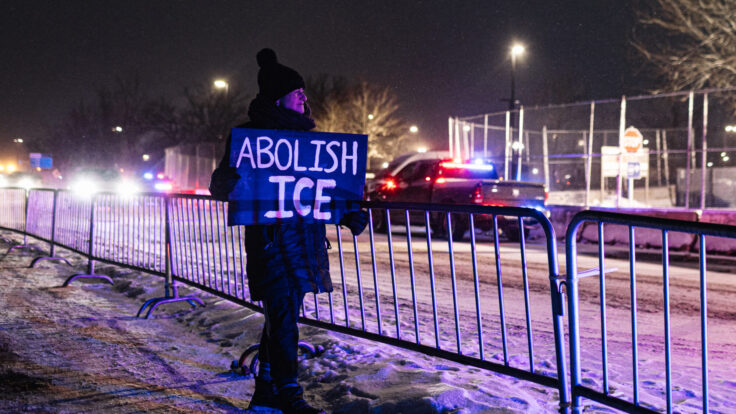
ICE lawsuit: The Lawyers’ Committee for Civil Rights Under Law has sued the Department of Homeland Security for records relating to ICE’s reported use of Mobile Fortify, a facial recognition app. The suit accuses D.H.S. of failing to comply with a Freedom of Information Act request for those records. Leah Frazier, the director of the committee’s Digital Justice Initiative, said in a statement: “We seek transparency—to expose the administration’s expansion of surveillance
infrastructure and check its attack on civil liberties.” ICE did not respond to a request for comment.
- What job loss?: Economists at both Apollo and Goldman Sachs have concluded that, so far, A.I.-driven job loss has been minimal. Comparing the unemployment rate of recent college grads with that of the entire U.S. population, Apollo chief economist Torsten Slok did not find “any sign that unemployment among younger workers is
structurally higher because of A.I.”
Economists at Goldman sought to quantify jobs’ susceptibility to “substitution” versus “augmentation” from A.I., and discovered—unsurprisingly—that the most-substitution-prone industries had shed jobs since the launch of ChatGPT, “with younger and less experienced workers hit hardest.” But overall job losses were largely offset by gains in industries where A.I. augments the work—resulting in a mere 0.1 percentage point increase in unemployment
attributable to A.I. over the past year. The economists acknowledged that the “true aggregate impact of A.I. is likely smaller” given the employment effects of all that data center spend, among other things. - AnthroPAC: In a sign of Silicon Valley’s increasingly determined invasion of Capitol Hill, Anthropic filed paperwork with the
Federal Election Commission on Friday to launch an affiliated (employee-funded) PAC called AnthroPAC. While not uncommon, the maneuver is notable for its timing: It comes as the company is locked in a legal battle with the Trump administration, and after it donated $20 million to Public First Action—the more pro-regulatory PAC that was created last year to oppose the “pro-innovation” PAC Leading the Future.
|
- Around
the same time that OpenAI acquired TBPN, the popular live tech podcast/show, for an undisclosed sum, Anthropic spent about $400 million acquiring the 8-month-old biotech startup Coefficient Bio, according to The Information. Anthropic didn’t return a request for comment. Gotta keep up, I suppose.
- The first quarter of 2026, according to Crunchbase
data, was “unlike any other for venture investment”—driven, of course, by continued investor excitement in A.I. Globally, $300 billion flowed into 6,000 companies in Q1, with 80 percent of the financing going to A.I. companies. Some $188 billion went to just four firms: OpenAI ($122 billion), Anthropic ($30 billion), xAI ($20 billion), and Waymo ($16
billion).
|
And now for the main event… |
|
|
|
American tech companies have constructed dozens of data centers in the Middle East, all
within striking distance of Iran. Recent attacks on A.W.S. facilities in Bahrain and the U.A.E. show how they’ve become geopolitical casualties of the U.S.–Israeli war. |
|
|
|
Donald Trump was supposed to be Silicon Valley’s president, but history rarely plays
out according to plan. The morning after the U.S. and Israel began their airstrikes on Iran on February 28, Iranian drones hit several Amazon data centers—two in the U.A.E. and one in Bahrain. The strikes, according to the company, “caused structural damage, disrupted power delivery to our infrastructure, and in some cases required fire suppression activities that resulted in additional water damage.” By the end of the month, another Amazon data center in Bahrain was
reportedly struck. (Amazon did not return a request for comment, but a spokesperson pointed me to an A.W.S. blog post noting that its “Bahrain Region has been disrupted as a
result of the ongoing conflict.”)
While Trump made headlines with his somewhat recent spate of A.I. dealmaking in the Gulf, the largest U.S. tech companies have been quietly scaling in the Middle East for the better part of a decade. Seven years ago, Microsoft launched
its first two data center regions in the Middle East, in Abu Dhabi and Dubai; in 2022, it opened a third data center region in Qatar. Between 2023 and the end of the decade, the company has
said, it will spend more than $15 billion in the U.A.E., a substantial portion of which will go to A.I. and cloud infrastructure.
Amazon, meanwhile, launched its first Middle East data
center region in Bahrain in 2019 and followed up with another, in the U.A.E., in 2022. In 2024, it committed to spending more than $5 billion on data center build-outs in Saudi Arabia. Google Cloud operates
data center regions in Saudi Arabia and Qatar; Oracle has built infrastructure in the U.A.E. and Saudi Arabia; and OpenAI is building a 5-gigawatt data center in Abu Dhabi for its Stargate project as part of a
partnership between the U.S. and the U.A.E.
The hyperscalers’ motivations are obvious: As PwC noted in a 2025 report, land
and power are cheap and abundant in the region—as is, well, money. Saudi Arabia, the U.A.E., and Qatar have all committed to investing billions of dollars in data centers and A.I. as their sovereign wealth funds seek to diversify away from oil. And the investments go beyond local infrastructure: MGX, the A.I. investment firm created by the Abu Dhabi government, is a lead investor in OpenAI and xAI. Qatar’s Investment Authority has
invested in Anthropic, and Saudi Arabia’s Humain has invested billions in xAI.
Naturally, these relationships were turbocharged by President Trump, who, in May of last year,
announced $200 billion in commercial deals between the U.S. and the U.A.E. At the time, Trump said that the trade relationship “will contribute to the U.S. boom in A.I. infrastructure, semiconductors, energy, quantum computing, biotechnology, and
manufacturing.”
As the war rages into its second unpredictable month, however, these investments have grown vulnerable. Iran’s Islamic Revolutionary Guard Corps has threatened 18 U.S. tech and finance companies that own or operate infrastructure in the Middle East—Microsoft, Apple, Google, Meta, Nvidia, IBM, Cisco, Oracle, Tesla, Intel, Palantir, JPMorgan, and Boeing, among others—with “the destruction of their relevant units in exchange for every assassination in Iran.” (None of the
named corporations responded to requests for comment.) The I.R.G.C. later threatened OpenAI’s Stargate data center, specifically.
The dynamic validates the dark prophecy
issued last July by Sam Winter-Levy, a fellow at the Carnegie Endowment for International Peace. While so much of the U.S. political discourse focused on the Silicon Valley oligarchs who stood behind Trump at his inauguration, and seemed prepared to tolerate his Gulf of America–style provocations in exchange for modest A.I. regulation, Winter-Levy saw a more dystopian possibility: He warned that Trump’s plans to partner with Middle Eastern governments on A.I. infrastructure
would place data centers “in locations highly vulnerable to attack from hostile actors—and at a time when the risk from cheap drones is intensifying.” |
How much damage could Iran actually inflict? As Winter-Levy noted to me, the Iranians “have every incentive
to exaggerate their capabilities as leverage or signaling in their negotiations with the U.S.” But the outcome “could range from mild temporary inconveniences for some of the world’s wealthiest companies to much more serious and prolonged outages for critical Gulf public and private services.” In many cases, he noted, even a few hours’ worth of data center outages could cost a company millions of dollars.
Part of what makes such outages hard to predict is that it’s unclear which
applications or institutions rely on which data centers, according to Charles Harry, an international security researcher at the University of Maryland. “No one really maps this stuff out,” he said, which makes it difficult to tell how widespread the impacts might be. “The big strategic risk here for the Iranians is that they’re going to hit something that they don’t recognize is critically important, either for the region or globally, that can lead to an unintended escalation.”
But even demonstrating that they could, as the I.R.G.C. recently did, might be enough to rattle markets—which Harry thinks is the point. “Their motive is all about applying pressure on the United States in an asymmetric way,” he said.
Indeed, while hyperscalers have invested a lot of money into defending against cyberthreats, they haven’t prepared nearly as much for physical ones. “When so many A.I. technologies depend on the infrastructure of a couple of companies around the
world, the ability to target that creates more single-point-of-failure risks,” said Justin Sherman, the founder and C.E.O. of Global Cyber Strategies. Describing the push to build A.I. infrastructure in the Middle East as a “reckless rush,” he said that the U.S. government now presumably recognizes the risks. “They should have seen them to begin with,” he added. (The Department of Defense did not respond to a request for comment.)
Assuming the current Iranian regime
survives, large-cap companies seeking to build or stay in the Middle East will have to consider additional, enormous expenses such as air defense, according to Dmitri Alperovitch, the CrowdStrike co-founder and cybersecurity expert. At that point, the region’s abundance of cheap land and power will be less of a bargain. “You have to think hard about the trade-offs of operating in the region,” he told me, adding that from a national security perspective, fewer data centers in the
Middle East arguably wouldn’t be a bad thing. And since most model training happens in the U.S., he said, a slowdown in the region wouldn’t necessarily translate to a slowdown in A.I.—just another factor for investors and governments to consider, and to pay to mitigate.
Still, he doesn’t think a Middle Eastern data center pullback is likely. Those governments see it “as a national priority to have sovereign A.I. infrastructure,” Alperovitch said. After the war, he suggested, many of these
companies will plow money into reconstruction. “I think the costs of compute in that region may go up, but if the governments are willing to subsidize it, someone is going to satisfy that need,” he added. “They’re going to figure it out.” |
That’s all for today. I’ll see you on Thursday.
Ian |
|
|
|
Join Emmy Award-winning journalist Peter Hamby, along with the team of expert journalists at Puck, as they let you in on the
conversations insiders are having across the four corners of power in America: Wall Street, Washington, Silicon Valley, and Hollywood. Presented in partnership with Audacy, new episodes publish daily, Monday through Friday. |
|
|
|
A professional-grade rundown on the business of sports from John Ourand, the industry’s preeminent journalist, covering the
leagues, players, agencies, media deals, and the egos fueling it all. |
|
|
|
Need help? Review our
FAQ page or contact us for assistance. For brand partnerships, email ads@puck.news.
You received this email because you signed up to receive emails from Puck, or as part of your Puck account associated with {{customer.email}}. To stop receiving this newsletter and/or manage all your email preferences, click here. |
Puck is published by Heat Media LLC. 107 Greenwich St., New York, NY 10006 |
|
|
|
|