Hello and welcome back to The Best & The Brightest. I’m Leigh
Ann Caldwell, on another day that ends in “y”—which means another day the president is talking about tariffs. More letters went out today to America’s trading partners, with tariffs now threatened to kick in by August 1.
Today, I’m looking at the myriad ways that Congress is handing over its power to a president only too happy to take it—including, notably, by trying to defang the Government Accountability Office. Everyone who works in or near Congress is familiar with the
G.A.O.; everyone else probably never hears about it. But right now, the agency finds itself in Congress’s crosshairs.
P.S.: Our new resident A.I. expert, Ian Krietzberg, launched his private email on the multitrillion-dollar A.I. industry this week. I know you enjoyed his first issue, which was previewed yesterday in these digital pages. The second dispatch goes out tomorrow—click here to never miss his brilliant, must-read newsletter, The Hidden Layer.
But first…
|
- The fiscal hawks’ BBBackroom deal: Now that the One Big Beautiful Bill has been signed into law, it’s becoming at least somewhat clearer what Republican fiscal hawks got in return for their votes on a measure to exacerbate the deficit. Over the weekend, Freedom Caucus chair Rep. Andy Harris told Newsmax that his band of budget conservatives negotiated a “sidecar” deal with the president overnight ahead of the vote.
As for what’s actually
in the deal, two Republican sources told me that it included agreements on eight of the hawks’ nine demands. Harris told Newsmax it involved “significant deficit reduction”; my sources declined to get more specific, other than to say it included commitments involving adjustments to the new state and local tax caps, funding prohibitions pertaining to Planned Parenthood, and further reduction of Inflation Reduction Act renewable energy tax credits through executive orders.
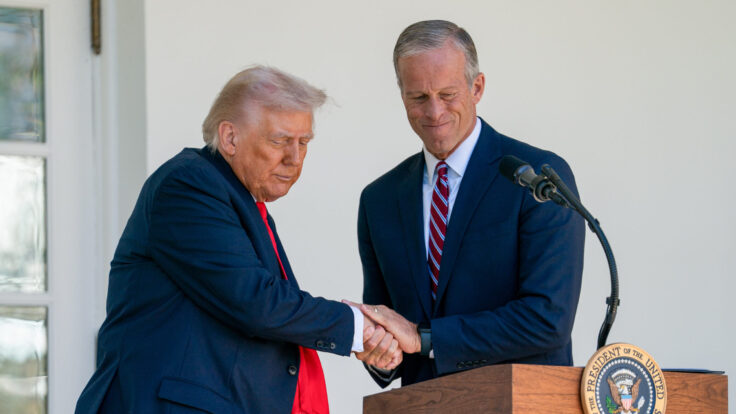
It’s unclear how any part of this deal would be implemented. While there’s been some chatter about another party-line reconciliation bill that would further reduce spending and revive some of the items stripped out of the BBB, many Republicans are skeptical it would happen. One such skeptic, an aide to a rank-and-file member, dismissed the idea as the kind of thing that gets floated as a bargaining tactic to get votes, then never materializes. - Momentum for Russia sanctions?: President Trump said he is looking “very strongly” at a bill to sanction Russia over Vladimir Putin’s unrelenting assault on Ukraine. Sen. Lindsey Graham, who wrote the legislation, is practically jumping up and down with excitement over Trump’s apparent change of heart toward the Russian leader, and his bill has overwhelming bipartisan support. But Senate Majority Leader
John Thune told reporters today that “it’s a bit of an open question” whether it will actually pass, and that he’s working with the House and the White House to ensure that it can. So what’s the holdup?
Our friends at Politico reported that the president wants changes made to the bill that expand
his powers and give Congress “no power to question Trump should he decide to end the sanctions.” You recognize the theme. - Rescissions decisions: The Senate has until next Friday to pass a bill the House passed last month to claw back $9 billion in funding for USAID and the Corporation for Public Broadcasting. But Republican opposition in the upper chamber could very well sink it. Some senators, including Susan Collins, are
concerned about cuts to PEPFAR, the highly successful Bush-era global HIV/AIDS health program. Others, including Senator Mike Rounds of South Dakota and Alaska Senators Lisa Murkowski and Dan Sullivan, are worried about funding cuts to C.P.B., a crucial information source and emergency alert system in their rural states. No clarity yet on what the bill will look like in the end—if it passes at all—but I’m hearing speculation
that the cuts could be scaled back to $5 billion or $6 billion.
|
|
|
Amid the Trump administration’s assaults on the Government Accountability Office,
the original DOGE, House Republicans have largely sided with the White House over their own watchdog—the latest sign that they would rather abrogate their constitutional powers than disagree with the president. |
|
|
Before DOGE was a twinkle in Elon Musk’s eye, there was the Government
Accountability Office—the investigative arm of Congress, its eyes and ears in the executive branch, a behind-the-scenes hunter of waste, bloat, and inefficiency. The G.A.O.’s work has, by its own estimate, led to $1.45 trillion in savings since 2002, and an average of nearly $92 billion a year more recently (although it can’t make those cuts directly). The independent agency
also helps enforce the Impoundment Control Act, the law that requires the administration to actually spend congressionally appropriated funds.
Naturally, Donald Trump is not a fan, and hasn’t been since his first administration—it’s a restraint on executive power, after all. Indeed, in an era when Capitol Hill lawmakers have largely ceded responsibility to the White House on everything from the elimination of federal agencies to the imposition of tariffs
and the bombing of Iran—all of which, in theory, require congressional approval, or at least consultation—the G.A.O. is one of the few institutions that allows Congress to truly flex its muscle. And yet, last month, Republican members of Congress themselves voted, in a funding bill that passed out of a House Appropriations subcommittee, to cut the G.A.O.’s budget nearly in half and impose stringent restrictions that would make its oversight job nearly impossible.
Specifically,
the House Appropriations subcommittee is trying to limit G.A.O.’s influence, as well as its budget. In addition to cutting its funding by 49 percent, to $415 million, the committee’s bill would severely constrain how it can spend those funds. For instance, G.A.O. wouldn’t be able to spend the money to file suit against federal employees or agencies that don’t comply with congressional appropriations, or on work that’s not statutorily approved by both chambers of Congress—a
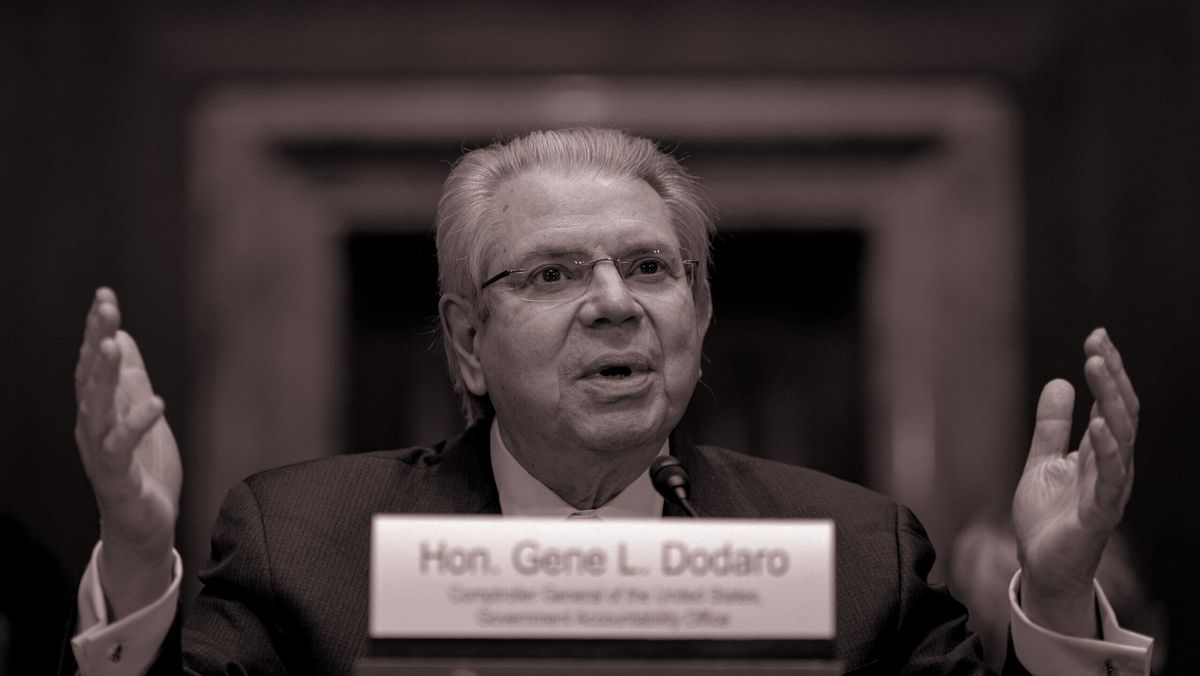
near-insurmountable barrier that would essentially eliminate routine requests from lawmakers for things like reports and issue-specific staffing help. In short, the House G.O.P. bill would have “pervasive effects in undermining our support of the Congress,” G.A.O. head and U.S. Comptroller General Gene Dodaro wrote in a letter to lawmakers. (A representative for
the agency declined to comment.) |
Of course, for top administration officials, that’s the point. Office of Management and Budget
director Russ Vought and his general counsel, Mark Paoletta, have been battling the G.A.O. since Trump 1.0, when the agency said that Trump’s 60-day pause on Ukraine aid, and his directive that federal agencies keep operating during the 2019 government shutdown, were both illegal. “The president can decline to spend the entire amount of an appropriation,” Paoletta wrote during the Biden interregnum, “just as the president has discretion to not
enforce every criminal law to the fullest extent.” Both believe that the Impoundment Control Act is unconstitutional. They also think the G.A.O. is partisan, anti-Trump, and, in Vought’s words, inclined “to call everything an impoundment because they want to grind our
work to manage taxpayer dollars effectively to a halt.” (O.M.B. declined to comment.)
This salvo also comes in the wake of repeated challenges from the G.A.O. this term. For instance, in May, the agency ruled that the Transportation Department had illegally failed to disburse electric-vehicle charger grants as required under the Biden-era Inflation Reduction Act, and, more recently, that the administration’s freeze on funding for the Institute of Museum and Library Services was
illegal. This spring, Paoletta wrote to the agency to insist that his own office was actually compliant with the Impoundment Control Act (needless to say, the two bodies interpret the law differently) and offered the non-concession that O.M.B. would cooperate with G.A.O., but only when doing so would not “unduly impede” the former’s ability to “implement the president’s agenda.”
That statement, naturally, was a major red flag to Democrats and G.A.O. supporters. “It sends a signal
that if O.M.B. isn’t going to cooperate, then the other agencies won’t either,” said Michael Missal, a former Veterans Affairs inspector general, who was fired, alongside 16 other I.G.s, in Trump’s “Friday Night Massacre” in January.
There would be more sternly worded letters to come. When the G.A.O. ruled earlier this year that the Senate couldn’t reverse California’s electric vehicle mandate through the Congressional Review Act—a law that allows Congress to overturn
rules issued by federal agencies—Vought argued in a letter to the comptroller that the G.A.O. was out of line. After that, Senate Majority Leader John Thune took the unprecedented step of holding a vote to overrule the G.A.O., and encouraged Republicans to support it, which they eventually did, despite some unease about breaking yet another norm. When I asked Thune whether Congress should gut the G.A.O., he said he hadn’t “taken a hard look” at that
yet. “Obviously we’ve had our differences with G.A.O. a few times this year, but we also know that they are a body, an entity, that is responsible, or supposed to be responsible to, and responsive to, the Congress.” |
Rep. David Valadao, a centrist from a purple district in central
California, is the chairman of the subcommittee that proposed the G.A.O. cuts—an unlikely warrior in this fight, having been critical of Trump (and even voting to impeach him) in the past. More recently, he led the effort to reduce the size of Medicaid cuts in the BBB. Perhaps attacking a soft target like the G.A.O. was an easy way for him to avoid the administration’s wrath, or perhaps leadership inserted the anti-G.A.O. language into the bill at the request of the administration. Whatever the
case, Valadao’s office didn’t respond to emailed questions.
Of course, Valadao isn’t alone—there’s a growing list of House Republicans, most of them Freedom Caucus fiscal hawks, who are willing to cede congressional powers of the purse. To wit: More than two dozen Republicans have signed on to legislation sponsored by Rep. Andrew Clyde of Georgia that calls for the Impoundment Control Act to be repealed. In my conversations with House G.O.P. aides whose
bosses generally support the measure, some sided with Vought, arguing that the Impoundment Control Act—which was passed in 1974 in response to Nixon’s refusal to spend congressionally appropriated dollars—is an unconstitutional infringement on presidential prerogatives. Others, however, felt there was a trickier constitutional question at play, but ultimately that the administration was better positioned to cut the $36 trillion national debt. Former North Carolina Rep.
Dan Bishop, who co-sponsored the Clyde bill in the last Congress, is now Vought’s deputy.
In the coming hours, the Senate Appropriations Committee is expected to release its funding bill for the legislative branch for a Thursday markup. I’m told by multiple Senate sources that they’re unlikely to cut the G.A.O.’s funding, and even more unlikely to embrace the House’s proposed limits on the office’s ability to function. That means this particular battle
may yet become a tug-of-war between the two chambers. Another signal will come later this year, when Congress forwards its nominees to replace the current comptroller, whose 15-year term ends in December. The names on it will indicate whether Congress has any desire—or none—to retain a sliver of its independence. |
|
|
Join Emmy Award-winning journalist Peter Hamby, along with the team of expert journalists at Puck, as they let you in
on the conversations insiders are having across the four corners of power in America: Wall Street, Washington, Silicon Valley, and Hollywood. Presented in partnership with Audacy, new episodes publish daily, Monday through Friday. |
|
|
The industry's go-to source for unflinching reporting on the trillion-dollar business of artificial intelligence -
perhaps the single most important technology of our time. Ian Krietzberg, the powerhouse journalist behind The Deep View, delivers twice-weekly insights into the latest dealmaking and breakthroughs in A.I., and how the intersecting worlds of finance, entertainment, media, and politics are being transformed in its wake. |
|
|
Need help? Review our FAQ page or contact us for assistance. For brand partnerships, email ads@puck.news. You received this email because you signed up to receive emails from Puck, or as part of your Puck account associated with {{customer.email}}. To stop receiving this newsletter and/or manage all your email preferences,
click here. |
Puck is published by Heat Media LLC. 107 Greenwich St, New York, NY 10006 |
|
|
|