{{ 'now' | timezone: 'America/New_York' | date: '%b %d, %Y' }} |
|
|
|
Hello, and welcome back to The Best & The Brightest. I’m Leigh Ann Caldwell,
wishing a happy Oscars day to all who celebrate. This is probably as good a moment as any to remind you that you’re simply not living a worthwhile life unless you’re subscribed to my partner Matt Belloni’s incredible newsletter on modern Hollywood, What I’m Hearing. The film and television business is also a Machiavellian ecosystem of high-powered egomaniacs, dexterous supplicants, and
insecure strivers. You might feel right at home!
The National Press Foundation made a bold statement at its annual awards dinner last Thursday: The organization bestowed honors on both NPR C.E.O. Katherine Maher, who is battling Congress and the Trump administration’s defunding jihad, and former 60 Minutes E.P. Bill Owens, who effectively left his job over the nonsense Kamala-gate settlement scandal that paved
the way for the cash-strapped Shari Redstone to finally unload her father’s true baby to the Ellison family. Introducing Owens, Scott Pelley said his bosses at CBS and Paramount “crumpled under pressure.” In his acceptance remarks, Owens said journalists are in “a fist fight” over the First Amendment, warning that it’s just the beginning.
I had a great time with a few of my Puck colleagues and our tablemates, but my personal highlight was
meeting the legendary sports broadcaster Bob Costas, who received the Excellence in Broadcast Journalism Award. Watching Costas as a kid inspired me to be a journalist, and I finally got to tell him so in person. I was flattered that he said he never misses a word of The Best & The Brightest, which explains his career longevity and great hair.
In today’s issue, I delve deep into a few of the messy issues on the Republicans’ punch list this week. Under pressure from the
right, the Senate will take up the SAVE America Act, legislation that aims to prevent noncitizens and people without documentary proof of citizenship from voting. There’s also the ongoing push among a minority of House members, including Speaker Mike Johnson, to move a second party-line reconciliation bill. And then, of course, there’s the ongoing war in Iran, which gets more perilous by the day for the G.O.P.
Also mentioned in this issue: John
Thune, Mike Lee, Ron Johnson, Jodey Arrington, Mitch McConnell, Kevin Cramer, John Boozman, Josh Hawley, Eric Schmitt, Pete Hegseth, Thom Tillis, and more… |
|
|
|
A MESSAGE FROM OUR SPONSOR |
Across the country, harmful corporate insurer practices are driving up costs and delaying care for patients and
families. Prior authorization requirements, AI-driven coverage denials, and excessive red tape shift medical decisions away from doctors and into corporate offices. These barriers can postpone critical treatment, increase out-of-pocket costs, and add stress during already difficult moments. Hospitals are focused on delivering timely, appropriate care, but insurer interference too often stands in the way. It’s time to
prioritize patients over paperwork and ensure access to affordable, reliable healthcare. Learn more about how these practices are impacting care and what can be done. |
|
|
|
- Can
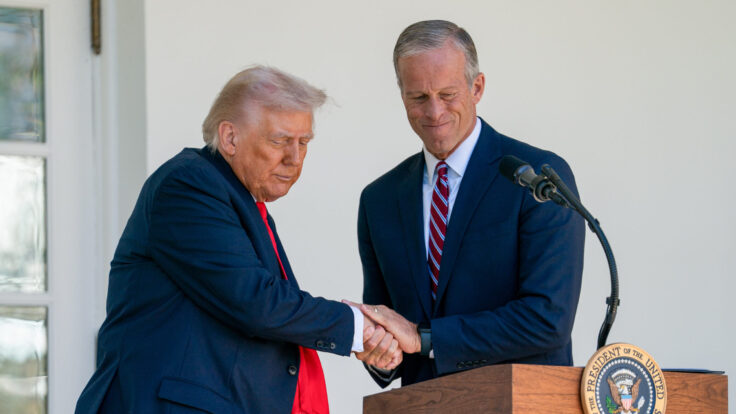
the SAVE Act be saved?: Under pressure from Trump and his conservative base, Senate Majority Leader John Thune is planning to spend the week—at least—debating, and eventually trying to pass, the SAVE America Act. Of course, Thune isn’t willing to eliminate the filibuster, nor even to placate the base by bringing back the so-called talking filibuster, which would take up weeks or even months of floor time and open up the process to unlimited amendments from
Democrats. (I wrote all about this dynamic earlier this year if you want to revisit the deets.)
But Thune will allow senators to debate the issue and have Republicans bring up amendments. If Sen. Mike Lee, who has been pushing this process internally, wants to stay up all night and talk about the SAVE America Act, so be it. Thune also
plans to ensure Democrats go on the record regarding all aspects of the bill, from voter ID to the requirement to show proof of citizenship in order to register to vote. He’s likely to push them even on eliminating mail-in ballots, a true Trump bugaboo.
Ultimately, this is all mostly a messaging exercise that does not result in changing voting laws—although Republican Sen. Ron Johnson told me that Thune should hold a vote on changing the filibuster rules after
the measure fails. “At least putting them on the record with a vote might carry a little bit more power to assure people,” he said. And Republicans will be able to campaign against Democrats for opposing voter ID. But either way, this pageantry seems unlikely to satisfy the president or Republican activists. Trump, for his part, will surely bemoan the bill's inevitable collapse as further evidence that elections are rigged, especially if the political environment remains unfavorable for
Republicans. After all, that’s what he’s done in every election that hasn’t gone his way since the Iowa caucuses in 2016. - Reconciled to no reconciliation: At last week’s Republican retreat, party leadership weighed whether or not to furnish another reconciliation bill—the party-line legislative maneuver that allowed them to pass the One Big Beautiful Bill last year. Speaker Mike Johnson was supportive. So was Budget Committee chair Jodey
Arrington. And yet there are major divisions within the conference.
Yes, Republicans need to rally around something as the midterms approach. The One Big Beautiful Bill continues to be unpopular, and moving another, more appealing piece of legislation would be politically prudent. But Republicans don’t even know what would go in such a bill—there’s no anchor policy, and trendy ideas change every day, from D.H.S. funding to the SAVE Act to the Iran supplemental. They’d
also have to pay for this thing one way or another. As one senior Republican aide told me, they’d “scraped the bottom of the barrel” to figure out how to pay for the OBBB.
Finally, and perhaps most consequentially, there’s simply not a lot of time. Republicans started planning for the OBBB, which passed last summer, before the 2024 elections. Also, the president isn’t engaged: He’s already said he doesn’t care about any legislation other than the SAVE Act. So while Johnson might support
his big bill about nothing—this sounds like a Seinfeld bit—the odds against it are enormous, and it risks dividing the party.
|
|
|
|
On Capitol Hill, Republicans are projecting a united front in support of Trump’s war. But
many of them fear rising gas prices in Peoria, not to mention dwindling munitions. And a number of them are trying to walk a line between supporting Trump and declaring mission accomplished. |
|
|
|
As the war in Iran enters its third week, Republicans on Capitol Hill have a slow-motion disaster playing out
on their hands: 13 U.S. soldiers have died, the Strait of Hormuz is effectively closed, rising gas prices have consumed the national narrative, and Trump’s quickie war appears nowhere near its conclusion. And yet most Republican lawmakers—even the ones representing swing districts—don’t quite see it that way. In fact, they are so supportive of the president’s war that it’s barely a topic of conversation in closed-door meetings. The Senate is fixated on voter ID laws, and the war
didn’t even come up during a closed-door, vent-anything Q&A sesh with leadership at the House Republican retreat at Doral. |
|
|
|
A MESSAGE FROM OUR SPONSOR |
Harmful corporate insurer practices are increasing healthcare costs and creating unnecessary barriers to care. Prior authorization delays,
coverage denials, and excessive administrative requirements slow treatment and drive-up expenses for patients and families. Reform is needed to ensure medical decisions are guided by doctors, not corporate red tape. Learn why curbing these practices is essential to lowering costs and protecting timely access to care. |
|
|
|
And while the country may be divided on the war, the core of Trump’s base isn’t. “The Republicans are still
holding on this—they’re still okay,” one G.O.P. strategist who works with swing-district House members told me, describing private polling of voters in those districts. That sentiment matches public polling, which suggests that Republicans, especially self-described MAGA voters—yes, those no-more-foreign-wars voters—are much more likely to support the war than the general public. A Reuters
poll found that 66 percent of Republicans cosigned the strikes; an earlier Fox News poll had that number as high as 84 percent. “Members trust the president on
this,” a senior Republican Hill aide told me.
Iran hawkism is, after all, a core feature of Republican DNA. Since the hostage crisis in 1979, which coincided with the rise of the Shia Islamic regime, hardline conservatives have advocated for defanging Iran, eliminating its nuclear ambitions, and retaliating for its proxy wars against the U.S. and Israel in Iraq, Syria, Yemen, and Lebanon. Yet no American president has been willing to strike the country, which is about four times the size
of Iraq and exerts almost total leverage over the Strait of Hormuz—a critical chokepoint for the world’s oil supply. The price of a barrel of oil is up about 50 percent in the last month.
But Republicans on the Hill prefer to discuss the war in a grander context. Kneecapping Iran, according to the war’s supporters, is essential for the broader geopolitical goals of weakening its allies, Russia and China. “I’ve urged colleagues and decision-makers in successive administrations not to
overlook the ways our adversaries’ threats to America’s interests are increasingly aligned,” Sen. Mitch McConnell said in a speech on the Senate floor this week. But one Democratic senator, who has attended classified briefings, said that even the administration has not gone there yet. Indeed, Iran is still managing to send oil to China, and the president has actually loosened sanctions against Russia—temporarily allowing India to buy Putin’s oil
again. |
Of course, beneath the surface-level consensus, things aren’t quite so hunky-dory. Despite their
support of the president, many Republicans are understandably nervous that wars don’t age well. Gas prices are often a leading indicator of the national mood, especially for suburban and rural voters. Republican senators are concerned about a dwindling munitions stockpile. And farm-state Republicans are worried about the cost of fertilizer, a large proportion of which also travels through the Strait of Hormuz. “This is really far-reaching,” Arkansas Republican Sen. John Boozman
told me. Sen. Kevin Cramer of North Dakota agreed that the war will “matter to the economic toll. It’ll matter to America’s patience.” But, he added, “We’re very impatient.”
Circumstances are yet more complicated for the noninterventionist Republicans, who are reluctant to criticize Trump but also have their own political brands on the line. Sen. Josh Hawley, for instance, pushed for “crushing” sanctions against Iran over its drone and missile attacks on
Israel during the Biden administration, but stopped short of advocating military confrontation. He’s loath to criticize Trump, but has also said that the war should be over. “I think we’ve met our objectives. This can come to a conclusion swiftly,” Hawley told me. His fellow Missouri Republican Eric Schmitt, who worried about the 2024 Iran–Israel conflict spiraling into a bigger Middle Eastern war, told me: “I don’t support a forever war in the Middle East, and
neither does the president.” |
|
|
|
In the past, presidents of both parties have spent weeks or even months building a public case for overseas
military action. But Trump never really brought the country along on the war with Iran. While the press reported on the military buildup in the weeks leading up to the attack, there was no outward messaging from the White House. Just four days before the U.S. began raining bombs and missiles on Iran, Trump spent only a few minutes on the subject during his State of the Union address.
Since then, the White House has worked overtime to keep Republicans on its side. Defense Secretary
Pete Hegseth has been holding near-daily superlative-filled briefings, invoking “no quarter, no mercy for our enemies,” and claiming “the U.S. is decimating the radical Iranian regime’s military in a way the world has never seen before,” etcetera. The White House has also been celebrating major military actions on social media, hyping up the warfighting in video-game-like animations, and posting typical wartime rally-around-the-flag images, but with direct messages to its base:
“No panicans!”—a reference to nervous Republicans.
Selling a prolonged war, however, cannot be managed on X or Instagram. Congress may not have greenlit this excursion, but it will be asked in coming weeks to dole out additional money to pay for it. That’s on top of the record-breaking infusion that the Defense Department already received during Trump’s first year, including the largest-ever annual appropriation—around $839 billion—and an additional $150 billion in the One Big Beautiful
Bill. That will add up to nearly $1 trillion this year.
Most Republicans are unlikely to deny the military any dollars it needs. Even Sen. Ron Johnson, a funding hawk, said that he is 100 percent supportive of additional resources for the Pentagon. “I would cut so many other things before I deny the president the resources he needs to try and end this evil regime,” Johnson told me. “Let’s take care of this once and for all.” But if the war becomes more unpopular, it could
be a politically harmful vote for Republicans. (It could also be a tough vote for Democrats.)
So even though Congress has been reluctant to rein in the president on a multitude of Article I powers—including tariffs, spending, and other military excursions—Trump could still find himself with an authorization problem down the line. If the Iran war escalates further, drags on, or requires foot soldiers, it could trigger another war powers vote. The War Powers Resolution of 1973 requires the
president to terminate hostilities within 60 days absent a congressional authorization for military force, with another 30-day grace period to withdraw thereafter. “They should be mindful of that,” Sen. Thom Tillis told me. |
|
|
|
Join Emmy Award-winning journalist Peter Hamby, along with the team of expert journalists at Puck, as they let you in on the
conversations insiders are having across the four corners of power in America: Wall Street, Washington, Silicon Valley, and Hollywood. Presented in partnership with Audacy, new episodes publish daily, Monday through Friday. |
|
|
|
Unique and privileged insight into the private conversations taking place inside boardrooms and corner offices up and down Wall
Street, relayed by best-selling author, journalist, and former M&A senior banker William D. Cohan. |
|
|
|
Need help? Review our
FAQ page or contact us for assistance. For brand partnerships, email ads@puck.news.
You received this email because you signed up to receive emails from Puck, or as part of your Puck account associated with {{customer.email}}. To stop receiving this newsletter and/or manage all your email preferences, click here.
|
Puck is published by Heat Media LLC. 107 Greenwich St., New York, NY 10006 |
|
|
|
|