 |
|
“I don’t think there’s anything that we can do.” That’s what someone told me the other day when I asked for the top-secret plan from rich Republicans to topple Donald Trump. Today, a dark story from my flurry of reporting calls to the Republican Party’s wealthiest donors: What if they are utterly powerless?
But first…
- Democratic mega-donor Reid Hoffman addressed the Biden age controversy in an email to his network last week, which naturally found its way to me. “I met with President Biden this week during his visit to the West Coast,” Hoffman wrote to “friends and allies” on November 17. “In speaking with him about global diplomacy, artificial intelligence, and domestic politics, I was reminded of another 80-something whom I got to know about a decade ago—a guy named Warren Buffett.” Hoffman continued: “When Warren was 83, he oversaw Berkshire Hathaway’s highest-ever quarterly profit, and the company reached a valuation of over $300 billion. Today, he is 93, still C.E.O., and the company is worth well north of $750 billion. In business and politics, some people reach their greatest achievements in their 80s and even 90s. Joe Biden has those qualities.”
The email, which included an ask that “friends and allies” donate money to political groups Hoffman has backed, also offered a challenge: “Normative judgments aside, we now can be nearly certain that the President in 2025 will be either Joe Biden or Donald Trump,” Hoffman wrote. “In that contest, each of you can make a difference by giving financial support directly or hosting fundraisers for these founders.”
|
 |
| The G.O.P. Megadonors Come to Jesus |
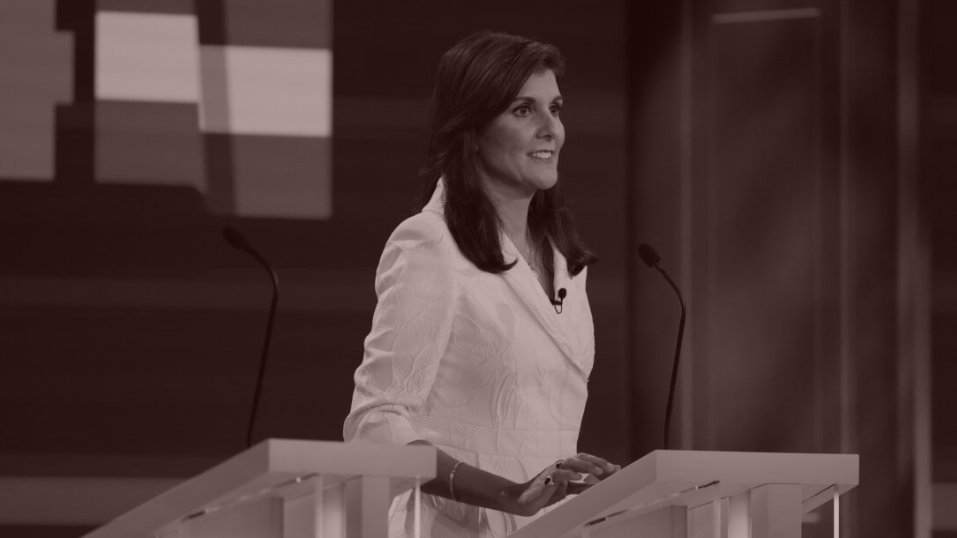
| Fear is growing within the Republican billionaire class that the party’s moneymen have lost any ability to elevate an alternative to Trump. Why would things be different for Nikki Haley? |
|
|
|
| When Ron DeSantis drove up from Chicago to Milwaukee two weeks ago for a fundraiser, he was sure to make a pit stop in the small town of Pleasant Prairie, Wisconsin. There, inside the corporate headquarters of their company, Uline, waited Dick and Liz Uihlein, the it-couple of hard-right conservative politics, and two of his biggest donors. The pair have been steadfast DeSantis supporters, and the get-together was organized by his super PAC, Never Back Down. The ask on the table, implicitly at least: Would the Uihleins be interested in making another contribution?
Meetings like this, never advertised, comprise the shadow campaign trail of presidential politics. And in 2024, that shadow campaign trail is a bleak place filled with fatalism, nihilism, and despondency. Most well-paid professional Republican donor-advisors and financiers acknowledge privately that there is very little chance of defeating Trump. The excuses come easily: Running against him is more like trying to primary an incumbent than to win an open contest; they’d be beating him if it weren’t for these politically motivated indictments; somebody—DeSantis, or Haley, definitely Chris Christie, hell anybody!—should drop out and help consolidate the field.
Typically left unsaid is the fact that the gap between the party’s financial class, the people I’m talking to, and its voters has never been starker, meaning that whatever the power brokers in River Oaks or at the Links Club believe should happen—or whomever they choose to blame for what is, in fact, happening—isn’t all that relevant. “Every major donor that we have met with has expressed a deep and dark depression that they think it’s going to be Trump,” one unaffiliated Republican fundraiser told me. I can report the same.
You could squint and argue that things are looking up for the anti-Trump movement, at least as up as they have been since DeSantis’s support began to crater last spring. After all, following months of concern about the non-credible Trump alternatives hanging around well past their sell-by date, both Tim Scott and Mike Pence recently dropped out. And big money is once again moving on the sidelines: On Tuesday morning, the Koch network endorsed Haley and said it would pivot its canvassing operation and paid-media campaign—up until now, solely anti-Trump—toward explicitly supporting her candidacy. If DeSantis likely peaked too early, Haley appears to be catching genuine, if relatively modest, momentum at just the right time.
Of course, the problem for Haley’s team is that DeSantis suddenly has a bit of reclaimed momentum. Haley’s argument to donors would be more convincing if DeSantis were hemorrhaging support, but he is not. His polling has bounced back, ever so slightly, over the past two months, and he began November by nabbing the support of Kim Reynolds, Iowa’s popular Republican governor, before securing the backing of Bob Vander Plaats, the state’s perceived evangelical kingmaker. He has his own momentum narrative, especially in Iowa.
Thus, the muddle persists: Anti-Trump Republican moneymen are trapped in a logjam, where both DeSantis and Haley are just viable enough to remain in the running, but not so competitive as to force the other one out. |
|
|
| Over the past few days, I chatted with 10 top G.O.P. donors and donor-advisers on Wall Street and in Silicon Valley to assess whether there is a working strategy at hand to break the logjam. Nobody had a convincing answer. Several who attended last month’s American Opportunity Alliance summit—a nerve center for the decentralized, socially moderate Wall Street crowd—told me they felt the get-together did not yield any real breakthrough.
DeSantis-sympathetic people felt Haley did not convince them she had a path to the nomination. Haley allies felt Jeff Roe and Never Back Down had messed up. (OK, plenty of DeSantis campaign donors feel that way, too.) The consensus—even before the Kochs’ announcement—is definitely that Haley is consolidating support, but also that none of it might matter.
On Wall Street, Ken Griffin said publicly this month that he is close to a decision on whether to boost Haley—the kind of thing you probably don’t say aloud if you’re not planning to do it, eventually. A former DeSantis supporter, Griffin has bristled at the governor’s positions on Disney, Ukraine, and abortion, as I’ve reported, but is he actually going to pull the trigger on a candidate who’s likely to lose? “If you’re Ken Griffin, and you’re going to spend that money, you’ve got to be certain that there’s a return at this point,” said one person who travels in his circles.
Griffin formed a one-two punch last year with Steve Schwarzman as the two G.O.P. megadonors willing to say out loud that the party needed to move on from Trump after the 2022 midterms. But Schwarzman has since been relatively quiet, and certainly less voluble than Griffin, and his silence—it has been over a year since he’s spoken publicly about his purported plans—has been noted by his peers. Some fundraisers expect him to instead just focus down-ballot. (A spokesperson didn’t return a request for comment.)
Also in the likely-Haley column, according to his peers, is Paul Singer, another hedge fund manager who appears to have had his fill of Trump. Although he hasn’t formally weighed in, his longtime aide Annie Dickerson has long raised money for Haley; and an upcoming blowout fundraiser for Haley in New York on Monday is co-hosted by top Elliott executive Terry Kassel and is being held at the home of former Meta executive Campbell Brown, who is part of a power couple with top Singer adviser Dan Senor. Those moves have been endlessly scrutinized (perhaps overly so) by Singer’s peers on Wall Street, as well as fellow Republicans who still reminisce about the moment on the fundraising calendar, in October 2015, when Singer notified his network that he’d be backing Marco Rubio. Singer hasn’t said anything publicly this time around, and a spokesman didn’t return a request for comment.
Then there is Jeffrey Yass, the billionaire hedge funder and TikTok investor who has backed what feels like the entire field. “He was anybody-but-Trump. That’s a big list,” said one person close to him and other major donors. “A lot of our bigger investors are—not satisfactorily—resolved that Trump is going to be the nominee.” |
|
|
| Meanwhile, over in Silicon Valley, support for Haley is emerging in some unexpected places. One major supporter, I’ve learned, is the Gen Z co-C.E.O. of pandemic darling GoPuff, Rafael Ilishayev, who was spotted at the most recent meeting of the American Opportunity Alliance in Dallas encouraging people to back Haley. Ilishayev, who hasn’t previously been much involved in politics, could be worth a billion dollars, on paper.
Another major Silicon Valley supporter of Nikki is WhatsApp co-founder Jan Koum, one of the world’s wealthiest people, who has taken a political turn over the past few years as he spends more of his fortune on Israel-related advocacy. Koum has grown close with Jon Lerner, Haley’s top adviser, and put $5 million into a pro-Haley super PAC earlier this year. A person who has talked politics with him said he is “absolutely a Republican” and has bonded with Haley over Israel, among other issues. “It’s the total package that she brings to the table—all the strengths of Trump without the Trump baggage,” said the Koum confidant.
Spotted by tipsters in the Haley section at the most recent debate were a few more Silicon Valley heavies, such as Keith Rabois, who recently jumped ship from DeSantis, and in the front row was Tim Draper, the Bitcoin-tie–wearing megadonor who has put over $1 million into the Haley super PAC and has been pitching her hard to his friends all year. “We should all do what we can,” Draper told me. “We need her.”
“There will be increased support for Nikki Haley from Silicon Valley donors now through the first few primaries,” argued Michael Robinson Byrd, a G.O.P. fundraiser who specializes in the Bay Area. “Between contribution limits and pay-to-play rules, DeSantis is tapped out on donor prospects for now. If Trump ends up becoming the nominee, a few donors will re-engage, but most will sit this presidential cycle.” Another person raising money for DeSantis there told me they were encountering “a lot of closed wallets,” noting there was barely any buzz even around his debate this week with Gavin Newsom. “The rest of us are playing with Tinker Toys underneath the table.”
Tim Scott megadonors Ben Navarro and Larry Ellison are considered unlikely to reprise their role as major backers of Haley. But a trio of Bay Area investors who had raised money for Scott—Frank Lavin, Alex Slusky and Greg Wendt—are now bundling for Haley, I’m told. Word is she’ll return to the Bay Area in February. If her campaign gets that far, of course. |
|
|
| Overhanging all this agita is the ghost of 2016. Many Republican moneymen told me they are fearful of repeating the mistakes of that fateful G.O.P. primary, when Trump clobbered each of his primary rivals in turn, in part because they never consolidated their support in time. The Koch network, now somewhat infamously, decided in the spring of 2016 not to throw its support behind a single challenger, falling prey to the sort of high-minded, short-sighted infighting that is endemic to complex organizations—not least organizations whose members are billionaires trying to merge their credit cards.
But there is another, less noble explanation, too. As I spoke to major G.O.P. donors and their advisers over the past few days, I also detected a desire among these business leaders to avoid a Trump vendetta like the one that confronted Singer—certainly during the primary campaign, but especially in the White House—if the nomination is indeed a foregone conclusion. So many titans of industry still speak fearfully, almost traumatically, about the first Trump era, and no one wants to waste their time and money on a campaign that is likely to get them nowhere but on Trump’s shit list. This time, unlike in 2016, at least they have fair warning. |
|
|
|
| FOUR STORIES WE’RE TALKING ABOUT |
 |
| Biden’s Woes |
| Why can’t POTUS sell the strong economy? |
| PETER HAMBY |
|
 |
| Saks Attack |
| On the Dior deal, Estée Lauder rumors, and more. |
| LAUREN SHERMAN |
|
 |
|
 |
|
|
|
|
|
 |
|
|
|
Need help? Review our FAQs
page or contact
us for assistance. For brand partnerships, email ads@puck.news.
|
|
You received this email because you signed up to receive emails from Puck, or as part of your Puck account associated with . To stop receiving this newsletter and/or manage all your email preferences, click here.
|
|
Puck is published by Heat Media LLC. 227 W 17th St New York, NY 10011.
|
|
|
|