Hello and welcome back to Dry Powder.
Thanks for being a part of Puck, our new media company covering the intersection of Wall Street, Washington, Silicon Valley, and Hollywood. And thanks for reading Dry Powder. If you're enjoying these private emails, consider sharing the subscription link with a friend.
On Thursday I'll be hosting an off-the-record event for Inner Circle members to discuss the extraordinary SPAC phenomenon: its rise, its peak, and its current decline. If you're interested in joining and have yet to upgrade your membership, contact fritz@puck.news to inquire about receiving the link.
Bill
SPONSORED BY 

An exploration into the latest B.S. post-crypto fiscal fantasy as investors embrace the economy’s late-stage-Covid consensual hallucination. You’d have to be living on Mars with Elon Musk not to have realized by now that most asset prices are historically overpriced: In addition to Tesla (worth more than $1 trillion even though it makes most of its profits from selling carbon credits, not electric cars), there are the famous meme stocks, such as GameStop, AMC and Hertz; there’s the publicly traded New Jersey deli (until very recently valued at more than $100 million; now still valued at a head-scratching $77 million); and of course Bitcoin, with a total value of more than $900 billion. That’s to say nothing of the many cryptocurrencies you’ve never heard of—Monero, anyone? Meanwhile, an NFT sold recently for more than $90 million and a ranch in Montana sold for $200 million to Rupert Murdoch, who is 90 years old. You get the idea.
Now, we may have reached the apex, leading some to wonder whether we have truly entered a collective late-Covid consensual tulip-craze. Enter: Olympus DAO, the progenitor of a crypto token that appeared on the market earlier this year and that bills itself as the world’s “decentralized reserve currency.” Olympus DAO currently claims to have a market value of around $2.7 billion, and has quickly become the vanguard of our WTF, YOLO, FOMO economy. “Yes, it’s a Ponzi scheme,” wrote Andrew Thurman recently on Coindesk.com, before hastening to add: “But who cares? So are the dollars in your pocket.”
In other words, according to the broad theory underpinning the rise of alternative currencies, fiat currencies are nothing more than a confidence game and central banks are inflating them like crazy, reducing their collective purchasing power, while our faith in institutions is waning rapidly. So, you know, the usual nonsense. “Both parties believe the other to be naive,” Thurman continued, “and watching each chide the other as callow is one of Crypto Twitter’s chief pleasures.”
ADVERTISEMENT 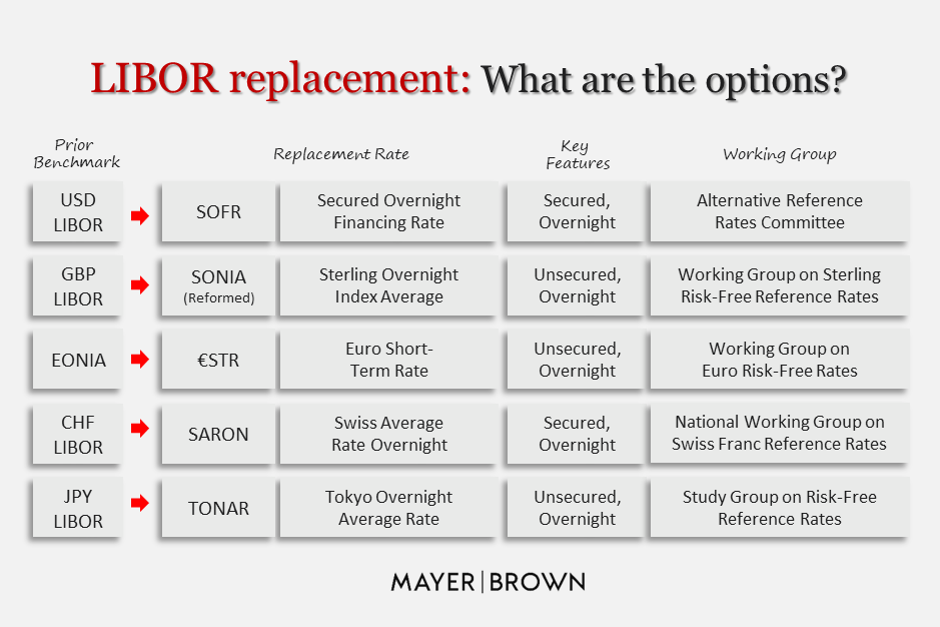
Synthetic LIBOR: Help on the way for some “Tough Legacy Contracts” While most USD-LIBOR settings cease mid-2023, other LIBOR settings finish at this year's end. Although there has been frantic conversion of existing contracts to new alternative reference rates, “tough legacy” contracts remain.
Synthetic LIBOR’s unveiling, facilitated by the UK’s Financial Services Act and the soon to be enacted Critical Benchmark (References and Administrators’ Liability) Bill, is providing some relief. The UK’s FCA is using its newly bestowed powers to designate 1, 3 and 6 month sterling and yen LIBOR settings as “critical benchmarks”, from January 1, 2022, and compel their continued publication under a modified methodology. These new Synthetic LIBOR settings, will follow Term SONIA Reference Rates (for sterling) and an adjusted “TORF” rate (for Japanese yen); plus the market standard ISDA spread.
Euro, Swiss franc, 1-week and 2-month US dollar and the remaining sterling and Japanese yen LIBOR settings will still cease as planned at year end though. Learn more.
A “DAO,” for the uninitiated, is a “decentralized autonomous organization,” with no central authority—unlike say JPMorgan Chase, where Jamie Dimon reigns—with decisions ostensibly made by the crowd and then memorialized on “the blockchain,” a digital public ledger maintained by its many users. For instance, the recently failed effort by a bunch of crypto fans to buy one of the original 13 copies of the U.S. Constitution, was a DAO. (Hedge fund billionaire Ken Griffin won the auction, paying $43.2 million, more than the $40 million the DAO crowd raised.) Another DAO, Krause House—named after the late Chicago Bulls general manager Jerry Krause, whose oversized ego led to the disassembling of the great Jordan-Pippen-Jackson dynasty—is trying to buy an NBA franchise. (It has a long way to go.)
In somewhat of a contradiction, though, the Olympus DAO does have “Zeus,” a pseudonymous moderator of an online forum who makes all sorts of Olympus DAO pronouncements and rulings. Zeus seems to be the central authority making suggestions and then the one urging the community to vote on his or her ideas. For instance, a month ago, Zeus announced, “I propose we rapidly bootstrap liquidity on other chains with 120k OHM (~$100m) through a cross-chain incentives program once gOHM is live next week.” (Whatever that means.)
When it comes to Olympus DAO, here’s my best Margot Robbie-in-the-bubble-bath explanation: On the Olympus DAO website, investors were recently being offered an irrational annual return of more than 7,000 percent on their purchase of an Olympus DAO token, known as OHMs, from the Olympus DAO treasury. (The returns offered to investors fluctuate daily; recently investors were offered an 8,000 percent annual return. Today they are being offered an annual return of 4,433 percent.) That should be the first warning sign to investors, but often isn’t, that investing in OHMs is extremely risky. By comparison, investors in junk-bonds (the riskiest corporate debt) are being offered these days a yield of 4.5 percent, or nowhere near 7,000 percent. Even Bernie Madoff limited his annual promises to investors to around 10 percent a year. Olympus DAO is way, way, way out on the crazy spectrum here.
On the other hand, there’s no better way to encourage investors to part with their money than to offer them an outrageous return. And we’re talking about an investment that is utterly and completely unregulated here, the Wild West of Finance. “Even a healthy skeptic has to give the OHMies credit for novelty,” as Thurman put it. “Money is simply a collectively shared delusion enabling economic exchange, the OHMies argue—so they went and invented a new kind of money,” now worth nearly $3 billion.
ADVERTISEMENT 
Not that it particularly matters what Wall Street thinks when it comes to cryptocurrencies. After all, disrupters are going to disrupt. But if Dimon is calling Bitcoin—the current king of cryptocurrencies—alternatively “dangerous” and “worthless,” it’s not hard to imagine what he thinks about OHM, if he’s even aware of it. It’s pure, wild ass speculation (and probably a Ponzi scheme to boot). On the other hand, Dimon and his troops have created a JPM Coin as a way for the bank’s clients to facilitate the movement of money internationally. Even the most staid investment banks are exploring the utility of blockchain technologies that might one day compete with their “TradFi” products.
There’s a catch to the Olympus DAO offer, of course. The returns are offered only in-kind, as in more OHMs, not in dollars, which would be far preferable, all things considered. It’s akin to the zero-coupon, payment-in-kind preferred stock that Wall Street sharpies cooked up in the 1980s. In other words, an investor forks over his or her dollars to buy an OHM—now trading for $382 per OHM—and in a year he or she gets back a cumulative total of (at the moment) 43 times more OHMs.
But it’s even more complicated than this, so stay with me here. To buy an OHM, you have to take your hard-earned dollars to a crypto exchange—say, Coinbase—and use those dollars to buy Ethereum, the second-most valuable crypto currency (current market value: almost $500 billion). Ethereum is “kind of like the gateway drug,” of cryptocurrencies, an Olympus DAO investor tells me, because you can use the Ethereum you just bought to do all sorts of other things in this rapidly advancing digital ecosystem. So you take your newly purchased Ethereum and do what’s known as “a sushi swap” (I am not making this up) on a decentralized (non Coinbase) exchange to buy something called DAI (what is known as a “stablecoin”) and then finally you swap your DAIs to get your OHMs.
Once you own your OHMs, the Olympus DAO promise is that at the end of the year, you’ll have in your OHM wallet 43 times more OHMs than you bought at the beginning of the year. Investors get paid their additional OHMs on a daily basis—twice a day, in fact—which encourages investors to hang in there and not sell. Pretty clever.
One more bit of OHM insanity. The geniuses behind Olympus DAO want to give the impression that your OHMs are not just vaporware but rather are actually secured by something supposedly valuable in the Olympus DAO “Treasury,” even though you can’t exchange your OHMs for what’s in the Treasury, as you used to be able to do when the dollar was pegged to gold and silver. Earlier this week, the Olympus DAO Treasury claimed to have assets worth some $710 million. But, on closer inspection, the “Treasury” is composed of five other cryptocurrencies, only one of which—Ethereum—anyone has ever heard of. The largest amount of cryptocurrency in the Olympus DAO Treasury is in our old friend DAI (there’s $390 million worth of that); followed by $162 million worth of Ethereum; $120 million of LUSD, a “stablecoin” pegged to the U.S. dollar; and $43 million of FRAX, another stablecoin. (There is also $781,000 worth of “Sushi” tokens in the Treasury, but never mind.) “It's risk upon risk, upon risk, upon risk,” the OHM investor confides. “The Treasury is at risk as well. The Treasury is at risk in a million different ways. It’s crazy.”
Another risk to OHMs is that they take investors on a roller-coaster ride of volatility. When the OHMs first started trading—as best as I can tell it was on March 23—the price per OHM was $384.40. A month later the price had increased more than four-fold, to $1,415 per OHM. A month after that, it had crashed to $165 per OHM. By October, the price per OHM was back up to around $1,330. Now, it’s back down again, to $382. So, of course, if you bought an OHM in October by forking over your $1,330 for some Ethereum and then going to the sushi mart to get your OHM, you’ve already lost, two months later, 71 percent of your investment. Of course, if you want, you can take comfort in knowing that during those two months you’ve accrued a bunch more OHMs in your wallet, which can offset, slightly, the absolute loss. With more OHMs out there, and in your wallet, the thinking is that you can make up for the price decrease. This logic is reflected in the overall market value of OHM, which reached its recent peak around Thanksgiving, at $4.4 billion, even though the high point on the price per OHM was a month earlier. Now, two weeks or so later, the OHM market value is $2.7 billion, a decline of 39 percent.
Thurman, over at Coindesk, tried to put the OHM phenomenon into some perspective. “Doubters sneer and say it’s doomed to collapse—blockchain’s equivalent of a high-yield investment program scheme,” he continued. “Believers, meanwhile, rest easy with the smug confidence derived from working at the bleeding edge of DeFi—a widely maligned and misunderstood sector that’s nonetheless ballooned to $250 billion in total value locked, the equivalent of a mid-sized American bank.”
He managed to find Zeus and to interview him. “At the bare minimum, this is one of the most interesting economic experiments in recent history,” Zeus explained to Thurman. “That’s honestly the angle that Olympus started with, modeling this and saying, ‘This looks insane,’ and then finding out what it looks like in the real world.” He added, with a laugh, “There’s a good bit of that in central banking, as well.” While claiming to understand somewhat the promise of OHM, Thurman remained skeptical. “The OHMies are a bunch of pseudo-anonymous anime women avatars in a Discord channel,” he wrote. “The idea these basement-dwelling dorks can will a new form of money into existence is ludicrous. Anyone who holds this belief should be mocked and pitied, for they are a silly frog shortly to be disabused of their delusions of grandeur.”
The Brooklyn-based OHM investor that I know also views OHM as a Ponzi scheme. And, yet, he still bought in. He’s down some 20 percent since he invested in OHM about a month ago. He also realizes that the only way he gets out of his OHM is if he finds a greater fool to come along and buy it from him, hopefully after the roller coaster goes back up again. He does take some comfort from the fact that the decline in the value of OHM since he bought it is offset by getting in his wallet more OHM on a daily basis, just like I suppose Americans take some comfort that while a gallon of gas costs much more than it used, at least your house, or your stocks, are more valuable too. “You look at the insane upside and essentially you assume you’re early enough that someone else will come in after you,” he texted me. “Totally irrational stuff but you justify it to yourself. I’ve seen people build out these complex models to try and predict how this thing works, but there are way too many moving pieces.”
In the FOMO economy, of course, the complexity of getting ahold of an OHM is part of its appeal. “It’s not trivial to execute,” my investor friend continued, “so there’s a sense of accomplishment after you’ve done lighting your money on fire. Maybe that’s part of the allure of this side of crypto—you feel like you’re in on something.” He added that while some of what goes on in DeFi has the potential to change the world, most people don’t care about that. “They’re just betting the price will go up,” he concluded. “Fundamentally that’s not so different from a stock or a piece of real estate.”
FOUR STORIES WE'RE TALKING ABOUT 
Marvel has been so successful for so long, begging the question: if we've reached Peak Marvel, how is Kevin Feige using his power? MATT BELLONI 
In a wide-ranging interview, Huma Abedin talks candidly about Hillary, Weiner, the Laptop, more Hillary, and Kamala. PETER HAMBY 
The recall election of Chesa Boudin is pitting tech’s billionaires against one another—and forcing the city to look itself in the mirror. TEDDY SCHLEIFER 
Who comes out on top as Vox Media merges with Group Nine, going head-to-head with BuzzFeed's SPAC-assisted roll-up empire? DYLAN BYERS 
You received this message because you signed up to receive emails from Puck.
Was this email forwarded to you?
Sent to {{customer.email}}
Puck is published by Heat Media LLC.
For support, just reply to this e-mail. For brand partnerships, email ads@puck.news |


SHARE