 |
|
Welcome back to The Best & The Brightest, I’m Abby Livingston, filling in for Peter Hamby.
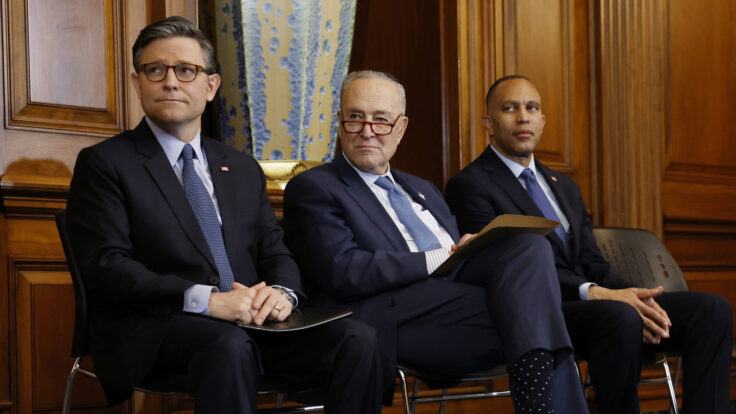
Tonight, here’s what I’m hearing about the reckoning in the Senate as the border deal negotiated by James Lankford, Chris Murphy, and Kyrsten Sinema, among others, hit shaky ground. For Mitch McConnell, who pushed this bill until the eleventh hour, there’s no going home again. But in truth, the immigration talks were dead long before Mike Johnson and Donald Trump declared them “D.O.A.”
Also in tonight’s jam-packed edition, we’ve got updates from Teddy Schleifer on Haley’s fundraising velocity, and Dylan Byers on the latest deck-chair rearrangements at CNN. Let’s get started.
First, here’s Teddy with a 2024 fundraising update…
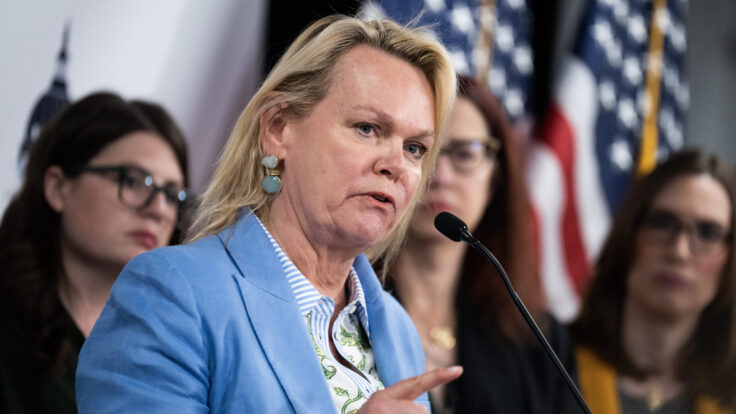
- The Cliff Asness theory: Nikki Haley raised an extraordinary amount of money in January: $16.6 million (or about $535,000 a day), her campaign disclosed this afternoon. That’s just shy of what she brought in during the entire fourth quarter of last year. Mercifully, we’ve entered the on-year of an election cycle, which means we can look forward to filings from campaigns every month, rather than having to belatedly learn about newsworthy developments from months prior.
Haley seems to have decent traction with low-dollar givers, who are flocking to her without the catalyst of a news-driven digital fundraising bonanza, like a debate win. Of course, she still has the favor of most of the major-donor class, who are fêting her at 17 high-dollar events through the South Carolina primary on February 24. The circuit begins in California, with events tomorrow in San Francisco and Atherton, hosted by the likes of Tim Draper (who has put $3 million into her super PAC) and Silicon Valley power lawyer Larry Sonsini; on Wednesday, she’s in L.A. and Orange County for two more fundraisers.
If Haley drops out, as today’s news reminds us, it will not be for lack of cash. Of course, whether any of that matters is the question of our time. I’m still thinking about a stray comment from Cliff Asness, a megadonor who recently hosted her for an event in New York. “It was venture capital,” he posted on Twitter/X, justifying the expenditure. “High probability of waste, small probability of saving the country. I don’t think it was a zero probability.” —Teddy Schleifer
|
| And now, Dylan Byers with a bit of CNN kremlinology… |
|
|
| On Monday, CNN chairman and C.E.O. Mark Thompson informed staff that he had decided to “reshape” the network’s morning lineup. This was Thompson’s first programming overhaul since taking the helm four months ago, and at first glance it seemed unremarkable: yet another rearranging of the network’s deck chairs, in which one anchor adds an additional hour, another moves from weekends to weekdays, a few others are gently shoved aside, etcetera. In fact, however, this move was more significant—it was a defiant declaration by Thompson that he no longer cares to compete in a world of diminishing returns.
For more than a decade now, CNN has tried in fits and starts to mount a response to the friendly morning banter shows like Today, GMA, Fox & Friends, and Morning Joe. Indeed, both Jeff Zucker and Chris Licht had come to fame as morning show producers—Zucker at Today, Licht at Morning Joe—and both made mornings a key piece of their linear strategies at CNN. Alas, success was always elusive. Zucker came closest to some semblance of it with the Chris Cuomo-Alisyn Camerota iteration of New Day; Licht’s attempt to pair Don Lemon and Kaitlan Collins failed spectacularly, audibly, and memorably.
To his credit, Thompson seems to have recognized the obvious: No one makes a habit of watching dull and earnest CNN personalities engage in faux banter over coffee. If they come to CNN in that hour, they come for breaking news. He is therefore abandoning that arena altogether: CNN This Morning, which is currently hosted by Poppy Harlow and Phil Mattingly, and draws a mere 300,000 or so viewers, will disband, and the anchors will be given new, yet-to-be-determined roles elsewhere. Kasie Hunt’s 5 a.m. show will inherit the CTM name and run for two hours, after which she’ll hand off to the Dunder Mifflin-esque CNN News Central, anchored by John Berman, Kate Bolduan, and Sara Sidner. Perhaps the most interesting and unexpected news here for CNN kremlinologists is that Jim Acosta, who survived the purge of anti-Trump chest-thumpers and quietly bided his time in weekends, will now anchor weekdays at 10 a.m. Pamela Brown will anchor at 11 a.m.
In effect, CNN mornings will now consist of signatureless, straightforward news digests, cheaper to produce and more or less indistinguishable hour to hour—a strategy whose low-wattage seems to be the point. Thompson has made it abundantly clear that linear television is no longer CNN’s primary theater, and that the company’s future instead depends on better engaging audiences on mobile and streaming. In the process, he is refashioning the linear product in the milquetoast mold of the BBC, where he once served as director-general. And, notably, Thompson will move production for all of these shows back to Atlanta—a cost-saving measure designed to maintain advertising revenue on the lowest possible cost structure. The New York-based production teams will be invited to reapply for new roles at the network, though presumably some will end up without them. “I’m very aware that today’s announcement means a great deal of uncertainty for many valued colleagues,” Thompson wrote in his memo. “Change and uncertainty are inevitable in an industry undergoing a revolution, but we must never underestimate the human consequences that come in their wake.”
Indeed, for many TV veterans, Thompson’s move only stokes long-simmering anxieties about the network’s diminishing stature. “This feels like a retrenchment,” one veteran CNN producer told me, “a return to the old CNN of the ’80s and ’90s.” And yet, that assessment probably underestimates the real significance of Thompson’s pivot. In fact, he is retreating from the linear ambitions that have driven CNN since its inception.
The challenge, of course, is that retreat itself is not a strategy. Television still makes a lot of money, and that money will be extremely hard to replace with digital ads and subscription revenue. (Virginia Moseley, CNN’s executive editor, had dinner with Times C.E.O. Meredith Kopit Levien last week, I’m told; presumably this came up.) The business itself is contracting, and until new revenue materializes, there will need to be more cuts. Indeed, there is growing speculation inside CNN that the company may even need to relocate from Hudson Yards to save money.
Regardless, the Thompson Plan—previewed in a Jerry Maguire-style mission statement a few weeks ago—is now coming to fruition. And as Alex MacCallum joins the organization next month, many expect that this morning linear shake-up is merely the first new wrinkle. Thompson has David Zaslav’s full confidence to instill his vision, whatever it may be. After all, if he can’t reorient CNN toward its post-cable future, who can? —Dylan Byers |
 |
| The Circus on the Hill |
| News, notes, observations, and horrors surrounding the latest machinations on Capitol Hill. |
|
|
|
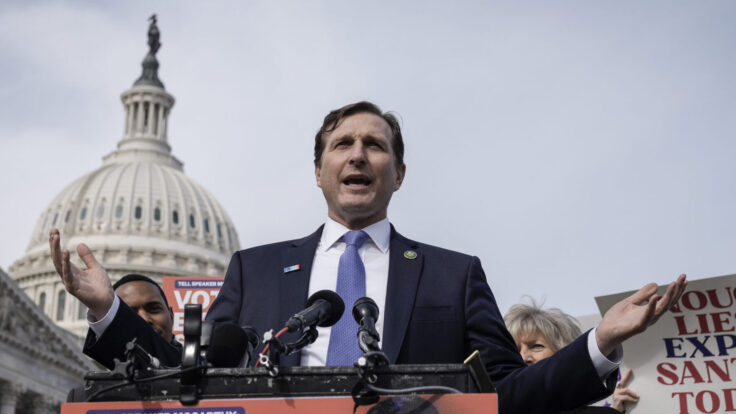
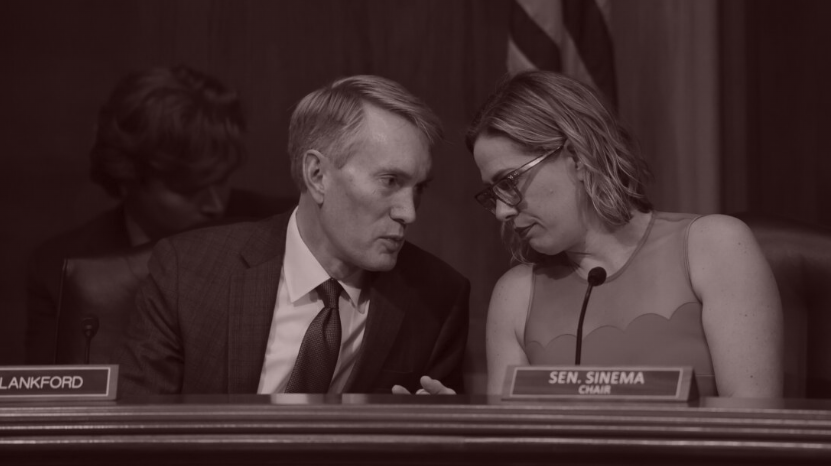
| Even as the House has become more unruly and chaotic over the past 15 years, it was always easy to cross the Rotunda, walk past the Old Supreme Court chamber, and suddenly step back in time to an era where politicians still bragged about bipartisan friendships and joining various “gangs” to cut great big, ambitious bills. That consensual hallucination seemed to evaporate on Monday, as a bill negotiated by three of the chamber’s best dealmakers—Republican James Lankford, Democrat Chris Murphy, and independent Kyrsten Sinema—ran into the buzzsaw of House Republican politics.
On Sunday, the three senators released the text of a bill addressing multiple third rails of American politics—a conservative proposal to tighten U.S. border security, combined with a package of foreign aid to Ukraine (despised by the far right), and additional military support for Israel (despised by the far left)—perhaps relying on a sort of old-school triangulation game theory that could lubricate its passage. What if everyone got something they wanted? How quaint.
The backlash was predictably swift, with Lankford taking the brunt of the onslaught. House leadership declared it D.O.A., but what might actually kill this bill in the cradle is how quickly several key Senate Republicans turned their heels. Two of “the Johns,” John Cornyn and John Thune, declined to endorse the bill on Monday, while Katie Britt and Steve Daines outright opposed it. All are members of Senate G.O.P. leadership.
Alas, the traditional Senate approach to negotiating—focusing on compromise by bundling legislation to placate multiple constituencies—doesn’t actually fly with a Trumpified House. For far right Republicans, at least, it’s easier to vote no on everything—even long-coveted, objectively conservative concessions on immigration—than compromise on anything. Now, official Washington is more terrified than ever that Capitol Hill won’t get its act together and vote to continue funding the war in Ukraine. After all, Trump is against it, as are enough Republicans to keep it from a vote. Democrats are mostly united on the issue, but pro-Ukraine Republicans grow quieter by the day. The expectation is that pro-Trump Republicans will revolt if Ukraine funding somehow hits the floor. |
|
|
| In December, Senate Republicans, many of whom still back Ukraine, picked up on Democratic anxiety over funding for the country’s continued defense against Russia, and offered to work out a deal that tied such funding to a border bill. This was obviously always going to be fraught. Immigration reform has divided the Hill for decades. When I first moved to Washington in 2006, the Senate was engulfed in negotiations on a far more liberal immigration bill that turned Republicans against George W. Bush. Illegal immigration predated the Wall Street bailout, the A.C.A, Obama, and Covid as the issue that most agitated the Republican Party’s populist wing.
With the logic that border security, funding for Ukraine, and also Israel all fall under a policy umbrella of national security, the bill is now public. The next two days will involve an intense whipping operation on the Senate side. Those involved will take a “middle-out approach” that will go after moderates and build toward 60 votes. (Democrats anticipate losing a handful of votes.) The Senate is expected to hold a procedural vote Wednesday evening that will reveal whether the negotiators can meet the 60-vote threshold.
There are open questions all over the Hill about whether that vote will come to pass—Senate Democratic sources had previously told me it’s on track—but regardless, there is no reason to doubt the House G.O.P. leadership will back down. Certainly, there is some hope that movement in the Senate will at least force a broader conversation. “Today was a necessary day to start the pressure campaign for Republicans,” a Senate Democratic leadership aide told me. “Now they’re actually going to have to talk about this, and not just in an offensive way. A solution is before them.”
And yet, I couldn’t find a House Republican constituency for this bill in a round of calls today. The Ukraine hawks were mum. I’m told the timing couldn’t be worse to reach out to House Republican pragmatists who might be inclined to back an immigration bill. We are still very much in candidate filing and primary season, so Republicans who might be vulnerable in the general are currently more worried about their primaries—where immigration has long been the most potent issue. |
|
|
| Supporters of the bill anticipated pushback, but the velocity was still stunning. Many observers couldn’t believe how many Republicans came out against the bill instantly without even pretending to take the appropriate amount of time to read it. Democrats also have a problem on their hands, as some sources from the Congressional Hispanic Caucus have been watching the negotiations with growing hostility. The caucus has a meeting tonight where the topic will surely be discussed.
Democrats know that the border crisis will hurt them in the House and Senate races, particularly in the New York metropolitan region. But over the last two weeks, I’ve watched operatives grow more confident that House Republicans have handed them an antidote to their vulnerability—their party, after all, has offered up the most conservative, bipartisan border security bill anyone can remember, and the Republicans can’t take yes for an answer? That’s a TV ad for the Hudson Valley’s competitive districts. “I do think House Republicans are underestimating how easy it will be to point out that this bill does the stuff they asked for and they suddenly opposed it because Trump wanted to deny Biden a victory,” Sen. Brian Schatz tweeted. “It’s quite easy to explain in the suburbs.”
When I posed this notion to Republican strategists, they mostly shrugged. In their perspective, voters know where Republicans stand on the border, and the party’s branding will withstand that argument. If anything, Republicans seem more confident than a few months ago that they will hold the House, citing Biden’s ongoing polling struggles. But what does worry some Republican consultants is an attack on a “do-nothing” Congress, like the campaign Harry S. Truman successfully waged against House Republicans in 1948. It’s an argument that Democrats already seemed primed to make, even before this episode.
There are major consequences to not passing a bill that go well beyond Washington. But one of the more immediate ones will be a loss of confidence on the Hill among the institutionalists. “If that [bill] fails, it will be a very, very sad mark on today’s politics in Congress more than anything,” said a Senate staffer who’s plugged into the negotiations. |
|
|
|
| FOUR STORIES WE’RE TALKING ABOUT |
 |
| Capitalist Tools |
| Digging into Forbes’ finances as it re-enters auction mode. |
| DYLAN BYERS |
|
 |
| Nowhere to Ronna |
| A dispatch from the R.N.C.’s winter gathering in Vegas. |
| TARA PALMERI |
|
 |
|
 |
|
|
|

|
 |
|
|
|
Need help? Review our FAQs
page or contact
us for assistance. For brand partnerships, email ads@puck.news.
|
|
You received this email because you signed up to receive emails from Puck, or as part of your Puck account associated with . To stop receiving this newsletter and/or manage all your email preferences, click here.
|
|
Puck is published by Heat Media LLC. 227 W 17th St New York, NY 10011.
|
|
|
|