| WELCOME BACK!
|
|
You’re receiving a complimentary version of The Hidden Layer as a welcome gift to new readers.
Start a free 14-day trial to unlock unlimited access to Puck. |
|
|
Welcome to The Hidden Layer, my brand-new, twice-weekly private email devoted to the often
complex, sometimes nerve-racking, and always fascinating world of artificial intelligence. I’m Ian Krietzberg.
Thanks to everyone who’s already signed up to become part of this community. I want to hear from you! If you’ve got questions, suggestions, tips, or anything you want to get off your chest, just reply to this email. Or message me on Signal at 732-804-1223. (And if you’re not yet subscribed to Puck,
click here to change that.)
In today’s inaugural issue: how the A.I. industry lost out in the One Big Beautiful Bill, and why New York is the next front in the regulatory war. Plus, the trouble with CoreWeave’s new acquisition, Elon Musk’s permit problem, OpenAI’s hallucination rate, and Euro tech’s fight to “stop the clock” on the A.I.
Act.
Also discussed in this issue: Thomas Regnier, xAI, Trump, Adam Thierer, David Sacks, Meta, Marsha Blackburn, the ELVIS Act, Kathy Hochul, Gavin Newsom, Camille Carlton, Hamid Ekbia, Gabriel Weil, Andrew Gounardes, Alex Bores, and many more…
Let’s get
started…
|
Deal of the Week:
CoreWeave?
|
On Monday, A.I. cloud provider CoreWeave
announced plans to acquire the data center infrastructure company Core Scientific in an all-stock transaction that values the combined entity at $9 billion. It’s a banner number, but the deal also demonstrates a hard truth about the market: Despite the explosive demand for A.I., the business of building and operating data
centers is extremely challenging. Three brokerage firms downgraded CoreWeave’s stock this morning.
Core Scientific, which initially focused on providing data center infrastructure for crypto miners, noted in the announcement that a majority of its revenue comes from its own digital mining operation. And even though
CoreWeave’s stock has just about quadrupled since its I.P.O. in March, the company has $1.5 billion in debt. According to its S-1 filing, CoreWeave made $229 million in revenue but netted more than $500 million in losses in 2023. In 2024, revenue surged to $1.9 billion, but net losses widened to $863 million. Making matters worse,
CoreWeave is highly dependent on a small number of large customers: Microsoft, its biggest client, accounted for more than 60 percent of its business in 2024.
CoreWeave may be turning things around thanks to a pair of big, post-I.P.O. deals with OpenAI and IBM, which drove a 420 percent surge in first-quarter
revenue this year. (Net losses rose 143 percent…) Of course, the real service that A.I. cloud companies provide is risk mitigation. Data centers are massively capital intensive, and the hundreds of thousands of chips that CoreWeave has purchased could become obsolete at any moment. As the industry’s biggest players know, it’s better to rent some computing power than to build it all yourself. |
Hallucination of the
Week
|
According to a Reddit thread, a woman lamented that her husband of 10 years
wants an open marriage so he can “take the next step” with his A.I. girlfriend. Love is a many-splendored thing, I suppose…
Now, let’s separate the science from the fearmongering… |
Three Things You
Should Know
|
-
Is the A.G.I. in the room with us right now?: Two or so years ago, there was an impression in the industry that so-called L.L.M. hallucinations would eventually go away, at which point the A.I. revolution that Wall Street’s been betting on would begin in earnest. But the phenomenon of generative A.I. chatbots spitting out fabricated or nonsensical outputs hasn’t gone away. In fact, it may actually be getting worse.
In a 2024
study, a group of researchers attempting to quantify the problem for medical use cases identified a hallucination rate of 39.6 percent for GPT-3.5 and 28.6 percent for GPT-4. More recently, however, in OpenAI’s system
card for its newer reasoning models, o3 and o4-mini, the company reported hallucination rates of 33 and 48 percent, respectively—or 51 and 79 percent, depending on the dataset it was evaluated on. (The papers use different methodologies, but the findings are notable nonetheless.)
That’s not entirely surprising. Luciano Floridi, the founding director of Yale’s Digital Ethics Center, recently
proposed that “as A.I. systems’ scope grows to cover complex, unstructured domains and corresponding powerful applications, perfect certainty about the reliability of their results becomes unattainable. No system can escape this trade-off.” In other words, while the goal for generative A.I. is to accurately handle real-world complexity, that complexity is the very thing that
reduces current models’ ability to be accurate.
Indeed, evidence is compounding that every L.L.M. output is, by the nature of its architecture, a hallucination. It’s just that, statistically speaking, a majority of those hallucinations happen to be accurate. But they’re never going away, at least with current technologies. In fact, the very methods that reduce
hallucination—the introduction of deterministic rules and guardrails, and the grounding of systems on smaller, specific datasets—contradict the non-deterministic ideal of generative A.I.
As two NASA safety engineers recently wrote: “By design, an L.L.M. is not concerned with producing true text, but rather text that is similar to the training
data. It has no capacity to evaluate its selections for veracity, only to replicate the patterns observed during training. Because of this, L.L.M.s produce both true and false texts with indifference and equal confidence.” - The hidden colossus: Last July, Elon Musk was praised for getting his “Colossus” data center online in such a short span of time—allowing xAI, whose Grok chatbot is now an inescapable presence on X, to catch up to
its competitors across a number of industry benchmarks. But it wasn’t until this July that the company finally received permits from the Shelby County Health Department to operate some, but not all, of the gas turbines that power the energy-hungry supercomputer. The permits cover only 15 turbines; recent satellite images showed 35
turbines on site.
Partial credit to Elon for almost playing by the rules. But what’s going on here exemplifies the recent concerns among researchers about the mounting public health burden tied to the expansion of data centers in “economically disadvantaged communities.” (They’re not building these things in Atherton.) According to the
Southern Environmental Law Center, gas turbines emit a combination of pollutants and chemicals, including formaldehyde. Boxtown, the predominantly Black neighborhood nearby, already suffers from severe industrial pollution. - Europe’s A.I. guardrails: David Sacks
may not have gotten his way with the A.I. regulation ban that got stripped out of the One Big Beautiful Bill, but at least Washington isn’t Brussels. As the European Union’s landmark A.I. Act begins to take effect, a coalition of tech companies across the continent, including Mistral and ElevenLabs, are urging regulators to delay enforcement for two years, lest they prevent Europe from unlocking its
“full potential in A.I.”
A spokesperson for the European Commission, Thomas Regnier, acknowledged the concerns but confirmed that the legislation will not be paused. “We take the concerns raised by the A.I. community and industry extremely seriously. And we will address what we can address,” he said. “But a legal text is a legal
text. Legal deadlines are legal deadlines.” Regnier added that the Commission’s goal is still to turn Europe into an “A.I. continent.”
|
And speaking of the Big Beautiful Bill’s A.I. moratorium… |
|
|
You’re receiving a complimentary version of The Hidden Layer at {{customer.email}} as a welcome
gift to new readers. For full access to Puck, and to each of my colleagues, subscribe today. |
|
|
Yes, the state regulatory ban was suddenly stripped out of Trump’s signature bill, but the
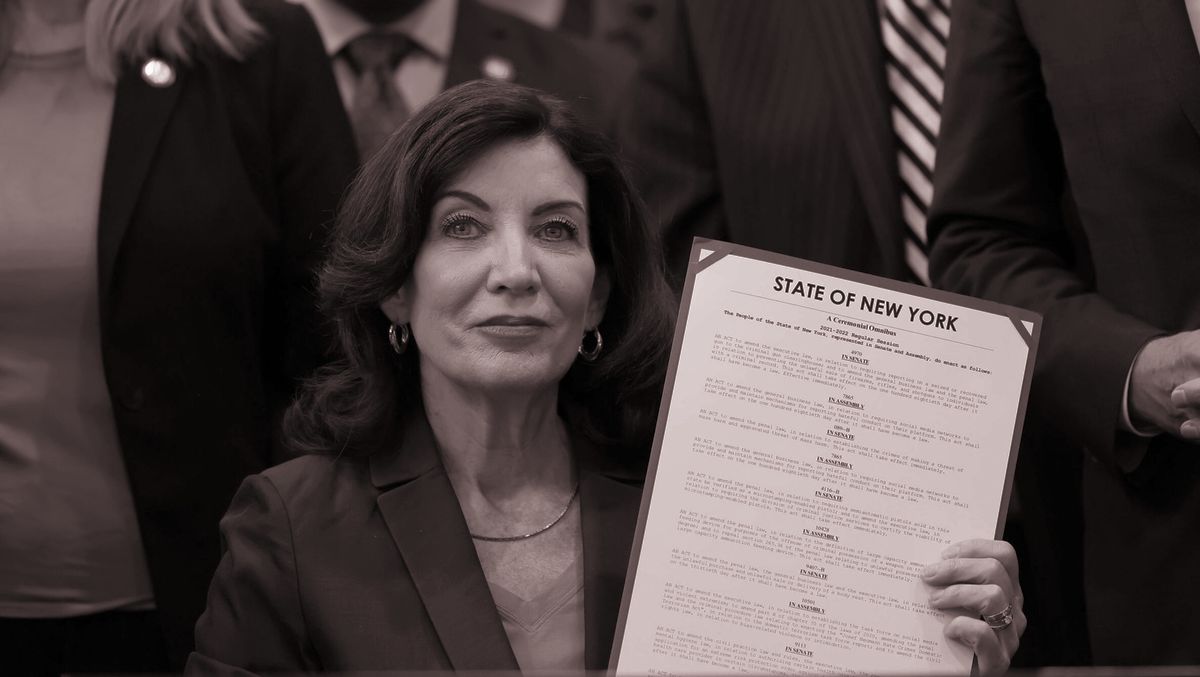
A.I. industry and its army of lobbyists won’t let the hallmark technology of our time be regulated without their perspective. Which is why everyone is paying attention to a bill currently sitting on Governor Kathy Hochul’s desk. |
|
|
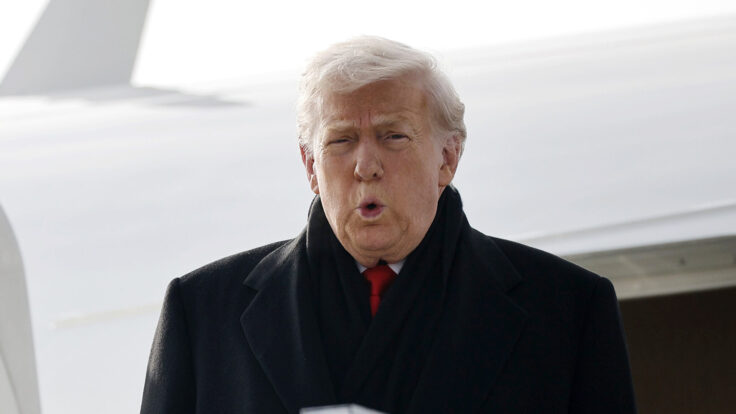
Last week, after a tumultuous few days, a provision in Trump’s sprawling, 900-page Big
Beautiful Bill Act barring states from regulating A.I. for the next five to 10 years was stripped out. The yanking of the so-called A.I. moratorium was, to put it mildly, a shocking twist—not least because its removal was supported by 99 senators. Adam Thierer, the think tank analyst who first proposed a federal
moratorium on state A.I. laws, called the volte-face a “major turning point in U.S. technology policy.”
In the end, it wasn’t just the bill’s hardline language that scared off a handful of Republican senators, namely Tennessee’s Marsha
Blackburn. It was also, according to several sources, the fact that there wasn’t a parallel effort to propose a national A.I. policy. Negotiators reduced the decade-long moratorium to a five-year pause, but even that was too much for Blackburn. “The current language is not acceptable to those who need these protections the most,” she said in a statement. “Until Congress passes federally preemptive legislation like the Kids Online Safety Act and an online privacy framework, we
can’t block states from making laws that protect their citizens.”
It’s obviously a disappointment for the industry’s boosters, like White House A.I. czar David Sacks. For the past two years, tech companies and lobbyists have waged a veritable crusade to convince policymakers that we can’t afford a state-by-state A.I. regulatory regime, or else our descendants will be learning Mandarin from Chinese L.L.M.s. In Meta’s public policy
proposal for the Trump administration’s pending A.I. Action Plan, the company calls explicitly for a federal preemption of state laws, since a “patchwork of state laws … will hamper American A.I. innovation.” OpenAI’s
proposal, Google’s proposal, Amazon’s
proposal, and a16z’s proposal all make similar arguments.
And yet, the public has remained pretty consistently skeptical: A 2023
YouGov poll found that 72 percent of Americans supported at least some form of A.I. regulation; more recently, a 2025 Pew Research
poll found that 58 percent of Americans were more concerned about too few A.I. regulations than too many.
In my conversations surrounding the last-minute changes to the Big Beautiful Bill, the prevailing sentiment was that the Senate had finally grasped the scale of the problem. “I think there was this realization that we can have both: We can continue to innovate, and we can have safety,” Camille Carlton, the policy director at the Center for Humane Technology,
told me. “And if the federal government wants to move forward with some sort of preemption regime, they need to step up and say, This is the law that we are going to pass that will be tied to preemption, instead of having nothing in place.” Dr. Hamid Ekbia, the director of Syracuse University’s Autonomous Systems Policy Institute, told me that the reversal demonstrated that, even in polarized times, “sanity can prevail—so that’s a good sign.”
But for how
long can it prevail against this sort of dough? In the first quarter of this year, Meta spent nearly $8 million on lobbying efforts—more than in the first quarter of 2024, according to OpenSecrets; Alphabet
spent $3.8 million, also more than it spent in the first quarter of last year; a16z spent $650,000, more than double its first-quarter spending last year; and OpenAI, after
spending $1.7 million in lobbying efforts in 2024, spent $560,000 in the first quarter of this year alone. Of course, this doesn’t count the millions in lobbying dollars spent this year by tech advocacy groups that represent many of these companies, including
TechNet and the Consumer Technology Association. The former pushed
for a “single national policy” on A.I., while the latter urged congressional leaders to “preserve” the moratorium.
In other words, the fight against state regulation is hardly over. Alix Fraser, the vice president of advocacy at Issue One, a political reform group,
warned last week that “Big Tech will try to push back against this victory. They will try to pad the pockets of every politician, and pull every lever in their power to bring this 10-year ban back.” Meanwhile, Sen. Ted Cruz and Rep. Brett Guthrie have
expressed support for the idea of a standalone A.I. moratorium bill.
Neither Meta, Amazon, OpenAI, IBM, nor Anthropic responded to requests for comment regarding either the death of the moratorium or their respective efforts to preserve it—although it’s worth noting that Anthropic C.E.O. Dario
Amodei has argued against a 10-year moratorium. In an emailed statement, Microsoft director of public affairs Kaitlin Haskins told me that “Microsoft did not support a full moratorium, but did lobby for a compromise that preserved the rights of states to regulate certain areas, including protecting consumers from the use of
A.I. in fraud.” A Google spokesperson pointed me to a May tweet in which it called the moratorium an “important first step to both protect national security and ensure continued American A.I. leadership.” |
Another view, offered by Gabriel Weil, a senior fellow at the Institute for Law and A.I., is
that the reversal aligns with a long-held tradition of allowing state-level experimentation to filter into, and eventually inform, federal law. “This is just a decision not to cut off that process,” he told me. Indeed, much of the state-level A.I. legislation that we’ve seen so far is relatively narrow: Tennessee’s ELVIS
Act, for instance, simply updates the state’s personal rights laws to protect artists from A.I.-generated mimicry. And while a few states have aimed a little higher, some have gotten singed in the process. Last year, California nearly enacted an infamous piece of legislation called SB 1047, which aimed to prevent “catastrophic harms” by regulating frontier models. It faced a crushing wave of lobbying from the tech industry before Gov. Gavin Newsom decided not to
sign it into law.
Now, the front line has moved to New York. In June, State Senator Andrew Gounardes and Assemblyman Alex Bores shepherded the Responsible A.I. Safety and Education (RAISE) Act through the legislature, partly building on SB 1047 while addressing some of its main critiques. For starters, RAISE applies only to
companies that spend more than $100 million to train their models, and requires transparency around safety, security, and risk-evaluation reporting, in addition to incident reporting. It also affords the New York attorney general the power to impose civil penalties of up to $30 million for violations. The bill now sits on Kathy Hochul’s desk, where Bores expects it to enter a chapter amendment process that remains unique to New York.
The
legislation would almost certainly impact the industry far beyond New York. Bores told me his goal was to set a regulatory baseline for not just the country, but also the world: “If you want access to the New York market—which most businesses on Earth do—if you are a frontier model developer, you will have to follow this,” he said, adding that it would likely apply to Chinese developers, like DeepSeek, as well as U.S. giants, regardless of where they’re headquartered.
Gounardes, however,
was more circumspect about the bill and the broader business climate. “I think, right now, the companies still following through on the voluntary commitments—it’s laudable, we applaud that,” he told me. “I’m concerned about a change in business incentives. You can very quickly see the line shift from, We’re going to be a thoughtful, responsible, A.I. corporate citizen, to, We have to win the race, no matter what the cost. And it’s that second one I find most concerning—when you
are chasing the dollar, you can be blinded to everything else.”
Naturally, as the bill floats in purgatory, the same lobbying efforts that fought against SB 1047 and for the moratorium have set their sights on Albany. The Computer & Communications Industry Association,
Chamber of Progress, and American Innovators Network—a coalition of startups and major venture capital firms, including a16z—are all staunchly opposed to the legislation,
and have urged Hochul to veto it, warning it might send A.I. companies fleeing from New York. (Tech companies used similar arguments when fighting 1047 last year.) Meanwhile, TechNYC, an advocacy group whose members include Google, Meta, and IBM, has denounced the bill’s supposed capacity to harm startups. (Bores and Gounardes, for their part, see its guardrails as a key enabler of innovation.)
Anyway, according to
polling by Beacon Research, 84 percent of New Yorkers support the RAISE Act. “This is a very strong bill,” said Bores, who emphasized the lengthy, complex industry feedback process that led to the removal of an audit requirement, among other things. “It’s one that will meaningfully improve our safety on frontier models, so I’m
very proud of the final product. But that doesn’t mean it’s 100 percent the bill I’d write if I were king.” |
Edition No. 1 is now officially in the books.
I’ll see you Thursday.
Ian |
|
|
Join Emmy Award-winning journalist Peter Hamby, along with the team of expert journalists at Puck, as they let you in on the
conversations insiders are having across the four corners of power in America: Wall Street, Washington, Silicon Valley, and Hollywood. Presented in partnership with Audacy, new episodes publish daily, Monday through Friday. |
|
|
A professional-grade rundown on the business of sports from John Ourand, the industry’s preeminent journalist, covering the
leagues, players, agencies, media deals, and the egos fueling it all. |
|
|
Need help? Review our FAQ page or contact us for assistance. For brand partnerships, email ads@puck.news. You received this email because you signed up to receive emails from Puck, or as part of your Puck account associated with {{customer.email}}. To stop receiving this newsletter and/or manage all your email preferences, click here. |
Puck is published by Heat Media LLC. 107 Greenwich St, New York, NY 10006 |
|
|
|