Welcome back to Wall Power, Inner Circle edition. I’m Marion
Maneker.
It’s been a long but good week in the art market, and it’s still only Wednesday. Trust me, I’m not complaining. But I also wasn’t expecting to be reporting to you that $1.5 billion has already been spent on art over the past two days, with several important sales still left to go. Tonight, I’m going to tell you what I saw last night at Sotheby’s debut of the Breuer Building. It could not have gone any better for them. |
|
|
A MESSAGE FROM OUR SPONSOR |
The first steps towards a masterpiece starts with a dream. The all-electric BMW i7 – the
evolution of brilliance. Learn more at BMWUSA.com |
|
|
-
Altice procurement scandal widens: The Financial Times reported yesterday that French police raided 15 homes and 14 companies as part of an ongoing corruption investigation related to Altice and Armando Pereira, who co-founded the company along with Sotheby’s owner Patrick Drahi. Pereira, per the FT, has been
cooperating with authorities, who suspect him of using a complex network of shell companies to overbill Altice by several hundred million euros. Pereira’s lawyers added that they hoped the authorities in Switzerland, the U.S., and France would “take a very close look at the activities and assets of Patrick Drahi and his associates in this case.” (Drahi has not been accused of any wrongdoing. The two men have
reportedly been estranged since the investigation began.)
|
Now, let’s get to the main event… |
|
|
Last night was years in the making for Sotheby’s, which brought Leonard
Lauder’s remarkable collection to its Breuer Building debut for the sort of brand-amplifying flex that makes or breaks a fiscal year. It could not have gone better… almost. |
|
|
I was standing just inches away from David Kownator, the chief
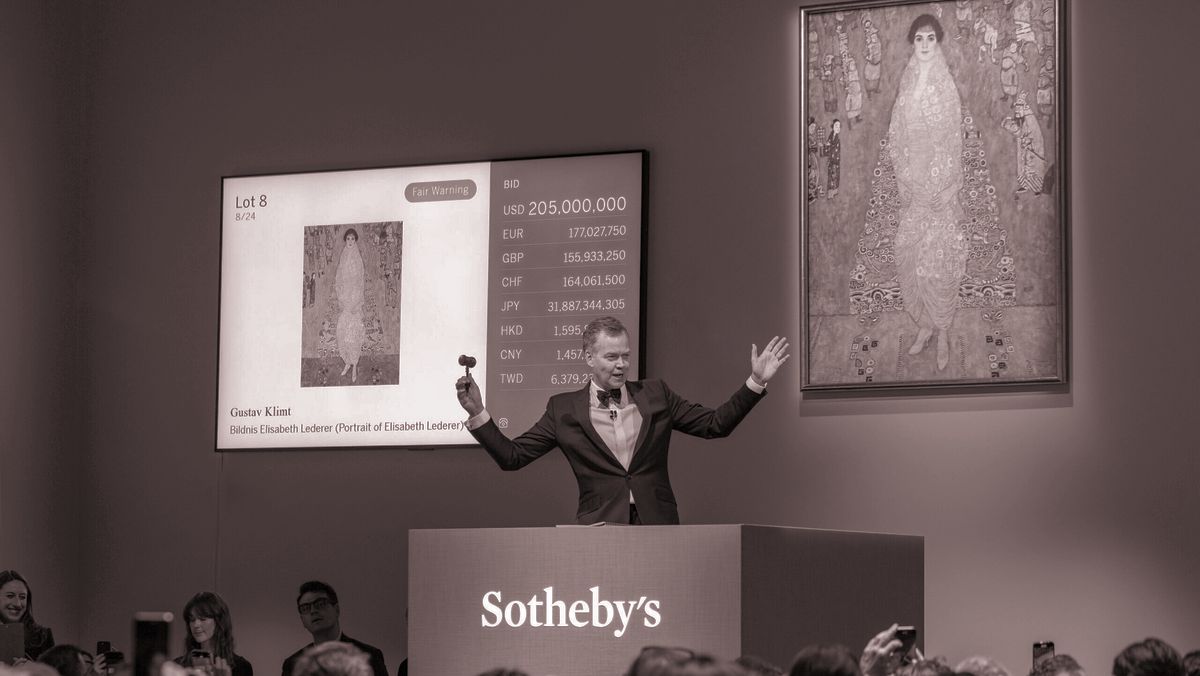
financial officer of Sotheby’s, when Gustav Klimt’s orange-and-teal Portrait of Elisabeth Lederer finally sold for a $236 million premium price after 20 minutes of bidding. Sotheby’s had taken a very big bet on the Leonard Lauder estate, which included three Klimts—outbidding its rivals by tens of millions to secure a premier, brand-defining sale for its launch of the Breuer Building.
Sotheby’s, which has made the Breuer its whole
personality lately, could not have scripted a better night. Altogether, the two evening sales made just a sliver under $706 million, with the Lauder collection pulling in $527 million and the evening sale of contemporary art making an additional, and quite strong, $178 million.
Patrick Drahi and his son Nathan hovered separately in the back of the room for much of the sale, underscoring the importance of the night to the entire company and its owners.
Perhaps more telling, Drahi’s trusted lieutenant and the former C.F.O. of Sotheby’s, Jean-Luc Berrebi, also sat through both sales to the end, warmly greeting his former colleague Brooke Lampley when she left at the end of the evening with her new boss, Larry Gagosian.
Selling three extremely high-value Klimts in one sale is a high-risk venture in any market. But it was especially fraught for Sotheby’s, and the entire market, after nearly
three years of declining auction sales. After all, just six months ago, Sotheby’s had allowed a consignor to roll the dice on a $70 million Giacometti that did not have a bidder. The repercussions of that decision have been echoing through the media ever since. Both Sotheby’s and the broader art market needed something to change the narrative.
But that wasn’t a foregone conclusion even as of late Tuesday morning. When Sotheby’s online catalogue was finally updated to
reflect the third-party guarantees for two of the three Klimts, it seemed like the most one could hope for was a solid placement for the paintings. Indeed, the bidding on the Lederer portrait started with a frantic low-ball bid (if you can call $135 million low) from a client of Helena Newman. That was followed by advisor Patti Wong’s $140 million bid. Then five bidders pushed the lot past the $150 million mark, which must have been a relief to everyone
at Sotheby’s. |
|
|
A MESSAGE FROM OUR SPONSOR |
The first steps towards a masterpiece starts with a dream. The all-electric BMW i7 – the
evolution of brilliance. Learn more at BMWUSA.com |
|
|
But it wasn’t until David Galperin entered at $171 million, knocking
out Wong, that the two final bidders slugged it out to $205 million in the room, or $236 million with fees. “Sotheby’s had been cautious all the way—not leaving anything to chance,” Wong wrote to me this morning. She also said that a Sotheby’s expert had opined to her in the salesroom that one of the landscape pieces could have made $100 million if it had been offered without the distraction of the Lederer portrait. There’s a good case for that argument, based on the $104 million sale
of Paul Allen’s Klimt landscape and Lauder’s powerful provenance.
Anyway, Wong marveled that the portrait had doubled the record public price of $108 million set in London two years ago for Lady with a fan, from 1917. And she was impressed with the number of bidders. “I was asked if Asian U.H.N.W. collectors have Klimt at the top of their collecting list,” she added. “That I cannot answer you. But why not? Or rather, who doesn’t?”
After the applause—a
much-needed release from the tense bidding—I leaned in to congratulate Kownator. “Your week just got a whole lot better,” I said. Without skipping a beat, Kownator replied, “My year just got better!” |
Not every one of the evening’s sales involved quite as much competitive drama. The
other two Klimts sold without much fanfare on single bids. Blooming Meadow, from 1908, went to specialist Simon Stock, who executed the irrevocable bid. Sotheby’s listed the premium price as $86 million in its results, which would be consistent with the guarantor getting the work.
Wong, who bid on each of the three Klimts for separate clients, bought the third, the beautiful Attersee landscape, for a hammer price of $61 million, which translated into a premium price just above $68 million.
The Klimts formed the centerpiece of the Lauder collection and accounted for $390 million, or 74 percent of the total. Speculation has already turned toward the potential buyer of the big Klimt. One collector texted me that a prominent European dealer was confidently
telling people the painting had gone to Asia. But Wong, who has traveled the world buying Klimts whenever they come up, would seem the likely representative for an Asian buyer. Others are pointing the finger at Abu Dhabi. There’s no reason Julian Dawes, the winning bidder, could not have been bidding for someone from the Gulf. Other guesses as to the buyer or bidders, based upon the specialists manning the telephones, are Bernard Arnault,
Steven Cohen, and, as always, Ken Griffin. (The specialist who bids for Jeff Bezos was present but not bidding. She bought Maurizio Cattelan’s gold toilet, America, which I will return to below.)
The answer would be fun to know, but the real takeaway from the sale was that there were six bidders above $135 million and two above $170 million, which tells us something about competition coming back to the top of the
art market. The Klimt portrait is probably a special case. Had it not overperformed so well, we would have looked to the other two Klimts selling below estimate and concluded, once again, that the very top of the market had become better suited to private sales.
Clearly, Lauder’s provenance added a great deal of value. Virtually every other lot in the sale made a price above the low estimate. Lauder’s Edvard Munch
sold to Alex Branczik’s phone bidder for $35 million with fees against a $20 million estimate without fees. Lauder’s fondness for Henri Matisse bronzes didn’t oversaturate the market, as one might have expected; the two top Matisse
lots (of the six offered) made $16.7 million each. Lauder’s taste for tiny Calders attracted many bidders—and more who just couldn’t
get bids in.
Both Agnes Martin paintings sold very well, too. Her sublime 1964 painting, The Garden, had something like eight bidders who chased the work to the artist’s third-highest auction price, or nearly $18 million. Untitled #4,
from 1995, was estimated at $2 million but sold for a $5.9 million hammer price, or more than $7.2 million with fees. Dealer Ales Ortuzar and advisor Kevie Yang both walked away from that bidding disappointed. |
A good portion of the audience left after the Lauder sale, even though Sotheby’s had
been under a great deal of pressure to admit as many people as possible to the 200-plus-person salesroom. Regardless, the Now and Contemporary evening sale opened strong, with collector Marcel Brient’s Raymond Pettibon surfer selling for twice the $1 million estimate to make $2.7
million with fees. A representative from Hauser & Wirth bid on Henry Taylor’s Before Gerhard Richter there was Cassi, from 2017, which doubled the $800,000 estimate and sold for $2 million with fees. |
|
|
You don’t see galleries defending their artists at auction much any more, as Hauser
did with Taylor. But Hauser also bid on Rashid Johnson’s work, Anxious Red Painting August 20th, from 2020, which had an irrevocable bid and sold at around the estimate level. And near the very end of the sale, Larry Gagosian beat a determined telephone bidder to buy Jeff
Koons’s Hulk (Rock), from 2004-13. The work had an irrevocable bid and a $2 million estimate, but Gagosian went all the way to a $3.55 million hammer price to buy his returning artist’s work for more than $4.4 million with fees. Gagosian was able to place some of Koons’s Hulk works earlier this year, so
presumably he had a buyer.
Meanwhile, former Gagosian C.O.O. Andrew Fabricant bought the Yves Klein sponge sculpture for $19 million. It was the second-highest lot in the sale behind Jean-Michel Basquiat’s Crowns (Peso Neto),
from 1981, which was bought for $48 million by Jen Hua, a deputy chairman covering mainland China and one of the contemporary portion’s most active bidders.
Nearly as dramatic as the Klimt bidding was the extended battle for Cecily Brown’s High Society,
from 1997-98. Sotheby’s London contemporary art crew engaged in an internecine war of attrition as Branczik bid against Ottilie Windsor, Aleksandra Ziemiszewska, and Tom Eddison, who ultimately prevailed to set a new record for the artist. The hammer price was double the $4 million
estimate—covered by an irrevocable bid—and the final price with fees was $9.8 million.
On the whole, most of the lots performed very well against their estimates. But that doesn’t mean everything went well, and some of the consignors couldn’t get out of their own way. Expensive works by Barkley Hendricks and Kerry James Marshall were bought in, and I’m told both had offers of irrevocable bids that were rejected. Even in a market where momentum is
building, bidders can be touchy and easily offended.
That brings us to Cattelan’s golden toilet. America is a great work of art, but I’m not sure it is a great art object. It works best in a public setting, as we all have seen over the last two weeks, with people lining up to see and be photographed with it at the Breuer. As with Comedian, the duct-tape-and-banana work, the real art is the frisson of reaction it generates from viewers. The moment it stops titillating, it
ceases to be a work of art. In latching on to the publicity value of Comedian, I’m not sure Sotheby’s fully grasped that the market response was not positive. The work sold to a cringey crypto investor—not really a club most collectors want to join.
To make matters worse, Sotheby’s added an additional stunt to the sale of America. The opening bid was meant to be keyed to the spot price of the gold needed to fabricate the toilet. But instead of opening the
bidding at that $9.2 million level, the auctioneer announced the first bid would be $10 million, negating the whole point of the gimmick. Thankfully, there was only one bid at $10 million, from a specialist known to work with Bezos, which sparked some speculation that Lauren Sánchez might be the buyer. The lot was quickly closed for a premium price of $12.1 million. By Sotheby’s own logic, that makes the “art” value of America less than $3 million—hardly worth the
hoopla. This morning, Sotheby’s told us the buyer was “a famous American brand” that might be making an announcement soon. This put us back in the realm of the Birkin bag prototype that a Japanese retailer bought as a marketing tool.
In that sense, Cattelan is having the last laugh. If America has a transcendent point beyond the well-deserved critique of American cupidity, it’s the idea that everything can and will be co-opted by commerce, including America itself. Late
this afternoon, it was reported that the buyer was Ripley’s Believe It or Not. |
There’s a lot more to say about these sales. And I’m going to say it on
Friday.
See you then,
M |
|
|
The ultimate fashion industry bible, offering incisive reportage on all aspects of the business and its biggest
players. Anchored by preeminent fashion journalist Lauren Sherman, Line Sheet also features veteran reporter Rachel Strugatz, who delivers unparalleled intel on what’s happening in the beauty industry, and Sarah Shapiro, a longtime retail strategist who writes about e-commerce, brick-and-mortar, D.T.C., and more. |
|
|
Finally, a media podcast about what’s actually happening in the media—not the oversanitized,
legal-and-standards-approved version you read online. Join Dylan Byers, Puck’s veteran media reporter, and Julia Alexander, a longtime media analyst, as they sit down with TV personalities, moguls, pundits, and industry executives for raw, honest, sometimes salacious conversations about the business of media and its biggest egos. New episodes publish every Tuesday and Friday. |
|
|
Need help? Review our
FAQ page or contact us for assistance. For brand partnerships, email ads@puck.news.
You received this email because you signed up to receive emails from Puck, or as part of your Puck account associated with {{customer.email}}. To stop receiving this newsletter and/or manage all your email preferences, click here. |
Puck is published by Heat Media LLC. 107 Greenwich St., New York, NY 10006 |
|
|
|