|
Welcome back to the Wall Power Inner Circle. I’m Marion Maneker.
Tonight, I’m looking at the data from Hong Kong, where there’s some good news and some not so good news—but mostly, I’m seeing a continuation of the trend established in London last month. Total sale volumes are way, way down, but estimates have reached a level that is proving attractive to bidders and buyers. We’re also seeing more money chase higher-value works. I’ll have the details below the fold.
But first…
|
- How much of Sotheby’s does Abu Dhabi actually own?: I’ll get more into Charles Stewart’s Financial Times interview in the endnotes. (I’m always up for a talmudic reading of the Sotheby’s C.E.O.’s external monologuing.) But the FT interview sort of answered one of the current riddles of the art market. The piece stated that ADQ, the Abu Dhabi sovereign wealth fund, received a 25-30 percent ownership stake in the auction company in exchange for its investment of nearly $1 billion. Ever since ADQ announced its investment, I’ve speculated on where it would sit on the cap table. So I got in touch with Sotheby’s to find out. Their spokesperson said that the FT’s assessment of the equity stake is correct.As with all of the mentions of Abu Dhabi’s investment, the $1 billion is characterized as comprising money from ADQ and Patrick Drahi himself. Why Drahi would need to add new capital alongside ADQ, if their equity stake was only going to be 25-30 percent, remains a mystery to me. Prior to the ADQ investment, Drahi owned 90-95 percent of the company. If he wasn’t in a position where he was going to lose his majority, why write a check? Again, from a Sotheby’s spokesperson: “The family of Patrick Drahi invested alongside ADQ because they believe strongly in the future of Sotheby’s.”
|
|
|
|
A MESSAGE FROM OUR SPONSOR
|
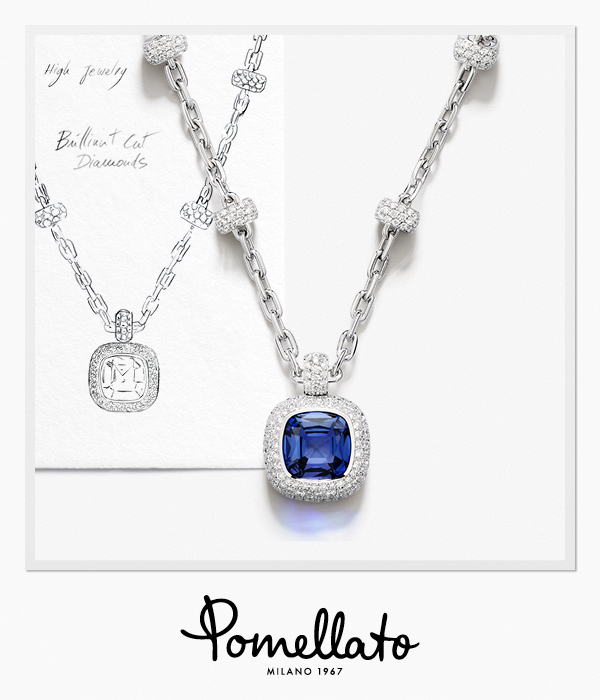
At the intersection of artistry and innovation lies Nudo, Pomellato’s most iconic creation. Each Nudo piece is a miniature masterpiece, where design creativity, expert craftsmanship, and gemstone mastery meet. The Nudo High Jewelry collection embodies Pomellato’s unique vision of precious jewelry, combining the collection’s signature lightness and wearability with new levels of creativity and craftsmanship.
LEARN MORE
|
|
|
- Ceramics have become contemporary art: The folks at Bonhams have been doing well with ceramicists like Toshiko Takaezu, Betty Woodman, and JB Blunk in their modern design sale last week in Los Angeles. And there is a strong overlap between the buyers of ceramics and contemporary art collectors. Bonhams says that 27 percent of their buyers in the ceramics category over the past four years have contemporary art collections. “Contemporary art buyers are looking to add dynamism to their collection, so they turn to sculptural forms,” says David Trujillo, who runs the design and decorative arts sales. “Smaller pieces, usually tabletop size, deliver this well.”
- More sales from Art Basel Hong Kong: Since our last Inner Circle newsletter, we’ve had more sales from Art Basel in Hong Kong. David Zwirner sold works by Oscar Murillo and Rose Wylie for $400,000 each. Hauser & Wirth sold a work by Zeng Fanzhi for $1.5 million. Thaddaeus Ropac sold a Roy Lichtenstein for $1.5 million, an Alex Katz for $900,000, and a Robert Rauschenberg for $200,000 to a museum in China. Perrotin sold a Takashi Murakami for $1.35 million. In the final hour of the final day of the fair, Pace Gallery sold a Lee Ufan for $1.1 million.There’s more: Galerie Lelong sold a work by David Hockney for €750,000 ($814,050), and one by Jaume Plensa for €470,000 ($510,000). White Cube sold works by Damien Hirst for $850,000, Georg Baselitz for €650,000 ($705,500), and Tracey Emin for £520,000 ($675,000), and two works by Antony Gormley for £500,000 ($648,000) each. Berry Campbell sold two works by Lynne Drexler—one for $750,000 and the other for $300,000. Kukje Gallery sold a Park Seo-Bo for $540,000 and a Ha Chong-Hyun for $390,000. Massimo De Carlo sold a Jennifer Guidi for $390,000. Kasmin sold an Ali Banisadr for $475,000. Mazzoleni sold a Salvo for $120,000. Gladstone sold an Anicka Yi for $225,000.
|
|
|
|
The results of the first-of-its-kind concurrent Hong Kong sales at Phillips, Sotheby’s, and Christie’s offer a few signs of life—particularly at the top of the market.
|
|
|
|
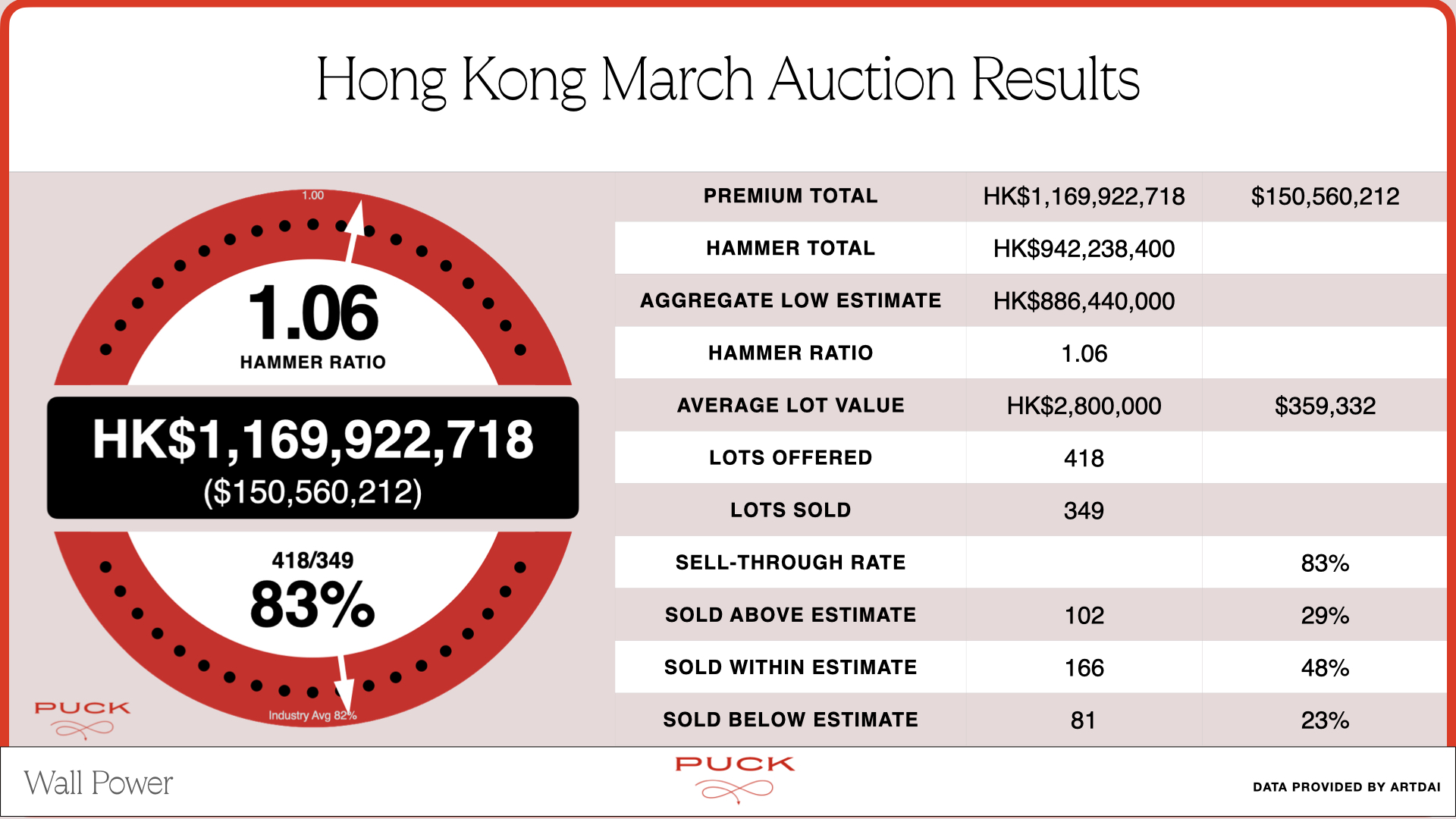
The news out of Hong Kong from last week’s first-ever concurrent auctions at Phillips, Sotheby’s, and Christie’s is a bit of a tale of two cities. In some ways, it was the worst of times: The total sales of modern and contemporary art in Hong Kong fell to their lowest levels in five years. On the other hand, while we may not be living through the best of times, things do seem to be getting better. The hammer ratio for these sales has bounced back from .90 last year to a promising 1.06 this year.
|
|
|
|
A MESSAGE FROM OUR SPONSOR
|
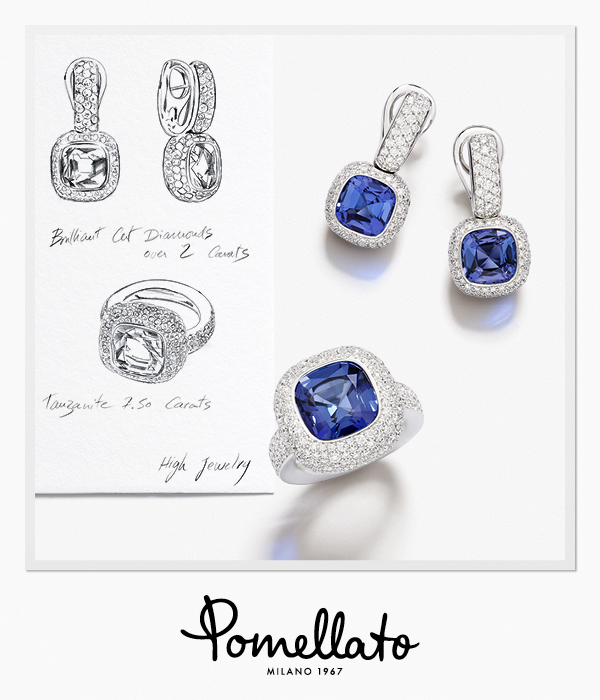
At the intersection of artistry and innovation lies Nudo, Pomellato’s most iconic creation. Each Nudo piece is a miniature masterpiece, where design creativity, expert craftsmanship, and gemstone mastery meet. The Nudo High Jewelry collection embodies Pomellato’s unique vision of precious jewelry, combining the collection’s signature lightness and wearability with new levels of creativity and craftsmanship.
LEARN MORE
|
|
|
|
It’s hard to make year-over-year comparisons given that this concurrent threesome of sales was a first of its kind. But my friends at ARTDAI were kind enough to gather the equivalent sales previously held over a three-month period to measure against the sales that were held last week. Their data reveals some hard truths. Over the past four years, the volume of modern and contemporary art sold in Hong Kong in the spring has dropped by two-thirds. As recently as 2022, these sales saw $438 million spent on art. In 2022, the hammer ratio for all of the sales combined was a plump
1.29. By 2024, the hammer ratio had fallen to an emaciated .90. From last year to this year, the volume fell 38 percent, even though the hammer ratio popped back up to 1.06.
|
|
Last week, the sales of modern and contemporary art totaled HK$1.17 billion, or $150 million, with an overall hammer ratio for the sales at the aforementioned 1.06. There were 418 lots offered; 349 of those sold. That’s an 83 percent sell-through rate, which is pretty much the industry average. The breakdown of the sold lots was even more instructive. Nearly half of the lots sold—48 percent to be precise—achieved prices within the estimate range. Another 29 percent were bid above the estimates, and 23 percent were sold for compromise prices below the estimate. Those are
neutral-to-positive numbers, suggesting consignors are now asking for prices that buyers consider reasonable.
|
|
Those are the aggregates. Across the houses, and between the day and evening sales, we saw a fair bit of variability. Christie’s and Sotheby’s evening sales both had 1.03 hammer ratios, though Christie’s sale total was almost twice as much as Sotheby’s. Christie’s 20th century day sale and Sotheby’s modern and contemporary day sale both had strong hammer ratios of 1.28; Christie’s totals again exceeded Sotheby’s in day sales, but this time Christie’s had about three times the dollar volume. Phillips struggled in this environment, posting a small fraction of the market
share and a subpar hammer ratio of .86.
Again, these hammer ratios tell us that estimates have come down to a level that activates buyers. The bidding energy remains stronger at lower estimate levels, but the mojo has returned to higher price bands.
|
|
|
|
Among the artists with strong performances were André Brasilier, who saw all three works on offer sell well; Javier Calleja, who had two works sell above the estimates; Ju Ming, who saw five works all sell well, with three exceeding estimates; Le Pho, with five works sold, four of them above the estimates; Mai Trung Thu, with all four lots exceeding estimates; Marc Chagall, with eight sales, five above estimates; Pierre-Auguste Renoir, with four works sold, two above estimates; and Vu Cao Dam, with five lots, all sold above estimates.
|
|
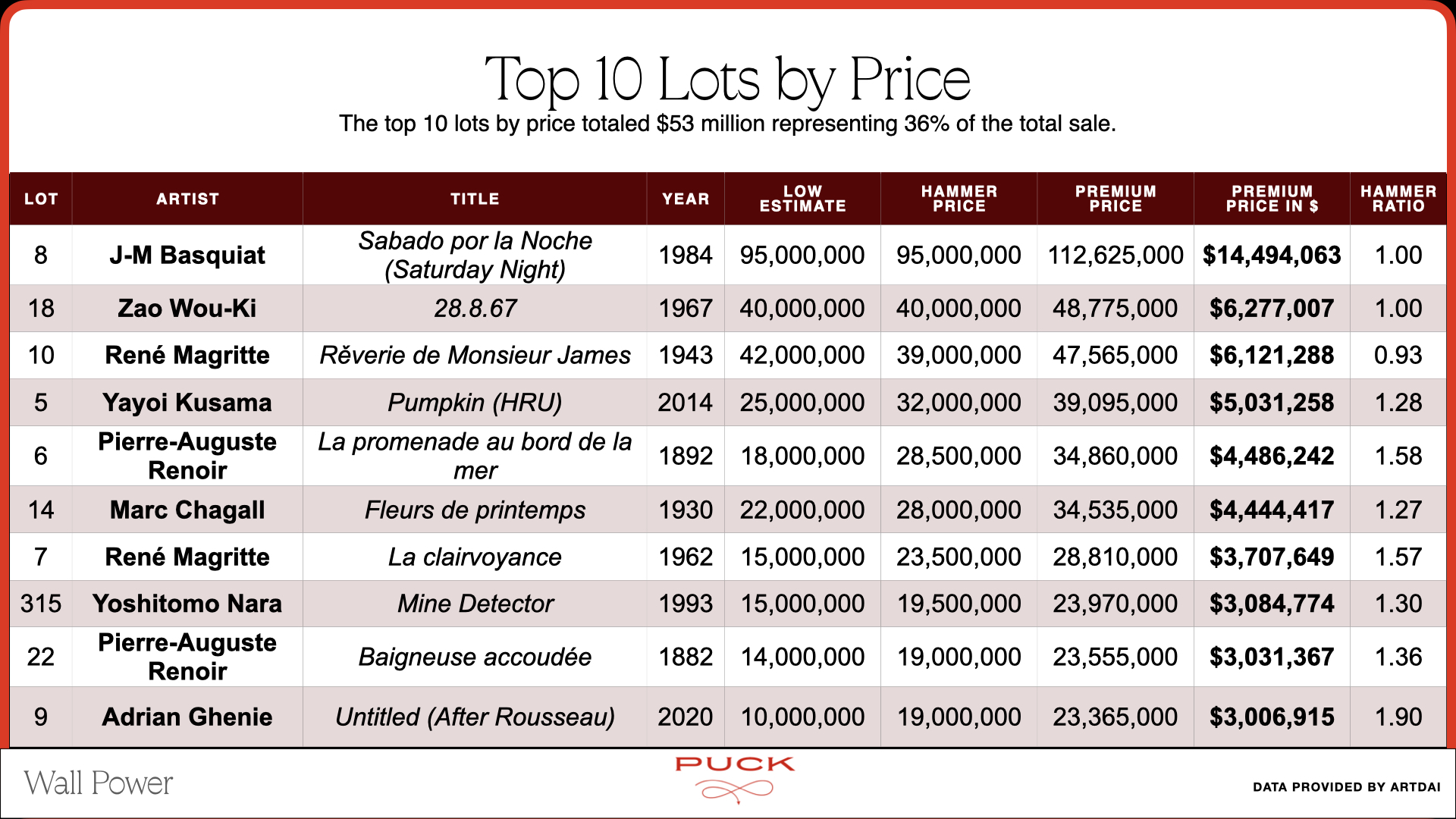
The top 10 lots by price saw only one work sell below the estimate. Another six works sold for prices within the estimate range, and works by Renoir, René Magritte, and Adrian Ghenie saw aggressive bidding. That’s a broad range of historical and contemporary artists. The top 10 lots also had an aggregate value of $53 million, or more than 35 percent of the total sale value. As markets heat up, a greater portion of the sale value is contained within the top lots.
|
|
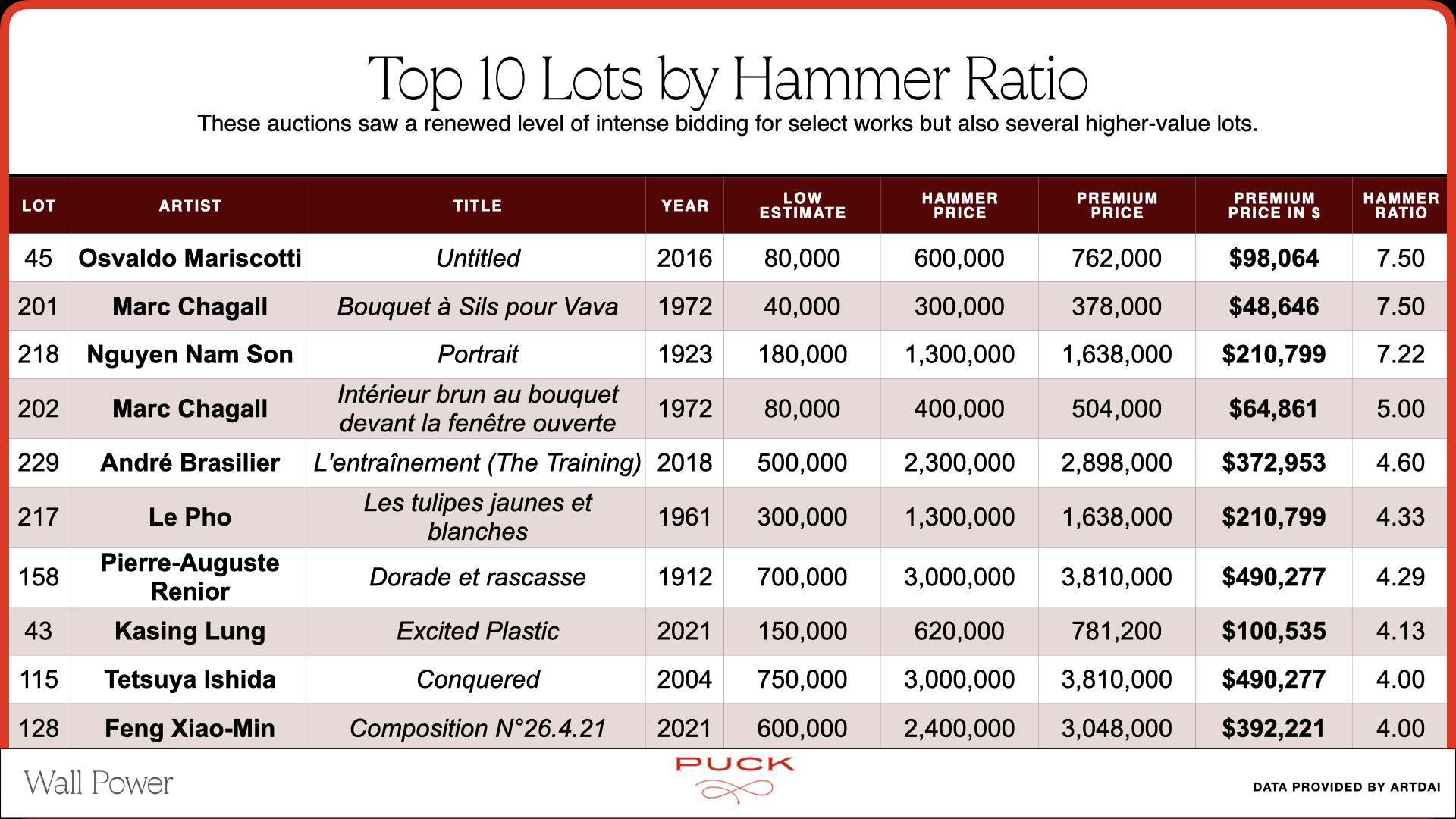
Turning to the top 10 lots by hammer ratio, seven of them were bid to six-figure premium prices. That’s an improvement from recent seasons, when the bulk of the lots with the most aggressive bidding remained at much lower price points. This is a positive sign. The two most valuable lots on the list were another Renoir and a work by Tetsuya Ishida, the Japanese artist who died in 2005 at the age of 31. His estate has been represented by Gagosian since 2023. Chinese-born French artist Feng Xiao-Min saw his work bid aggressively to four times the estimate and a final price of $392,221. Another French painter, 95-year-old André Brasilier, saw intense bidding for his recent work. Two historical Vietnamese artists, Le Pho and Nguyen Nam Son, were bid to the same $210,000 price. And Hong Kong illustrator Kasing Lung rounded out the lots that saw dynamic bidding over $100,000.
|
|
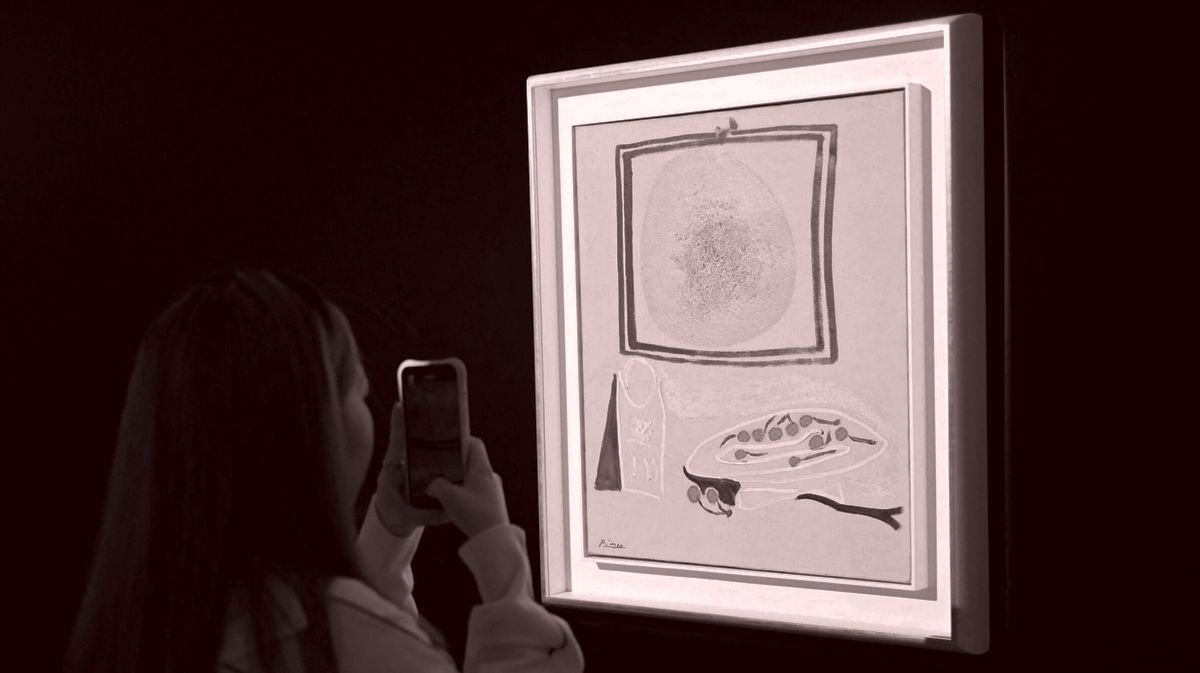
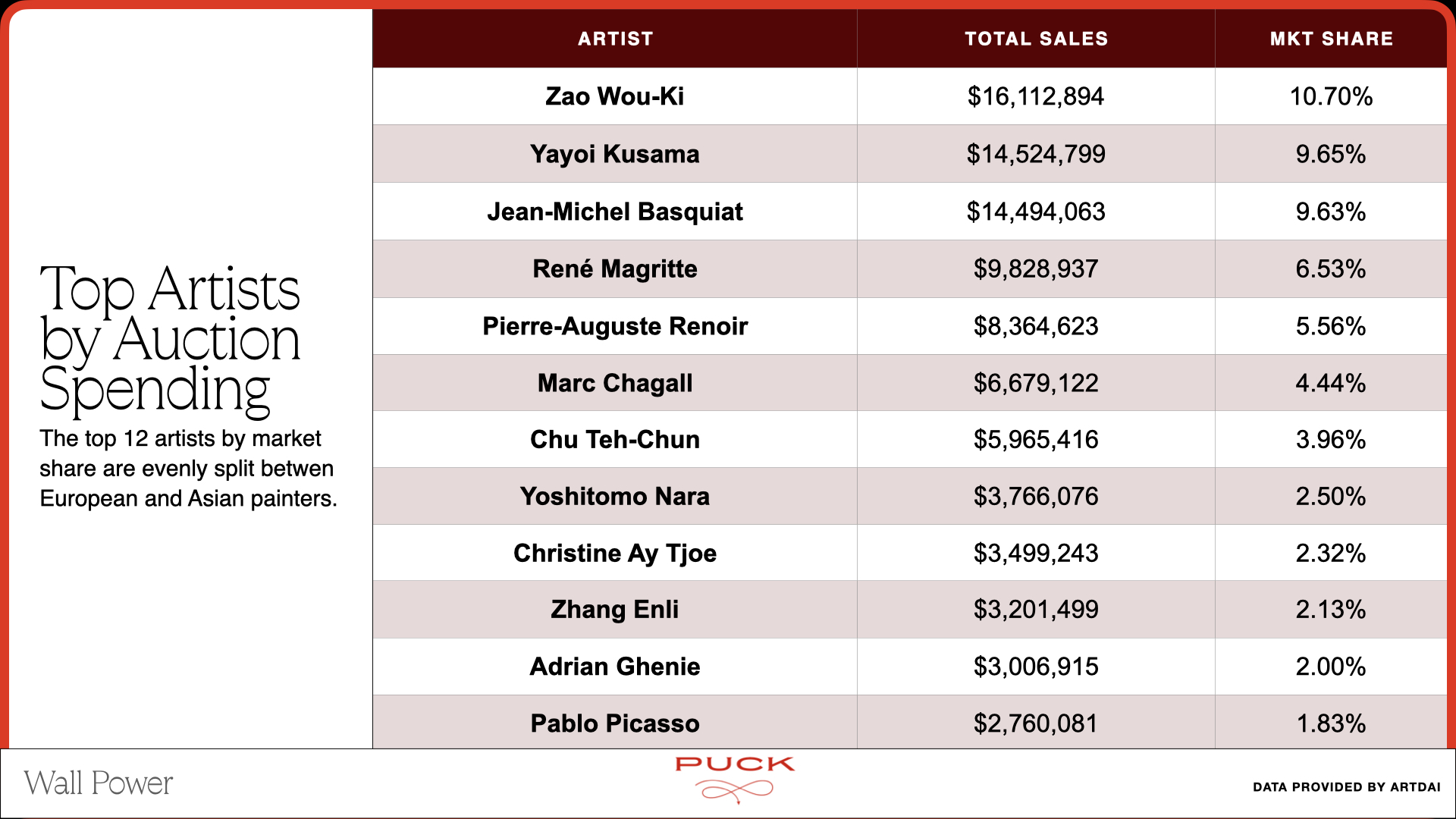
Finally, the market share numbers show a fairly consistent decline from the top three artists—Zao Wou-Ki, Yayoi Kusama, and Jean-Michel Basquiat—to the next three historical artists (Magritte, Renoir, and Chagall). Chu Teh-Chun seems to occupy a unique strata. That final group of mostly contemporary artists, including Yoshitomo Nara, Christine Ay Tjoe, Zhang Enli, and Adrian Ghenie, also contains the venerable Pablo Picasso, with just under 2 percent of the dollars spent.
|
I know many of you read the aforementioned Financial Times interview with Sotheby’s C.E.O. Charles Stewart—I received a lot of comments through various channels. (Keep ’em coming, folks.) I’m still confused about it, myself. I understand the impulse to do the interview. Sotheby’s is trying to bounce back from a bad year, filled with bad press. The company needs to build confidence with consignors. One only has to look at the past two sales cycles in London and Hong Kong, where Sotheby’s trailed its rival in the duopoly, posting volumes that were half those of Christie’s. If this imbalance—which reflects lopsided consigning—persists, it won’t be much of a duopoly anymore.
We are still a long, long way from that scenario, but the houses remain much further apart than most of us thought they would be at this point. Of course, much of the problem comes from Sotheby’s attempt to reorient the fee structure away from an ever-increasing buyer’s premium, toward a more sustainable cost-sharing between buyer and seller. In December, when they abandoned that new fee structure, it seemed like it’d be only a matter of time before the auction house returned to its previous form by reinstalling the old fee structure and making attractive deals that would lure back consignors. So far, that doesn’t seem to have happened.
I haven’t heard any reports that Sotheby’s has refused to make attractive offers. So we can cross that off the list of reasons for the consignment gap. The second possibility is that, after extensive cuts to the staff, there are just fewer people in-house to hit the phones and bring in consignments. Finally, there’s a third issue of confidence around the company. Do consignors feel Sotheby’s can get the job done for them? To me, that’s the backdrop to this interview.
Sotheby’s has to rebuild, and all of its efforts should be focused on bolstering the market’s perception of the company and this wobbly moment in both the art market and the global economy. Would putting its C.E.O. in front of the FT accomplish that? Perhaps, but only if Stewart were focused on answering the kinds of questions that might be holding consignors back.
You can judge for yourself whether he pulled it off, but the headline focused on Brexit. The subhead referred to “choppy economic waters.” The pull quotes were about how small the audience is and how few opportunities Sotheby’s has to engage clients.
To make matters worse, the interview was clearly conducted a month ago, when Stewart was in London for the auctions. He chose to comment on President Trump’s tariff plan, which, at the time, might have seemed less of an obstacle. His comments that Trump’s levies “seem targeted at boutique segments” and “intended to send more of a signal than have a truly disruptive economic impact” have not aged well.
As one person who works for a large global gallery commented to me, the interview doesn’t help the industry very much. It focused on all of the negatives and offered few concrete and positive examples of the health of the art market or Sotheby’s robust comeback. Yes, we’re told that there’s a massive wealth transfer about to happen, but we didn’t need Stewart to tell us that. And it would’ve had far more impact if it had been a comment accompanied by the announcement of a major consignment. Anyway, P.R. works best when it amplifies real momentum.
|
|
While you mull over these deep thoughts, I’ll be working on our next newsletter, coming to you on Friday.
Until then,
M
|
|
|
|
The ultimate fashion industry bible, offering incisive reportage on all aspects of the business and its biggest players. Anchored by preeminent fashion journalist Lauren Sherman, Line Sheet also features veteran reporter Rachel Strugatz, who delivers unparalleled intel on what’s happening in the beauty industry, and Sarah Shapiro, a longtime retail strategist who writes about e-commerce, brick-and-mortar, D.T.C., and more.
|
|
|
|
Finally, a media podcast about what’s actually happening in the media—not the oversanitized, legal-and-standards-approved version you read online. Join Dylan Byers, Puck’s veteran media reporter, as he sits down with TV personalities, moguls, pundits, and industry executives for raw, honest, sometimes salacious conversations about the business of media and its biggest egos. New episodes publish every Tuesday and Friday.
|
|
|
Need help? Review our FAQ page or contact us for assistance. For brand partnerships, email ads@puck.news.
You received this email because you signed up to receive emails from Puck, or as part of your Puck account associated with . To stop receiving this newsletter and/or manage all your email preferences, click here.
|
|
Puck is published by Heat Media LLC. 107 Greenwich St, New York, NY 10006
|
|
|
|