 |
|
I’m Bill Cohan. Welcome back to Dry Powder.
|
|
Few C.E.O.s on Wall Street are scrutinized more closely than the leader of Goldman Sachs. But I wonder if the hyperventilating media narrative attaching itself to David Solomon isn’t overblown. Today, a behind-the-scenes look at the inside conversation within the firm—and some much-needed historical perspective.
|
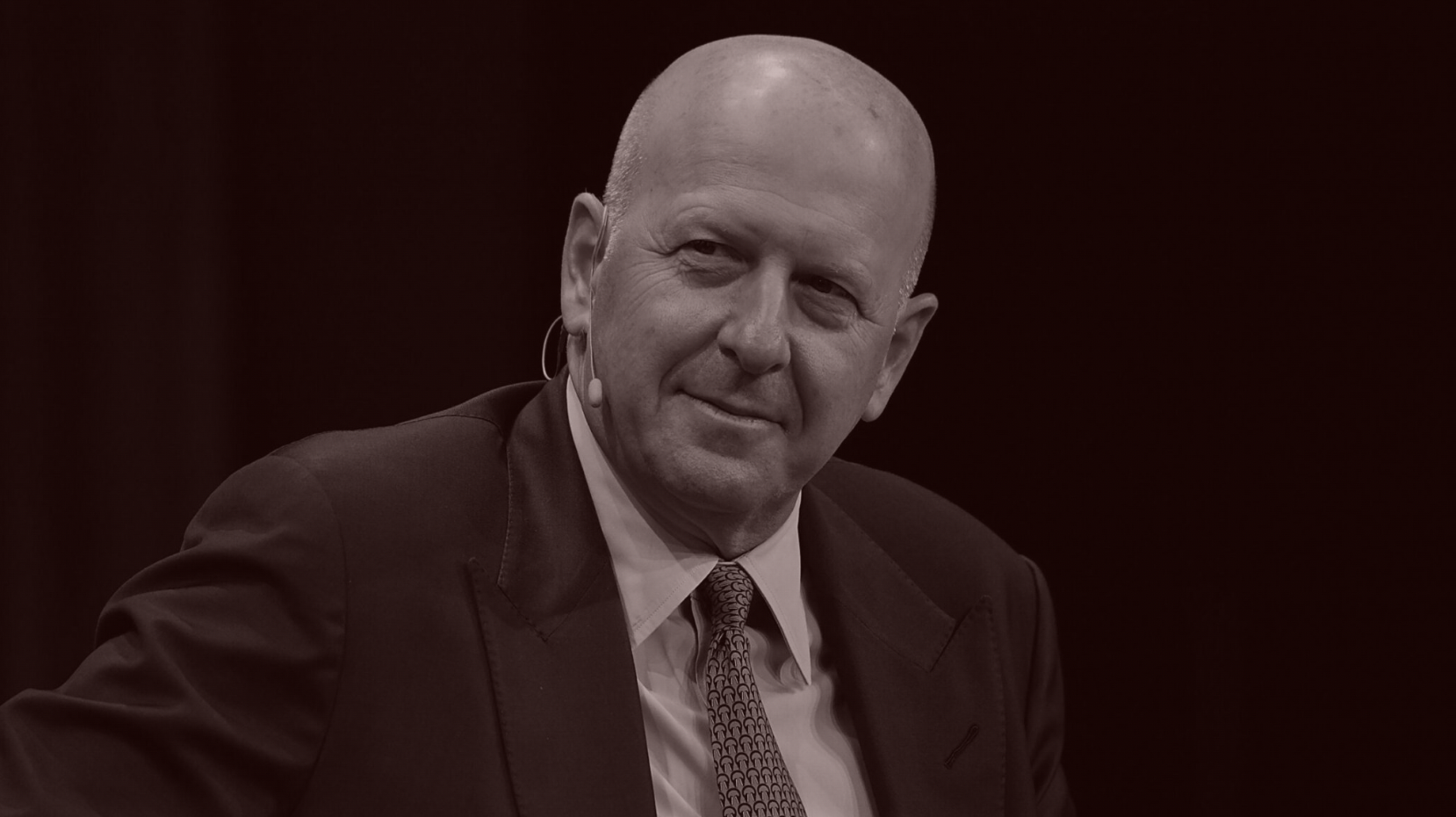 |
| Song of Solomon |
| The player haters are out for Goldman after a painful quarter, cost-cutting and layoffs. But Goldman historians (like yours truly) have seen this movie before and it always has a happy ending. |
|
|
|
| Running Goldman Sachs is a bit like managing the New York Yankees or being the president of Harvard—it’s a job draped in prestige and riches and accomplishment and yet everyone pretty much thinks he or she can do it, or has an opinion about how to do it better. And heaven help you if you make a gaffe, as the garrulous Lloyd Blankfein did in November 2009 when he referred, in an off-the-cuff, tone-deaf remark, to his job as “doing God’s work.” Or when the venerable economy-rescuing Hank Paulson, Blankfein’s predecessor, claimed, in January 2003, that about 20 percent of Goldman’s employees were generating 80 percent of the value for the firm. “I think we can cut a fair amount and not get into muscle and still be very well positioned for the upturn,” he said at an investment conference. The chattering classes had a field day in both instances.
These days, some critics are out for David Solomon, the 61-year-old C.E.O., who is now into his fifth year leading the 154-year-old firm. Plenty of the gripes trend toward the superficial. His extracurricular DJ-ing was the subject of yet another ridiculous New York Times article, this one on the front page, no less. Solomon has also been criticized for cutting 3,200 jobs, and lamenting that he hadn’t accomplished the task sooner. The bonus pool for 2022 was reduced by half from the fulsome 2021 levels, while the Goldman board of directors reduced Solomon’s compensation by only 29 percent, to $25 million. He’s also been blamed, fairly or not, for a smattering of partners exiting the firm.
Some criticisms, on the other hand, are more tactical, such as the billions of dollars in losses, accounting and realized, that have resulted from Solomon’s ill-fated efforts, so far, to have Goldman products (like Marcus savings accounts and Goldman-powered Apple credit cards) available to the masses. Then there is the widening gap, now $40 billion and counting, between the market values of Goldman and its arch-rival, Morgan Stanley, despite the fact that Goldman had higher net income in 2022 ($11.3 billion) than did Morgan Stanley ($11 billion). These days, Mr. Market seems to prefer the steady fee income that managing money generates rather than the volatility of investment banking and trading profits. Morgan Stanley has chosen to diversify away from the volatile investment banking businesses, with much success, by betting more heavily than Goldman on asset and wealth management. Morgan Stanley’s earnings get rewarded by the market with a 16x multiple; Goldman’s earnings are valued at 12x, hence the $40 billion valuation discrepancy.
Meanwhile, also fairly or not, a media narrative has been gestating. A recent Economist cover story about the bank ran with the headline, “The Humbling of Goldman Sachs,” along with a reconfigured melting Goldman logo. Last week, Insider’s Dakin Campbell reported that some of the troops are getting restless. “The degree of dissatisfaction inside Goldman has gotten to the point where some partners have discussed how they might spur action from the firm’s board of directors, according to four people who have spoken to these partners,” Campbell wrote. “Some of them have even considered bringing their concerns directly to the board, though they haven’t yet, in part, because they see Goldman’s board as insular and out-of-touch with the day-to-day conditions of the firm, two of them said.”
I asked Campbell if he had received any pushback from Goldman about this reporting. He declined to comment and referred me to Goldman’s statement, noted in the piece, pointing to the firm’s 10.2 percent return on equity and saying all the sniping was hogwash. Campbell went so far as to report that dissidents were mentioning Richard Gnodde, a longtime Goldman partner and international investment banker, as a potential Solomon replacement, while noting that John Waldron, the number two Goldman executive, was too close to Solomon to be considered a possible successor, at least by this group of dissidents. As with all things Goldman, it made me wonder whether there was something real going on or if this was just the ritual player hating, the latest chapter in the public’s desire to caricature the bank as a vampire squid. |
|
|
| There is another pervasive perspective, of course, which a newish Goldman partner shared with me. And, generally speaking, it subscribes to the theory that Goldman is still the most prestigious bank on Wall Street and the second-hand fulminations of a few pissed off partners, all of whom are probably way too ambitious to tattle to the board, is just some watercooler grumbling that feeds into that ye olde vampire squid narrative. “In 2021, Goldman had the best year in the history of any bank ever,” this person noted, hyperbolically. “Everyone got paid—a lot. 2022 was a challenging year. Not a bad year overall in that environment, but a bad 4th quarter. And so a lot of people got paid down from the heights of 2021 and they’re angry about it. Some parts of the bank did well, some parts didn’t, and some people aren’t happy about sharing in a down year. And they aren’t happy about having to do headcount reductions again.”
Goldman recorded $21.1 billion of net income in 2021, its best year ever and one of the best of any bank, particularly on a per-capita basis. But JPMorgan Chase actually had $48 billion in net income that same year. Of course, the usual caveats apply: JPM has a lot more people, more business lines, more capital and a much bigger balance sheet. In any event, we can stipulate that Goldman had a damn good year in 2021.
The partner then laid some competitive jujitsu on me. “The irony is Goldman was the best performing bank across its peers in 2022,” he continued. “If you bought Goldman stock a year ago, you’re ahead, just a few percent”—3.3 percent to be exact, but considering the overall direction of the financial markets in the past year that’s pretty good—“but you’re up. If you bought BofA, or Citi, you’re down 23-24 percent. If you bought JPMorgan, you’re down 9 percent. Morgan Stanley is down 7-8 percent.” He then reminded me that Goldman had higher net income in 2022 than Morgan Stanley (that $11.3 billion) before also noting that Goldman “took market share” from Morgan Stanley in the core businesses of investment banking and trading. “That’s what made the Economist cover so dumb,” he continued. “Goldman was the bank that sagged the least in 2022.”
The conversation then turned to the hard-boiled Mike Mayo, the highly respected Wall Street research analyst at Wells Fargo, who recently raised Goldman’s price target to $420 a share, a 13 percent increase above where the stock is trading now. Mayo’s previous price target for Goldman’s stock was $390 per share. In his recent report, Mayo shared his view that Goldman is undervalued compared to its peers and should trade at a one-third higher price-to-book ratio, of 1.6x, than it currently does, and perhaps even higher, at 1.7x book, in line with Morgan Stanley’s valuation. (When Goldman went public in 1999, it was valued at 4x book.)
In other words, Mayo can’t figure why Goldman trades at such a discount to Morgan Stanley, especially now that Solomon has bitten the bullet on the headcount reductions (although Mayo thinks more cuts are needed) and on the nascent consumer business—a “more narrow consumer approach” was how Mayo put it. He also figured that Goldman’s horrible fourth quarter of 2022—the worst quarterly results in a decade by the Economist’s reckoning—were “partly” a “clear-the-deck moment as it deals with consumer and expense issues.”
Mayo, like other Goldman kremlinologists, is focused on the firm’s upcoming “investor day” presentation—a Solomon innovation—on February 28, to reset the table for how Goldman thinks it will perform for the next 10 months of the year. Mayo told me in an interview that he thinks Solomon will survive the recent unrest. He also said that he’d like the lead independent director on the Goldman board, Adebayo Ogunlesi, to address investors regarding the issues that seem to be riling folks up at 200 West Street: the alleged morale concerns, the financial losses in the consumer business, the wobbly cultural issues, and whether the board will come out in support of Solomon at this challenging moment. (I’m pretty sure that Ogunlesi is unlikely to attend the meeting.)
I reminded Mayo that the Disney board unanimously came out in support of Bob Chapek in June 2022, and gave him a three-year contract extension, only to fire him five months later and bring back Bob Iger, his predecessor. So such displays of support can be fleeting. He was unfazed. “Investors are spending a lot of time analyzing the company assuming he’ll stay in place,” Mayo said of Solomon. “And I’m doing the same. If there’s a chance he’s not going to be around, let’s not waste our time. But if he is the person for the next three years, let somebody tell us. And have they checked out the issues that have been highlighted in the press? And if they’ve checked them out, what have they found?” |
|
|
| For perspective on the machinations at Goldman, it’s instructive to go back 30 years, all the way to the pre-I.P.O. Goldman era of 1993 and 1994. The parallels are fascinating. In 1993, led by some successful trading bets made by Jon Corzine, then head of fixed-income at the bank, the private Goldman made $2.7 billion in pre-tax profit, the most in the firm’s history to that point. The senior partner at the time, Steve Friedman, pocketed $46 million, while other members of the management committee made at least $25 million each. These were pretty much unheard of pay numbers for Wall Street bankers back then, unless you were Mike Milken.
All that began to turn around quickly as the calendar changed to 1994. Suddenly, a new trading scheme overseen by Corzine was losing money hand over fist, as much as $100 million a month, on a massive wrong-way bet on the direction of interest rates. All hell broke loose at the firm: 1994 pre-tax profit fell 80 percent, to around $500 million, from the year before. That was the official number; in the reporting of my book about Goldman, Money & Power, a number of Goldman executives told me that the firm actually lost hundreds of millions of dollars in 1994.
Friedman decided to retire, mostly for health reasons. Somewhat surprisingly, Corzine was selected to succeed him, instead of Hank Paulson, who would become second-in-command and eventually replace Corzine five years later and take the firm through its very successful I.P.O, all before his heroic second act as Treasury Secretary. It was quite curious. Why had Corzine, who oversaw the trading losses, been promoted to run the firm? As one trader told me for the book, “He’s the only one who understood how to get out of it. You have to have someone who knew how to get out of it.” More incredibly, some 40 Goldman partners voted with their feet and decided to leave the firm, taking with them more than $200 million of their capital. Needless to say, never before or since has such a high percentage of Goldman partners left the firm in one year. The voluntary departures these days are a trickle in comparison.
All of which is to say that as bad as things may seem down at Goldman at the moment, they aren’t nearly as bad as they were in 1994. Or as bad as they were in 1969 and 1970 when lawsuits related to the bankruptcy of the Penn Central Railroad almost blew a hole right through Goldman’s tiny capital base, or as bad as the 1929-1935 period when Goldman almost went down the tubes because of the infamous Goldman Sachs Trading Corporation scandal. My prediction is that Solomon will be fine, especially if Mayo turns out to be right and Goldman’s stock takes off this year and the difference in valuation between it and Morgan Stanley begins to narrow.
Solomon may embark on some small-ish acquisitions in the wealth management and alternative asset categories, perhaps companies such as Blue Owl Capital (market value: $18 billion) or Petershill Partners plc (market value: $2 billion) that the Federal Reserve and the politicians in Washington are less likely to make a big stink about. My suggestion is that Goldman buy Bank of New York Mellon (market value: $40 billion). It’s a wonderful strategic fit for Goldman but since they are both SIFIs—systemically important financial institutions—getting the Fed and the pols to approve any deal would be a heavier lift, if not impossible. (As usual, this is not investment advice.) In any event, at an investor conference yesterday in Florida, Solomon categorically rejected the idea of a Goldman merger with a SIFI, like Bank of New York Mellon. “That’s not something we want to do,” Solomon said.
One thing I’ve realized about Goldman Sachs over the years, though, is that just when its adversaries think (or hope) it is down and out for the count, the bank finds a way to come roaring back. Solomon clearly feels the same way. “One of the things I think I’ve learned, both as a banker over a long period of time advising companies, but also just in my four and a half year tenure [as Goldman’s C.E.O.],” Solomon said this week, “is that basically you have to expect the unexpected, things never go the way you expect them to. And I think one of the great attributes of all great organizations is basically the organizations and the management teams learn and adapt.” I really don’t think this time will be any different. |
|
|
|
| FOUR STORIES WE’RE TALKING ABOUT |
 |
|
 |
|
 |
|
 |
| NCAA Apocalypse |
| Notes on the legal challenges set to transform the collegiate sports landscape. |
| ERIQ GARDNER |
|
|
|
|
|
 |
|
|
|
Need help? Review our FAQs
page or contact
us for assistance. For brand partnerships, email ads@puck.news.
|
|
|
|
Puck is published by Heat Media LLC. 227 W 17th St New York, NY 10011.
|
|
|
|