 |

|
|
Welcome back to The Best & The Brightest. I’m Tara Palmeri. In tonight’s issue, my partner John Heilemann presents his bracing conversation with a pair of up-and-coming, moderate-ish Democratic Reps—Seth Moulton and Ritchie Torres—who offer their candid prescriptions for reinventing the party in the wake of Kamala’s decisive loss. And Abby Livingston returns with another inside look at the G.O.P.’s Senate turmoil.
But first…
- 🎧 Trump cabinet roulette: On today’s episode of Somebody’s Gotta Win, I was joined by The Bulwark’s Marc Caputo and Politico’s Meridith McGraw to gauge the odds that Matt Gaetz is actually appointed attorney general, to speculate about Trump’s first few days in office, and to consider Susie Wiles’s forthcoming reign as chief of staff. You can listen to the full episode here.
- The miseducation of Linda McMahon: While Trump continues to cobble together his made-for-TV cabinet, only a small handful of top posts—mostly in the economic realm—remain unfilled. (I’m told nearly the entire cabinet, plus most economic advisory and agency roles, will be filled by Friday.) Earlier today, Howard Lutnick—Trump’s transition chief and ham-fisted self-advocate to lead the Treasury Department—was named commerce secretary. That decision dashed the dreams of his transition co-chairwoman, Linda McMahon, who had made it known throughout Washington that she was a shoo-in for Commerce.
McMahon, after all, had already endured a Senate confirmation process—in 2017, she was tapped by Trump to lead the Small Business Administration, and she currently sits on the board of Truth Social. Now, I’m now hearing from multiple sources that Trump informed McMahon within the past 24 hours that she will be secretary of education, a role that would put her in charge of leading a department that Republicans intend to dismantle as part of a pivot to privatized education, a longstanding obsession. As with anything pertaining to Trump, he could always change his mind at the last minute.
As for the remaining economic vacancies, Trump continues to dangle the prize of treasury secretary, extending the cabinet pageantry even if it should only last until Friday. Just a few weeks ago, hedge fund manager Scott Bessent was in the lead, duking it out with Lutnick. Now, Trump has thrown out new names, including Sen. Bill Hagerty and former Federal Reserve governor Kevin Warsh. Trump has always been enamored with name brands, which explains why Apollo’s Marc Rowan has also been floated, but many see him as a less likely contender. Other outstanding appointments for those left on the sidelines include the head of the National Economic Council, the U.S. trade representative, Labor Department, the S.B.A., and perhaps special assistant roles for Trump’s less confirmable compatriots, like Peter Navarro.
|
| Now, here’s Abby Livingston with the latest vexations on the Hill… |
|
A MESSAGE FROM INSTAGRAM
|
|
|
Instagram Teen Accounts: a protected experience for teens, guided by parents
Instagram Teen Accounts are designed to address parents’ biggest concerns, providing automatic protections for who can contact their teens and the content they can see.
The impact: Built-in limits give parents more peace of mind when it comes to protecting their teens.
Learn More
|
|
|
|
|
The non-MAGA contingent inside the Senate remains at odds over what to do about Trump’s most controversial nominees—Tulsi Gabbard for national intelligence director, Matt Gaetz for attorney general, and R.F.K. Jr. for H.H.S. secretary—all of whom seem hand-picked to dismantle key functions of the agencies they would lead. (Pete Hegseth, the secretary of defense nominee and Fox News personality who recently settled a lawsuit over a sexual assault allegation, has been an afterthought in most of these conversations.) The working assumption is that some Republicans may feel they only have political cover to oppose one of Trump’s picks, and it’s a matter of choosing the lesser of two or three evils. The Gaetz proposition is undeniably the central focus on the Hill, roiling both chambers, thanks to the outstanding House Ethics report into allegations of Gaetz’s own sexual misconduct. (Both Hegseth and Gaetz deny any wrongdoing.) Here’s the latest on the Senate calculations:
- The Great Gaetzby: The fight over Trump’s A.G. nom is in a holding pattern until the ethics report issue is resolved. But it’s inevitable that a version will get out. The New York Times’s Robert Draper is reporting that an “unnamed hacker” has gotten access to damaging information about Gaetz, leading some Beltway observers to speculate that a leak is forthcoming. Indeed, there’s no shortage of Hill denizens who’d love to see Gaetz get his comeuppance—and Republican Senators who’ve actually worked with Gaetz are perhaps most likely to shudder at the idea of voting to confirm him. His alleged fondness for showing colleagues nude photos of women he claims to have slept with is regarded as one of many strikes against him.
- Shock-and-awe second-guessing: As phones ping day and night with news alerts about Trump’s latest and strangest cabinet appointments, it’s worth pondering whether this high-speed strategy actually serves the president-elect’s long-term interests. Has there been time to even cursorily vet the nominees? In recent conversations, two Republican Hill insiders argued that Trump is wasting an incredible amount of political capital with the Senate on these predictably troubled nominations—two months before he’s even sworn in.
- Senate C.Y.A. magical thinking: Most Hill Republicans I speak with seem to genuinely believe this is Trump’s last term, and that he will not make a play to upend the Constitution and run for a third. (And yes, a zillion other people vehemently disagree with the notion that this term ends in a clean, conventional manner.) But if these Republicans are correct, we only have one more Senate class up for reelection with Trump as the party’s central figure, and this logic may give a few of these senators a stiffer spine in the weeks ahead.
|
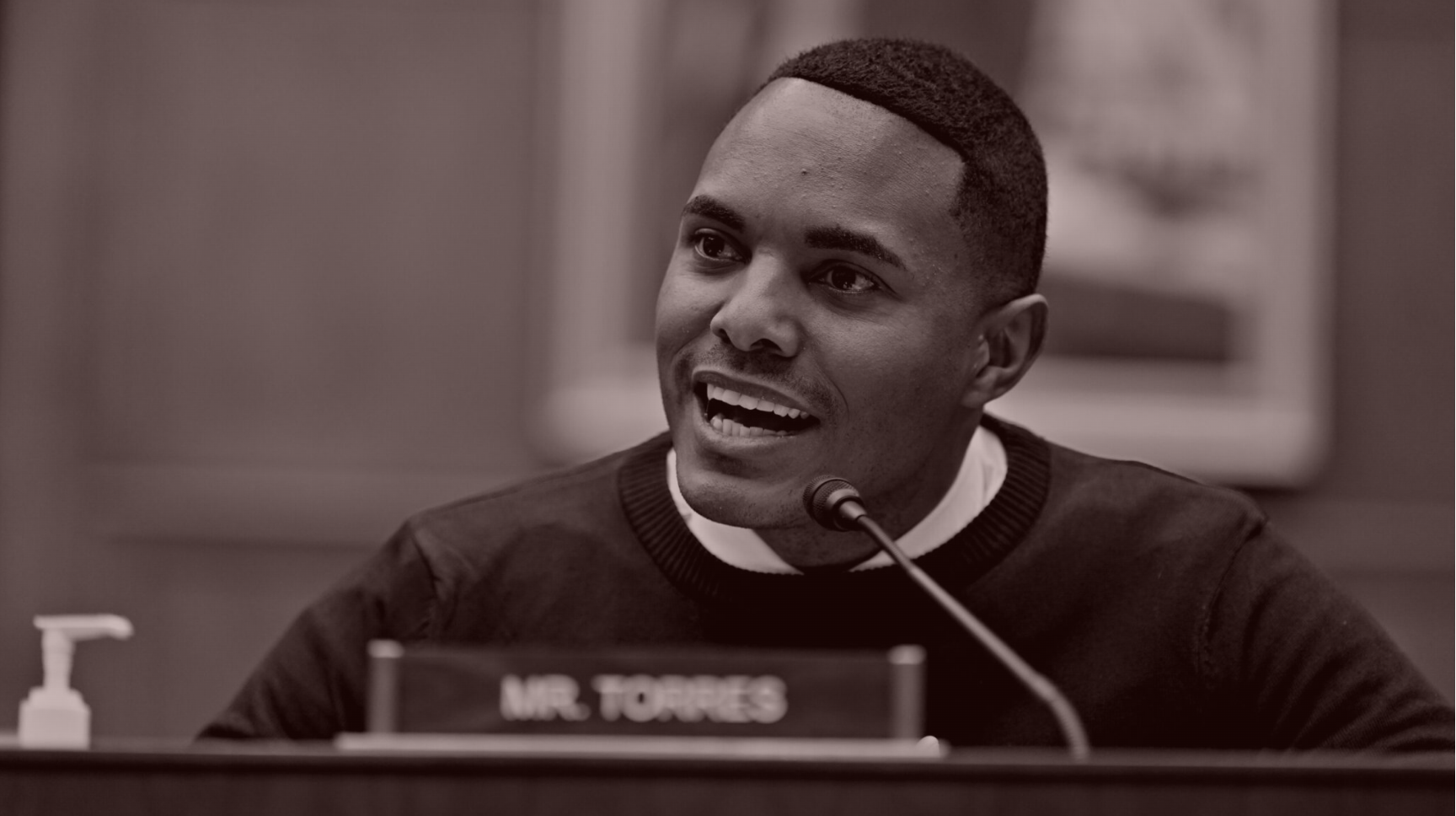
| Now, here’s Heilemann getting the readout from Reps. Seth Moulton and Ritchie Torres… |
 |
| Party Animals |
| Two up-and-coming Democratic congressmen—Seth Moulton and Richie Torres—candidly assess the great political realignment of ’24, offering some well-deserved scorn, and some timely constructive solutions, for their flailing party. |
|
|
|
| What a year the past two weeks have been. In the head-spinning days since Trump’s history-making reelection and amid his wildly unpredictable cabinet-selection process, Americans could at least count on an old standby: Democrats are once again in disarray. Various factions and personalities within the party have been reprising comforting old classics such as finger-pointing, second-guessing, blame-casting, backstabbing, and shit-talking. Still, if there’s vigorous dissension about the exact dynamics of their loss, many Dems can agree on one thing: The party has lost its way.
Among the more constructive analysts of the malaise are two young Democratic congressmen who seem (or perhaps just hope to be) destined to play a role in addressing it: Seth Moulton, of the North Shore of Massachusetts, and Ritchie Torres, of the Bronx. Aside from both being youngish men (Moulton is 46, Torres is 36), the two of them could hardly be more different in the superficial terms of identity politics. Moulton is a straight, white Iraq War veteran who holds multiple degrees from Harvard; Torres is gay and Afro-Latino and never graduated from college. But when it comes to what happened on November 5, what needs fixing in the party, and what that mission might entail, Moulton and Torres are singing from the same songbook.
In this lightly edited conversation, which has been excerpted from Sunday night’s episode of Impolitic, they offer their prescriptions for how to win as Democrats. Less preaching and more listening. Way less pandering to the left. And for the love of God, Democratic leaders, take some accountability. |
|
A MESSAGE FROM INSTAGRAM
|

|
|
Instagram Teen Accounts: automatic protections for teens
Parents want safer online experiences for their teens. That's why Instagram is introducing Teen Accounts, with automatic protections for who can contact teens and the content they can see.
A key factor: Only parents can approve safety setting changes for teens under 16.
Learn More
|
|
|
| The Party of Purity Tests |
|
| John Heilemann: Last week on MSNBC, Hakeem Jeffries said Democrats have to be clear-eyed in assessing the election, but can’t be hysterical in seeing this as some anti-incumbent wave that knocked down Democrats all across the country when the facts actually say something different. I didn’t necessarily understand his analysis. Maybe you have a better sense of it than I do.
Seth Moulton: The first thing he’s saying is that we need to be honest about what went wrong and ask serious questions, look ourselves in the mirror as a party, and see what we can do better. What I’m not sure about is his quick analysis of where we are today and how we got here, because the reality is we got wiped out across the board in this election. What I want to hear from our leaders [in the Democratic Party] is some accountability. That’s core to what I learned about leadership in the Marine Corps—you take accountability for your successes and, even more importantly, your failures.
Hakeem pointed out that the vast majority of Democratic incumbents held on to their seats on election night. By historical standards, it wasn’t some epic shellacking. The Democrats lost 54 House seats in 1994 and 63 seats in 2010. The Republicans lost 42 seats in 2018. We don’t know the final tally this year, but Democratic losses are going to be tiny compared to those numbers.
Moulton: Yeah, you’re right. It wasn’t terrible, terrible—but we were running against Donald Trump, a convicted criminal. This should have been easy; we should have cleaned up from the school board to the president of the United States, all across the country, because the Republican Party is in the midst of a civil war. Let’s be honest here, this was bad.
Almost by definition, we’ve lost touch with the majority of American voters. And when you go issue by issue—there are some where I think our policy is just out of touch with the mainstream, but there are others, including some of the most important, like the economy and immigration, where Democrats actually have a reasonable policy position. So if we have the right policies, why are we not trusted? To me, this felt like more of a cultural election. Americans just don’t believe that Democrats are listening. We have become a party of preachers. We talk down to people. If you don’t agree with us, you’re morally wrong, you’re a bad person. This is a pervasive problem in the party that hits a lot of issues that matter to American voters.
How do we effectively get rid of the impulses that drive toward purity tests, and cancel culture, and all that afflicts a small but loud part of the Democratic coalition?
Moulton: The first thing you have to do is convince fellow Democrats to just genuinely listen to American voters. It’s amazing how many people within my own party live in these ivory-tower ideological bubbles where they actually believe that most Americans agree with them. And then we need to get to a point where we can seriously have these discussions and be willing to admit our strategy didn’t work. So we need a new strategy; we need to be willing to entertain new positions on these issues. I know this is an amorphous response, but the core of it is: Stop preaching and start listening. |
|
|
|
|
| Trump got 27 percent of the vote in the Bronx—three times as much as the 10 percent that he got in 2016. As you know, the Bronx is 8.6 percent White, 28.3 percent Black, 56.4 percent Hispanic, and 3.8 percent Asian. For a Republican to get close to three out of 10 of those votes is historic. What do you think explains that?
Ritchie Torres: What I found most troubling was not only the fact of Donald Trump’s victory, but the manner in which he won. He managed to build the kind of multiracial coalition that the socialists dream of building, uniting the white working class of rural America with the Black and brown working class of urban America. For me, his greatest electoral achievement lies not so much in breaking the blue wall in Pennsylvania, Michigan, and Wisconsin, but in beginning to break the ultimate blue wall in urban America.
The gains that Trump made among communities of color are mostly a function of rejecting a status quo marked by an inflation shock and the migrant crisis. We have forgotten the extent to which inflation is a political death sentence. We had the highest in more than four decades, and the lowest-income communities of color in places like the Bronx tend to be the hardest hit by inflation. It’s often said when America has a cold, the Bronx gets the flu.
Since 2022, there’s been an overwhelming wave of migration whose impact was felt not only in border states like Texas, but also in cities like New York, where the shelter system, and the safety net, and our municipal finances were completely overwhelmed. In December 2023, Quinnipiac found that 85 percent of New Yorkers were concerned about the impact of the migrant crisis on New York. And despite clear signs of popular discontent over the migrant crisis, the Biden administration waited two and a half years before issuing an executive order restricting migration at the border, and by then, it was too late. The Republicans had won the issue.
The fundamental point is that most Black and brown voters in places like the Bronx are not progressives in the ideological sense in which the far left defines it. Most working-class people of color are moderate rather than radical, are pragmatic rather than ideological, and are concerned about the basics—public safety, affordability, and even border security.
You can understand why some of Trump’s more culturally conservative positions might be appealing. But why isn’t that overridden in the minds of more Black and Hispanic voters by the fact that, I mean, the very first day of his 2016 campaign the guy started talking about how Mexico was sending drugs and rapists. How do you explain that?
Torres: I think our operating assumption as Democrats is that Donald Trump is more repulsive to communities of color than your run-of-the-mill Republican. I’ve long thought the opposite—he’s more attractive because he’s willing to show up to places that Republicans have historically ignored, like the barbershop on Castle Hill, like Crotona Park in the South Bronx. And he’s a familiar face to communities of color. Among Republicans, he has singular appeal to working-class communities of color, just like he has singular appeal to working-class whites in rural America. He’s a turnout machine. I want to be clear, though. I feel if you remove inflation and immigration, we win the election. I think every other explanation is of secondary and tertiary influence.
The morning after the election, you tweeted that there’s more to lose than to gain politically from pandering to a far left that is more representative of Twitter, Twitch, and TikTok than it is of the real world. You’re saying, in addition to the issues on politics and culture, that the far left is a real problem for the Democratic Party.
Torres: I think the two are connected. On immigration, I feel the far left kept the Biden administration from acting decisively to rein in the crisis. When there is a metaphorical fire provoking widespread public outcry, you have to act decisively to extinguish the fire, or else the voters will decisively punish you at the ballot box. The president’s slowness in responding to the migrant crisis was its own kind of pandering to the far left. I think the far left is a gift to Donald Trump, and it’s the gift that will keep on giving until there’s a serious reckoning with the results of the election. We have to come to grips with the fact that most Americans are in the center. That’s not a statement of personal policy preference; that’s a statement of political reality.
The Republican Party is now the party of the working class, and the Democratic Party is the party of college-educated voters. How big a problem is that? And what can and should be done about it?
Torres: We have to be careful not to overinterpret the results. The Democratic brand might have been damaged but it’s not broken. We had Democrats who won competitive seats in states that Trump won. The Democratic brand is remarkably resilient.
But the nature of Trump’s victory demonstrates that we cannot take historically loyal constituencies of the Democratic Party for granted. We have to work for every single vote. We should strive to be a party that stops pandering to the far left, that represents the pragmatic priorities of working-class people, that is defined not by identities, that is a big tent rather than a battleground for a culture war. |
|
|
|
| FOUR STORIES WE’RE TALKING ABOUT |
 |
| Condé’s China Mess |
| On the skepticism surrounding Roger Lynch’s financial strategy. |
| LAUREN SHERMAN |
|
 |
|
 |
| Pod Save MAGA? |
| The latest post-election polling revelations from Echelon Insights. |
| PETER HAMBY |
|
 |
|
|
|

|
 |
|
|
|
Need help? Review our FAQs
page or contact
us for assistance. For brand partnerships, email ads@puck.news.
|
|
You received this email because you signed up to receive emails from Puck, or as part of your Puck account associated with . To stop receiving this newsletter and/or manage all your email preferences, click here.
|
|
Puck is published by Heat Media LLC. 227 W 17th St New York, NY 10011.
|
|
|
|