{{ 'now' | timezone: 'America/New_York' | date: '%b %d, %Y' }} |
|
|
Hello and welcome back to The Best & The Brightest. I’m Leigh Ann
Caldwell.
I hope everyone spent time enjoying their lives this weekend and stayed far away from social media, because it’s a really depressing, divisive, and dark place right now.
In today’s edition, news and notes on the rage coursing through Capitol Hill, which doesn’t bode well for the upcoming government funding fight. Plus, updates on a couple other consequential matters: why Senate Democrats—many of whom are perpetually frustrated with Chuck
Schumer—regret not taking a deal with Republicans on nominations, and the ongoing A.I. influence wars between the China hawks and the Trump administration.
But first… |
- Circling
the wagons: Utah Gov. Spencer Cox is trying to be the rare voice of unity in the aftermath of Charlie Kirk’s murder. While making the rounds on the Sunday shows, Cox said on Meet the Press that he was calling for sanity at the request of the White House, where “they’re worried about the escalation that’s happening out there.”
The appearance offered a remarkable contrast with Trump and his top aides, including Stephen Miller,
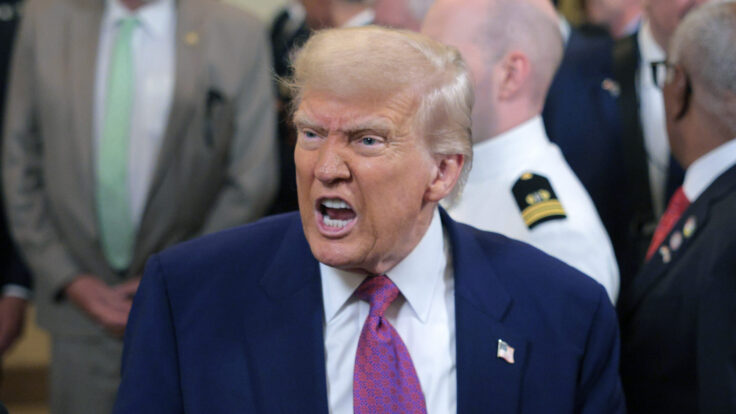
who have suggested seizing the moment to investigate or defund liberal groups, nonprofits, donors, and more. “We are going to do what it takes to dismantle the organizations and the entities that are fomenting riots, that are doxxing, that are trying to inspire terrorism,” Miller said on Fox News over the weekend. Trump, for his part, said that “the radicals on the left are the problem,” and declared on Fox that liberal megadonor George Soros should be prosecuted for
racketeering. Some MAGA influencers and members of Congress, including Rep. Derrick Van Orden, have said that anyone who mocked or celebrated Kirk’s death should be fired or their government employers defunded.
|
|
|
A MESSAGE FROM OUR SPONSOR |
Hospitals are here when you need us most – but hospitals across America are at risk of closure. |
|
|
- More
A.I. fissures: The G.O.P. divisions over A.I. that I wrote about last week are resurfacing again on Capitol Hill. Sen. Jim Banks, an enthusiastic Trump ally, is being pressured by the administration to change the language of his A.I. legislation, which is part of the annual defense bill currently being debated in the Senate. His
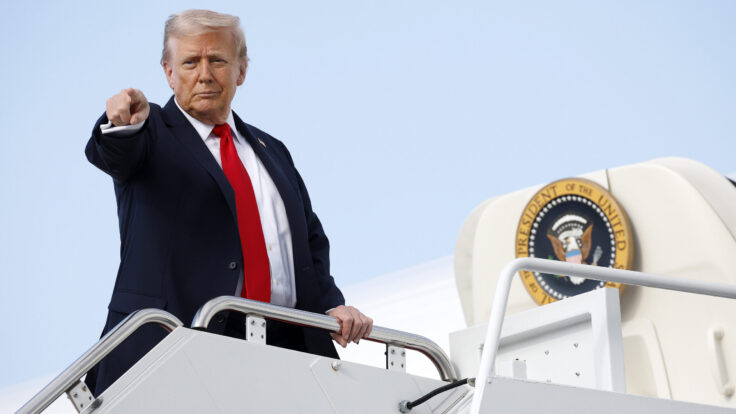
Guaranteeing Access and Innovation for National Artificial Intelligence (GAIN AI) Act would restrict exports of U.S.-made chips to U.S. adversaries, and require firms to prioritize U.S. purchasers. Naturally, this has put him at odds with Trump, who recently decreed that Nvidia could sell a less powerful version of its A.I. chips to China in exchange for a legally dubious 15 percent kickback to the Treasury.
In a statement, Nvidia spokesman John Rizzo said that Banks’s
bill, as it was originally written, isn’t necessary. “The U.S. government already has full visibility and veto power over every licensed sale—GAIN’s original scheme would have allowed private companies to exploit export controls to harm competitors, manipulate suppliers, and overrule the U.S. government’s decisions.” He added that the U.S. “has always been, and will continue to be, our largest market. We never deprive American customers to serve others.”
After an earful from Nvidia and
White House A.I. czar David Sacks, Banks is working to tighten the language of the bill—which he’s called “America First in action”—to narrow the export restrictions to impact China and U.S. adversaries. Of course, it’s unclear whether these changes will satisfy Trump and his tech allies.
|
|
|
News, notes, and recriminations aplenty from a terrible week on Capitol Hill: the fallout
from Kirk’s assassination; Thune versus Schumer; Britt versus Murphy; Democratic division over a shutdown, and more. |
|
|
It’s no secret that Congress is a pretty miserable place to work these days. Republicans are unwilling to
cross a president who demands their loyalty, offers none in return, and is happy to make or break careers at whim. Democrats, meanwhile, are furious with their colleagues across the aisle, who continue to demonstrate they’d rather bow to Trump than preserve their own constitutional powers. And yet, even by those standards, Congress was an especially toxic workplace last week.
In the wake of Charlie Kirk’s murder, both parties had a chance to walk back
from the brink. Instead, shouts echoed across the House floor following a moment of silence for Kirk, and some Republicans, including Reps. Anna Paulina Luna, Derrick Van Orden, and Nancy Mace, have outright blamed the media and Democrats for his murder. At the same time, instead of striking a bipartisan deal to advance the president’s nominees, lawmakers in the Senate fought bitterly over the process. Meanwhile, there’s only about two weeks to
go until government funding runs out. None of this bodes well for negotiations to avoid a shutdown. |
The drama surrounding the process for confirming Trump’s nominees escalated on Thursday. Democrats have tried
to make Trump’s confirmations as painful as possible by putting candidates through an achingly slow, one-by-one process that eats up an enormous amount of floor time. Republicans, meanwhile, had been threatening a Senate rule change to speed up the process, a step that would inevitably whittle away any remaining comity in the chamber. |
|
|
A MESSAGE FROM OUR SPONSOR |
Hospitals need your help to stay. Protect 24/7 care—because when the doors close, it is too late. |
|
|
There were paths that emerged at the last minute to avoid this. Republican Sen. James
Lankford and independent Sen. Angus King proposed a deal that would allow the Senate to pass 15 nominees at a time, except for judges and cabinet officials, that had all cleared the same Senate committee. There was also a proposed side deal, in which Republicans would protect the cherished “blue slip” tradition that gives home-state senators approval over judicial nominees, and prevent recess appointments, which presidents use to bypass Senate confirmation altogether.
(Trump wants to get rid of the blue slip process and make recess appointments possible.)
These deals would have been a rare moment of dealmaking and goodwill in the chamber, and demonstrated that Republicans were willing to protect some Senate authority from Trump’s demands. They also would have shown that members from both parties are still willing to find middle ground despite pressure from their base. “If we can win the day on this, it’ll be a good day for America,” Alabama Sen.
Katie Britt told me when the Lankford-King deal seemed within reach. “And America needs a good day.”
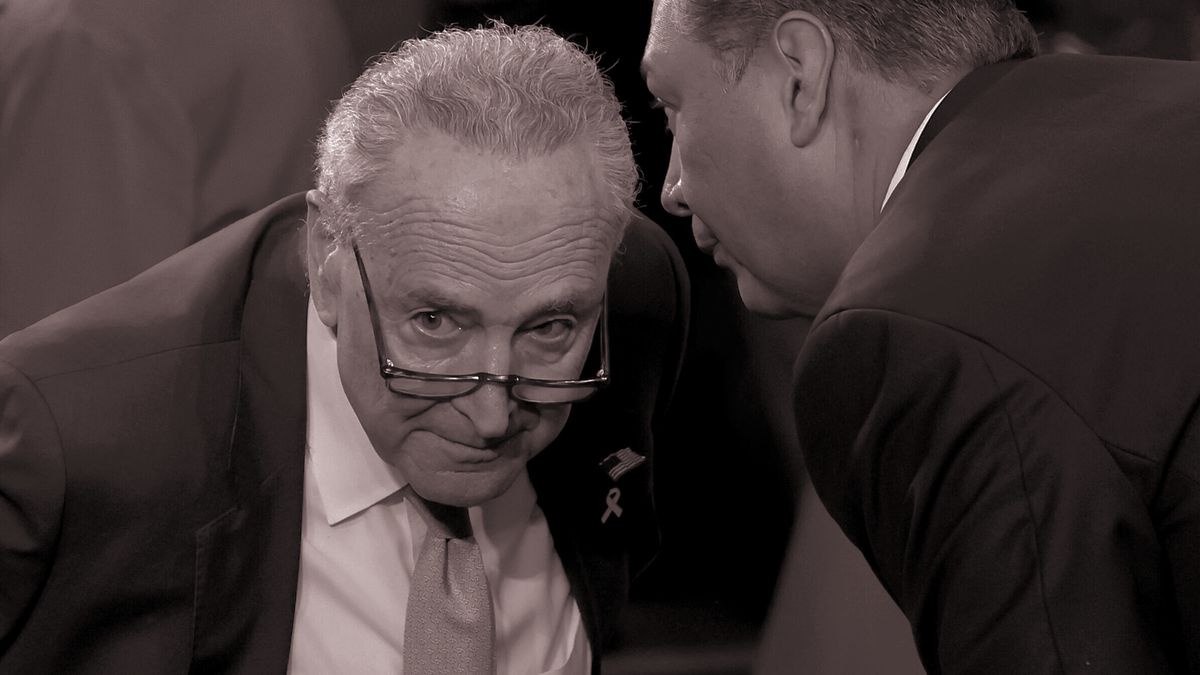
Instead, after a day of intense negotiations, the Senate’s compromise framework fell apart: Chuck Schumer didn’t trust a handshake agreement over blue slips, and pushed to delay a move on the rules until Monday. John Thune, suspecting a delay tactic, and not trusting Schumer to deliver support from his caucus, called time. “The good idea
fairy will start to circulate around here and we’ll have a whole bunch more conversations and nothing will get done,” Thune angrily said on the Senate floor.
In the end, Republican Senators were so angry at Schumer that all 53 of them—even those skeptical of altering Senate procedure—voted to advance a Senate rules change that, via a new framework, would allow dozens of unrelated nominees to get confirmed at the same time. It was another low point in a series of low points in the Senate.
“We are getting more and more mad with each other over things large and small, things the president’s doing, things that we’re not doing,” Democratic Sen. Chris Coons, who was involved in the negotiations, told me. When asked about the alternative routes not taken, he said: “I think it might have contributed to a healthier environment.” |
Blame
Games & Brinksmanship
|
Once again, some within the Democratic caucus are frustrated with Schumer for not being better prepared.
Several Democrats pointed out that Thune had been threatening to change Senate rules since July, which should have given Schumer plenty of time to negotiate a deal—or, at least, have a counterproposal ready to go. “If I were Schumer, I’d be aware that anything we get in a deal is going to be an improvement over what they’ve been trying to shove down our throats all week,” one Democratic aide said. But Democrats on Schumer’s side doubt that Thune would ever have agreed to a deal,
pointing out that he had enough Republican votes. |
|
|
Schumer has been on his back heels since he fumbled the government funding fight in March. Democrats then
were exasperated that Schumer didn’t have a plan or a demand in response to Republicans’ efforts to jam him on a government funding bill. Schumer has been working to ensure he doesn’t make the same mistakes again as Congress is on the precipice of another government funding fight.
Republicans are expected to push a partisan short-term government funding extension until November as early as this week, while Democrats are insisting that any stopgap should include measures to reduce
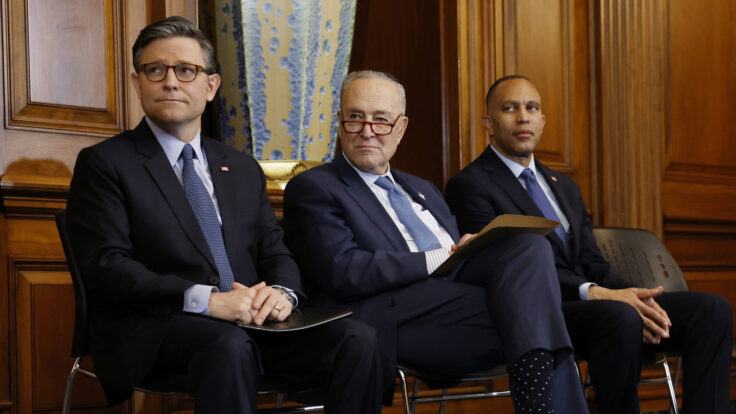
healthcare costs. Schumer and House Democratic leader Hakeem Jeffries announced this week that they wouldn’t vote for a short-term government funding bill unless Republicans “meet with us in a true bipartisan negotiation to satisfy the American people’s needs on healthcare.”
Obviously, there is scant indication that will happen. Late last week, Trump told Fox that Republicans shouldn’t “even bother dealing with” Democrats, and Thune told Punchbowl that he has no intention of striking a healthcare deal with Democrats for the sake of a stopgap funding measure. Separately, the Appropriations Committees have been working behind the scenes to preserve what’s left of the government funding process—in theory, the government is supposed to be funded through 12 separate appropriations bills crafted by the various
appropriations subcommittees—but that process is fraying, too, despite the futile efforts of the leaders of the Appropriations Committees, including Sen. Susan Collins, to make it work, or make it seem like it’s working.
The battle playing out in the Homeland Security subcommittee, where Sen. Chris Murphy is the ranking Democrat, is instructive: He is simply refusing to vote for the funding bill, or any other funding bills, that the committee has
produced. Murphy and the subcommittee’s top Republican, Sen. Katie Britt, have been at odds all year over Homeland Security funding, including a public spat on the Senate floor earlier this year. Murphy is protesting the Trump administration’s use of rescissions to claw back congressionally approved funds, and says he will not fund masked ICE agents indiscriminately picking Hispanic people off the street. He also argues that D.H.S. already got a $150 billion infusion through the One Big
Beautiful Bill—50 percent more than its roughly $100 billion annual budget—and is now paying local police salaries through the 287(g) program to deputize officers for immigration enforcement. One Democratic aide argued to me that this violates federal law, which explicitly requires state and local governments—not Washington—to bear those costs. (D.H.S. did not respond to requests for comment.)
All these little fires are hard to put out, but even more difficult to rebuild from. |
|
|
Join Emmy Award-winning journalist Peter Hamby, along with the team of expert journalists at Puck, as they let you in on the
conversations insiders are having across the four corners of power in America: Wall Street, Washington, Silicon Valley, and Hollywood. Presented in partnership with Audacy, new episodes publish daily, Monday through Friday. |
|
|
Unique and privileged insight into the private conversations taking place inside boardrooms and corner offices up and down Wall
Street, relayed by best-selling author, journalist, and former M&A senior banker William D. Cohan. |
|
|
Need help? Review our FAQ page or contact us for assistance. For brand partnerships, email ads@puck.news. You received this email because you signed up to receive emails from Puck, or as part of your Puck account associated with {{customer.email}}. To stop receiving this newsletter and/or manage all your email preferences,
click here. |
Puck is published by Heat Media LLC. 107 Greenwich St, New York, NY 10006 |
|
|
|