{{ 'now' | timezone: 'America/New_York' | date: '%b %d, %Y' }} |
|
|
Welcome back to Dry Powder. I’m Bill Cohan.
Last week, I was on hand for
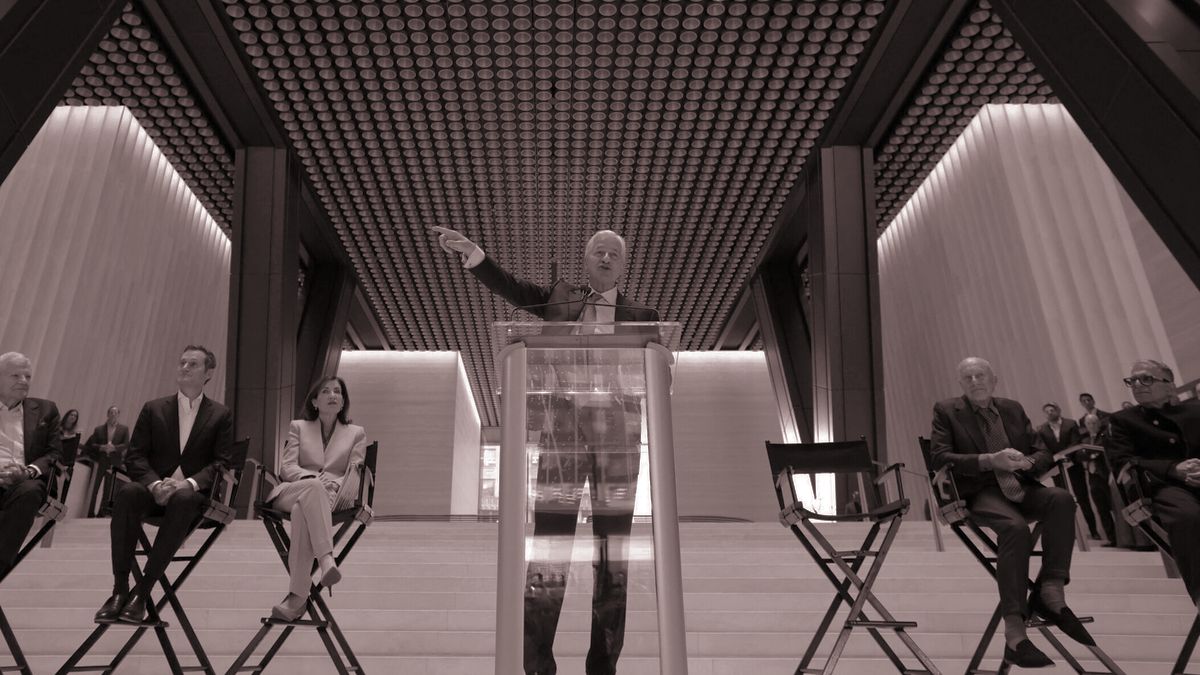
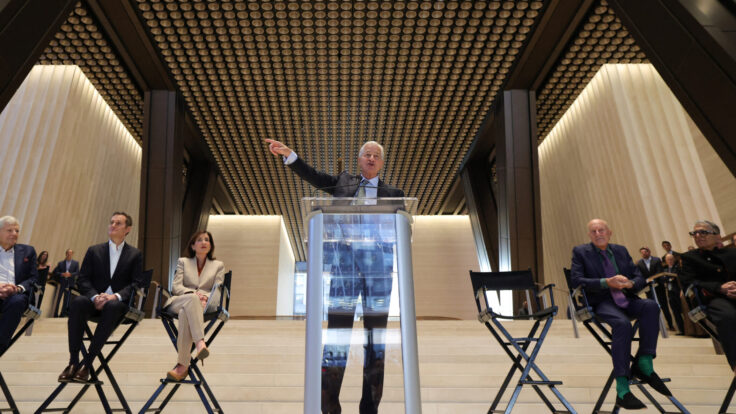
Jamie Dimon’s long-awaited ribbon-cutting ceremony at his new multibillion-dollar, Norman Foster–designed palace of American capitalism. It’s an extraordinary accomplishment—the work of thousands—and it will place the JPMorgan Chase C.E.O. literally head and shoulders above everyone else on Wall Street. But there are some important lessons for us to remember as Dimon’s bankers move in to fill its 60 floors.
But first… |
As I
noted last week, Sam Bankman-Fried’s appeal is on the docket for November 4 in the Second U.S. Circuit Court of Appeals. Coincidentally or otherwise, his father, Joe Bankman, recently appeared at the White Collar Conference—“the first-ever conference by white collar justice-impacted people for
white collar justice-impacted people”—where, among other candid disclosures, he shared the news that he considered suicide in the midst of his son’s woes. And now Sam’s mother, Barbara Fried, has broken her silence too.
Like Joe, Barbara has been a law professor at Stanford going on close to 40 years. (She is now emeritus.) In a 64-page essay, published October 21 and titled “The Trial of Sam Bankman-Fried,” Barbara makes an effective case for why her son
was wrongly convicted and sentenced. In the piece, which has the look and feel of a legal brief, she lays out the “erroneous rulings” that she believes Judge Lewis Kaplan made during the trial, and how the prosecution failed to make its case. “To convict Sam,” she wrote, “the prosecution had to prove two things beyond a reasonable doubt. The first was that the loans at the center of the alleged fraud in fact wrongfully appropriated customers’ money. The second
was that Sam acted with the intent to defraud customers.”
Regarding the first issue, she argued that “the government introduced no evidence that the loans violated the terms of service that governed FTX’s contract with customers.” On the second issue, she continued, none of the witnesses testified that Sam “said or did anything that showed he thought he was violating the law.” Meanwhile, she continued, “the prosecution presented no evidence that Sam had ever formed a plan to defraud
customers or had ever discussed doing so with his alleged co-conspirators, or established any motive for the alleged crime.”
She wrote that, “by far,” the testimony of three other members of the FTX executive team—Caroline Ellison, Gary Wang, and Nishad Singh—hurt Sam more than anything else. “All three were threatened with decades in prison for their role in the alleged fraud,” she
observed. “Each of them testified pursuant to a cooperation agreement, which all but guaranteed them minimal or no jail time in return for their testifying against Sam at trial, provided that the government, after the fact, judged their testimony to have significantly helped its case against Sam.”
She also made the point that, at the moment, the FTX estate has paid out more than $8 billion to the exchange’s former customers, and that 98 percent of former customers with qualified claims
have been paid back plus interest at a rate of 20 percent, with the balance to be paid out next year. The remaining customers will be repaid over the course of 2026, with billions left over in the FTX estate. “Sam took responsibility for the collapse from day one because, as he said at the time and many times since—he was C.E.O. and the buck stopped with him,” she wrote. “But businesses fail all the time through bad luck, mismanagement, or a combination of the two, without anyone having
committed a crime. The distinction matters profoundly to justice. For Sam, it is the difference between twenty-five years in prison and freedom.”
The gist of Barbara’s argument mirrors S.B.F.’s own at trial—that he was a lousy C.E.O. but he did nothing criminal, and that he had no criminal intent. While her essay is well-written and accessible, it remains to be seen whether it will have the slightest impact on the Second Circuit,or in the court of public opinion, or in the Oval Office. Is
it a positive omen or a stick in the eye that Donald Trump recently pardoned convicted Binance founder Changpeng Zhao—Sam’s rival, and the man whose tweets in November 2022 initiated the events that led to the collapse of FTX a few weeks later? Perhaps we’ll soon find out.
And now on to the main event… |
|
|
Dimon’s $3 billion (or maybe as much as $6 billion, really) new headquarters is the physical
embodiment of his fortress balance sheet and a metaphor for our fractional banking system. But the seeming permanence of its bronze facade shouldn’t fool old Wall Street hands, who know nothing is forever. |
|
|
This week, I jumped on the opportunity to attend the “ribbon cutting” at JPMorgan Chase’s new 60-story,
Sir Norman Foster–designed headquarters at 270 Park Avenue. It is the newest and most extravagant addition to the Midtown Manhattan skyline, and it is a beast, and that’s not by coincidence. Jamie Dimon, the architect of the renaissance of JPMorgan Chase during his more than 20-year tenure as the bank’s C.E.O., has repeatedly spoken about the bank’s “fortress balance sheet” as a way to instill
confidence in the company. Now he has a legit fortress to back it up.
In some ways, the JPMorgan Chase Building represents the evolution of the industry. Banking has always been something of a confidence game—we wouldn’t voluntarily give our hard-earned cash to a bank unless we had confidence that it would be there when we wanted to withdraw it. That’s why, especially once upon a time, banks were physically designed to instill confidence, with their granite facades, tellers behind bars,
and massive, 2-foot-thick steel vault doors.
In our modern fractional system, however, a bank is really just a stage set. Depositor money is used for loans, securitizations, collateralizations, and a zillion other transactions. The bank, of course, makes money on the spread—the difference between what they pay us for our deposits and what they charge others to borrow money. JPMorgan Chase, which has a market capitalization of more than $800 billion, has mastered this model and
will probably make $60 billion in net income this year.
The Foster-designed HQ is the physical embodiment of this extraordinary success. The ceiling height at 270 Park is so generous that its 60 floors are fitted into what should be a 100-story building. Various reports cited the cost at $3 billion. Jamie allowed at the gathering that the cost was more like $4 billion, but I’ve heard others say the final tally will come in closer to $6 billion. (A JPM spokesman declined to
comment on this topic.) The new headquarters not only has eight trading floors—each a city block in every direction—but also a food court that is designed to accommodate 19 restaurants, gigantic meeting halls, a wellness center, and a whole raft of advanced systems for HVAC, water recycling, energy use monitoring, etcetera, that make it about as “green” as a skyscraper can be. Naturally, the whole thing runs on renewable energy. It is, in other words, a sort of bunker in the sky that its 10,000
or so occupants will hardly ever need to leave.
Dimon’s bank buys and sells $2 trillion worth of securities a day, has some $2.5 trillion of deposits, and lends out $4.5 trillion of capital a year. Yes, the confidence game of banking has been undermined a few times in recent history when collective freakouts led to mass withdrawals. That’s pretty much what happened in 2008, and again during the mini bank crisis in 2023, when there was a run on Silicon Valley Bank, Signature Bank, and
First Republic Bank. And yet, the new JPMorgan Chase Tower is designed to project the strength to withstand any crisis. |
This new headquarters was a passion project for Jamie, who grew up in Jackson Heights, the descendant of
Greek grandparents who dropped out of high school. “I know they might be watching,” Jamie said, “and be proud of what we’ve done and what we’ve built here.” He collaborated closely with Sir Norman, of course, and with the bank’s head of global real estate, David Arena. The building’s developers—Jerry Speyer and his son, Rob— supervised a union workforce of thousands. While the dignitaries were assembling, including New York
Governor Kathy Hochul, the music blared, including Taylor Swift’s new hit, “Opalite”; “Golden,” from KPop Demon Hunters; and “One Kiss,” by Dua Lipa and Calvin Harris.
Somewhat surprisingly, JPMorgan Chase hired Deepak Chopra as a wellness consultant on the project. “His expertise was instrumental in shaping our new
headquarters,” Arena said, “infusing it with principles of mindfulness and holistic health and yes, indeed, joy.” Needless to say, Chopra is not the kind of person you would expect a company at the heart of capitalism to seek advice from on their massive real estate project.
Nevertheless, Chopra was the first to speak at the christening. Dressed in his trademark head-to-toe black, Chopra asked the hundreds of people assembled in the new lobby to close their eyes and take a deep breath.
“Feel the stillness beneath the movement of the city,” he said. “Feel the quiet beneath this magnificent building and sense the silence that gives birth to sound, to thought, to creation. In this stillness lies the theme of infinite prosperity.” JPMorgan Chase, he said, was a company that existed “to fulfill everyone’s dreams everywhere. … A dream that we dream alone remains a dream, but the dream that we dream together becomes reality.” Not exactly your typical Wall Street hype man.
For
his part, Sir Norman said the building was “not a conventional tower” in that it “moves twice the amount of fresh air that the codes would normally dictate” and is “very much about natural light and connecting to the natural realm.” The building is carbon neutral and insulated with “three layers of glass” to conserve energy. He also noted that the “town hall space” halfway up the tower is the same size as the gargantuan lobby. “All of these are without precedent,” he said, “It’s really the
workplace of the future, today.”
In a nod to the importance of instilling confidence, Sir Norman said the foundation of the new buildings goes down to the “bedrock of New York.” The bank destroyed, and then rebuilt, the railroad concourse below the building, and is also rebuilding the Park Avenue viaduct that allows traffic to bypass Grand Central Station. He also acknowledged the building’s “unusual” bronze cladding, describing the material as “timeless in its qualities, in its
endurance, … and associated with works of sculpture”—all of which, of course, speaks to Dimon’s fortress metaphor. The bank, after all, traces its lineage back to 1799, more than 225 years ago if you count the countless mergers over the decades that began with the Manhattan Company, a water utility that became a bank. (That’s why the Chase logo looks like a water pipe.)
Sir Norman also noted the materials in the building—the glass, the wood, the stone—were fashioned by hand into the new
skyscraper, “and that means hundreds or thousands of people have contributed to this building.” He also likened the huge lobby to the traditional “banking hall” in branches, which were “welcoming” and “generous,” although that analog age has been replaced by a digital age of banking. But, he said, “It is here symbolically” and “associated with that extraordinary tradition.” You get the idea. |
In all, the new headquarters is very much the ultimate expression of Dimon’s dominant position on Wall
Street—his lair at the top, into which he hasn’t yet moved, is said to be the highest office space in Manhattan. But despite the symbolic nature of this extraordinary building and its extraordinary cost, we must always remember just how fragile the whole system is and how vulnerable it remains at any moment to human emotions. Next door to 270 Park Avenue is 383 Madison Avenue, which once served as the billion-dollar headquarters of Bear Stearns, the 85-year-old investment bank that JPMorgan
Chase swallowed up in March 2008, as the financial crisis was unfolding. Given the purchase price that Jamie paid for the carcass of Bear Stearns, JPMorgan Chase got 383 Madison for free.
As the old 270 Park was being taken down piecemeal and then rebuilt, much of the JPMorgan Chase workforce, including its investment bankers, was housed next door at 383 Madison. Jimmy Cayne, the longtime C.E.O. of Bear Stearns until close to the bitter end, loved 383
Madison, which had been completed in 2002. He took pleasure in every exacting detail of the building, just as Dimon has done at the new 270 Park. But word is that the JPM bankers hated 383 Madison and found it dysfunctional. Now that 270 Park is all but completed, 383 Madison is being gutted and rebuilt—all the evidence you need, I suppose, that nothing is ever as permanent as we’d like to think. |
|
|
Join Puck’s chief political columnist, John Heilemann, as he roams the corridors of power and influence in America on this
twice-weekly interview show, taking you beyond the headlines with the people who shape our culture: icons and up-and-comers, incumbents and insurgents, moguls and machers in the overlapping worlds of politics, entertainment, tech, business, sports, media, and beyond. The conversations are rich and revealing, unrehearsed and unexpected… and reliably impolitic. A Puck-Audacy joint, new episodes drop every Wednesday and Friday. |
|
|
Puck’s daily political newsletter from Washington on what’s really happening in this town, from the White House to the Pentagon
to Capitol Hill, K Street, and the campaign trail. |
|
|
Need help? Review our FAQ page or contact us for assistance. For brand partnerships, email ads@puck.news. You received this email because you signed up to receive emails from Puck, or as part of your Puck account associated with {{customer.email}}. To stop receiving this newsletter and/or manage all your email preferences, click here. |
Puck is published by Heat Media LLC. 107 Greenwich St, New York, NY 10006 |
|
|
|