Happy Sunday and welcome back to Dry Powder. I’m Bill Cohan.
In tonight’s
issue, the latest scholarship on the roiling debt crisis at Saks Global, which has finally jumped the shark and attracted the eagle-eyed interest of the singular Jim Grant. It’s fascinating to see how the debt scholars of our time layer their analysis atop what the hedge fund community has been saying for a while now: that Saks Global is in big trouble. Such has been the velocity of the meltdown that Wall Street wags have referred to Saks Global’s $2.2 billion junk bond as an
NCAA bond—as in “no coupon at all”—given concern that the bond, now trading for 26.5 cents on the dollar (on July 29), and yielding more than 60 percent, wouldn’t make its first interest payment. (But it did.)
More on that below the fold. But first… |
-
The Figma I.P.O. shanda: You’d think the geniuses at Morgan Stanley, Goldman Sachs, Allen & Co., and JPMorgan Chase would know how to price an I.P.O. after all these years. But they sure blew it big time with Thursday’s Figma public offering, although you wouldn’t know it based on all the glowing headlines in the financial press.
For the uninitiated, Figma is a collaborative software that allows users to design, create, and test websites, mobile apps, and other digital
products. In 2022, Adobe, the industry leader, offered to buy Figma for $20 billion, but the deal was terminated because of regulatory concerns. (Thanks, Lina Khan?) Last year, Figma was valued at $12.5 billion when employees were permitted to sell some shares. On Wednesday night, the lead underwriters at Morgan Stanley and Goldman priced Figma at $33 a share, at the high end of the range they had previously determined, and a price that valued the company at $19.5 billion—nearly
what Adobe had offered three years earlier. For that advice, the underwriters split fees of nearly $55 million (with more to come after they exercised the overallotment option).
In the I.P.O., at $33 per share, the company raised $1.2 billion, $393 million of which went to Figma itself and $771 million to a group of selling shareholders, including co-founder Dylan Field and venture capital firms Kleiner Perkins, Index Ventures, Greylock Partners, and Sequoia Capital,
among others. Field’s co-founder, Evan Wallace—they were both students at Brown when they founded the company in 2012—was not a seller in the I.P.O. He left the company in 2021. (And he was smart not to sell, at least at the moment.)
We all know the way the game is played with a hot I.P.O. It has to be priced high enough so that the company and the selling shareholders feel like they are making out, but low enough to entice the new institutional and retail shareholders
buying in at the I.P.O. price, thereby creating the desired pop. But Figma was so poorly priced by the underwriters that the first day “pop” was outrageous. The Figma stock opened Thursday at $85 a share and then closed at $115.50, up a whopping 250 percent for the day.
Most of the headlines heralded the stock’s gargantuan move up, but that was actually a total fail by the underwriters, who not only misjudged the market, but also left hundreds of
millions of dollars on the table for both Figma and its selling shareholders (although, since they didn’t sell all their stock, they benefitted from the price increase, at least on paper). I’d be pissed if I were Dylan Field, that’s for sure—although not that pissed. Instead of the $20 billion that Adobe offered for Figma, the company is now valued at $59 billion; Field is still worth more than $6 billion. But the big, recent winners of this underwriting fiasco were the investors who
bought in at $33 a share, assuming they could get an allocation. Their stock was trading around $122 a share on Friday afternoon, up some 257 percent from the I.P.O. price. Other big winners include the V.C. players on Figma’s cap table: Index (with stock worth around $8 billion now); Greylock ($7.5 billion); Kleiner ($6.6 billion); and Sequoia ($4.1 billion).
Another big winner is Iconiq Capital, a venture capital firm that supposedly invests money on behalf of billionaires Jack
Dorsey and Mark Zuckerberg. One of its partners, Will Griffith, has been giving interviews right and left in the wake of the Figma I.P.O. He started investing in Figma in 2013, paying 9 cents a share. You can do your own math on his gains.
|
Plus, here’s my newest Puck partner, A.I. correspondent Ian Krietzberg, on another head-spinning
valuation story… |
|
|

| Ian Krietzberg
|
|
- Anthropic’s cash burn:
OpenAI rival Anthropic is reportedly in talks to raise a fresh round of funding, somewhere in the vicinity of $3 billion to $5 billion, at a $170 billion valuation. The pace of growth for that valuation is somewhat mind-boggling. In early 2024, Anthropic raised a Series D at a $18.4 billion valuation. This March, the company closed a $3.5 billion Series E at a $61.5 billion post-money valuation. It’s been about four months since then, and the valuation has roughly tripled.
(Anthropic declined to comment.)
This reminded me of a conversation I had recently with a venture capitalist, who explained that for V.C.s focused on foundation model companies, like Anthropic, the pipeline is “very capital-saturated, and many of these companies are operating at immense burn rates. There’s not a lot of clarity around long-term pricing power, given A.P.I. commoditization and how costly training cycles can be on an ongoing basis.” Indeed, Anthropic
reportedly expects to burn around $3 billion this year alone.
They went on to explain that, at this stage in the frenzy, they’re more interested in infrastructure players—in other words, the next Nvidia. “There’s immense opportunity, but there’s also immense incumbency; competition in the structural layer is brutal, but
it’s fragmenting,” they continued. “Nvidia’s moat is real, but it’s not total; it’s a standard today, but it’s not the ceiling, especially not for the next generation of compute workloads.” You know the old saying: During a gold rush, sell shovels.
(Sign up for Ian’s private email, The Hidden Layer, by clicking here.)
|
|
|
It’s worth remembering, of course, that one of the seminal early investors in the company was none other than
the incarcerated Sam Bankman-Fried, who invested $500 million in Anthropic at roughly a $4 billion valuation. Over time, his stake got diluted down to around 8 percent; that 8 percent stake would be worth almost $14 billion today. But the FTX estate sold most of Sam’s Anthropic stake for about $890 million in March 2024.
Anyway, on to the main event… |
|
|
The latest Wall Street scholarship on Saks Global—from the heralded Grant’s Interest
Rate Observer to Pari Passu to Covenant Review—offers a tragic and epic narrative of decadence and “consensus at gunpoint.” |
|
|
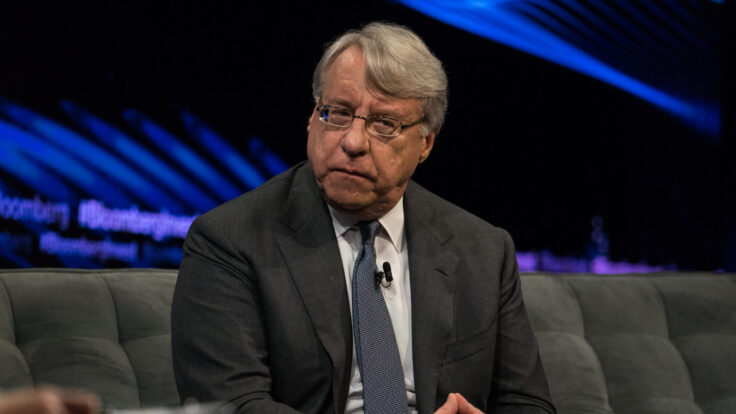
Jim Grant’s Grant’s Interest Rate Observer is a bible of sorts for the highly
sophisticated slice of Wall Street focused on the machinations in the bond market. That should be everyone, of course, because what happens in the bond market is often the leading indicator of where the financial markets are headed. And where the financial markets go, economic policy soon follows, as Donald Trump discovered after “Liberation Day” and his nutty trade war, which is nothing more than another sales tax on American consumers. (But let’s talk about
how much money the tariffs are generating, right, Donald?)
In any event, when Grant’s dials in on a topic, it is usually so insightful and prescient that I can’t recommend it highly enough. For instance, Grant’s was an invaluable source while I wrote my book about GE, Power Failure, given its numerous insights about the trouble brewing at GE Capital long before they nearly toppled the company during the 2008 financial crisis. In his newsletter, Jim kept
warning Jeff Immelt about the financial risks floating around; either Jeff didn’t read Grant’s while he was GE’s C.E.O., or he ignored the warnings, nearly to a fault.
Naturally, I’ve been waiting to see whether Grant’s was going to weigh in on the latest “liability management exercise” now underway at Saks Global, the overleveraged luxury retailer that seems to be teetering on the edge of bankruptcy, which I’ve been preoccupied with for
several weeks now. (It’s not just me, either. The Saks debt crisis came up aplenty during the recent private Puck event that I participated in at the tony Westmoor Club on Nantucket.)
It’s pretty rare for a $2.7 billion merger, financed with a $2.2 billion bond offering, to come a cropper as quickly as the Saks Global bond did—thereby forcing the liability management exercise engineered by the dynamic duo of David Nemecek, at Kirkland & Ellis, and Jamie
Baird, at PJT Partners. Such has been the velocity of the meltdown at Saks Global that Wall Street wags were referring to the Saks junk bond as an NCAA bond—as in “no coupon at all”—given concern within the hedge fund world that the bond, now trading at 26.5 cents on the dollar (on July 29) and yielding more than 60 percent, wouldn’t make its first $120 million interest payment on June 30. But the Saks Global management team, led by Marc
Metrick, decided to make the payment: They sent the much-needed cash out the door to bondholders, when there were definitely other paths that could have been pursued. |
On August 1, Grant’s finally turned its attention to Saks Global. James Robertson,
an analyst at Grant’s, wrote that the “shock value” of Saks’ liability management exercise may have exceeded the rapidity of the bond’s price collapse in terms of its “speed and ferocity.” He then quoted Ross Hallock, the head of high-yield research at Covenant Review, an industry rag, who said, “I would say that the Saks L.M.E. is one of the most severe liability management exercises I’ve seen. It’s virtually unprecedented to have an L.M.E. of this size
within seven months of the issuance of the notes. And I think it’s reflective of a trend toward more-severe L.M.E.s.” Robertson then launched into a fascinating intellectual discussion about the purpose of L.M.E.s and whether they represent “progress” or “decadence.”
They do both, no surprise. They represent progress in the sense that they allow the debtor to buy more time to pull itself out of its financial death spiral. If it can, as Carvana once did, then both creditors and equity
holders end up happy. If it can’t, then all the L.M.E.s in the world won’t save creditors in a bankruptcy or create value for equity holders. Meanwhile, L.M.E.s are decadent to the extent that they represent a serious failure by the par buyers of debt to stand up for their rights at the time they agree to buy the debt from the company in the first place—in this case last December, as the Saks Global deal to buy Neiman Marcus Group was closing. Instead of being seduced by the 11 percent
coupon that Saks Global was offering, the creditors should have demanded tougher covenant protections that would have stymied the vicious L.M.E. that Saks perpetrated here.
But they didn’t demand these protections last December, so they get what they deserve in August. “Yet lenders, in growing numbers, choose to participate [in a L.M.E.], however predatory the terms may appear to a principled onlooking journalist,” Robertson wrote on Friday. “With higher participation rates, borrowers can
amend more of the indenture than they otherwise might. And in the amending, they can inflict more punishment on holdouts than they otherwise could.” He then borrowed a concept from his peer at Covenant Review: This whole mess represented “consensus at gunpoint.” Added Pari Passu, another restructuring newsletter, “This deal points to things getting worse.”
What will Saks Global do with the time that Baird and Nemecek have bought for the company? Saks Global has done a
perfectly lousy job of sharing information about its financial performance, which, of course, is its right as a private company. It refused to make the bond exchange documents available to me. And I had to get the original bond prospectus from a source, since the company refused that request, too. (Not a good idea, Marc, but well within your legal rights…) But it also has public debt and thousands of vendors that would like to know how things are going. Grant’s wrote that, “at last
report,” Saks owed some $275 million in overdue payments to its vendors, and as I reported last week, it’s already started delaying payments to new vendors beyond the new 90-day payables schedule it imposed on Valentine’s Day.
For what it’s worth, Bloomberg reported that June sales fell by 28 percent at Saks and by 26 percent at Neiman Marcus and Bergdorf Goodman. Meanwhile, sales increased 13 percent at Bloomingdale’s, Saks Global’s main competitor. One of my faithful correspondents
wrote that on a recent Saturday tour of the women’s department at Bergdorf, on Fifth Avenue, the “inventory” was “bare,” with only two sizes “at most” on display. Both Moody’s and S&P are poised to declare the $2.2 billion bond in default once the exchange offer closes in two weeks.
Moody’s predicts that Saks’ debt to EBITDA ratio will be more than 10x by the end of 2025—a scary proposition indeed for the companies’ vendors, debt holders, and equity investors. Mickey
Chadha, the Moody’s analyst, is not sanguine about the company’s long-term prospects. “Although the injection of $600 million in new liquidity is a near-term positive as it will alleviate the company’s near-term liquidity pressures, we do not view this to be a longer-term solution unless Saks Global can grow its topline, meaningfully improve earnings, and improve free cashflow generation,” he wrote. |
I wish I could be more optimistic about the prospects for Saks Global. After all, its flagship Saks Fifth
Avenue and Bergdorf Goodman stores along Fifth Avenue are an iconic part of New York. And Neiman is a beloved brand throughout the country. But Saks Global vastly overpaid for Neiman Marcus Group, which itself had emerged from bankruptcy a few years earlier, and then used too much leverage to buy it and not enough equity. (I’m told Apollo offered Saks Global a different debt deal that would have required more equity, but instead Saks Global went with the public bond offering, underwritten in
large part by Jefferies.)
By the time the debt narrative is juicy enough for Grant’s, it could be too late. The Saks bondholders let themselves be fleeced of their protective covenants in exchange for a few extra points of interest. And now they’ve thrown good money after bad as part of an aggressive exchange offer that could have been prevented from happening last December. If you ask me, the two sides deserve each other. I don’t see how the equity investors—Amazon, Salesforce,
Rhône Capital (my old Lazard buddies), Insight Partners, Abu Dhabi Investment Council, and Abrams Capital, etcetera—make money here. I also don’t see how the debt holders make money, even after the creditor-on-creditor violence they heaped on each other as part of the exchange offer.
I also worry about the smaller vendors, for whom selling to Saks must have once been considered a major accomplishment, and whether they will get paid. When all is said and done here, this will make one
helluva Harvard Business School case study. Just not the one that Metrick wants. After all, as Mark Twain said, history doesn’t always repeat itself, but it often rhymes. Old Wall Street hands will recall that Metrick’s late father, Richie, a longtime Bear Stearns executive, played a key role in rescuing the investment bank from the jaws of bankruptcy in March 2008. But that wasn’t enough to save its independence in the end. |
|
|
Join Puck’s chief political columnist, John Heilemann, as he roams the corridors of power and influence in America on this
twice-weekly interview show, taking you beyond the headlines with the people who shape our culture: icons and up-and-comers, incumbents and insurgents, moguls and machers in the overlapping worlds of politics, entertainment, tech, business, sports, media, and beyond. The conversations are rich and revealing, unrehearsed and unexpected… and reliably impolitic. A Puck-Audacy joint, new episodes drop every Wednesday and Friday. |
|
|
Puck’s daily political newsletter from Washington on what’s really happening in this town, from the White House to the Pentagon
to Capitol Hill, K Street, and the campaign trail. |
|
|
Need help? Review our FAQ page or contact us for assistance. For brand partnerships, email ads@puck.news. You received this email because you signed up to receive emails from Puck, or as part of your Puck account associated with {{customer.email}}. To stop receiving this newsletter and/or manage all your email preferences, click here. |
Puck is published by Heat Media LLC. 107 Greenwich St, New York, NY 10006 |
|
|
|