 |
 |
|
Three years ago, just one week before the election of Joe Biden, I reached out to Sam Bankman-Fried with an interview request. I had come across his name on an F.E.C. filing alongside a Stanford postal address. And so yeah, I was a little curious what this kid, my age, was doing donating $5 million to a super PAC. “Hi Sam! Was hoping to be in touch with you on something,” I wrote.
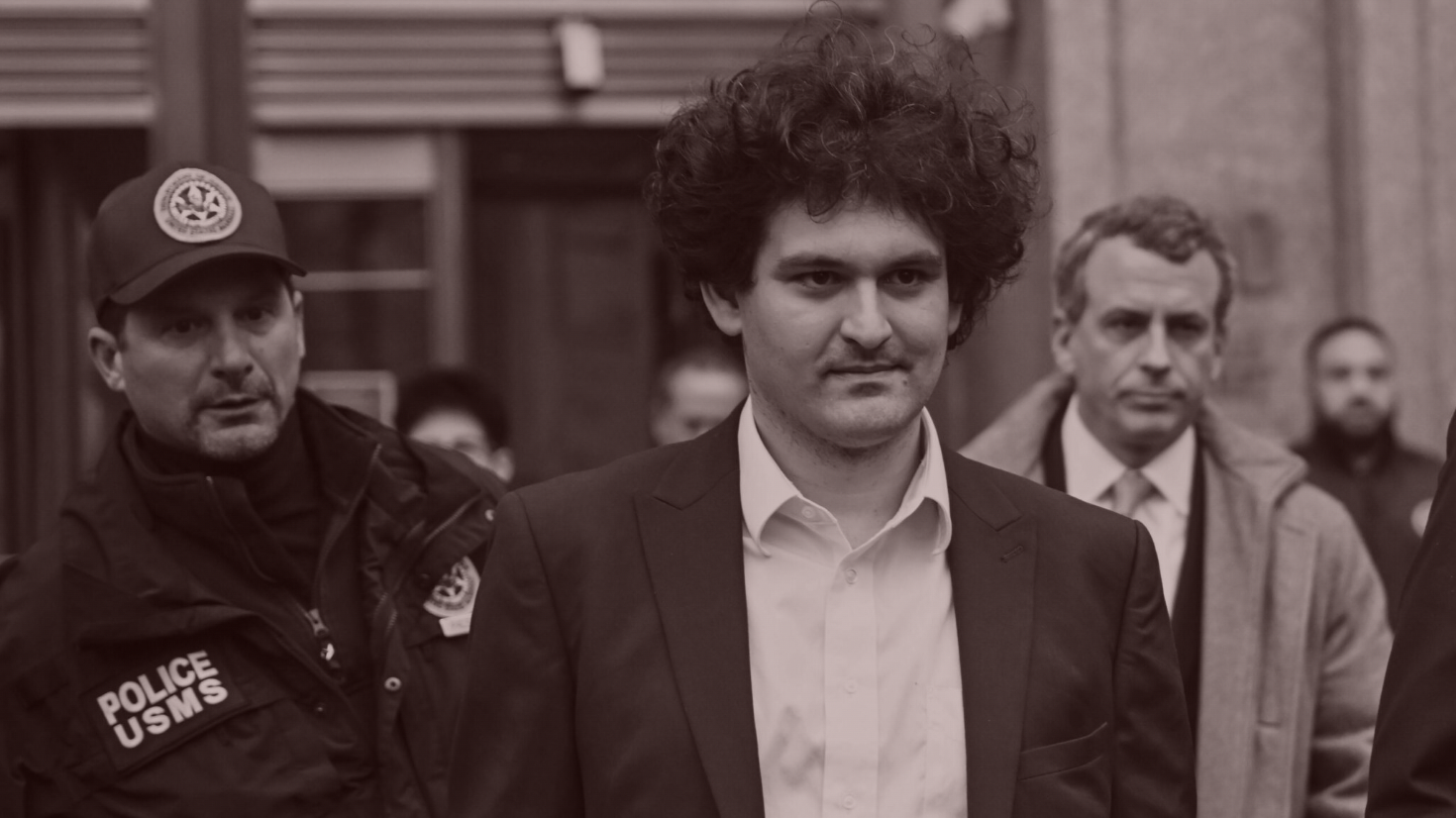
Forgive the nostalgia, but this weekend I reread the notes from that off-the-record November 2020 call, one of his first ever with a journalist. I’m now on the way to New York to watch that same person face a media circus and, more importantly, a criminal jury that will decide whether to convict him for orchestrating an alleged multi-billion dollar fraud. In today’s edition, I look at why exactly Bankman-Fried made the decision to fight—and how it could be almost rational… or “rational.”
Also in today’s edition, some exclusive news on a call being organized by Reid Hoffman this week to squeeze No Labels out of their money, along with news on Big Tech rabble-rouser Luther Lowe’s new gig.
But first…
|
|
|
- About that S.B.F.-Trump deal…: Can everyone please dispense with the fiction that S.B.F. seriously tried to get Trump to bow out of the 2024 race for a $5 billion bribe? That anecdote, vaguely reported by Michael Lewis in his new book—and then exaggerated by both pro-Trump and anti-Trump partisans with agendas, and summarily swallowed by a search-traffic hungry press corps—is more-or-less bogus. To be clear, all Lewis reported is that S.B.F. “got a number”—likely from some low-level Trump wiseguy intent on trolling the media. Who among us can’t “get a number” for something absurd like that if you rummage through your phone contacts?
“I remember it just being floated as an aside, as a joke,” one person familiar with the matter told me. Another source described it thusly: “It wasn’t really real. It wasn’t particularly fake. Just like these insane out-there conversations were commonplace.” The translation: This tells us something real about how S.B.F. and some of his aides viewed the world—as nakedly transactional, and possible to gamify with a big enough check. But no, there was no serious movement on this whatsoever, and it was more of a thought experiment for effective altruists than a plan worthy of Lewis repeating it on 60 Minutes as fact.
|
 |
| S.B.F.’s Expected Value Calculation |
| There are two reasons why Sam let this get to trial, and why he thinks he has a chance at a miraculous outcome. Plus: Reid Hoffman’s war against No Labels, and a new hire at Y Combinator. |
|
|
|
| In early 2022, when FTX was growing exponentially and his own powers seemed virtually limitless, Sam Bankman-Fried offered what is some of the best insight into his mathematical, sometimes alien view of the world. “Let’s say there’s a game,” the economist Tyler Cowen asked him in an interview. “51 percent, you double the Earth out somewhere else; 49 percent, it all disappears. Would you play that game? And would you keep on playing that, double or nothing?” S.B.F. responded, essentially, that of course he would keep flipping that coin, forever and ever if he could. Sure, he might destroy the world, but he also might double it, whatever the hell that means, entering into “an enormously valuable existence. That’s the other option.”
That now infamous exchange has been on my mind recently as I’ve fielded questions about why S.B.F. decided to go to trial this morning, the first day of a six-week ordeal that could end with decades in prison. Some former friends and allies—there aren’t many current ones—have been amazed that there wasn’t a last-minute settlement. Why would S.B.F. not plead guilty for a lesser sentence, given the overwhelming evidence from first-hand witnesses and plenty of Signal chats that bolster the fraud and conspiracy charges against him? Why does Sam feel the need to flip the coin when his odds are so objectively terrible?
This excessive hubris, even in the face of dire circumstances, may be the best manifestation yet of the personality—the infatuation with risk, the Billions-inspired love of schemes or “plays” as his team called them, and blithe ignorance to unpleasant outcomes—that led to the mayhem at FTX. “If a deal comes now, it will be a good one. Parents off, Gabe [Bankman-Fried] off, under 20 years in a nice place. No one wants a trial except Sam,” one friend of the family wrote to me last week. “I guarantee he is eager to bring the truth out and is more confident than one would expect.” |
|
A MESSAGE FROM OUR SPONSOR
|
 |
| Revisiting Nuclear as a Clean Alternative
In the wake of geopolitical conflict and volatile energy prices, policymakers are rediscovering appeal in nuclear power. As a low-carbon fuel source, nuclear could be a viable bridge to a renewable energy future, while driving demand for uranium and related materials.
Explore the Global X Uranium ETF (URA) for targeted exposure to this emerging trend.
|
|
|
|
|
| Prosecutors said Tuesday that a plea agreement was never offered, but even if there was one, this trial is happening for two reasons. First, don’t underestimate S.B.F.’s ego. Sam, as I’ve learned over three years of conversations with him, is supremely confident in himself, and a steadfast believer that plenty of the people around him—lawyers, other executives, some reporters—are idiots, or at least can be manipulated. The decision to not settle, in my view, is rooted partially in a belief that he can somehow weasel his way out of this, just like he has weaseled out of so much before.
But it is also a belief, some people close to him have posited, in the math—in the expected-value calculus that undergirded so many of S.B.F.’s choices and eccentricities. In short, is there a sufficient probability that he can find a single juror in the courtroom who believes he is innocent, unfairly targeted, or even just plain sympathetic? “I wonder if it’s his insane views on risk. Like, he might just think the E.V. is there and be committed like that,” one (former) friend said. “He might think a 20 percent chance of zero [time] is better than a 100 percent chance of 20 years.”
Only Sam can answer just how much Expected Value he would extract during prison—though in my time with him, I’ve always gotten the impression that he cares more about his reputation than about prison time. But let’s be real: Whether he gets acquitted probably doesn’t really matter, reputationally. How many people convicted Elizabeth Holmes before a jury even heard a single witness? There is little absolution coming based on the preponderance of information that has been unearthed about FTX, Alameda Research, etcetera. Whatever the jury finds is unlikely to change that impression etched into our culture. Perhaps Sam thinks that flipping the coin, as weighted as it may be, is the only option he has left.
The jury, which will be seated today, is scheduled to hear from a battery of witnesses including FTX customers who lost all of their money (including one victim in Ukraine), as well as some FTX investors who will describe how they were defrauded. But the truly heartstopping moments will likely come from Caroline Ellison, the former co-C.E.O. of Alameda, whose testimony could be particularly searing given her past romantic relationship with Bankman-Fried, although the defense will try desperately to poke holes in her credibility. The jury will also hear from FTX co-founder Nishad Singh, who was among the most universally liked executives at the company, a record-setting marathoner always armed with “big hugs,” and there is a hope from Sam critics that Singh’s testimony will be particularly spellbinding. Along with co-founder Gary Wang, both of them have pleaded guilty to charges including wire fraud and conspiracy to commit wire fraud, securities fraud, and money laundering. All three have been preparing their testimony for months, and it will be brutal.
Other witnesses could include everyone from Ramnik Arora, the S.B.F. lieutenant in charge of product and investor relations, to Dan Friedberg, the company’s general counsel, as well as Can Sun, another former FTX lawyer; Natalie Tien, S.B.F.’s assistant; and Jen Chan, the company’s C.F.O. Two witnesses have been promised immunity in exchange for their testimony, according to prosecutors. Lawyers have traded plenty of speculation about who those could be. |
|
|
| Sometime in early November, we’ll get an answer to the biggest question of the trial: whether Sam Bankman-Fried testifies, himself, which might not be decided until fairly late in the process. Normally, defense lawyers tell their client not to take the stand—although, obviously, S.B.F. has been doing whatever he wants, his lawyers be damned, ever since his Substack era. But in this case, he is considered to be more likely to testify given the volume of co-conspirators laying blame at his feet. Part of the defense strategy telegraphed by S.B.F.’s lawyers is to argue that the then twentysomething founder was merely careless, rather than conniving. Putting him on the stand might help make their case—though it is obviously exorbitantly risk.
And then there are the parents, Joe Bankman and Barbara Fried. Could they testify? Joe and Barbara are essentially part of Sam’s legal team, but plenty of people also hold them responsible for FTX’s risk-taking in Hong Kong and excesses in The Bahamas. And what about Sam’s brother Gabe, who oversaw his political and philanthropic operation, even though the campaign-finance charge is no longer on the table?
One person who worked for FTX told me that Joe and Barbara’s fall from grace made him more sympathetic to Sam. “I mean, I think it’s sort of worked on me in viewing him more favorably. Kinda like a variant of the ‘affluenza’ defense,” this person told me. “I’ll be honest, I’m pulling for him. Not that I think he has much of a chance of avoiding a long sentence.”
That’s the consensus, of course: that Sam is screwed, and that the media circus that has arrived in New York for the next six weeks is there to witness a public flogging. I asked one other person who has worked with Sam, and who remains in pain from the whole experience, whether they would be paying close attention to the trial. “I’m not sure the schadenfreude is worth it,” they told me. |
|
|
| Hoffman’s War on No Labels |
|
| For the last year, LinkedIn founder Reid Hoffman and his team have been waging a private war with his fellow centrists to abandon their support for No Labels, the third-party political group that has been trying to organize an independent ticket to run against Joe Biden and Donald Trump in 2024. Hoffman, one of the biggest contributors to Democratic causes, and the de facto leader of the Silicon Valley donor community, has lately become hyper focused on what he fears could be a spoiler campaign.
On Wednesday, Hoffman plans to host a Zoom call, in partnership with the rival third-party group Third Way, with a number of No Labels donors and ideologically sympathetic donor targets in an attempt to convince them to not support the group. In an email to “friends, allies and fellow patriots,” last week that made its way to me, Hoffman promised a “discussion on our approach to the 2024 election.”
He continued: “As we look toward 2024, I’m increasingly struck that this fight to safeguard our democracy is a multi-front battle in ways that are distinctive from past cycles, bringing together new coalitions of people and organizations (and also fracturing and dividing some who were previously allied).”
That parenthetical is the subtext of the get-together. Hoffman will argue that if these donors want to support pragmatism and centrism, then there are plenty of ways to do it, such as Hoffman’s Mainstream Democrats project that targets A.O.C.-aligned Democrats in primaries, or by supporting Hoffman’s ranked-choice voting initiative, or by reelecting Biden, whom he views as a mostly centrist president. Hoffman’s political aide, Dmitri Mehlhorn, along with representatives from Third Way, will then make the case for why they believe No Labels absolutely cannot win.
Hoffman, I am told, donated the first $1 million to the effort, organized by Third Way, to cripple the No Labels bid, and other donors have followed. So far, Third Way has used that money for legal research, media publicity and general sniffing-around to, hopefully, convince No Labels C.E.O. Nancy Jacobson to leave their ballot line blank. For instance, one thing the group has tried to do, with Hoffman’s help, is learn what candidates No Labels is courting to run on its ticket. (The group has had meetings with Joe Manchin, Larry Hogan, and Susan Collins, as my partner Tara Palmeri has reported.)
Hoffman has unique credibility with his peers as the spear tip of Silicon Valley’s Democratic resistance, serving as a sort of port-of-call for aspiring mega-donors. He also maintains a close relationship with Biden, whom he hosted on his fundraising trip over the summer. And Hoffman is hardly a bleeding-heart liberal. “Of course, I do not agree with every one of this administration’s policies. President Biden’s appointees have ranged from center-right to far-left progressives, and I have disagreed with some of their decisions,” he said earlier this year. If anyone has the power to lean on No Labels’ potential donor base, it’s the well-respected billionaire who is a looming threat to their financial support. “Reid and their team want to shift the narrative away from the idea that this is partisans against No Labels,” a person familiar told me. Reid’s message, if you put him on truth serum? “I would be into this if it were actually viable.” |
| A Google Critic’s New Gig |
|
| Lastly, I first heard gossip about two weeks ago around Washington about a change afoot in the world of Silicon Valley-D.C. fixers: Luther Lowe, the longtime top policy executive at Yelp, and one of the industry’s most dogged Big Tech critics, was going to leave soon, I was told. Sources told me that he was going to Y Combinator as its first Head of Public Policy—a revealing move at a time when the startup accelerator is engaging in more political fights than ever.
Lowe confirmed my hunch last week: He’s left Yelp and will be starting at YC soon. The 41-year-old Arkansan is a very well-known quantity in Washington if you’re schmoozing in certain circles: the husband of CBS News correspondent and upcoming WHCA president Weijia Jiang; a schemester who is always tracking the machinations of Eric Schmidt; the kind of guy who is first at the mic at the Code Conference and at the front of the line to snag one of the civilian seats on the first day of arguments in U.S. v. Google. He is an activist, and at Yelp he had quite the long leash to basically do whatever he wanted to go after the tech giants. The antitrust suit against Google is basically the apotheosis of his career, or so he put it when we talked last week on Zoom as he gripped a “Wu, Khan & Kanter” coffee mug, a hipster antitrust in-joke. David Segal, the founder of the liberal activist group Demand Progress, is taking over for Luther at Yelp.
Anyway, now Luther is going to Y Combinator to serve as their policy guy, which will involve helping YC founders with specific policy problems and serving as a de facto policy strategist for the startup community. “There’s this whole adage about D.C.: If you're not at the table, you’re on the menu,” he told me. “And I think kind of another way to say it is: A startup founder may not care about D.C., but D.C. definitely cares about things relevant to that founder’s life and that founder’s business. And I think Garry is a more politically oriented C.E.O., and I think he appreciates that tension.”
Garry is Garry Tan, the newish head of YC. Lowe’s arrival at the company coincides with Tan’s ascent as a higher-profile and often polarizing figure in local politics, where he’s cut checks to moderate Democratic groups and tried to mobilize the tech community. (In some ways, Tan is taking up the energetic and divisive mantle of Ron Conway, just with more provocative tweets and fewer all-caps emails.) Part of Lowe’s job will be helping Tan with his Washington work and serving as a strategist on his policy fights on behalf of the startup community, such as the federal response to the Silicon Valley Bank crisis, in which Tan was involved. Tan, who lobbied alongside Yelp for the most recent tech antitrust bill, has frequently spoken about the importance of being a spokesperson for what he calls Little Tech. “He’s an incredibly friendly guy, but he’s also a fighter,” Lowe told me. “And I see myself as a fighter.” |
|
|
|
| FOUR STORIES WE’RE TALKING ABOUT |
|
|
|
|
|
 |
|
|
|
Need help? Review our FAQs
page or contact
us for assistance. For brand partnerships, email ads@puck.news.
|
|
You received this email because you signed up to receive emails from Puck, or as part of your Puck account associated with . To stop receiving this newsletter and/or manage all your email preferences, click here.
|
|
Puck is published by Heat Media LLC. 227 W 17th St New York, NY 10011.
|
|
|
|