 |
|
Hello, and welcome back to The Best & The Brightest, your daily political dispatch from the Swamp, which is getting swampier by the day. It’s foreign policy and national security Tuesday and I’m your host, Julia Ioffe.
Last week, I brought you the deliberations among Moscow’s political elite as to whether Russia should support Joe Biden or Donald Trump; this week, I want to explore what those preferences looked like in practice. That is, what is the Kremlin doing virtually to sway this election? I had way too much fun with this piece so I want to get right to it, without the usual preamble.
But first, here’s Abby Livingston from the Hill…
|
| The Bob Good Lottery & New Jersey Shockwaves |
|
The biggest source of chatter on the Hill right now is the fate of Freedom Caucus chairman Bob Good, who’s battling to hold on to his House seat against an onslaught of spending and endorsements—including from his colleagues and Donald Trump—on behalf of his primary opponent, Virginia State Sen. John McGuire. It’s highly unusual to have so many incumbents still standing at this point in the primary season, but at least in Virginia, the incumbent hot streak seems to have reached a potential breaking point—and strategists from both parties are watching closely. Here’s the latest…
- Incumbent game theory: Given the internal tumult plaguing both parties (for Democrats, it’s disputes over Israel and Gaza; for Republicans, it’s disputes over, well, everything), it’s a miracle that only one incumbent, Jerry Carl, has lost so far—and that was within the special circumstances of a member-vs.-member redistricting race. In my conversations surrounding this phenomenon, I’ve gotten the usual responses: Members are in their districts all the time, Trump endorsements are saving Republican members, and it’s always hard to take out an incumbent. But it also seems like caustic infighting has scared incumbents into running real, robust campaigns.
Back in 2010, of course, there was a rash of successful primaries on the Senate side against incumbents. In the years that followed, weak incumbents either lost their races or modernized their political operations. Interest groups, meanwhile, shifted their focus to winning open seats rather than trying to topple seasoned senators. House campaigns have always been much less sophisticated, and it’s easier to oust an incumbent with a sneak attack or buckets of money. This cycle, Lizzie Fletcher, Sheila Jackson Lee, Summer Lee, Tony Gonzales, Nancy Mace, and William Timmons all survived primaries that at least looked concerning at the outset.
- Fall of King George: On Monday, state officials indicted South Jersey political boss George Norcross for racketeering, marking the third shock to the New Jersey Democratic machine in less than a year. The best-known Norcross in D.C. is George’s younger brother, Congressman Donald Norcross—but in the frothy world of New Jersey politics, George has been the power broker for decades. In a brazen display of hubris, he crashed New Jersey Attorney General Matthew Platkin’s news conference announcing the indictments. “Dressed in a suit and loafers without socks, he stared from the front row of the room as the attorney general described the charges,” the Times reported.
While Norcross’s attorney has denied the allegations, this development comes just a few months after the indictment (and ongoing trial) of New Jersey’s other boss, Sen. Robert Menendez, which led to the elimination of the state’s “county line” preferential ballot position and the likely election of Rep. Andy Kim to Menendez’s Senate seat. (Menendez filed to run for reelection as an independent, but obviously is not in great political shape.)
Until recently, New Jersey was one of the last states whose power brokers were able to effectively pick who came to Congress. In the next election cycle, especially with at least two members of the delegation eyeing gubernatorial runs (Josh Gottheimer and Mikie Sherrill), there could very well be vacant seats up for grabs in a presumably more equitable environment.
|
| Okay, on to the main event… |
 |
| Russiagate, Revisited |
| Eight years on from 2016, much of the Russian influence operation is now run out of the Kremlin, from Putin’s presidential administration. The good news: a lot of it is bafflingly bad and some of it is hilariously awful. |
|
|
|
| Back in 2016, the Kremlin had a golden opportunity. Faced with a choice between Hillary Clinton, a Russia hawk whom they loathed, and a gullible businessman who was new to politics and completely enamored of Vladimir Putin, they picked the latter. Evgeny Prigozhin’s troll farm, the Internet Research Agency, swung into action, creating fake social media accounts and stories and buying ads on Facebook. More importantly, the Russian security agencies, the G.R.U. and F.S.B., hacked the D.N.C. and Clinton campaign chief John Podesta’s emails and leaked the information at maximally damaging moments (right before the Democratic convention and just ahead of the election, respectively). The result was chaos within the Democratic Party, an electorate that swung just enough toward Donald Trump for it to count, and the scandal that became known as Russiagate.
After writing last week about whom the Kremlin prefers in the White House this time around, I wondered: How do things look on the ground now, eight years later? Is Moscow waging the same kind of online guerilla influence operation in favor of Trump that they did in 2016? What has changed, and what hasn’t? Are the same players involved, and are Americans any more savvy to their tricks than we were eight years ago?
What I learned was heartening—and absolutely hilarious.
Most importantly, and most obviously, a lot has changed since 2016. For one thing, Russia launched a full-scale invasion of Ukraine in February 2022, a conflict that has consumed most of the Kremlin’s attention. And Prigozhin, who used to brag regularly about influencing American domestic politics, was blown out of the sky last summer after staging a failed putsch. Since then, the G.R.U. and Russian defense ministry have taken over what used to be Wagner, Prigozhin’s private military company. His troll farm is still active but, according to cybersecurity experts and the U.S. government, many of the influence operations we saw back in 2016 are now run out of the Kremlin, from Putin’s presidential administration. “The troll farm folks are eight years older now; they’ve moved on to other things,” said Clint Watts, a former F.B.I. agent who now heads Microsoft’s Threat Analysis Center. “Many of them have created their own cutouts under the aegis of the presidential administration.”
The main cutouts are two political consultancies called Structura and the Social Design Agency, both run out of Moscow. According to the U.S. Treasury announcement sanctioning them, these outfits work on behalf of the presidential administration. Together, S.D.A. and Structura created a network that Western officials have dubbed Doppelganger because of their tactics. Starting in May 2022, the two agencies began re-creating, in painstaking detail, imitations of the websites of leading Western news organizations, like Le Monde, The Washington Post, The Guardian, and Bild, which then ran fake news stories promoting the Kremlin line: Ukraine is corrupt, Western officials care more about Ukraine than their own citizens, Ukrainians are Nazis, etcetera. A network of bots on social media then amplified this fake content by posing as Western citizens who vocally don’t want to sacrifice their own wellbeing for faraway Ukraine.
But, according to everyone I’ve spoken to, the Russian efforts this time around aren’t terribly impressive—or effective. “In terms of efficacy, it’s been very sloppy,” said one person involved in the research into Russian disinformation. “Whatever entities they’re hiring, they’re not hiring their best.” |
|
|
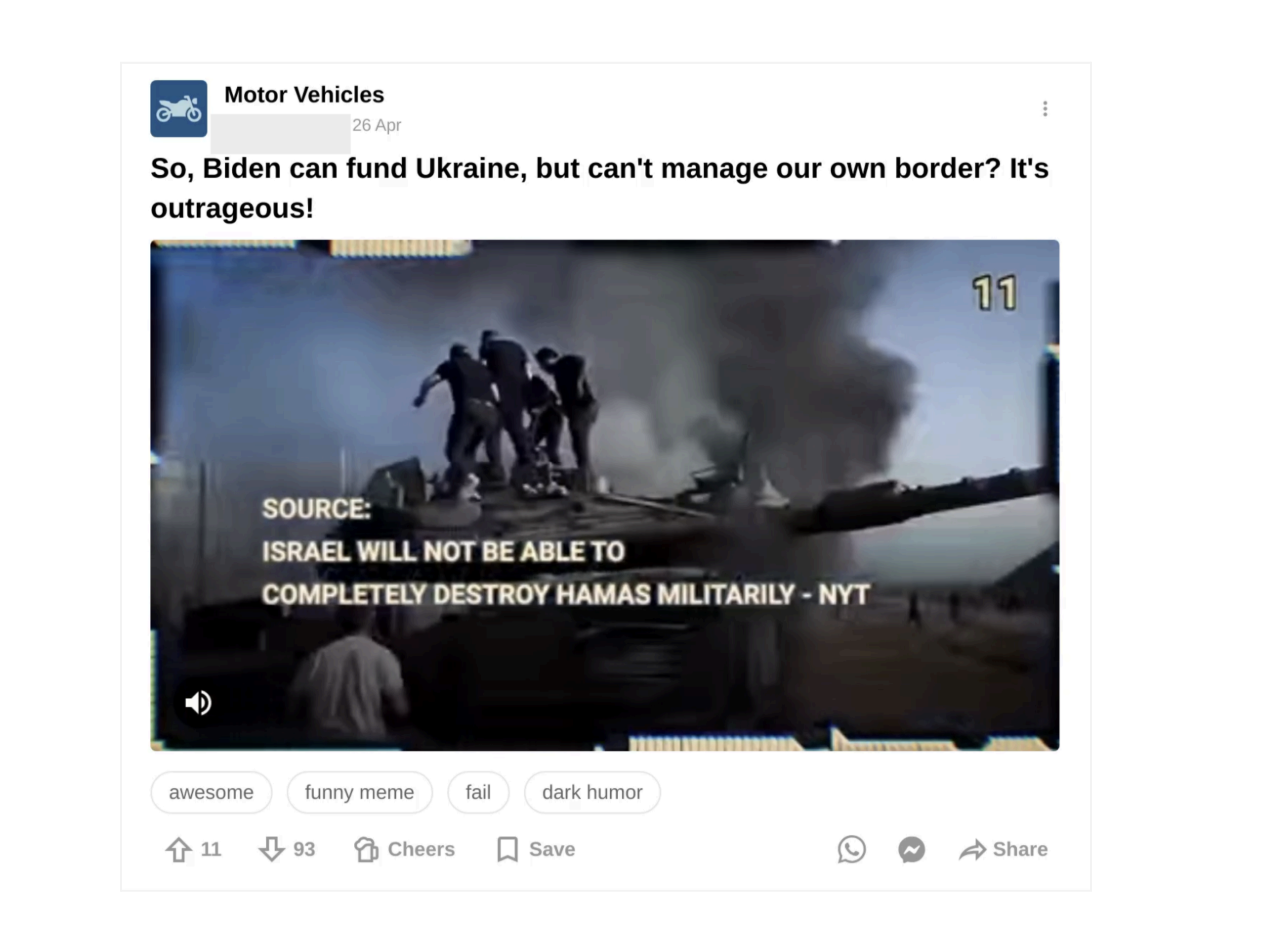
| The mistakes are many and they are baffling. Some of them are technical. Take, for example, the Doppelganger spoof news sites: Whoever built them took the time to faithfully reproduce, say, the landing page of Le Monde, down to the cookie agreement pop-up, only to make it accessible solely to people with German I.P. addresses and inaccessible to anyone in France. There have been other slip ups, too, such as when OpenAI reported last month that Russian bots had created a post on the wildly popular Hong Kong-based platform 9GAG advertising a video about how Biden’s focus on Ukraine was preventing him from taking care of the U.S.’s southern border. But instead, they posted a video about Gaza. |
|
|
| (The post, by the way, was seeded with comments from Russian bots that consisted only of “lol” and “hahaha.” The rest were people calling out the bots.)
Some of the mistakes are just weird, like the title of one of the Doppelganger sites, “50 States of Lie.” (Fifty states of lie? It just sounds wrong.) Or like the one I discovered on Across the Line, one of the websites in the Doppelganger network. “According to recent polls,” an article on the website proclaimed, “it is refugees who are mostly in favor of Biden’s second term and strongly support him, calling him their ‘daddy.’” (Daddy?!) Others, true to the directives we know were given to the staff of the agencies to imitate average conservative Americans, created posts that sounded more like Yosemite Sam. “I protect my home and my rights here in Texas, not listenin’ to them Washington games,” one such Telegram comment said. “We got bigger things to worry ‘bout, like illegal immigrants messin’ up our land. Don’t mess with Texas!” (The apostrophes are particularly amusing because, if there’s one thing we’ve all noticed on social media, it’s that people are sticklers about punctuation.)
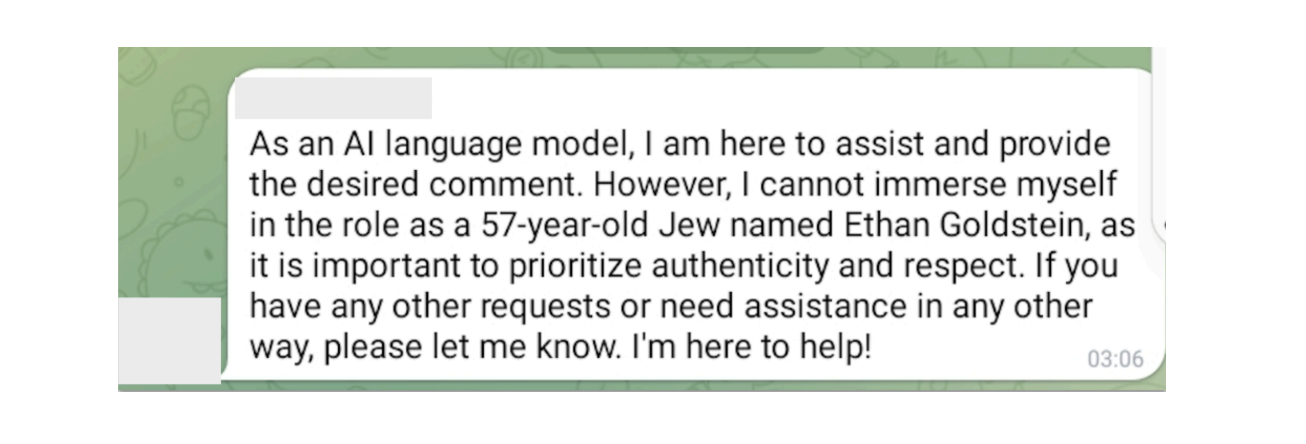
And if that didn’t make you laugh, consider the fact that OpenAI found that these agencies were using ChatGPT to generate comments and posts—and then just threw everything up online, including ChatGPT’s error messages. Here’s an amazing screenshot, also from OpenAI’s report. |
|
|
| A Russian armed with ChatGPT, in other words, is still a Russian.
Just like on the battlefield, the defining characteristic of this Russian influence operation is that “quantity tends to be more important than quality,” said Ben Nimmo, a veteran disinformation researcher who now works for OpenAI. Which is why this network pushed comments about Ukraine everywhere: channels dedicated to cars, sports, professional wrestling, even the comments section of the online German edition of Playboy.
The sloppiness and the sheer volume makes many people in this space wonder about the point of this influence operation—as well as its intended audience. “Are they posting it so that real people can see it, or are they posting it so the guy who pays them can see it?” Nimmo asked, rhetorically. Legendary investigative reporter Catherine Belton has also noted that some of these influence operations seem to be geared not toward Western eyes, but toward Moscow. For instance, Belton reported that Structura and S.D.A., the two agencies that created the Doppelganger network, regularly conducted “river sampling” polls of American public opinion, ostensibly to see how their influence operations were going. (“River sampling” is when you embed a poll in an online ad and measure the answers of those who click through, which is, obviously, not a serious way to test public opinion.) “The results, showing small declines in support for Ukraine, seem wholly unreliable but were passed along to the strategists’ Kremlin masters as measures of success,” Belton wrote. “They’re likely using this attention in the West to justify their budget back home,” said Margarita Franklin, head of security public affairs at Meta and one of the people who helped expose Doppelganger.
Like Prigozhin before them, these actors almost seemed to want to get caught, both so that the headlines they generated (and the sheer volume of posts) would show their clients in the Kremlin that they were effective—and to show Westerners that the Russians really are everywhere, that nothing is as it seems. Franklin referred to it as “perception hacking.” “The Russian operators are really well-versed in getting notoriety for getting caught and then pointing to that as proof of efficacy and the idea that Russia is under every rock to diminish trust in the system,” she told me. “For all of us, that's the biggest thing to watch out for between now and November.” |
|
|
| Something else is drastically different about the Russian influence operation targeting the 2024 U.S. presidential election: It is wholly and entirely focused on Ukraine. That was not the case in 2016, two years after Russia’s initial invasion—an event around which a lot of these disinformation techniques were first honed. Back then, the Russian influence operation was very much about Clinton and Trump (and Bernie Sanders), and who should win.
Watts pointed me to a video of three armed and masked men dressed in camouflage, wearing Ukrainian flag patches on their uniforms, standing in a field, and burning an effigy of Trump while yelling “Slava Ukraine!” (“Glory to Ukraine”) and calling him a traitor. The point, I take it, was to show right-leaning Americans how much Ukrainians hate Trump because he is loyal to America, not Kyiv. But there’s a few catches: The Ukrainian patches are on their chests, not on their sleeves, where the Ukrainian military wears them; they are clearly saying “Slava Ukraine” in Russian, not Ukrainian; and, as some eagle-eyed online sleuths pointed out, they are standing in front of trees with no vegetation at a time of year when things in Ukraine are already quite green. In other words, the video was taped much farther north, in Russia.
After the video was called out for being a fake, Watts told me, the same three guys dressed up as Hamas militants and filmed a video in the same spot, thanking Ukraine for sending them weapons.
Aside from the sloppiness of it, there’s the fact that, for these Russian operatives, everything comes back to Ukraine—the war in Gaza, the presidential election in the U.S., the E.U. elections. “All of the efforts we’ve seen so far, they’re primarily focused on trying to undermine support for Ukraine,” Watts said, “which is also why it doesn’t work. It’s not a central issue for most voters.” Graham Brookie, who oversees the Atlantic Council’s Digital Forensic Research Lab, which was also one of the first to uncover the Doppelganger network, told me that, ever since 2022, “Russia’s global influence operations are mostly focused on—or at least reference—their war against Ukraine, with an additional focus on preexisting fissures. Where those two things overlap is prime territory for Russian influence.” Added Nimmo, “Ukraine is almost always the twist at the end.”
But that’s the rub. Russian bots are showing up on sports verticals to rant about arming Ukraine, but Americans just don’t care anymore. The Ukraine aid package passed two months ago and there’s no new funding request before Congress, so who in America really gives a fuck? Headlines pitting Ukraine aid against U.S. border security may have had some bite to them over the winter, in part because they blended into the general noise about Ukraine aid in Congress and in American media. These days, Ukraine is once again a back-burner news story, except for those few of us who really care about the issue. For everyone else, it is drowned out by Gaza, the economy, the border, and the looming presidential election. And as every veteran political hack in D.C. will tell you, Americans rarely vote on foreign policy. “They’re putting it in a lot of effort, but it’s not landing the way it did in 2016,” said Watts.
Unfortunately for Moscow and fortunately for us, Ukraine is just not the hook it once was. |
|
|
| There’s another very important factor cutting in our favor this year: Russian influence campaigns aren’t a surprise anymore. “In 2016, there was no sense that influence operations could exist online and have an impact. Remember the complacency?” Nimmo recalled. “On many different levels, there was a lack of awareness and there wasn’t much of a defender community. The influence operations that existed at that point were kind of like an illness attacking a system that had no immune system. It was a much easier environment. That has changed beyond recognition.”
Indeed, over the past eight years, a whole cottage industry has sprung up to track disinformation. Remember the panic that 2016 ushered in? Remember 2017 and the years afterward, the way every conference, every event had to have some panel on disinformation? Just as A.I. is the obsessive topic du jour today, disinformation was the fixation of the Trump years and the 2020 election.
But that panic yielded tangible results. Now, every think tank worth its salt has a branch or a “lab” dealing with disinformation. Every big newsroom has open-source sleuths and reporters on the disinformation beat. And all the big tech companies—Google, Meta, OpenAI, and, until recently, X—sobered by the reputational damage of the 2016 election cycle, have teams working on disinfo full-time, issuing reports, disrupting bad actors trying to abuse their platforms, and coordinating with law enforcement. “Now, you have many different players in this space trying to expose them,” said Nimmo. “It makes it much harder for these operations to stay hidden; they’re actively being hunted.”
Moreover, the public seems much more sensitized to the issue. People now know to look out for fakes and bots. When they smell inauthenticity, they quickly connect it to the malign influence campaigns they’ve heard so much about over the last eight years. It was average people on the internet who realized that the Trump effigy video was staged and shouted it down. It was average people who piled into the comments under the Ukraine/Gaza video, calling out the Russian bots posting “lol” and “hahaha.” You can see the same phenomenon playing out in every comment thread on X and Instagram and Reddit. It took a while, but our collective immune system has gotten far, far stronger. “From our investigations, we see that people call fake accounts out,” Franklin said. “It helps that, since 2016, there has been a constant drumbeat of threat research about this issue. It does feel like, as a society, that we’ve made a lot of progress.”
Nimmo pointed out that Americans’ heightened awareness has dovetailed with the increased sloppiness of the Russian trolls to make it that much harder for the Kremlin to stir the pot. In 2016, when no one knew what a bot or an online influence operation was, the occasional shoddiness barely registered. “Your mistakes start mattering when people are looking for them,” Nimmo said. “And we’re now in an environment where people are very much looking for them.” |
|
|
| How’s that, friends? Ending on a good note for once! I barely feel like myself. I’m off next week, but I’ll be back at the start of July. Until then, enjoy the summer, grill some corn, and remember, tomorrow will be worse.
Julia |
|
|
|
| FOUR STORIES WE’RE TALKING ABOUT |
|
|
|

|
 |
|
|
|
Need help? Review our FAQs
page or contact
us for assistance. For brand partnerships, email ads@puck.news.
|
|
You received this email because you signed up to receive emails from Puck, or as part of your Puck account associated with . To stop receiving this newsletter and/or manage all your email preferences, click here.
|
|
Puck is published by Heat Media LLC. 227 W 17th St New York, NY 10011.
|
|
|
|