Hello and welcome back to The Best & The Brightest. I’m Leigh Ann Caldwell.
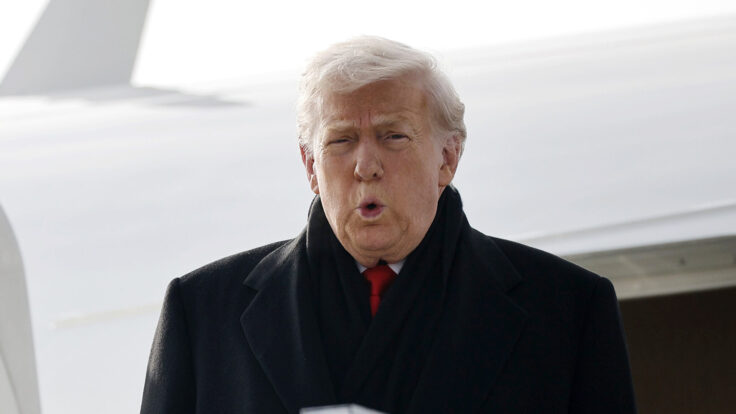
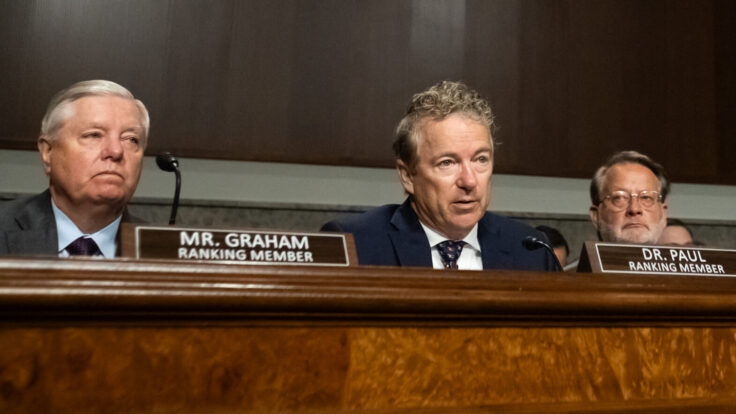
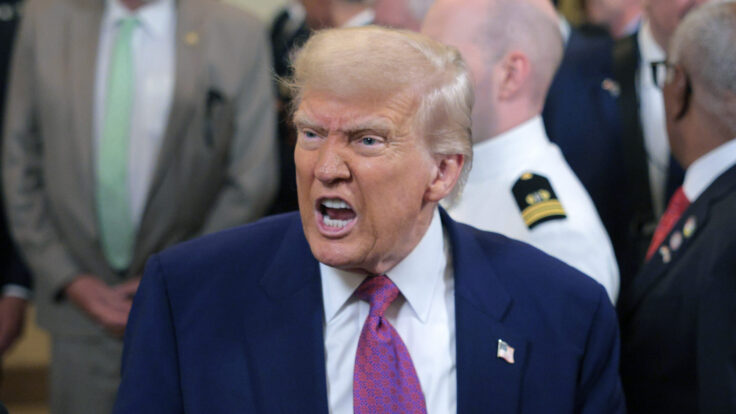
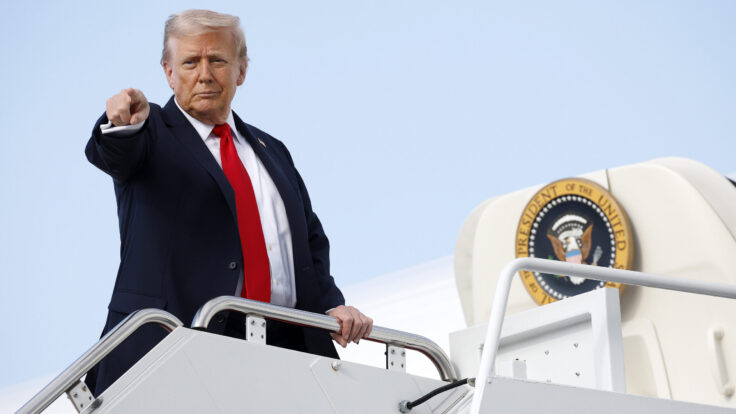
President Trump seems to have finally reached a breaking point with Vladimir Putin, announcing today that he will send offensive weapons to Ukraine, and warning that he plans to impose 100 percent tariffs on countries that buy Russian energy products if the Russian president doesn’t agree to a ceasefire in the next 50 days. Any direct tariffs would be mostly symbolic, since the U.S. does very little trade with Russia. The Senate’s bipartisan Russia
sanctions bill, led by Lindsey Graham and Richard Blumenthal, has also been watered down: While it allows up to 500 percent sanctions on countries that trade with Russia, it also gives the president complete flexibility to implement those sanctions as he sees fit—which is quite the loophole.
Programming note: This Thursday, I’ll sit down with Rep. Angie Craig, the top Democrat on the House Agriculture Committee
(and top candidate for the open Minnesota Senate seat) for the next Puck Power Breakfast at Ned’s Club. If you’re interested in attending, send me a note and I’ll try to get you on the list. Also, if this private email was forwarded to you, you can clear your conscience by subscribing here.
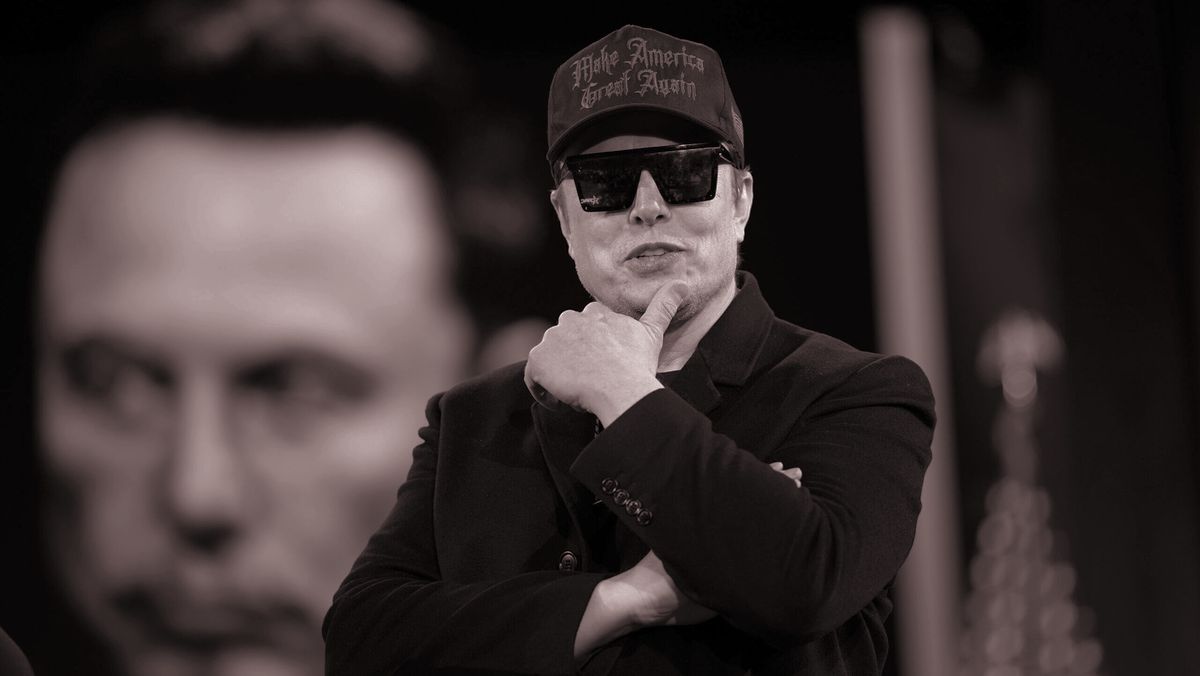
In tonight’s issue, my colleague Abby Livingston tackles Elon
Musk’s announcement that he wants to form a third party, and how Republicans are reacting to the ostensible challenge—and, importantly, the potential loss of Elon’s bucks for their own races.
But first… |
- Crypto
week in Washington: The House is set to take up three crypto-related bills in the coming days, in what has been dubbed “Crypto Week.” This has been years in the making, as the digital currency has moved from the counterculture to a multitrillion-dollar business, complete with lobbyists, super PACs, congressional scorecards, and even a supportive president—persuaded, of course, by hundreds of millions of dollars in campaign contributions, as well as hundreds of millions of dollars in
personal profit.
For a long time, the crypto industry has been pleading with Congress to create a regulatory framework that ensures the U.S. can be a leader in the industry. Skeptics, however, say that the bills being considered do little to regulate anything, and will create even more challenges in the financial markets. Many Republicans don’t really even understand the bills that are up for consideration, frankly, but are being told they’re a Trump priority, which is
likely enough to make House Republicans sign on. (Trump has pledged to be the “crypto president” and make the U.S. the “crypto capital” of the world.)
The first bill on the docket, the GENIUS Act, would regulate stablecoins, a type of digital currency whose price can be pegged to liquid assets, including the U.S. dollar or Treasury bonds—an attempt to legitimize the product. The legislation, which passed the Senate with 68 votes last month, was advanced in close collaboration with
Bo Hines, the executive director of the President’s Council of Advisors on Digital Assets, and David Sacks, the White House A.I. and crypto czar.
The second bill to be taken up in the House this week, the CLARITY Act, would create a regulatory market structure for crypto, divided between the Securities and Exchange Commission and the Commodity Futures Trading Commission. If it passes, however, it could be a heavier lift in the Senate, given that Democrats
are expected to demand that it limit Trump’s ability—or that of any president—to profit off crypto. Since he took office in January, Trump has made a whopping $600 million from crypto and other assets, according to his financial disclosures; his sons, meanwhile, also have an ownership stake in his crypto firm, World Liberty Financial. Banking Committee chair Sen. Tim Scott said he wants to pass a market structure bill by the end of September.
Some Democrats, led by Sen. Elizabeth Warren in the Senate, are fiercely against the crypto bills. In the
House, Financial Services Committee ranking member Rep. Maxine Waters wrote in an opinion piece for MSNBC today that the bills were “written by and for the crypto industry.” But Democrats will not whip the measure, and are letting their members vote how they’d like.
To mark the occasion, the crypto firm Coinbase is handing out chocolate bars wrapped with pro-crypto ads at downtown D.C. Compass Coffee locations—the first coffee shop to accept crypto as payment—and by
stocking them in Capitol Hill vending machines.
|
|
|
Musk is threatening to go scorched-earth on the G.O.P., and the party has responded, so far,
with a collective shrug. How much damage can one scorned billionaire do? |
|
|
Despite all the drama surrounding Elon Musk’s very public falling out with
Donald Trump—which culminated in a vow from the world’s richest man to launch a third party and to support primary challenges against “every member of Congress” who voted for the “biggest debt increase in history”—virtually every Republican I’ve spoken with over the past week has expressed the same view: We’re not that worried.
Perhaps they’re having flashbacks to Musk’s failure in the Wisconsin Supreme Court race, or they’re tracking his –23 percent net
favorability, which is even lower than when he left the administration. But there are other, more systemic reasons why his new America Party will have trouble getting off the ground, let alone defeating Republicans who supported the president’s signature, deficit-exploding legislation. As it turns out, even a centibillionaire can’t spend his
way out of the stranglehold of the two-party system.
To start, there’s the patchwork of state laws that makes ballot access daunting for third-party candidates. Musk’s deep unpopularity will also make it challenging for him to recruit serious talent, whether consultants or candidates, who fear Trump’s wrath. It’s also increasingly hard for insiders to take him seriously, given that it was only two months ago that he
claimed he had “done enough” political spending and would refocus his energies on Tesla. “What month does he lose interest and stop?” a seasoned House G.O.P. consultant mused to me. “The likelihood that he goes through the whole thing in a serious effort, outside of a couple of races, seems low to me.”
Musk, for his part, says that he doesn’t need to
win more than a few races to shake up D.C. Indeed, rather than trying to mint a third-party presidential candidate—the most successful U.S. example being Ross Perot, in 1992, when the anti-deficit, populist billionaire (sound familiar?) won nearly 19 percent of the popular vote—the America Party strategy would be “to laser-focus on just two or three Senate seats and eight to 10 House districts,” Musk
wrote on X over the Fourth of July weekend. He continued: “Given the razor-thin legislative margins, that would be enough to serve as the deciding vote on contentious laws, ensuring that they serve the true will of the people.” In short, Musk is launching a highly unusual, and likely incredibly difficult, effort to disrupt things now—which means shaking up the coming
midterms. |
“Money
Can’t Solve Everything”
|
Despite their sprawling geographic scale and billion-dollar price tags, presidential campaigns are actually
much simpler than your typical midterm showdown. After all, it’s one thing to spend nearly $300 million on a single candidate like Trump—as Musk did in 2024—and another thing entirely to spread capital and other resources between a dozen or so races out of the 468 seats up for grabs in 2026. And, without a presidential candidate at the top of the ticket, these midterm races will be much more localized, featuring idiosyncrasies relating to specific regions and districts. Candidate
recruitment might be Musk’s biggest hurdle, but his party would also need to hire political talent that understands how to navigate these local fights—at the risk of being blackballed in the future. “Money can’t solve everything,” one G.O.P. operative noted to me.
That’s not to say there isn’t an appetite for a third-party option. Increasingly, voters don’t identify with either of the two major parties, and last year, Gallup found that 58 percent of voters felt a third party was needed. But drawing voters into a new camp requires a strong political proposition, and Musk, himself, doesn’t exactly have that kind of crossover appeal. In the aftermath of his DOGE antics, there’s
little chance he would be embraced by voters on the left after feeding USAID “into the woodchipper.” An AP-NORC poll from June shows a mere 6 percent of Democrats view him favorably. Musk would also likely struggle to pick off voters from the Trump-aligned MAGA base. Earlier this summer, when he first declared political war on Trump over
the Big Beautiful Bill, Musk called the tax and spending legislation a “disgusting abomination,” among other things. At the time, Republicans told me it was a “no-brainer” whose side to choose: the president’s.
Still, the AP-NORC poll found that while Musk’s favorables slipped a few points among Republicans amid the fracas, 64 percent of Republicans still
view him very or somewhat favorably. And Musk could easily spoil a handful of campaigns, potentially affecting the narrow balance of power in Congress. After all, even where third-party candidates don’t crack 10 percent in returns, they can pull just enough votes from one side to deliver victory to the other, particularly in the narrowly divided districts where the House is won or lost—although which of the two major parties benefits is unpredictable from race to race. “Third-party candidates
are an important aspect of individual races every cycle, but you cannot predict or make a blanket statement about the way they will play out,” Democratic pollster Anna Greenberg told me years ago. “It is very individualized.”
In the long run, of course, the real problem for Republicans is likely much simpler: the loss of Musk’s
campaign money. Musk didn’t just spend more than $250 million to elect Trump in 2024—he also contributed $10 million to the Senate G.O.P.’s super PAC and coordinated with the House G.O.P. campaign apparatus. Yes, Republicans have done just fine fundraising in 2025 without Musk: The Congressional Leadership Fund, the House G.O.P.’s super PAC, announced today that it has raised more than $60 million so far this year. But given the steady uptick in campaign spending, and the cost of mounting
a race at any level, it will hurt for a $20 million-ish donor to “come off the board,” the House G.O.P. operative told me. |
|
|
Join Emmy Award-winning journalist Peter Hamby, along with the team of expert journalists at Puck, as they let you in on the
conversations insiders are having across the four corners of power in America: Wall Street, Washington, Silicon Valley, and Hollywood. Presented in partnership with Audacy, new episodes publish daily, Monday through Friday. |
|
|
The industry's go-to source for unflinching reporting on the trillion-dollar business of artificial intelligence - perhaps the
single most important technology of our time. Ian Krietzberg, the powerhouse journalist behind The Deep View, delivers twice-weekly insights into the latest dealmaking and breakthroughs in A.I., and how the intersecting worlds of finance, entertainment, media, and politics are being transformed in its wake. |
|
|
Need help? Review our FAQ page or contact us for assistance. For brand partnerships, email ads@puck.news. You received this email because you signed up to receive emails from Puck, or as part of your Puck account associated with {{customer.email}}. To stop receiving this newsletter and/or manage all your email preferences,
click here. |
Puck is published by Heat Media LLC. 107 Greenwich St, New York, NY 10006 |
|
|
|