{{ 'now' | timezone: 'America/New_York' | date: '%b %d, %Y' }} |
|
|
Hello and welcome back to The Best & The Brightest. I’m Leigh
Ann Caldwell.
I’ve been loving all of your notes and tips in response to my dispatches. After my colleague Abby Livingston’s insightful piece about Kevin McCarthy’s apparent vanishing act in the California redistricting fight, one savvy reader emailed me to note that McCarthy was dining at Ned’s Club last week with House Ways and Means Chairman Jason Smith. I was also
told he was in England the week before that. Obviously I don’t have McCarthy’s day planner, but it seems like the guy has other things on his mind besides a ballot measure that he once pledged to support with a cool $100 million in fundraising. If you missed Abby’s great piece, you can read it here.
In today’s issue, I take a look at the paradoxical role
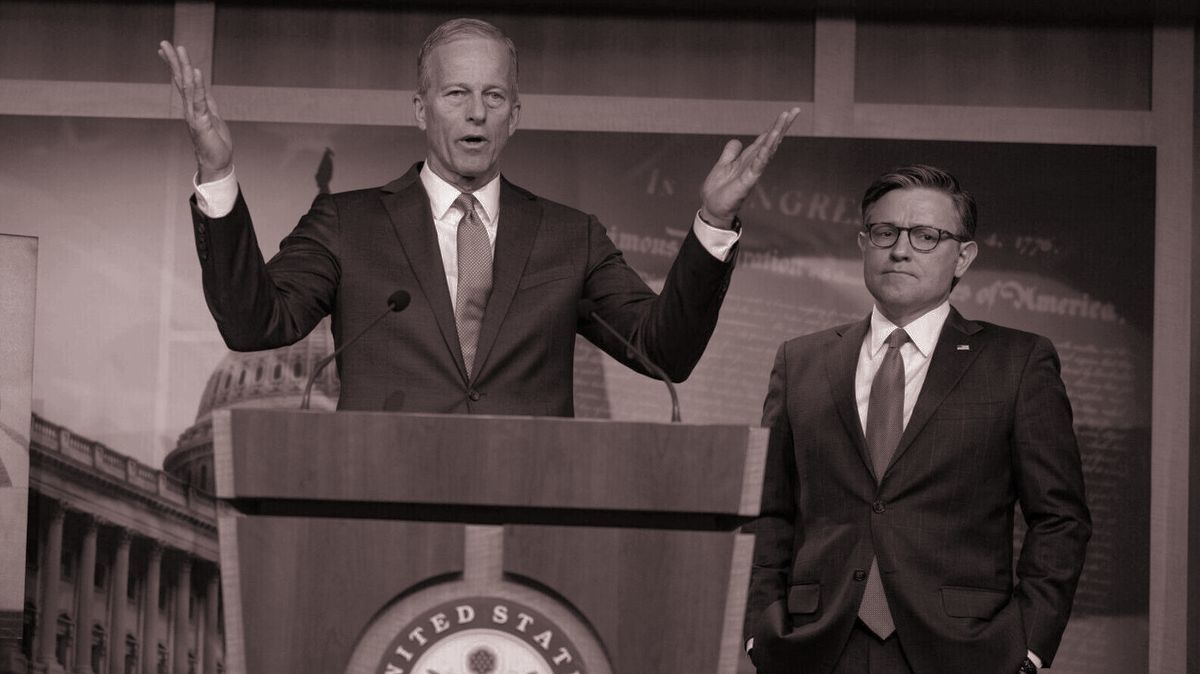
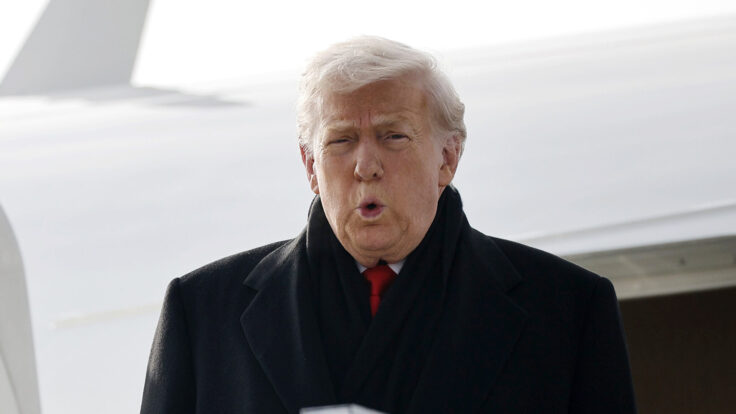
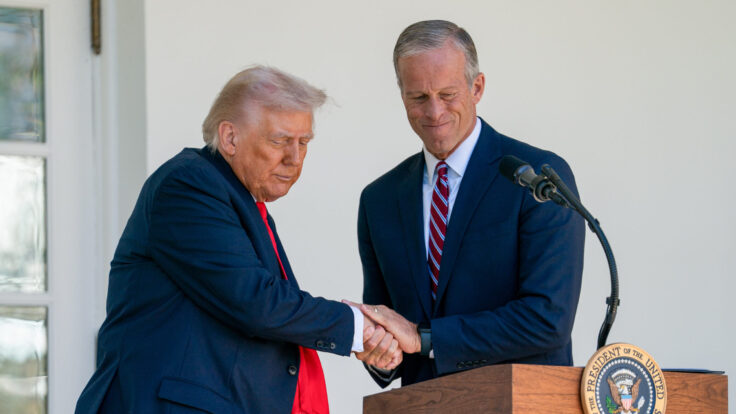
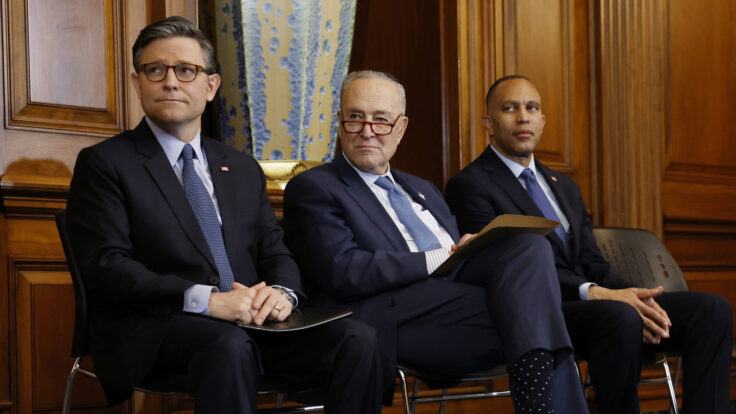
Mike Johnson and John Thune are playing in the dissolution of their own power. Yes, most presidents try to expand their power while in office—during the Obama and Biden presidencies, Republicans shouted about their respective “authoritarian” actions. Thune and Johnson, however, are willingly handing Trump the keys to the Capitol, while some of their colleagues voice their
concerns in private.
But first… |
-
Shutdown pressure builds: The coming week is expected to be pivotal as the shutdown nears its one-month mark. The Trump administration has so far sidestepped many potential pressure points—using unrelated Pentagon funds to cover a first paycheck for the troops, and soliciting $130 million from Republican donor Timothy Mellon to help with the next one, while also using tariff revenue to pay for the Women, Infants, and Children food assistance program.
But federal workers have now missed their first full paycheck, the Mellon donation won’t cover all the troops’ pay, and reduced Affordable Care Act subsidies are expected to be locked in on the first of the month.
Now, CNN reports that the Trump administration is refusing to use U.S.D.A. contingency funds to fund the food stamp program through November
as long as the government stays shut down. When people’s E.B.T. cards stop working, it could put even more pressure on lawmakers to start negotiating in earnest. - The Chinese TACO trade: Treasury Secretary Scott Bessent went on Meet the Press this morning to announce a preliminary trade agreement with China—a significant development ahead of Trump’s Thursday meeting with President Xi
Jinping in South Korea, two days after which an additional 100 percent tariff would have supposedly gone into effect as retaliation for China’s new export controls. “I believe we’ve reached a very substantial framework that will avoid that and allow us to discuss many other things with the Chinese,” Bessent said—including managing the fentanyl crisis, “substantial soybean and ag purchases” after China stopped U.S. imports of the crop, achieving a “more balanced trade”
between the two countries, and even the war in Ukraine. Meanwhile, of course, Trump announced an additional 10 percent tariff on Canada as punishment for an ad, funded by the province of Ontario, featuring snippets from a Reagan speech arguing against tariffs.
- Notes on the ballroom ordeal…: The White House has found another way to troll recent Democratic presidents, this time with a
web page in defense of its controversial East Wing teardown project featuring so-called “Major Events” that transpired on the sacred grounds of 1600 Pennsylvania Avenue. Naturally, these historic events include the initial planning of the White House, the fire set by the British during the War of 1812, the addition of the Oval Office in 1909, and the creation of the
briefing room in the early ’70s. The timeline also includes the Monica Lewinsky scandal, a “Muslim Brotherhood Visit” during the Obama administration, and the discovery of cocaine in the building during the Biden administration.
|
Now on to the main event… |
|
|
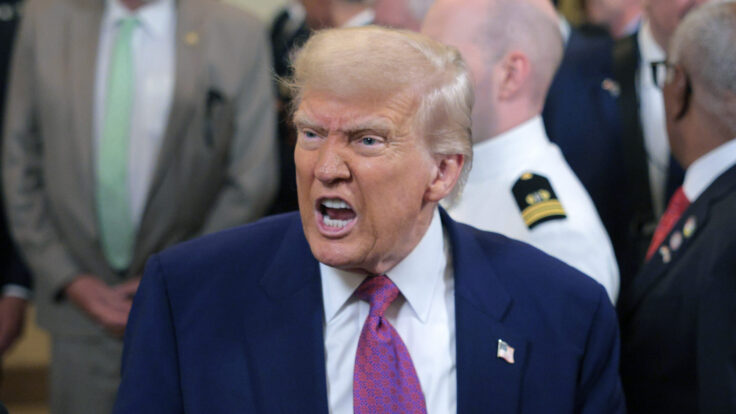
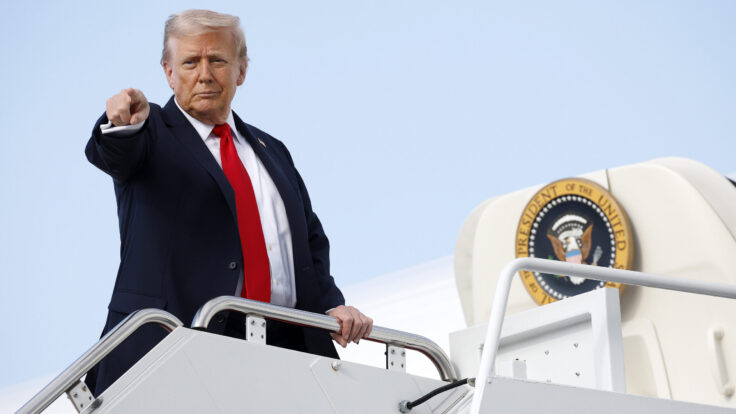
Nine months into Trump’s second term, the House speaker and Senate majority leader
are relinquishing many of their powers to the president. “I think it’s fair to say that most of our leadership class in this country has bent the knee,” one G.O.P. senator told me. But almost no Republicans dare push back in public. |
|
|
Earlier this week, Mike Johnson marked his second anniversary as speaker
with an unusual distinction: It has now been more than a month since the House of Representatives was open for business. For the fifth week in a row, he has told lawmakers to stay home until Senate Democrats vote to reopen the government. No hearings are being held, and no votes taken. Meanwhile, Johnson is still refusing to swear in Adelita Grijalva, the representative-elect from Arizona, who won her seat on September 23.
Johnson is ostensibly trying to prove a point—the
House has done its job and voted to fund the government. And it’s easier for him to hammer that messaging personally without aimless lawmakers interfering with the message or going rogue to work on a compromise with Democrats. But by keeping the House out, Johnson is also inadvertently reducing the legislature’s own authority, temporarily suspending a branch of government while President Trump seizes de facto spending and taxation powers that were once the domain of
Congress.
The speaker and Senate Majority Leader John Thune have seemingly made the calculation that it’s easier to be on the president’s side rather than run the risk of ending up like Paul Ryan or Kevin McCarthy or even Mitch McConnell. But standing with the president has come at great cost to the institutions they lead. As a result of their reluctance to cross the president on any issue, Congress has effectively
relinquished its role on matters of spending, tariffs, war, and advice and consent. Republican leaders supported Trump’s alleged ability to claw back congressionally appropriated funds, backing his $9 billion in rescissions and $4.9 billion in pocket rescissions. They nodded when Russ Vought, the head of the Office of Management and Budget, unilaterally fired thousands of federal workers, eliminated agencies, and used the government shutdown to further shrink programs that
Congress had created and funded.
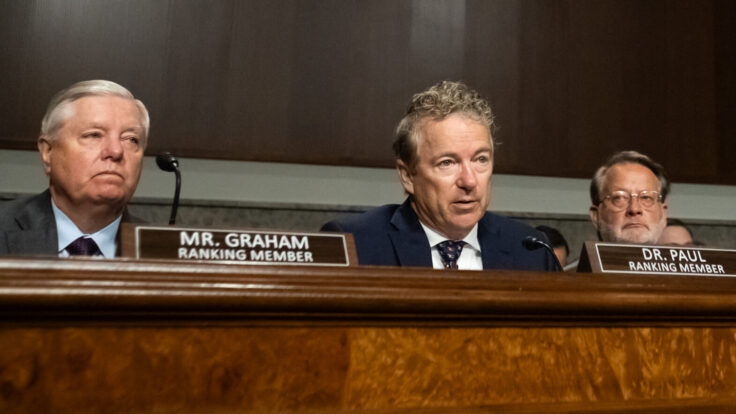
With few exceptions—including Sen. Rand Paul and Rep. Thomas Massie—Republicans haven’t pushed back against Trump’s claimed national security powers, either. They haven’t stood in the way of Trump’s tariffs, and have mostly defended the bombing of alleged drug boats in the Caribbean. They also haven’t denounced the military buildup off the coast of Venezuela, which has transpired in full view without any congressional
authorization. Nor have they created legislation or filed amicus briefs to defend their constitutional authority as Trump’s various power grabs wend their way through the courts. Indeed, Thune recently minimized the Senate’s advice-and-consent authority over presidential appointees by changing parliamentary rules to advance dozens of Trump’s nominees at a time.
In his first year as speaker, Johnson’s tenure was surprisingly productive: He passed bipartisan spending bills, arm-twisted his
caucus into approving military aid to Ukraine, and helped Republicans retain the majority. In his second year, however, he is setting himself up for a much different legacy: as the speaker who handed over the keys of the House to the president. |
A few Republicans do worry privately about the president’s determination to sideline their
own institution—but they won’t talk about it in the open. For one thing, some Republicans tell me, Trump is setting a precedent that a Democratic president could just as easily take up. One House Republican lawmaker said of Johnson, “He needs to tell the administration what we’re going to do, not the other way around.” Congress, after all, is the Article I branch of government, and “if we’re just going to cede this authority to the administration, we ought to just admit it,” this person
continued. Even some members of the hard-right House Freedom Caucus are unsettled, according to an aide to one of its members.
Yet it’s not clear what, if anything, Republican lawmakers intend to actually do about their concerns. One G.O.P. senator told me that they spend half their day thinking about how much power Congress is ceding, but it’s hard to build a mass movement among a Republican conference whose 53 members all see the problem differently. Asked whether Thune should step up, this
person said, candidly, “I wrestle with that.”
Why would Congress take a stand when law firms, universities, publicly traded companies, religious leaders, et al. have all capitulated? “I think it’s fair to say that most of our leadership class in this country has bent the knee—is not looking for creative solutions or incremental ways to push back,” the Republican senator said. Even the Supreme Court has temporarily sided with Trump on issues of tariffs and government funding. “When the Roberts Court says that there will be presidential immunity for actual felony crimes committed by a president in office, it sends the message to an already invertebrate Republican majority in Congress that they should just roll over and let Trump do whatever he wants to do,” Democratic Rep. Jamie Raskin told me.
Johnson, of course, frames the moment differently. “This is what unified government looks like,”
he said recently on This Week.
It’s not new that congressional majorities tend to be more pliant toward presidents from their own party. Democrats didn’t stop Joe Biden from unilaterally forgiving student loan debt. Former Senate Majority Leader Harry Reid eliminated the filibuster for judicial nominations to aid President Obama. But no president has demanded loyalty, and repercussions for those who step out of line, the way
Trump has. And it’s shifting the balance of power in a way that has not been seen since the Nixon administration. |
Both Johnson and Thune have publicly been in lockstep with Trump from the moment he arrived for his
second tour of Washington. Johnson used the final weeks of the Biden administration to nuke a bipartisan set of healthcare bills that Trump and Elon Musk didn’t like, thereby depriving the departing president of one final legislative victory and a significant bipartisan accomplishment. It was a turning point in how Johnson governed, from dealmaker to Trump placater, Hill and lobbyist sources say. He hasn’t worked with Democrats on anything since.
On
Thursday, in a rare break with Trump, Thune opposed the president’s call to import beef from Argentina—he represents a cattle-producing state, after all. But no such public rebukes appeared imminent during a luncheon at the White House on Tuesday where Senate Republicans clapped, cheered, and laughed at the president’s jokes. They even clapped for Vought, the mastermind behind ignoring congressional appropriations.
The senators ate hamburgers, Trump’s favorite meal, and I was told they
were delicious. But they couldn’t tell me if the beef was American. (The White House didn’t respond to queries about this.) Less palatable, perhaps, were Trump’s comments about the utility of his co-equal branch. “We don’t need to pass any more bills,” he said, touting his One Big Beautiful Bill, which extended tax cuts, implemented agriculture provisions that have now jeopardized passage of the farm bill, nearly tripled the budget of the Department of Homeland Security, and gave the Pentagon a
massive cash infusion. And senators returned to the Capitol carrying gift bags containing red baseball caps with white block embroidered lettering reading “Trump was right about everything,” signed by the president in his signature black Sharpie.
“He got a lot of his legislative agenda,” Rep. Tom Cole, the chairman of the House Appropriations Committee, told me. “A lot of the rest of it is foreign policy, it is reshaping the world, the international
trade system. It’s not like he’s not engaged. I’m not saying he’s gone away. But on the appropriations process, there’s not a lot that he wants.
Meanwhile, lawmakers are blaming themselves for the loss of their power. “If we want to take back some sort of control and oversight, we’ve actually got to start passing budgets, writing our own laws,” Sen. Josh Hawley, Republican of Missouri, told me. “We are going through an
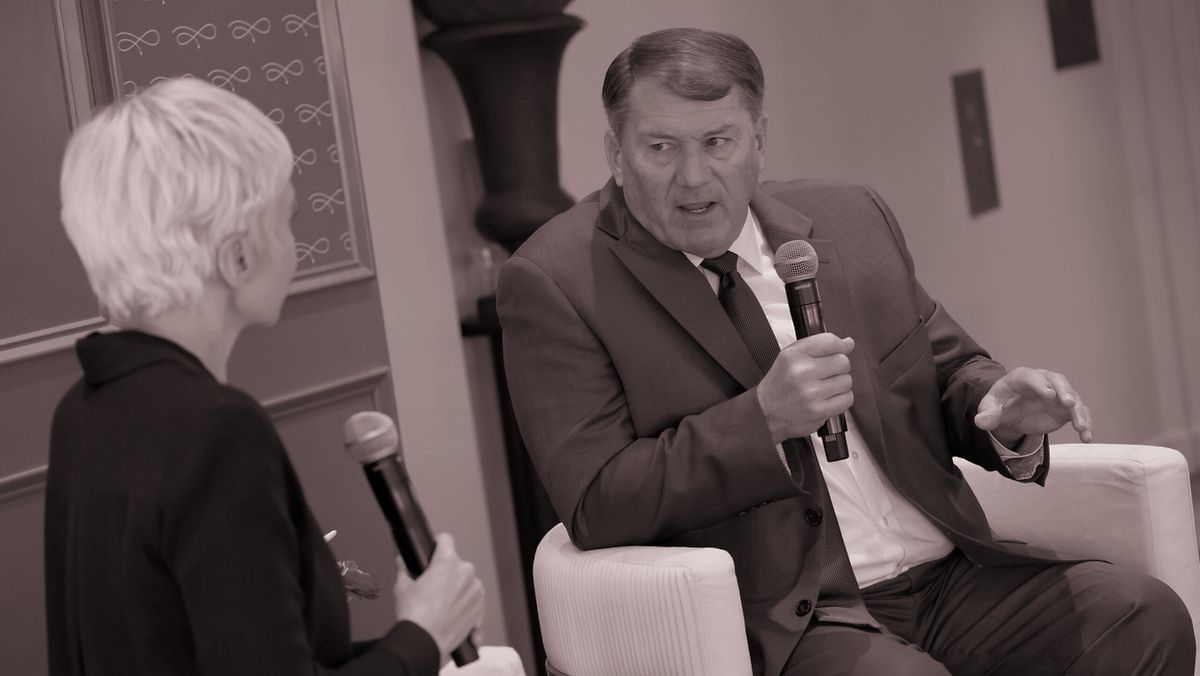
experiment with unicameralism.” Congress hasn’t passed a budget since 2019, and all of their appropriations bills since the ’90s. Their productivity has plummeted; they write fewer and fewer laws. “The president, he just looks at it and says, You give me a blank check, of course I’m going to use it,” South Dakota Sen. Mike Rounds told me last week.
Some members of the Appropriations Committees are feeling this most acutely. Chair Susan Collins and Ranking Member Patty Murray have added protections into their funding bills that would require the administration to notify Congress if they cancel a program or grant, and that would codify spending instructions into law. Cole said that he doesn’t think an expanded executive is “as big of a
problem” as his Democratic colleagues do, but that he’s willing to “look” at adding guardrails in House versions of spending bills. “Those are not lines in the sand, okay? I’ve had that discussion,” he told me.
Democrats, naturally, don’t think these sorts of guardrails go nearly far enough. Last week, Sen. Jeff Merkley of Oregon spoke on the Senate floor for more than 22 hours to highlight Trump’s overly broad view of presidential power. (The president’s
dismissal of Congress was one of Merkley’s chief complaints.) Democrats are also planning to force a series of votes next week to repeal Trump’s tariffs, an attempt to wrest that power back for their own branch.
The bill is highly unlikely to pass given the Republican majority, of course. But Democrats are seizing the moment in an effort to put their colleagues on the record as abdicating their constitutional authority. “How would you like to go down in history as the last speaker of a
functional House or the last majority leader of a functional Senate?” one Democratic senator told me. “The Senate majority has effectively given away our nominations and confirmation process. We aren’t doing any treaties right now. What’s left? Power of the purse. Eight hundred years of fighting against English kings, which came down to the drafting of Article I, and they’re on the verge of handing it away. Yeah, that’s a big deal.” |
|
|
Join Emmy Award-winning journalist Peter Hamby, along with the team of expert journalists at Puck, as they let you in
on the conversations insiders are having across the four corners of power in America: Wall Street, Washington, Silicon Valley, and Hollywood. Presented in partnership with Audacy, new episodes publish daily, Monday through Friday. |
|
|
Unique and privileged insight into the private conversations taking place inside boardrooms and corner offices up and
down Wall Street, relayed by best-selling author, journalist, and former M&A senior banker William D. Cohan. |
|
|
Need help? Review our FAQ page or contact us for assistance. For brand partnerships, email ads@puck.news. You received this email because you signed up to receive emails from Puck, or as part of your Puck account associated with {{customer.email}}. To stop receiving this newsletter and/or manage all your email preferences,
click here. |
Puck is published by Heat Media LLC. 107 Greenwich St, New York, NY 10006 |
|
|
|