 |
|
Welcome back to The Best & The Brightest. I’m Peter Hamby, back from a very fun few days in Washington, where Puck, WME, and Snap hosted a buzzy party at the Riggs hotel to kick off a marathon weekend of WHCA socializing. My partner Matt Belloni and I had the pleasure of interviewing Aaron Sorkin before the assembled V.I.P.s, during which Sorkin broke the eye-popping news that he’s working on a new film about January 6. You can listen to the whole conversation on today’s episode of The Powers That Be.
Tonight, my take on a new poll showing that Joe Biden should be very worried about Robert F. Kennedy Jr. and his stubborn appeal to young people, driven in part by the outsider candidate’s commitment to alternative media.
But first, here’s Abby Livingston with the latest dish from the campaign trail…
|
| Dynasty Dramas & Dem Headaches |
|
If the cherry blossoms are out, it’s primary season on Capitol Hill. On May 14, two small, overlooked states will host races involving candidates hoping to extend their powerful families’ reach. Here’s what’s around the corner:
- The Capito dynasty: Shelley Moore Capito is the power center of West Virginia politics. The daughter of the late governor Arch Moore, Capito accelerated the state G.O.P.’s dominance when she led the wipeout of federal Democrats on the ballot in 2014. (Yes, Joe Manchin was not in-cycle that year.) Now, the family’s third generation is making its move.
Capito’s son, Moore Capito, and her nephew, Riley Moore, who have both spent time in the state government salt mines, are running for higher office. By all appearances, the younger Capito is the Republican frontrunner for governor, albeit amid a crowded and unpredictable field that also includes Patrick Morrisey, who unsuccessfully ran against Manchin in 2018. Over the weekend, an ad dropped featuring Sen. Capito doing a direct-to-camera pitch for her son.
Meanwhile, Riley Moore is running for Shelley’s old congressional seat in the 2nd District, which Alex Mooney has ditched in order to run for Senate. How the Moore progeny fare in the Republican primary will tell us a lot about how one of America’s last dynastic families is holding up in an anti-establishment era.
- Hulk Hogan: In other dynasty news, former G.O.P. governor Larry Hogan, son of the late congressman Lawrence Hogan, has become a headache for Senate Democrats in their bid to hold the seat of three-term senator and Maryland fixture Ben Cardin, who is retiring at age 80. Democrats are coming to terms with the fact that they may have to actually spend money here. In many ways, the race to replace Cardin is the antithesis of Ted Cruz’s reelection campaign, where Republicans still seem confident they’ll hold the Texas seat, even though Democratic challenger Colin Allred is raising the kind of money that can’t be ignored.
The primary contest to face Hogan in the general has become a pain point in Democratic circles: Congressman David Trone has loaned his campaign $18.5 million (so far…), and while Trone’s deep pockets could ease some financial concerns in a general election, it’s fairly clear that Angela Alsobrooks—the EMILYs List- and Steny Hoyer-backed Prince George’s County executive—is a sentimental favorite and represents an opportunity to elevate a Black woman to the Senate.
- Also in Maryland: Nancy Pelosi is pumping significant money into the House campaign of April McClain Delaney, who’s running for the seat her husband, John Delaney, held before he ran for president in 2020. Through her campaign and leadership PAC, Pelosi has kicked in $18,000 to Delaney. Tom Suozzi, John Larson, Debbie Dingell, Don Beyer, Scott Peters, and John Garamendi also contributed.
As her husband did during his first run, in 2012, Delaney has spent a significant amount of her own money—$550,000 and counting—on her campaign, giving her a two-to-one fundraising advantage over her closest opponent. John Delaney ultimately spent $2.4 million on his race, and based on the patterns of her husband’s first congressional campaign, it wouldn’t shock me if the Delaneys have deployed more money since the most recent fundraising deadline.
|
 |
| R.F.K. Jr. & The Aaron Rodgers Election |
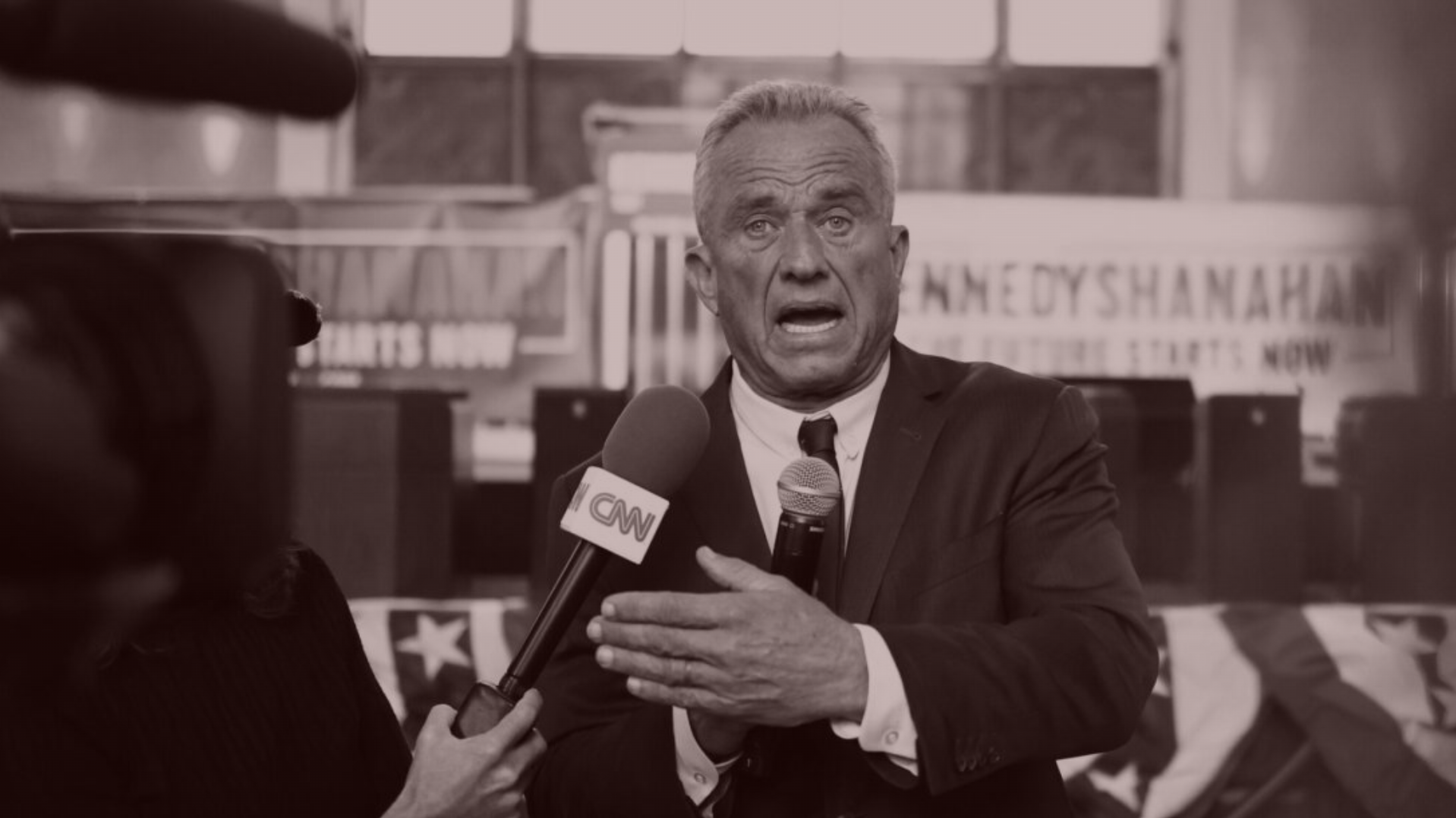
| The Kennedy campaign is pinning its hope on a combination of alarming factors breaking their way: “double haters” who can’t stand Trump or Biden, the rise of dudebro do-your-own-researchism, and an anti-establishment turn among Gen Z men, in particular, who are ripe for R.F.K.’s contrarian message. |
|
|
|
| While official Washington occupied itself with small talk and passed canapés during last week’s White House Correspondents’ Dinner party circuit, Robert F. Kennedy Jr. was predictably not on anyone’s guest list. The ruling classes were, as usual, laughing at Kennedy from a safe remove. Comedian and Saturday Night Live writer Colin Jost—who was very funny as the headline guest at the WHCA Dinner, despite claims to the contrary from one snooty New York Times critic—joked that Kennedy will never be president. “Like his vaccine card says, he doesn’t have a shot,” Jost said, with a smiling President Biden seated just to his right.
Instead, Kennedy spent the last week far from the green rooms of Washington, sitting for yet another round of alternative media interviews that have made him a sensation among the quirkier sectors of the American electorate—and an ongoing threat to Biden’s reelection chances, even if he has no shot at winning. Kennedy talked to dudebro YouTuber George Janko, faithfluencer (and occasional Laura Ingraham sub-host) Raymond Arroyo, and conservative talker Ben Shapiro, who asked if Kennedy was “the last real Democrat.” And while Biden was roasting and toasting the press on CNN and C-SPAN over the weekend, Kennedy was on HBO, jousting with Bill Maher about vaccines and free speech.
For his supporters, Kennedy’s views on vaccines and the military industrial complex are at the core of his appeal. But since the launch of his campaign last year, first as a Democrat and then as an independent, Kennedy’s fervent embrace of new media has served him well. His willingness to say yes to all interviews, with almost any podcaster, digital media creator, or clout-chasing grifter, is almost Trumpian in its megalomania. But the strategy is also smart amid an election cycle when the power and reach of the mainstream press has never been more circumscribed. The podcasters who interviewed Kennedy last week may never be invited to a catered party in what is still in many ways Kay Graham’s Washington, but their combined reach is in the many millions. Janko, a former Vine star who asked Kennedy if Biden is “evil,” has almost 7 million followers across his YouTube, Instagram, Facebook, and TikTok accounts.
Sure, Kennedy’s unfavorable ratings have been growing in recent months among all voters, likely the consequence of ramped-up attacks by Democrats—and members of Kennedy’s own family. But young Gen Z men, in particular, are drawn to a candidate who encourages them to “do your own research,” whether about the debunked links between vaccines and autism or prescription drugs and mass shootings. Not surprisingly, the new poll found that the Biden campaign still has serious work to do in persuading young people that a vote for Kennedy is a dangerous thing. |
|
|
| Harvard’s youth polling expert John Della Volpe has been a friend and collaborator over the years, given my work at Snapchat, one of Gen Z’s favorite platforms. A few weeks ago, to better understand the concerns of young people, Snap commissioned him to geek out and survey voters under 30 on whatever he wanted, with no agenda attached, allowing him to go beyond what he found in the Harvard Youth Poll he released earlier this month. Last Friday, Della Volpe shared those results with my colleagues at Snap and several national political reporters in a briefing at The Jefferson Hotel in Washington.
The poll, which surveyed 2,173 registered voters ages 18-29 between April 5 and 9, found more than half of respondents were open to voting for Kennedy, with the highest numbers among young Hispanic voters (59 percent) and young Black voters (52 percent). Unsurprisingly, Kennedy’s support was strongest among the so-called “double haters,” or young people who have unfavorable views of both Biden and Trump. Those voters make up a fifth of the youth electorate, Della Volpe found. When they were asked to make a choice in a five-way race that also included Jill Stein and Cornel West, Kennedy came out on top, winning 27 percent of young double haters, compared to 18 percent for Biden and 10 percent for Trump.
Of course, we’re only talking about a slice of a slice of the electorate. But Kennedy is now officially on the ballot in Michigan, and will likely be on the ballot in other key battlegrounds like Nevada, Arizona, Georgia, and North Carolina. If only a fraction of the youth electorate turns out for Kennedy in those states, that could spell doom for Biden in November.
Still, Della Volpe discovered that while these young voters have unfavorable views of Biden, they generally remain aligned with him and the Democrats on the issues, much more than with Trump and Republicans. Gen Z continues to be progressive on issues like the economy, abortion rights, and gun control—even if they don’t hold Biden, himself, in high regard. (The war in Gaza, as I wrote last week, is actually not a top concern for young voters, even young Democrats.) Lately, Trump has started to attack Kennedy, perhaps out of fear that he would steal his votes this fall. But according to Della Volpe’s research, Kennedy would be taking more young votes from Biden than from Trump.
My interest in Kennedy’s alternative media strategy was sparked by something Della Volpe told me: In focus groups, and in his Harvard Youth Poll, he’s noticing that voters on the younger side of Gen Z, in particular young men, are ripe for Kennedy’s contrarian style and messaging, as well as Trump’s. “I find it’s now commonplace for young men, in particular, to tell me about the pride they have in finding their own ‘independent’ media sources,” he said. “It’s a badge of honor and finger in the eye of the establishment.” In other words, the Aaron Rodgers style of news consumption. Della Volpe reports that younger men are more open to conspiratorial views than their older cohorts, expressing concerns about government surveillance, distrust of the military, and consensus that federal and state governments overreacted to the Covid pandemic. That’s Kennedy’s sandbox.
In the Harvard Youth Poll, young voters were wayyyyyyy more likely to say they turned to Instagram, YouTube, TikTok, and Facebook for news and current events rather than traditional sources like CNN, Fox News, or local television. Again, that dynamic favors Kennedy and not Biden—even though the president and his team have taken pleasure lately in poking The New York Times on their declining cultural relevance. |
|
|
| Rob Flaherty, Biden’s deputy campaign manager and the point person for his digital efforts, said last week that they aren’t too worried about the high-information news crowd. “If you look at the people who show up all the time and care about politics and pay attention to traditional political media, we are winning a lot of those voters,” Flaherty said in an interview for Offline With Jon Favreau. “Trump has his sporadic voters who are going to show up. The question is: What happens to our sporadic voters, who are deciding not between Joe Biden and Donald Trump, but Joe Biden and the couch?”
Maybe. Flaherty is smart; I’ve known him for a decade. But to me, the question of this election is what happens to those young voters who are deciding between Biden, the couch—and Kennedy.
Kennedy has been complaining lately about the Biden’s campaign’s efforts to gather dirt on him and peddle it to the press. During his Janko interview, Kennedy singled out Mary Beth Cahill and Lis Smith, two veteran Democratic operatives practiced in the art of ratfucking, who have been deputized by the Democratic National Committee to sully Kennedy. Their work seems to be having an effect: Kennedy’s favorable ratings have been slipping since the beginning of the year, according to YouGov polling. The number of people who don’t have an opinion about Kennedy has also been falling. He’s more well-known, and less well-liked.
But as is clear from Della Volpe’s polling, Kennedy still has some goodwill with younger Americans. The trick for the Biden campaign will be to reach those same voters with messaging about Kennedy they might not like: His stalwart support for Israel’s war, his opposition to government intervention on climate change, his mixed signals on abortion, his lack of clarity on gun violence. The theme the D.N.C. wants to hammer home with young voters is that Kennedy is not simply a progressive alternative to Biden. But reaching those voters is harder than it’s ever been—and in certain influential corners of the internet, Kennedy is already more trusted than anyone with Beltway credentials, six months before Election Day. |
|
|
|
| FOUR STORIES WE’RE TALKING ABOUT |
|
|
|

|
 |
|
|
|
Need help? Review our FAQs
page or contact
us for assistance. For brand partnerships, email ads@puck.news.
|
|
You received this email because you signed up to receive emails from Puck, or as part of your Puck account associated with . To stop receiving this newsletter and/or manage all your email preferences, click here.
|
|
Puck is published by Heat Media LLC. 227 W 17th St New York, NY 10011.
|
|
|
|