{{ 'now' | timezone: 'America/New_York' | date: '%b %d, %Y' }} |
|
|
Hello, and welcome back to The Best & The Brightest, your daily dispatch on all things politics.
It’s foreign policy Thursday and I’m your host, Julia Ioffe.
Today is the 24th anniversary of 9/11, the devastating terrorist attacks that destroyed the Twin Towers in New York City and damaged a section of the Pentagon here in Washington. It’s hard to overstate the seismic effect of that day, not just on the country’s psychology, but on its foreign policy. A decade after the collapse of the Soviet Union, 9/11 totally reoriented the country’s national security priorities
to counterterrorism and, later, when the wars in Iraq and Afghanistan ground to a stalemate, counterinsurgency. In universities, there was a stampede to study Arabic and the Middle East (rather than Russian and Soviet studies). Thousands of young people were motivated to join the military in those first terrifying months. And both recruitment pipelines completely changed the profile of the country’s national security institutions and establishments.
That day also shaped a generation of
Millennial men who joined the military after 9/11 but came away deeply, viciously skeptical not just of the utility of American entanglements far from our shores, but of the wisdom of the American foreign policy establishment writ large. The American wars launched because of September 11 were the smithy in which Republican politicians like Dan Crenshaw, Lee Zeldin, Pete Hegseth, and J.D. Vance were forged. And when national
security priorities shifted once again—away from counterterrorism and back to Russia—these men brought their foreign policy disillusionments with them, shedding their party’s traditional hawkishness toward Moscow in favor of a more isolationist approach to the world. And that too is a consequence of what happened 24 years ago today.
📚 Some personal news before we get into it. My forthcoming book, Motherland, has just been
longlisted for the National Book Award. Many of you have been following its progress over the years, so I think you’ll understand when I say that I was utterly floored by the citation. The book, which comes out on October 21, is now available for preorder, and I do hope
you’ll give it a read.
Meanwhile, I know it feels like a million years ago, but it was still a B.F.D.: On Tuesday night, Russia sent almost two dozen drones into Polish airspace, probing NATO’s air defenses as well as its collective resolve. Calling NATO’s bluff has long been one of Vladimir Putin’s pet projects, but with Donald Trump at the helm of the alliance’s most powerful member, does he even have to? My thoughts on that story, below the
fold.
But first… |
- Troll
so hard: Three weeks ago, I wrote about how Steve Witkoff, the New York real estate guy turned Trump emissary, didn’t just accept from Putin the Order of Courage for Michael Gloss, an American who had been killed fighting for Russia in Ukraine. Witkoff then actually gave it to Gloss’s mother, Juliane
Gallina, the C.I.A.’s deputy director for digital innovation—thereby inadvertently helping Putin humiliate Gallina and the broader I.C. Now, we get news that the Russian occupational authorities in Donetsk have named a school in Gloss’s honor. “All the way from America, Michael Alexander Gloss was able to understand what’s happening here,” said Denis Pushilin, head of the so-called Donetsk People’s Republic. “He took a stand and made the choice to fight against Nazism
and neo-Nazism.” Whatever Trump thinks about Putin, the Russian trolling of America continues unabated.
|
|
|
A MESSAGE FROM OUR SPONSOR |
Millions of Americans rely on the health care tax credit to afford their coverage, but it’s set to expire this year.
Without action from Congress, families across the country could see their health care costs skyrocket. Congress: Extend the health care tax credit or families will lose coverage.
Understand the impact if it expires.
|
|
|
Now here’s Abby with the latest on the Hill… |
|
|

| Abby Livingston
|
|
- The post-Kirk chill: The
fear was palpable on Capitol Hill following the assassination of Charlie Kirk, with members and staffers from both parties describing the mood to me as “bleak,” “heavy,” “horrific,” “sickening,” and “tough.” As one Republican lobbyist put it, “I stayed home… No one quite knows how to be today.” The atmosphere was even more grim among senior members and aides who, amid their dazed reactions to Kirk’s death, also spent the day recalling their evacuations on 9/11.
Looking
forward, Speaker Mike Johnson called for more security for members. “We’re in a deliberate review process right now to determine what measures are appropriate, how much we could allocate for that,” he said on Wednesday. “We’ve got to protect people who run for public office or no one will, and that’s heavy on
our hearts and minds as we also work through the trauma of what happened yesterday.” At the same time, members understand the reality of the job. Oklahoma Rep. Kevin Hern told my partner Leigh Ann Caldwell, “You can’t get secured from everything. It’s just the nature of our freedoms. Even the president, with his security detail, had an assassination attempt.” Virginia Democratic Sen. Tim Kaine also told her that senators received their first
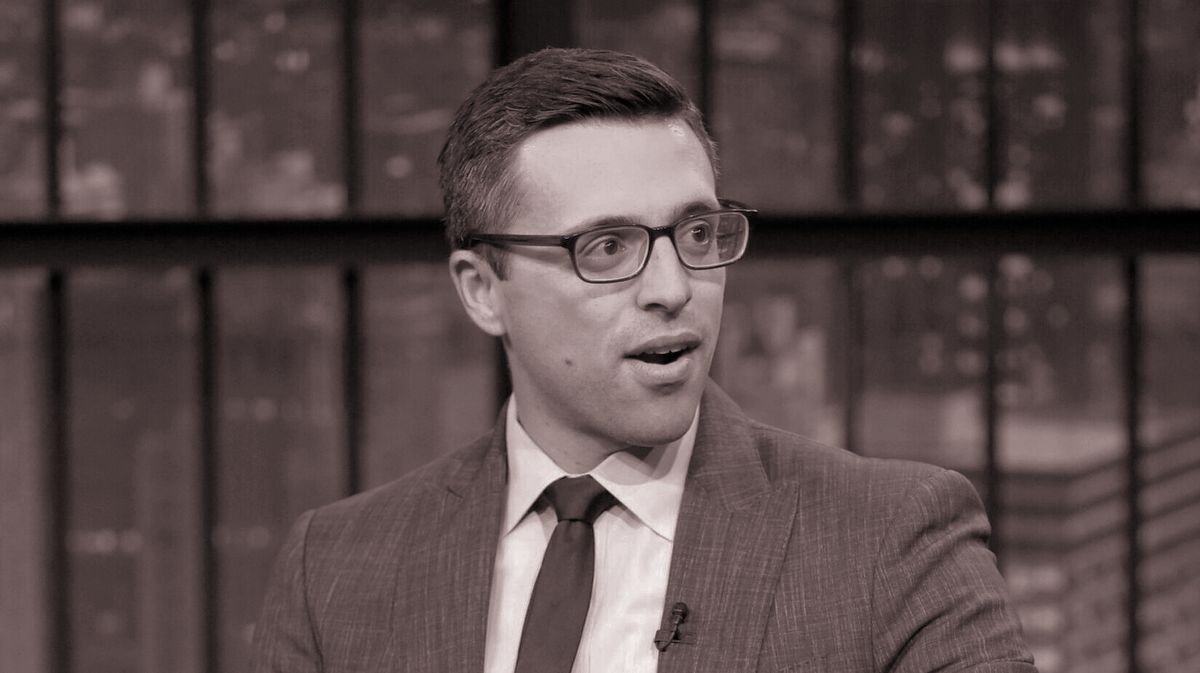
all-senator security briefing since the Minnesota lawmaker shooting. - Schumer’s shutdown ask: Democrats have been divided over how to leverage the possibly imminent shutdown of the federal government, which will run out of money on September 30 without 60 votes in the Senate. (As Leigh Ann reported yesterday,
Ezra Klein’s op-ed calling on party leaders to stiffen their spines has only deepened their agony.) Now, however, we’re beginning to get glimpses of how the caucus intends to respond.
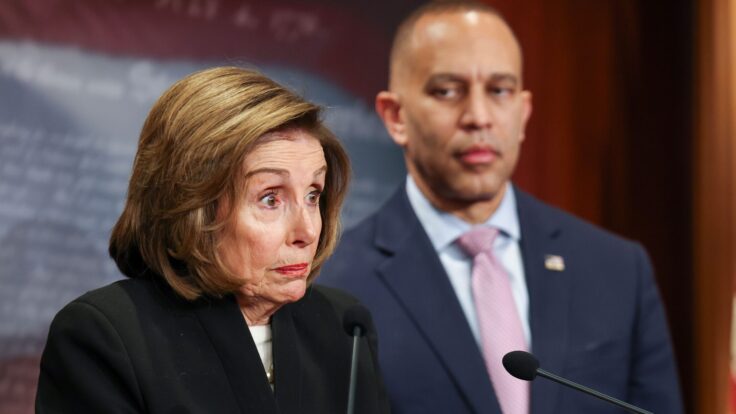
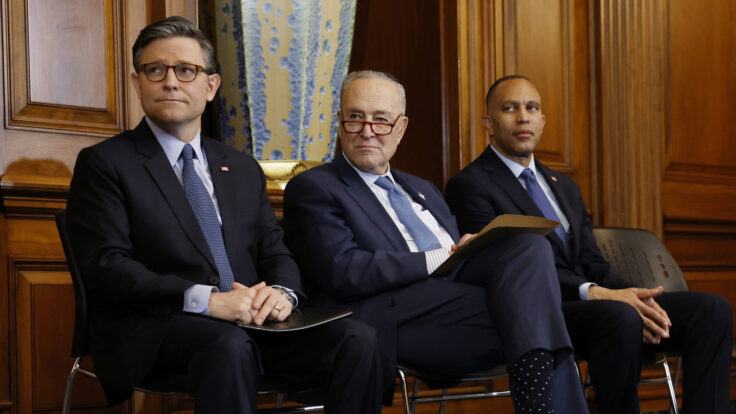
On Wednesday, Senate Minority Leader Chuck Schumer and House Minority Leader Hakeem Jeffries presented a unified front. “The House and Senate, Hakeem and I, all of us here in total agreement, what the Republicans are proposing is not good enough for the
American people and not good enough to get our votes,” Schumer said at the Capitol, demanding major concessions on healthcare—presumably the extension of enhanced A.C.A. insurance subsidies and the reversal of Medicaid cuts. The emphasis on unity is a clear difference from March, when the two Democratic leaders had opposing views on whether to shut down the government: Jeffries backed doing so, while Schumer was subject to staggering fury for voting to fund the government and keep it open.
- The Epstein numbers game: Virginia Democrat James Walkinshaw was sworn into the House yesterday, after winning the special election to replace his former boss, the late Rep. Gerry Connolly. For Democrats, this is good news on two fronts: Walkinshaw continued the trend of Democratic overperformance in special elections (a positive sign for the next cycle), and the House Republican margin has now shrunk to two votes. On
September 23, House Dems will pick up another reserve, when Arizona Democrat Adelita Grijalva is expected to win the race to succeed her father, the late Rep. Raúl Grijalva, in the special election for his safe Democratic Tucson seat.
Democrats desperately need this small cavalry for more leverage in negotiations, like over the coming House spending bill. More explosively, though, Grijalva could be the final vote that Republican rebel Thomas
Massie needs to advance his discharge petition calling for the release of the Epstein files. After Grijalva is sworn into office, House Republicans and Democrats will each have one remaining vacancy in seats they should easily hold.
|
|
|
Now on to the main event… |
|
|
Having had his way with Trump, Putin is testing NATO’s mettle with over a dozen drones in
Polish airspace. Is it an invasion, a provocation, or simply a way to highlight America’s hollow institutions and empty promises? |
|
|
In the early hours of Wednesday morning, Ukrainians tried to warn their Polish neighbors. As Ukrainians spent
another sleepless night staring at their phones and tracking Russian drones headed for their cities, they saw that about 20 of them were headed for Poland instead. “Poles come on get up, you are being attacked, NATO hello!” one Ukrainian Telegram channel posted.
The Poles did, in fact, get up—as did the Dutch, the Italians, and the
Germans, who all quickly activated F-35s and F-16s; Mi-24, Mi-17, and Black Hawk helicopters; and Patriot air defense systems and shot down the drones. A few hours after the incident, the Polish government was trying to determine whether the drones had gone astray from their targets in Ukraine—or if this was a
deliberate provocation. But that was just an exercise in due diligence. “It’s difficult to believe that this scale is an accident,” one NATO defense minister told me. |
|
|
A MESSAGE FROM OUR SPONSOR |
Millions of Americans rely on the health care tax credit to afford their coverage, but it’s set to expire this year.
Without action from Congress, families across the country could see their health care costs skyrocket. Congress: Extend the health care tax credit or families will lose coverage.
Understand the impact if it expires.
|
|
|
Before long, Polish Foreign Minister Radek Sikorski (who is also the husband of The
Atlantic’s Anne Applebaum) formally accused the Russian military of purposefully violating the country’s airspace. The Russian government, predictably, denied that the incursion was intentional. That didn’t stop Poland from invoking Article 4 of the NATO charter, which calls for alliance members to consult with each other in case their territorial integrity is under threat—and is a prerequisite to potentially invoking Article 5.
Testing the West’s resolve, of course,
was the real point of the Russian exercise. Ever since Russia illegally annexed Crimea and invaded Eastern Ukraine, the countries on NATO’s northeastern flank have been vocally worried that they, as former Russian colonies, would be next. Their alarm—and attendant hawkishness—became a frequent thorn in Washington’s side, but they have also been the alliance’s highest spenders on defense. It’s Eastern Europe, after all, that had the most to gain from a strong NATO.
But did Russia just
invade? What would count as an invasion? Recall that Russia doesn’t always just roll in with hundreds of thousands of soldiers and tanks. It sometimes sends little green men in unmarked uniforms. It messes with elections and installs friendly governments, like it has in Georgia and is trying to do in Moldova. And now, it sends drones, including dummy ones, without explosives.
It’s precisely these questions that have complicated NATO’s ability to deter Moscow without devolving
into an all-out, direct military conflict with Russia.
Moreover, what will Washington, the ultimate guarantor of European security, do in response? For the last 11 years, presidents Obama, Biden, and Trump have been unified by their distaste for “escalating” with Russia—albeit for different reasons. Obama and Biden were worried about getting into an all-out war with Vladimir Putin, while Trump seems genuinely fond of the
guy. (On the White House lawn today, Trump again gave Putin the benefit of the doubt. “Could’ve been a mistake,” he said when asked about the Russian drones.)
Putin, meanwhile, makes no secret of the fact that he has been at war with the West this whole time. And if he has any real reservations about getting into a hot war with NATO, he has not made them clear. Trump, in
turn, has rewarded him with a summit in Alaska that broke Putin’s Western isolation but yielded nothing for the U.S. or the West. As recompense, Putin has made an absolute mockery of Trump’s attempts to end the war in Ukraine. A recent C.S.I.S. analysis clearly shows how Russia has dramatically escalated its attacks on Ukraine since Trump came into office.
And yet Trump is still holding up a Senate bill with 84 co-sponsors that would slap more sanctions on Russia. He and his MAGA allies have consistently said that Ukraine is Europe’s problem, not America’s. But if that’s the case, whose problem is Poland? (I think we all know the answer: Poland’s new president, who
ran on a right-wing “Make Poland Great Again” platform.) The U.S. may have 10,000 troops stationed there as part of a NATO presence, but will they engage Russian drones or aircraft
or any other attempts to prod NATO’s defenses? And how long will Trump keep them there if he feels like some of them are about to start coming home in flag-draped coffins? |
|
|
Putin has long relied on American reluctance. He knows the West is afraid of military confrontation with
Russia, and he’s happy to play on that fear by explicitly gesturing toward his vast nuclear arsenal. Except that now, he’s not only escalating in Ukraine—he’s encroaching into NATO itself.
One of Putin’s long-standing goals has been to prove the hollowness of Western institutions. That has proven remarkably easy to do. What good, for instance, is the U.N. charter, which ostensibly protects the sovereign borders of a country like Ukraine, if it can’t be enforced? What good are Western
security guarantees if they don’t come with a credible threat of force? And what good is the NATO alliance if it can be poked and prodded, and its territorial integrity pseudo-violated, without responding in a way that Russia finds meaningful?
So far, the alliance has not found a response that would get Putin to stop, either in Ukraine or elsewhere. And Putin, for his part, has been able to turn what we think of as our strengths into weaknesses. He knows, for instance, that Europe is
squeamish and that their voters would much rather pay for their social programs than for a vast military buildup. (Also, note that some of the weapons NATO used to shoot down those Russian drones are the same ones the West has been sending to Ukraine. Even as European defense production has reluctantly ramped up since 2022, there is still a sense of scarcity. What will be the European appetite for sending these systems to Ukraine if they are increasingly needed to fend off Russian pseudo-attacks at home?)
Putin also knows that the motley alliance of Western democracies—led by people who all face electoral pressures and have different national interests to consider—will have a hard time agreeing on a course of action against him, the head of a unitary dictatorship where there is only one decision-maker. Before January 2025, Putin could only pick off smaller targets, like Hungary or Slovakia or Turkey, to undermine NATO unity. Now he has an admirer in the White House who
can’t quite decide whether NATO is worth it.
For now, Poland has closed the eastern part of its airspace. And Ukraine—which seems to be realizing, finally, that it is mostly on its own—is going to train Polish military representatives on the ground in Ukraine on how to shoot down
Russian drones and missiles. That is hardly enough to deter Russia. Having paid nothing for this breach, it will conclude that it’s worth pushing further still. In the meantime, the more Russia escalates and NATO deescalates, the more Putin will have proven that the alliance is practically irrelevant. That point can be made without firing a shot. |
That’s all from me, friends. I’ll see you back here next week. Until then, good night. Tomorrow will be
worse.
Julia |
|
|
Join Emmy Award-winning journalist Peter Hamby, along with the team of expert journalists at Puck, as they let you in on the
conversations insiders are having across the four corners of power in America: Wall Street, Washington, Silicon Valley, and Hollywood. Presented in partnership with Audacy, new episodes publish daily, Monday through Friday. |
|
|
Unique and privileged insight into the private conversations taking place inside boardrooms and corner offices up and down Wall
Street, relayed by best-selling author, journalist, and former M&A senior banker William D. Cohan. |
|
|
Need help? Review our FAQ page or contact us for assistance. For brand partnerships, email ads@puck.news. You received this email because you signed up to receive emails from Puck, or as part of your Puck account associated with {{customer.email}}. To stop receiving this newsletter and/or manage all your email preferences,
click here. |
Puck is published by Heat Media LLC. 107 Greenwich St, New York, NY 10006 |
|
|
|




_01K4D79V9948E54329KGAMTMRV.png "BlueCross BlueShield Association")