{{ 'now' | timezone: 'America/New_York' | date: '%b %d, %Y' }} |
|
|
Welcome back to Wall Power’s Inner Circle. I’m Marion
Maneker.
Tonight, I have some thoughts about the state of the market after spending time with folks in private sales, and reading two reports available this week. The first is Artnet’s Intelligence Report: Mid-Year Review 2025. The second comes from
Morgen & Stern. If nothing more, both reports helped clarify my thinking on what might be happening in the market. I’ll share that thinking below the fold.
But first… |
- Dora Maar at The Henderson: Christie’s has begun to roll out some of its top lots for the sales coming up in Hong Kong later this month. Pablo Picasso’s 1944 painting Buste de Femme—depicting Dora Maar, his wartime lover and muse—is estimated at HK$86 million ($11 million) and will lead the sale.
Other works include a red Zao Wou-Ki from 1963, titled 17.03.63, estimated at HK$70 million ($9 million); a Yayoi Kusama, Pumpkin [TWAQN], estimated at HK$22 million ($2.9 million); and a Walter Spies landscape, Pagodenlandschaft, estimated at HK$20 million ($2.6 million).
|
|
|
A MESSAGE FROM OUR SPONSOR |
Greatness isn't achieved in an instant. It's tested until there is no question — only performance. |
|
|
- Daniel Humm fronts Sotheby’s Contemporary Curated sale: Daniel Humm, the celebrated chef at Eleven Madison, got married this summer to the actress Annabelle Dexter-Jones, whom you may remember as Jeremy Strong’s addled love interest on Succession. No stranger to the art world, Humm is friends with dealers, collectors, and is a collector himself, and Sotheby’s has tapped him to be the celebrity face of their Contemporary
Curated sale on September 26 in New York. With just two weeks before the sale, Sotheby’s has released only a few highlights. They include a Yu Nishimura painting with a $50,000 estimate; a
Keith Haring tarpaulin, estimated at $1.8 million; and a Helen Frankenthaler, from 1966, that is estimated at $500,000 but comes with an irrevocable bid.
|
|
|
Auction results so far this year paint a mixed picture, offering reasons for
sobriety as well as optimism. Are we looking at a “bloated infrastructure struggling to support itself” or a “buyer’s market”? |
|
|
The conversation was upbeat at the very fancy Midtown restaurant where I found myself
yesterday, talking with a few serious participants in the art market. Not even a kitchen snafu—which derailed the meal and compelled an assistant manager to apologize to us and the nearby real estate mogul who owned the building—could dampen the mood. Sure, the summer had been slow, but there was a low-eight-figure deal about which to trade tidbits of info. Plus, there was the Elaine Wynn estate sale to look forward to, as well as the latest tranche of
Lichtenstein family material, and Pauline Karpidas’s collection next week. In perhaps the most auspicious sign of all, my art world lunchmates were spending money at a tony restaurant and not complaining. (Nor was the finance skylord at the table to our left, who was so enmeshed in the art world that his ex-wife wound up living with an art dealer.)
Certainly some recent market trends warrant sobriety, but whether you see the burgundy glass as half-empty
or half-full is all a matter of perspective. On the half-empty side, a banker friend remarked that he hadn’t read “a more downbeat piece on the state of things” than this week’s Artnet Intelligence Report, which tried to gather as much evidence for a market rout as it possibly could, from the scare subhead—“Who’s getting swept
away?”—to the piece’s view that the “market’s bloated infrastructure is now struggling to support itself.” Meanwhile, Morgen & Stern’s recent Global Blue-Chip Art Market Report depicted a narrowed market turning toward historically significant art, where bid and ask spreads run 10-25 percent for “blue-chip works.” It’s “the strongest buyer’s market
in more than a decade,” the report declared, where high-value transactions have moved to private dealing.
The Artnet report builds its narrative around some unrelated gallery closings; scare quotes from a perma-bear “collector” who appears more in the press than in the art market; and a legitimate discussion of “inversion”—when primary prices, especially at the big galleries, are quite high, but work by the same artists trades much lower on the secondary market. Some mid-career and
recently established artists are experiencing this right now, which is not what the last few decades have trained them to expect. |
|
|
A MESSAGE FROM OUR SPONSOR |
Greatness isn't achieved in an instant. It's tested until there is no question — only performance. |
|
|
The market inversion is an interesting and complex problem. There are supposed to be
lower primary prices for select, proven collectors, and a reasonably reliable secondary market to address later demand and build confidence in an artist’s growing reputation. Art dealers and artists don’t like to lower their prices, which has led to a market standoff, especially for longtime collectors, who hardly need new art and are wary about having to pay up for unproven work.
The market’s scapegoat for this dynamic is the so-called speculator—a short-term holder who buys work that
they believe will rise in value over six to 18 months, after which they can flip the work. Collectors, dealers, and art advisors regularly say that speculators have left the market, which should be a good thing. But then why is the market so tough? It’s because the inversion is caused by the lack of end users—the buyers who are so excited by an artist’s narrative, they’ll pay any price.
Now, as both a cause and effect of the downturn in sales by emerging artists, those buyers are gone.
Maybe they got satisfied (they acquired some cool paintings and don’t need any more); maybe they got burned (they’re stuck with formerly cool paintings); or maybe they just lack a narrative to buy into at the moment (they don’t have a clue what’s going to be cool next). Some who paid top dollar at auction, or privately, to flip a work by a formerly hot artist, are now end users, whether they like it or not. |
Even with the lousy jobs reports, tariff fears, and the political distractions at home
and abroad, there’s a lot of money that could be available to spend on art. It’s just that the art market lacks a coherent story to give buyers confidence and bring back those end users. And monetary value isn’t the only factor. People don’t buy art for asset appreciation alone; they buy art because it gives them social currency. The hard trick right now is convincing a buyer that the work they buy today won’t be embarrassing to them in three to five years when their dinner guests see it.
There’s a lot of art bought in the last few years that isn’t aging well.
The good news is that Artnet’s data offers some clues that we’ve been through the worst of it, and may soon be seeing strong positive signs. According to Artnet’s database, spending at auction was down just under 9 percent in the first half of 2025, but the number of lots fell just under 2.5 percent. This comes after much bigger falls in previous years, though Artnet does say that the half-year average price of an
auction lot has reached its lowest level in a decade, at a little more than $24,000. The good news: Sales in the $1 million to $10 million range picked up by nearly 14 percent in dollar volume in the first half of 2025. The number of lots selling in that range rose nearly 7 percent.
The most valuable thing that Artnet does in their report is break down the data by auction category. The report admits that the “ultra-contemporary” category was down 31 percent at auction this year, though it
was never a huge dollar volume. For Old Masters, auction totals were up overall by 24 percent. The even better news is that value wasn’t concentrated in one or two very, very expensive masterpieces, as is often the case with Old Masters. All of the top 10 lots in the category sold for prices above $3 million. |
|
|
Impressionist and modern art had fewer top prices over $20 million than the same period
last year. Nevertheless, the top names at auction—Picasso, Magritte, Monet, and Giacometti—were consistent with past years. It was both surprising and not to see Marc Chagall rank in the top 10 artists at auction in the imp-mod category.
In contrast, the postwar category had a far greater variety of names among the top 10 lots at auction: two Indian postwar masters, Tyeb Mehta and
M.F. Husain; François-Xavier Lalanne; and Michael Andrews. Switching to the top artists by auction volume in the postwar period, those familiar names reemerge. Because of the way Artnet pulls its data—by the birthday of the artist—there are some artists, like Mark Rothko, Alexander Calder, and Lucio Fontana, who end up on the imp-mod list, when we really think of them as postwar
artists. But no matter how they’re categorized, each of these three artists saw strong sales in the $40 million to $60 million range for the first half of the year. If they were included on the postwar list, they would rank below Roy Lichtenstein and Andy Warhol, who both sold close to $80 million in the first half, but above Gerhard Richter, Lalanne, Yayoi Kusama, Ed Ruscha, and David Hockney. M.F. Husain and
Zao Wou-Ki each sold $30 million-plus at auction, reminding us that despite the slowdown in Asian buying, Asian and South Asian artists remain important fixtures in the art market.
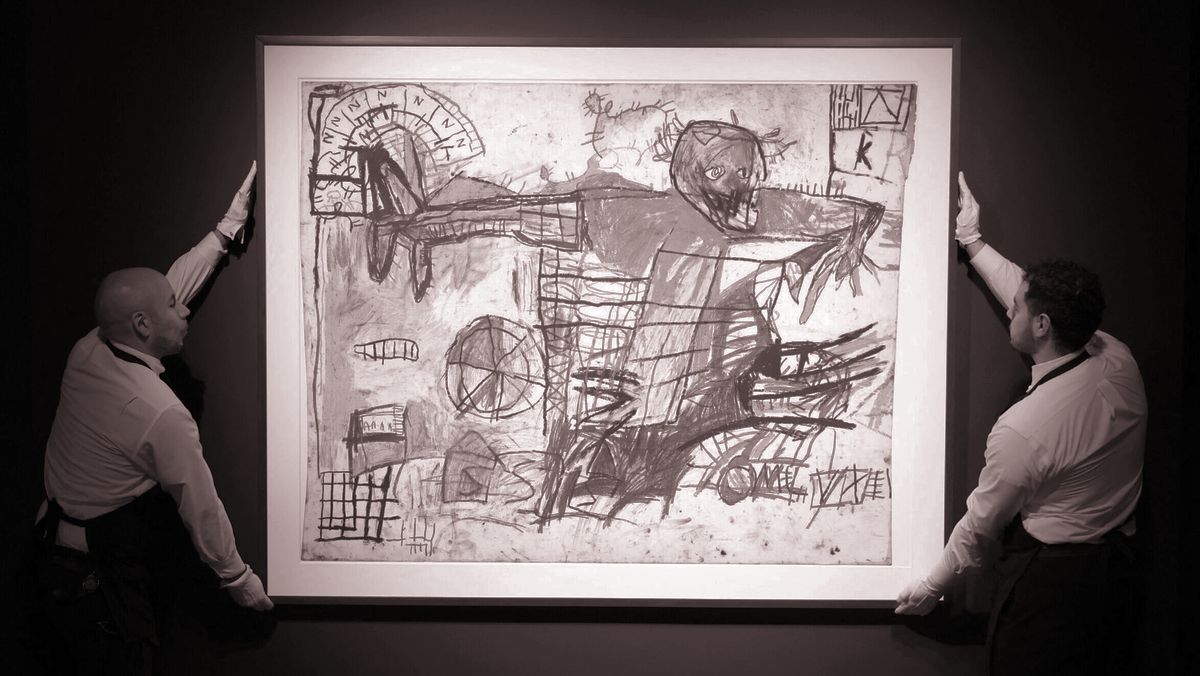
The contemporary market was dominated by sales of Jean-Michel Basquiat’s work, which accounts for six of the top 10 auction prices in the category. Three of the remaining four went to women artists, and two of those—Marlene Dumas and Jenny Saville—also appear
on the list of top 10 contemporary artists by auction volume. Basquiat unsurprisingly leads the list with $101 million in auction sales for the first half of the year. Yoshitomo Nara and Richard Prince follow with $20 million. George Condo saw just more than $15 million in auction sales. Banksy, Christopher Wool, and Keith Haring also made that chart.
As I’ve said before, I
expected we’d see more of a rise in the art market in the first half of this year, and that the growing sales would take place around historical artists of one type or another. I was right about the historical part; the faltering auction volume may be a function of political and economic uncertainty, or a sign of secular decline. And though I don’t really subscribe to the Morgen & Stern idea of a buyer’s market—there’s nothing forcing art holders to sell except death and taxes—I do think we’re
in an era where buyers are looking to get back in, now that prices have come down substantially. So I’m optimistic that much of this historically proven art is going to be attractive to buyers. We’ll have to wait and see how the next 18 months play out. |
Anyway, those are my deep thoughts for today. I’ll be back on Friday with a look at
Elaine Wynn’s collection.
Until then,
M |
|
|
The ultimate fashion industry bible, offering incisive reportage on all aspects of the business and its biggest
players. Anchored by preeminent fashion journalist Lauren Sherman, Line Sheet also features veteran reporter Rachel Strugatz, who delivers unparalleled intel on what’s happening in the beauty industry, and Sarah Shapiro, a longtime retail strategist who writes about e-commerce, brick-and-mortar, D.T.C., and more. |
|
|
Finally, a media podcast about what’s actually happening in the media—not the oversanitized,
legal-and-standards-approved version you read online. Join Dylan Byers, Puck’s veteran media reporter, as he sits down with TV personalities, moguls, pundits, and industry executives for raw, honest, sometimes salacious conversations about the business of media and its biggest egos. New episodes publish every Tuesday and Friday. |
|
|
Need help? Review our FAQ page or contact us for assistance. For brand partnerships, email ads@puck.news. You received this email because you signed up to receive emails from Puck, or as part of your Puck account associated with {{customer.email}}. To stop receiving this newsletter and/or manage all your email preferences, click here. |
Puck is published by Heat Media LLC. 107 Greenwich St, New York, NY 10006 |
|
|
|