{{ 'now' | timezone: 'America/New_York' | date: '%b %d, %Y' }} |
|
|
|
Welcome back to Wall Power’s Inner Circle. I’m Marion
Maneker.
It was a big day in the art market yesterday, even if it wasn’t a particularly glamorous one. Phillips had a solid evening sale with a broad mix of property and real bidding, and Sotheby’s had a strong showing in a sale without many star lots. The action confirmed that the art market is on a new footing. Up top, I explore the robust day sales for modern art and works on paper at Christie’s, and Inigo Philbrick’s long-contested
Basquiat finally gets resolved.
Also mentioned in this newsletter: Mattia De Luca, David Nahmad, Andy Warhol, Édouard Vuillard, Judd Grossman, Bernard Arnault, Salman Toor, Cecily Brown, Lee Bontecou, Pat Passlof, Helen Frankenthaler, P.S. Krøyer, and
many more. |
-
Is Christie’s modern day sale leading a recovery?: Yesterday’s day sales of impressionist and modern art at Christie’s told a different story than Monday evening’s high-flying auctions, though the day sales in these categories were up 50 percent year over year. In May of last year, works on paper totaled $10 million, and the rest of the imp-mod day sale made $31 million, for a total of $41 million. This year, works on paper totaled $21 million, and the sale of impressionist and
modern art notched $41 million—up sharply from this time last year, though actually down slightly from the $47 million spent in November.
Standout lots in the works on paper sale were a colorful Pablo Picasso drawing, Homme et femme, from 1964, that was estimated at $700,000 but sold for $2.5 million; René Magritte’s
Le mois des vendanges, from 1959, which was estimated at $300,000 but sold for $2.1 million; and Edgar Degas’ Quatre danseuses à mi-corps, from 1899, which was estimated at $800,000 but sold for $1.5 million.
In the sale of paintings, a small Pierre-Auguste Renoir, Femme nue couchée dans un paysage, from 1902, sold for $2.4 million against an estimate of $1 million. Bridget Tichenor’s untitled work was estimated
at $60,000 but attracted enough bids to sell for $840,000. Édouard Vuillard’s Madame Arthur Fontaine en rose, from 1904, had a $200,000 estimate and sold for $825,000. There were many more similar stories. If you put them all together, it’s a compelling case that the turn toward historical art has fully arrived. - Inigo Philbrick’s finale: This morning, the U.S. Court of Appeals denied a motion from Athena Art Finance’s lawyers to keep control of Jean-Michel Basquiat’s Humidity. The painting has been at the center of Inigo Philbrick’s most visible fraud, and this was Athena’s last attempt to stop its return to its legal owners. Philbrick first bought the painting for $12.5 million, misrepresented its cost at $18 million, and sold shares in it to two
private collectors. Then he used the painting as collateral to get a loan from Athena. He was later sentenced to seven years in prison for the fraud, but released in 2024 after serving only half that sentence. In the meantime, the private collectors’ lawyer, Judd Grossman, has been pursuing a seven-year court case to get the painting back from Athena. Today’s ruling finally gives Grossman's clients full possession of the work.
|
Now, let’s get to the evening auctions… |
|
|
|
Beyond the billion-dollar single-night bonanzas and the movie-star
promo spots, smaller sales are revealing a less sexy dynamic in the market: Collectors are exercising the freedom to sell without taking too big a loss—and their willingness to move on is creating liquidity that will fuel future growth. |
|
|
|
Liquidity has returned to the art market, praise be. And even though we don’t fully
understand the reasons for the unprecedented three-year slide that only showed signs of a real reversal last November, it now seems clear there is a robust (but still cautious) market for high-value art. More importantly, the money is visible beyond the big-name collections that were sold earlier this week and last, and the billion-dollar one-night totals. The true indicators of a solid market are instead apparent in last night’s more humble $115 million evening sale at Phillips, and the
$304 million modern evening sale at Sotheby’s shortly thereafter.
In both events, artworks were resold at par or even a slight loss. While this might seem like a light capitulation, it’s actually an important market milestone. Despite the popular fixation on making money from owning art, the truth is that its real value is in the experience of living with it. Getting most of your money out when you sell is a small but tangible victory for the vast majority of collectors.
That
dynamic has been missing from the market in recent years. Sure, some sellers were compelled to off-load works on account of the inexorable duo of death and taxes. But discretionary sellers—or buyers who might have regretted a purchase, or experienced a change of circumstances, or just needed the money—have mostly been opting not to sell their art for some time, perhaps waiting out the uncertainty that shrouded the market during the past few years.
This behavior has been
reminiscent of the retrenchment that followed the global financial crisis in 2009, when collectors who bought in the euphoria of the market boom from 2004 to 2007 required a few years of soul-searching and wound-licking to resell those pieces. In 2011, however, a number of works came back to market after prices reached a point where penitent buyers could sell at only a slight loss. This behavior released market tensions, gave sellers a sense of relief, rewarded buyers, and helped to revive the
market. As we go through the recent sales at Phillips and Sotheby’s, this dynamic may be resurfacing. |
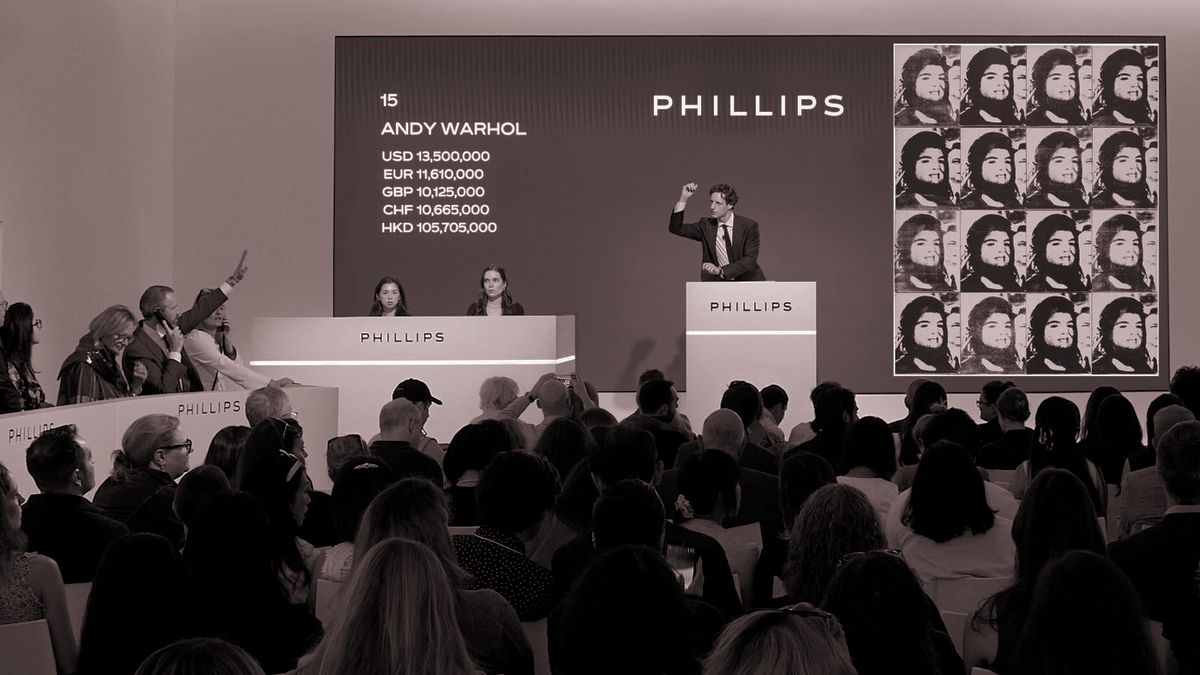
Last evening’s sale at Phillips was one of the liveliest in recent memory at the auction
house, with most of the lots selling for prices at or above the low estimate. Throughout its quarter-century as a contemporary auction house—yes, Phillips was founded 230 years ago, but this modern version is the more recent product of Bernard Arnault’s luxury ambitions—its estimates have tended to be aspirational. Even last night, a third of the lots sold for compromise prices below the low estimate. Nevertheless, they sold.
There was active bidding on
two-thirds of the lots, which may be a product of Phillips’ new priority bidding system, in which anyone can lock in a third-party guarantee at the low estimate within 48 hours of the sale. Whatever the source of confidence, the abundance of bids showed that Phillips can be tactical and stay in the game even as the broader market contraction of the past three years squeezes its competitive position.
Some high points of the sale were the solid competition for works by Salman
Toor, Cecily Brown, Joseph Yaeger, and Lee Bontecou. A colorful abstract work by Pat Passlof sold for a new record price of $580,500. And a domestic-size Helen Frankenthaler, Paloverde, from 1978,
sold for nearly $2.2 million, or nearly three times the estimate.
A self-portrait by Danish painter P.S. Krøyer made more than three times the estimate to sell for nearly $1.3 million. Oddly, brothers David and
Alberto Mugrabi, who were seated in the back row, chose to leave just after the Krøyer bidding. One might have assumed, given the family’s history of owning hundreds of Warhols, that they were in attendance to keep an eye on the three Warhols on offer. Regardless, a small self-portrait and Marilyn reversal painting did well after they left.
The Krøyer selfie was part of the Loeb collection, which also included
four works by Vilhelm Hammershøi, one of which was underbid by Italian dealer Mattia De Luca. The dealer, who trades in works by Giorgio Morandi, also bid on the Morandi lot that followed. Although the
first Loeb Hammershøi did well, the remaining three were sold at compromise prices, two of those to museums, which is a good thing all around.
Phillips’ top lot, Andy Warhol’s Sixteen Jackies, had been bought in November 2023 for just under $26 million. It sold last night for a total of just over $16 million, a $10 million setback. Although there is talk that the sale
was part of a broader art liquidation, it also matched the loss made by another Warhol painting the night before at Christie’s. That work, Double Elvis [Ferus Type], from 1963, was sold for $27 million after having been purchased for $37 million eight years ago.
Whatever the motivation, we’re beginning to see sellers cave and move on. A Claude Monet winter
scene that was the number two lot at Phillips made $9.9 million, even though the sellers got the work in May 2017 for almost $11.5 million. It was guaranteed and backed by a third party, so there’s no way to discern how much of a haircut the sellers took, but it’s at least $1.5 million. At least they’re moving on.
Phillips itself was doing the same with a Jackson Pollock drip painting that had been sold for $15 million a year and a half ago to a guarantor who reneged, leaving the auction house on the hook. Last night, it got a little more than $9 million of its money back. |
I was surprised to learn at the end of Sotheby’s modern evening sale that the total was almost $304
million. Only half of the top 10 lots saw much bidding above the low estimates, though Henri Matisse’s La Chaise lorraine was the night’s surprise battle—three bidders, including David Nahmad, seated in the front row, pushed the hammer price 60 percent above the $25 million estimate. In the end,
the work sold to a telephone bidder for more than $48 million with fees. Dealer Per Skarstedt lobbed in a bid on Pablo Picasso’s cubist Arlequin (Buste), from 1909, but it was a half-hearted attempt. The work sold for $42.6 million with fees, suggesting it went to the holder of the irrevocable bid. The other Matisse in the sale, La Séance du matin,
sold for $20 million—again, a number that should indicate the buyer was the irrevocable bidder. Taiwanese singer Jay Chou is bragging about it on his Instagram.
Sotheby’s
revealed that 11 of the lots had bidding from Asian clients, and that five were acquired by those bidders. The lack of Asian, particularly Chinese, buyers in the past few years has been a major feature of the market slowdown.
Ten of the 41 lots sold at Sotheby’s made prices below the low estimate. So, as at Phillips earlier in the evening, consignors had to come to grips with market realities. Buyers balking at sellers’ expectations isn’t a new thing, nor is it a surprise in the modern
category. The night before, at Christie’s, a Renoir that had not been on the market for generations sold to a backer for just shy of the low estimate.
A similar story played out with the watercolor on paper by Vincent van Gogh. An undeniably great work of art, it sold at the $25 million low estimate
to make a premium price of a little more than $29 million. It was last sold in 2003 for $10 million, which would be more than $18 million in today’s terms; a previous buyer paid $14 million for it in 1997, or $29 million in today’s purchasing power. In an additional indicator of the market’s swings, another van Gogh watercolor sold in 2021 for nearly $36 million. Yes, timing is still everything in the art market.
Two Alberto Giacometti works made it into the top 10 at
Sotheby’s, including La Clairière, a bronze cast in an edition of six from 1960, which had been owned by the consignor since 1981. It sold for $23 million. A similar work sold for almost $16 million eight years ago. And Annette d’après nature, one of five
bronzes cast in 1954, sold for $8 million.
Finally, surrealist works by Óscar Domínguez, Leonora Carrington, Leonor Fini, René Magritte, Yves Tanguy, and Dorothea Tanning all did well, selling solidly above the estimates. The
Tanguy made a price almost twice the estimate. |
That’s it for today. But we’re not done with the auctions yet. I’m at Christie’s tonight, and
tomorrow I’ll be at their postwar and contemporary day sale to see if they can match the heat Sotheby’s brought last Friday. I’ll have a final report on these sales at the end of the week before the holiday.
Until then,
M |
|
|
|
Puck founding partner Matt Belloni takes you inside the business of Hollywood, using exclusive reporting and insight
to explain the backstories on everything from Marvel movies to the streaming wars. |
|
|
|
The industry’s go-to source for unflinching reporting on the trillion-dollar business of artificial intelligence -
perhaps the single most important technology of our time. Ian Krietzberg, the powerhouse journalist behind The Deep View, delivers twice-weekly insights into the latest dealmaking and breakthroughs in A.I., and how the intersecting worlds of finance, entertainment, media, and politics are being transformed in its wake. |
|
|
|
Need help? Review our
FAQ page or contact us for assistance. For brand partnerships, email ads@puck.news.
You received this email because you signed up to receive emails from Puck, or as part of your Puck account associated with {{customer.email}}. To stop receiving this newsletter and/or manage all your email preferences, click here. |
Puck is published by Heat Media LLC. 107 Greenwich St., New York, NY 10006 |
|
|
|
|