{{ 'now' | timezone: 'America/New_York' | date: '%b %d, %Y' }} |
|
|
Welcome back to The Hidden Layer. I’m Ian Krietzberg, feeling celebratory in
light of Puck’s fourth birthday. It has been a thrill to be a part of such a special company with a deep roster of passionate, talented people.
In recognition of four years’ worth of industry-shaping reporting, we’re offering Puck subscriptions for 20 percent off—so if you’ve been waiting to sign up, now’s a good time. Just click here.
Today, a close look at a company that has branded
its model as the first “self-building” A.I. on the market. We’re also examining the breakup-makeup drama between Microsoft and OpenAI as well as the latest political machinations surrounding the technology.
Mentioned in today’s issue: OpenAI, Google, the F.T.C., Mark Meador, Microsoft, Elon Musk, Sam Altman, Ted Cruz, Gary Marcus, Arun Bahl, and many more…
Let’s get
into it… |
- The
challenges of companionship: The Federal Trade Commission has launched an official inquiry into the impacts of artificial companion chatbots on kids. Last week, the agency announced that it was seeking information from seven major players in the A.I. companionship space—OpenAI, Google, Meta, Instagram, xAI, Snap, and
Character—on how their respective companion bots were developed, tested, and monitored. The regulator is also interested in hearing about how these companies monetize user engagement.
In a separate statement, Commissioner Mark Meador specifically mentioned the recent, alleged ChatGPT–related suicide of 16-year-old Adam Raine as a major catalyst for the inquiry. Of course, the F.T.C. is not the only government agency spurred into action by the
well-publicized wrongful death lawsuit filed against OpenAI: The Senate Judiciary Committee held a hearing today to examine the harms of A.I. chatbots. Adam’s parents were in attendance: Matt, his father, even testified. It marked the first public comments from the family since they filed suit. More on this Thursday.
- OpenAI’s dealmaking: After OpenAI announced its plan to purchase $300 billion worth of compute from Oracle over the next five years, Microsoft moved quickly to assure investors that it wouldn’t get left behind. After all, Microsoft’s own cloud business has been boosted by OpenAI—and, of course, the companies have been intertwined since the start of the A.I. race: Microsoft famously invested around $10 billion in OpenAI several years ago,
although SoftBank recently replaced the company as OpenAI’s largest investor.
Last week, the companies jointly published a three-sentence statement announcing a nonbinding M.O.I. regarding the “next phase” of their partnership and touting efforts to “finalize contractual terms in a definitive agreement.” The terms are
expected to outline how Microsoft’s stake in OpenAI will translate into the soon-to-be public benefit corporation, and what the revenue split will look like. It will also, probably, clarify whether Microsoft would have access to artificial general intelligence should OpenAI cross that threshold (under the current partnership structure, it would not).
While the terms get fully ironed out, The Information has
reported that OpenAI expects to start sharing considerably less revenue with partners over the next few years. At the same time, OpenAI announced that its nonprofit arm will take a $100 billion stake in the public benefit corporation, whenever that structure takes shape. The proposition has invited plenty of scrutiny and criticism—the company is currently locked in negotiations with the California A.G. over its proposal, while simultaneously battling Elon Musk in court. External groups are also trying to combat the transition,
arguing that the actions of the company, and Sam Altman, demonstrate a “prioritization of profit and abandonment of its nonprofit mission.” Much of the recent funding that OpenAI has raised, including billions from SoftBank, is contingent upon the company successfully completing
its transition.
|
|
|
AI growth is outpacing power infrastructure, making energy strategy a board-level concern. The
2025 Mid-Year Power Report highlights grid delays, rising onsite generation, and the strategic importance of power access. Read report |
|
|
- Cruz’s
A.I. approach: Last week, Senator Ted Cruz released a new framework to guide congressional action on A.I. Among other things, the proposal aims to clarify federal legislative standards to prevent “burdensome state regulation,” “unleash” A.I. innovation by allowing model developers to train on federal
datasets, streamline the permitting process for building A.I. infrastructure, and protect Americans from deepfake fraud and other risks.
The framework arrives just a few weeks after the intense debate over a decade-long moratorium on state legislatures regulating A.I. that was included in the House version of the One Big Beautiful Bill Act. That provision was removed following a near-unanimous vote in the Senate, although
experts I spoke with expected some version of the moratorium to be resurrected. The release of Cruz’s proposal also dovetails with the California State Legislature’s
passing of SB 53, the state’s second shot at imposing safety regulations on the A.I. industry. The bill is now over to Governor Gavin Newsom, who vetoed the first attempt.
|
Hallucination of the
Week
|
Albania’s Prime Minister, Edi Rama, recently
appointed an A.I. system called “Diella” to a ministerial position in his cabinet and tasked “her” with ensuring that “public tenders will be 100 percent free of corruption.” It’s a big promotion for Diella, which was launched earlier this year as a virtual assistant on the country’s public service platform. It’s
not clear how Diella was trained or how she will be used—but if Rama’s goal was to make a splashy new hire, he certainly succeeded.
And now for the main event… |
|
|
News and notes on Aloe, a buzzy new entrant in the A.I. race, which is seemingly capable of
building, vetting, and using tools to more reliably answer user queries. |
|
|
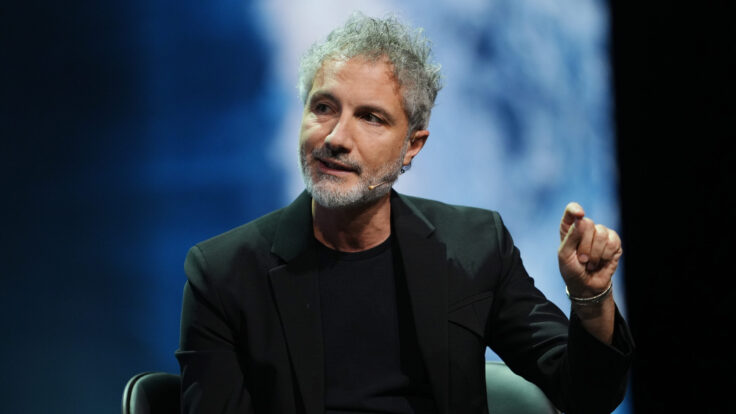
Arun Bahl is hoping to build a different kind of A.I. company, one explicitly designed to
steer our society away from a dystopian future and toward something more… agreeable. But what really distinguishes Aloe, which Bahl co-founded in 2023, is that the company’s A.I. model (also called Aloe) is apparently “self-building.” There’s a certain woo-woo aspect to the endeavor: The company’s employees are referred to as “gardeners” who shape and guide the technology, and the website emphasizes that
Aloe isn’t going to sell your data or “mine your dopamine.”
Aloe’s mission, like that of Amazon’s AGI Labs, is to provide a technological remedy to the “distraction economy.” Bahl, a cognitive scientist turned serial entrepreneur, told me that his goal was to build a chatbot that can “help bolster our abilities, so that we can thrive in this environment that’s not the same
as the one that we evolved for.” Plenty of scientific research backs up the link between distraction and weakened cognitive performance, and that attempting to process too much information leads to worse memory recall; Bahl believes that A.I. can eliminate
the digital clutter that exacerbates this phenomenon.
In his view, getting there involves moving past the industry’s fixation on large language models and designing an auditable system that users will find genuinely trustworthy. Bahl told me this requires users to actually believe the chatbot is capable of sound reasoning; has access to good information; and isn’t a malicious actor. Of course, it also means dipping a bucket into the veritable river of V.C. cash that’s been flooding
Silicon Valley since 2022. So far, Bahl told me, his small team of three has been able to bootstrap the company, helped along by a few angel investors. But a big capital raise is probably the next step—if the “right partners” with the right motivations come along. |
|
|
As AI adoption accelerates, power has become the defining constraint—and opportunity—for data center growth. Our
latest 2025 Mid-Year Power Report reveals a dramatic shift in how industry leaders are planning for the future. Read the report. |
|
|
It’s unclear how far along those conversations are, but Bahl told me that a raise would happen “soon.” In the
meantime, the company’s main focus has been on pulling people off the waitlist to test how well Aloe works in the real world. “In a moment where sometimes it feels a bit hard to have optimism, I think that we can,” Bahl told me. “Being clear about what our expectations are, not just for our tools, but tech as an industry, I think that there’s a real opportunity to rewrite that script and nudge the boat in a different direction.” |
According to Bahl, Aloe’s model leverages a combination of neurosymbolic reasoning, program synthesis, and
confidence scoring to more helpfully respond to problems that tend to trip up stand-alone L.L.M.s. But that was as much as I could squeeze out of him. That said, the idea of neurosymbolic A.I., which has been pushed by a number of researchers in the field, including Gary Marcus, is to combine the two prominent A.I. architectures—symbolic A.I., which
relies on rules-based reasoning and formal logic; and artificial neural networks, which power L.L.M.s and recognize patterns from data—in a way that overcomes each of their respective shortcomings.
Moreover, Aloe’s capabilities are based on an artificial version of metacognition, a jargony term that, in humans,
essentially equates to self-awareness. In terms of A.I. systems, a metacognitive model would be trained to automatically question why it landed on a certain answer, which would in theory make the output more trustworthy. “If there’s a disease I want to bequeath to this thing, it’s crushing self-doubt,” Bahl told me. In short, through confidence scoring, Aloe seems capable of recognizing when its responses aren’t trustworthy, and can then leverage symbolic tools to write code
autonomously as a means of problem-solving. One example Bahl offered is training a model to use a calculator to answer a math query, rather than rely on its own brittle “reasoning.” The trick is getting the model to actually reach for the calculator, which requires enough “self-awareness” to suspect that its initial response is incorrect.
This is where the “self-building” component comes in. Beyond merely relying on an external tool when necessary, Bahl said that Aloe is “able to create
new tools if it doesn’t have the tool that it needs for a certain situation.” He offered an anecdote in which Aloe “needed to be able to understand that there was some speech inside of an MP3 file.” The model wasn’t given a tool to identify the speech, but Bahl said that when it recognized the problem, “it stopped and wrote the tool to do that. It iterated through, and didn’t just write the code, but tested it. And when it looked like [the code] was running well enough, it could then bring that
tool back into its toolbox and use it. Once it’s been able to create this new tool to work through a type of problem, that’s now available for all such types of problems.” (Neither the tool nor this specific capability has been independently tested or verified, so it’s almost impossible to know, at this point, just how effective, robust, or reliable Aloe actually is.)
Bahl also noted that Aloe is built on a number of L.L.M.s. “We’re totally model agnostic, so we can use open source too,”
he said. “There were situations where Gemini couldn’t answer this question, but Gemini inside of Aloe can.” At some point, Bahl said he might be interested in building a proprietary language model to power Aloe and specifically expressed interest in the promise of a smaller, more efficient model. But he reiterated that, for now, the team’s focus is on the scaffolding that can be built around an existing L.L.M.
A month ago, Aloe
released test results against the popular General A.I. Assistants benchmark (GAIA), in which its system beat the competition to achieve state-of-the-art scores by a healthy margin. As Bahl pointed out, perhaps the most significant revelation was that Aloe’s lead over the competition was at its highest on the most
difficult questions. (Aloe achieved a score of 78.9 on the third level of the GAIA benchmark, compared to GPT-5 medium’s 38.4.) Of course, Aloe’s score has been neither verified nor peer reviewed—not to mention the fact that benchmarks rarely measure what they purport to measure. Unlike the verified scores on GAIA’s leaderboard, it’s also unclear what it cost Aloe to achieve its scores. But as a marker against which the entire industry is competing, Aloe seems to have slipped to the top.
|
Last week, Sam Altman sat down for a wide-ranging conversation with Tucker Carlson. Carlson
pushed Altman on a number of topics, including the relationship between ChatGPT and suicidal ideation. He also seemed to suggest that Altman was somehow behind the death of Suchir Balaji—a former OpenAI employee who died shortly after he began publicly criticizing OpenAI’s approach to copyright. A stunned Altman firmly rejected the conspiracy theory that Balaji had been murdered.
[Spotify]
This one’s a little in the weeds, but still super interesting: Gary Ang (Ming), a researcher and expert in time series models, breaks down the predictive capacity of L.L.M.s and how it has evolved over the past few years.
[A.I. Realist]
A group of internet companies, including Reddit, Yahoo, and Medium, recently launched a new standard—called Really Simple Licensing—that will prevent A.I. companies from automatically crawling and training their models on public-posted content.
[Medium]
Brian Merchant’s latest edition of his newsletter details the ways that artists, across different industries, have lost their jobs amid the rise of generative A.I.
[Blood in the Machine] |
That’s all for today. I’ll see you Thursday.
Ian |
|
|
Join Emmy Award-winning journalist Peter Hamby, along with the team of expert journalists at Puck, as they let you in on the
conversations insiders are having across the four corners of power in America: Wall Street, Washington, Silicon Valley, and Hollywood. Presented in partnership with Audacy, new episodes publish daily, Monday through Friday. |
|
|
A professional-grade rundown on the business of sports from John Ourand, the industry’s preeminent journalist, covering the
leagues, players, agencies, media deals, and the egos fueling it all. |
|
|
Need help? Review our FAQ page or contact us for assistance. For brand partnerships, email ads@puck.news. You received this email because you signed up to receive emails from Puck, or as part of your Puck account associated with {{customer.email}}. To stop receiving this newsletter and/or manage all your email preferences, click here. |
Puck is published by Heat Media LLC. 107 Greenwich St, New York, NY 10006 |
|
|
|