 |
|
|
|
Give The Gift of Puck
|
|
Puck members can now spread the holiday cheer by giving the gift of Puck to friends, family, or co-workers with an exclusive 25% off code (HOLIDAYGIFT).
|
|
|
|
|
|
Hi you,
I’ve got a lot on my mind as the year winds down, including the loss of some people whose efforts to spread love and understanding are needed now more than ever.
The first is Michael Latt, a strategist, producer, founder, and C.E.O. of Lead With Love, an entertainment marketing agency that uplifts the creative work of women and people of color. I worked with him on projects like #BlackMenSpeak, #JusticeForFlint, and the MLK Now annual event, to name a few. (Check out this L.A. Times piece about his life.)
The other is Norman Lear, the epic writer, producer, and Hollywood legend. Just days after the 2016 election, I had the opportunity to interview Lear about his life’s work. His TV shows literally helped raise me in the 1980s. His commitment to active citizenship inspired some of my own work with How To Citizen. This 2015 interview with him on Death, Sex & Money reveals some of his humor and humanity.
Today, I’m going to dive back into the Israel-Hamas war, at least tangentially. Previously, I focused on how the war was playing out on social media. Today, I want to focus on how it’s impacting life on American college campuses and what schools could do differently. But I’ll be candid: This is a very hard subject for me to write about. Of course, I remain horrified by Hamas’s brutal attack and the growing revelations of sexual violence that were part of that attack. Meanwhile, the Israeli response, as many predicted, has unleashed orders of magnitude more suffering upon civilians through siege, mass displacement of already displaced people, and indiscriminate bombardment. I want to see greater efforts to resume the ceasefire, return the hostages, and get much-needed aid to the millions of Palestinians who did not attack Israel on October 7.
This is an incredibly difficult subject to talk about, think about, and write about. And that conflagration is already manifesting itself at our elite institutions, including one I have a lot of familiarity with…
|
 |
| Old School |
| The public scandal around Claudine Gay and Liz Magill, among others, has distracted us from the real problem here: Elite institutions should focus less on press releases and more on their power to convene experts and host well-facilitated discussions. This is hard work, but it is desperately needed. |
|
|
|
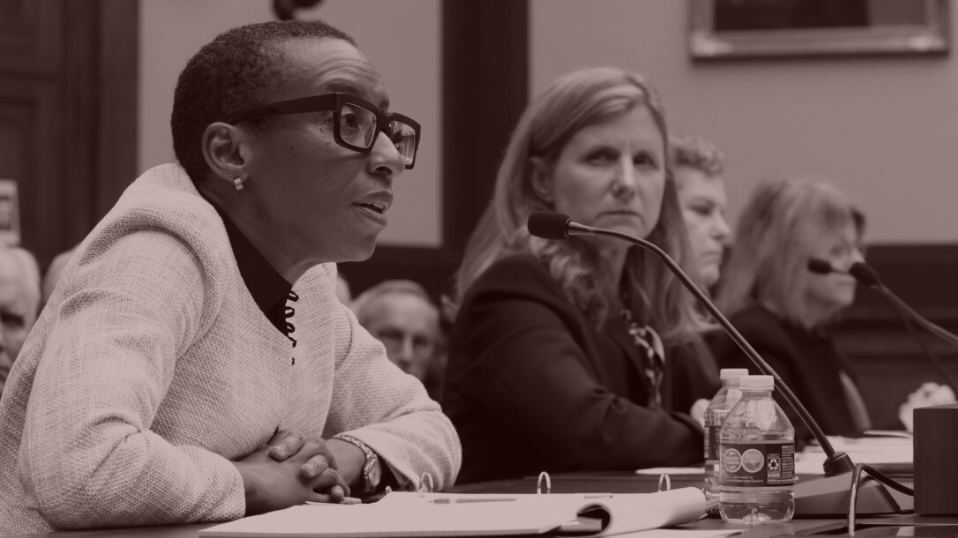
| I heard about the controversy—on Twitter and in text threads—before I saw the clips myself. Earlier this month, in a four-hour hearing before the U.S. House Committee on Education, Harvard president Claudine Gay, University of Pennsylvania president Elizabeth Magill, and M.I.T. president Sally Kornbluth responded to a line of questioning from G.O.P. Rep. Elise Stefanik about students calling for genocide against the Jewish people. Their responses, which have now reverberated across the internet and the world, were in many ways a rage-inducing display of over-lawyered, inhumane, rhetorical evasion. Why are you making an easy thing look so hard? I wondered. Just say that calls for genocide against Jews or any group are bad!
But looking past that sensational moment of equivocation, Stefanik’s question was in some ways a perfect political snare. The New York Republican didn’t simply ask whether genocide is wrong, but whether calling for genocide “violates your code of conduct.” Perhaps sensing a trap, the presidents fell back into a defensive, legalistic crouch. Most of us watching the clips, inundated with news reports about the horrors unfolding in the Middle East, were looking for an unambiguous rejection of hatred. But it never arrived.
The presidents’ fatal misstep was their attempt to bring complexity to a loaded fight. Magill stepped down four days after the hearing, while Kornbluth has somehow managed to sidestep the same fate. Gay’s future at Harvard was also tenuous, until the university’s board rallied behind her last week after shows of support from the faculty, Black alumni, and more. As a Black Harvard alum myself, I felt for Gay. I want to see her succeed, and while I’m glad she managed to keep her job, I acknowledge that she should have done better in that testimony. But I also agree with the student newspaper, The Harvard Crimson, which published a staff editorial demanding the university “not allow Congress to tell the story of this moment on campus.” (For more on Gay and Harvard, take a look at my Puck partner Bill Cohan’s latest piece.)
Of course, college campuses have been hotbeds of protest since the 1960s—over civil rights, the Vietnam War, women’s rights, LGBTQ+ rights, apartheid in South Africa, U.S. involvement in Latin America, affirmative action, climate change… take your pick!—but this war has unleashed a new kind of fervor. The current generation of students, who came of age in the post-George Floyd, post-#MeToo, and post-Trump era (hopefully, we remain post-Trump), are more attuned to social injustice. They are likely experiencing this war on smartphones, with videos of carnage interspersed between videos of Kardashians. They have seen active shooters, or at least prepared for them, and they live with climate disasters playing out as the weather. Their educations were interrupted by a once-in-a-generation pandemic. They have access to virtually unlimited, but also unfiltered and unregulated, information.
It’s hard to see how these ingredients wouldn’t harden and shape their temperament. Current college students are fiercely passionate, demanding of action, and prone to self-righteousness. In their eyes, the world can be reduced to a battle of good versus evil, featuring clearly demarcated teams of oppressors and the oppressed—a lens that has led many to see the Israelis as colonizers and Palestinians as the displaced and downtrodden. There is truth in this, but it’s not the whole truth, and this perspective flattens reality. On tightly wound campuses, the result is hostility and offense felt by all, not least because no campus letter, poster, or protest is limited to campus. Everything is fodder for the internet, which allows those of us at a distance to get an exaggerated view of what’s happening. |
|
|
| There’s a legitimate debate to be had on college campuses about freedom of speech and intellectual vitality. Monocultures aren’t good in nature or in academia. But how do you foster an environment of open debate and inquiry, while also creating an inclusive environment to which everyone can belong? This necessary debate, however, is happening alongside an illegitimate one, in which antisemitism is weaponized and positioned as the only harm being perpetrated, pushed by people who lack credibility and have alternative motives that stray far from the goal of protecting Jewish students.
Rep. Stefanik, also a Harvard graduate, who drove the viral questioning that led to the ouster of Penn’s president, is also a self-described “ultra MAGA” backer of Donald Trump who has trafficked in the racist and antisemitic “great replacement theory.” After insurrectionists stormed the U.S. Capitol on January 6, 2021, Stefanik voted to toss out Pennsylvania’s Electoral College votes for Biden, making false claims of fraud. Her baseless claims about the 2020 election got her removed from the prestigious Senior Advisory Group at Harvard’s Institute of Politics. She has never apologized or taken responsibility for her own speech, or that of the former president, whom she unequivocally supports. Are we to believe that Stefanik was acting in good faith?
Then there’s Bill Ackman, the hedge fund investor and two-time Harvard alum, from the college and business school. Like many, he was disappointed in the university’s initial public statement and a pro-Palestinian student letter that blamed Israel alone for all the unfolding violence. Unlike others, he took to Twitter/X writing, “I have been asked by a number of C.E.O.s if Harvard would release a list of the members of each of the Harvard organizations that have issued the letter assigning sole responsibility for Hamas’ heinous acts to Israel, so as to ensure that none of us inadvertently hire any of their members.”
He wasn’t just asking for names; Ackman wanted to permanently seal off their pathways to the job market. He’s also made it his mission to remove President Gay, not just for her congressional performance but for her alleged lack of qualifications. He’s posted allegations that she plagiarized her academic research, and essentially claimed she only got her job because of diversity, equity, and inclusion initiatives—not her award-winning undergraduate thesis work at Stanford, or her Harvard Ph.D., or her various administrative and faculty roles at Harvard before assuming the presidency. She mishandled a hard situation, but now she shouldn’t have gotten the job in the first place because she’s a cheater and a diversity hire? Please. The man who created a blacklist for pro-Palestinian students called the D.E.I. era “the McCarthy era Part II.”
Here’s another Ackmanism: “Over its nearly 500-year history, Harvard has been a beacon for excellence based on the equality of opportunity it offers, not by promoting a system or ideology which forces or requires the equality of outcomes.” For the record, Harvard, which was founded in 1636, benefited from extensive financial ties to slavery, and only started admitting women when it merged with Radcliffe College in 1977. Ackman, who wrote his senior thesis at Harvard on the university’s longtime policy of excluding Jews, ought to have a more nuanced view.
Morehouse College president David Thomas shared his thoughts on Ackman’s antics in a post on LinkedIn, which is worth reading in full. In it, he argued that “legitimate concerns about antisemitism on university and college campuses will be hijacked by those with an agenda to undermine black and female leaders in elite institutions whose leadership for centuries has been the almost exclusive province of white men.” Thomas, who was once Ackman’s professor, added that: “Mr. Ackman and others are right to call attention to issues of antisemitism at his alma mater where he attended as a Jewish student. To turn the question to the legitimacy of President Gay’s selection because she is a black woman is a dog whistle we have heard before: black and female, equal not qualified.”
Whether they’re aware of it or not, Ackman and Stefanik belong to a focused and dangerously effective effort to delegitimize the use of education as a tool to move society toward more inclusive policies. That effort includes ending affirmative action in colleges, banning books about race and gender in schools, prohibiting honest lessons about America’s history, and canceling diversity, equity, and inclusion efforts. Last week, Oklahoma joined Florida, Iowa, and Wisconsin in halting D.E.I. initiatives in public universities and state agencies. It is possible to call out antisemitism and all forms of hate without also rolling back the clock. And we should not cave to bullying and harassment from people claiming to oppose bullying and harassment, whether they do so from the floor of Congress or the servers of X. |
|
|
| All ideas should be periodically challenged and questioned. I used to support prominent businesses and institutions issuing statements about their stance on almost any race-related matter, but I finally abandoned that expectation, and any assumptions of its value, during the summer of 2020: Endless companies made big, bold statements about racism and policing after Derek Chauvin killed George Floyd, but they didn’t do much else. They made pledges, but few followed through in measurable ways.
This perhaps predictable phenomenon raises another germane question about the value of public speech. Sure, we’re all quasi-public figures thanks to the internet, but here’s the big secret: It’s not necessary to say something about everything all the time, especially if the idea is half-baked or shot from the hip. You simply don’t. Your kid’s daycare leader doesn’t. The president of your community garden doesn’t. The place where you buy your bagels doesn’t have to condemn every act of terrorism or violence to earn the right to sell you carbs. Universities, which do have a public-interest mission, are not obligated to speak about every news event or tragedy.
Instead, during the heat of wartime—cultural or literal—institutions should carefully consider how to best fulfill their mission to educate in tense and complicated moments. Actions, after all, are much more impactful than public rhetoric. Are you tending to the needs of your students, emotionally, physically, and educationally? Are you leaning on your core competencies of research, discussion, intellectual exploration, and inquiry? Universities are sitting on volumes filled with histories and perspectives that can illuminate the events rocking our world. They have the power to convene experts and host well-facilitated discussion groups. This is hard work, but it is desperately needed, much more so than press releases.
Universities should be equipping students with the tools and methods they need to figure things out for themselves. The First Year Connect program from the peace-building group Search for Common Ground provides a useful model. At Dartmouth, the departments of Jewish Studies and Middle Eastern Studies have built on their pre-existing relationship to jointly offer forums where people can inquire and learn about the history of the Israeli-Palestinian situation and engage with the current war via deep context and content. These have been open to both the university and the general public. Another example comes from Harvard’s Kennedy School, where the Middle East Initiative has been hosting a series of similar conversations.
We should encourage more multidisciplinary academic leadership, so there’s a working model for people to engage with and emulate. Most importantly, we should acknowledge and support those in the region seeking long-term peace. Efforts like the Solidarity Speaks series hosted by Israelis and Palestinians through Green Olive Collective point the way by centering those most directly affected. At Harvard, Shira Hoffer, a college junior, used her formal training as a mediator to establish the Hotline for Israel/Palestine, a texting service promoting education for peace. I’ve tried it, and it’s impressive. It’s run by over 40 volunteers from various religious, political, and national backgrounds who are trained in dialogue skills, as well as how to provide a range of resources from multiple perspectives, to help people come to their own conclusions.
I recently called Hoffer to ask what she thought universities could do better to help promote peace, and she suggested they foster curiosity. “We’re missing a lot of curiosity these days, and when people feel like they have moral certainty, then there’s no reason for curiosity because you know the answer already,” she told me. “And even if they do know the answer, there’s still a benefit in having a conversation with someone who thinks there’s a different answer, because at the very least, you can strengthen your own argument. And you also just make a connection with another human being, which I think is fundamentally valuable. I think we’ve kind of lost touch with the community of intellectual inquiry that college is supposed to be.” If only she could talk to Bill Ackman.
|
|
|
|
| FOUR STORIES WE’RE TALKING ABOUT |
 |
| Times Flies |
| Notes on James Bennet’s screed against the Gray Lady. |
| DYLAN BYERS |
|
 |
|
 |
|
 |
|
|
|
|
|
 |
|
|
|
Need help? Review our FAQs
page or contact
us for assistance. For brand partnerships, email ads@puck.news.
|
|
You received this email because you signed up to receive emails from Puck, or as part of your Puck account associated with . To stop receiving this newsletter and/or manage all your email preferences, click here.
|
|
Puck is published by Heat Media LLC. 227 W 17th St New York, NY 10011.
|
|
|
|