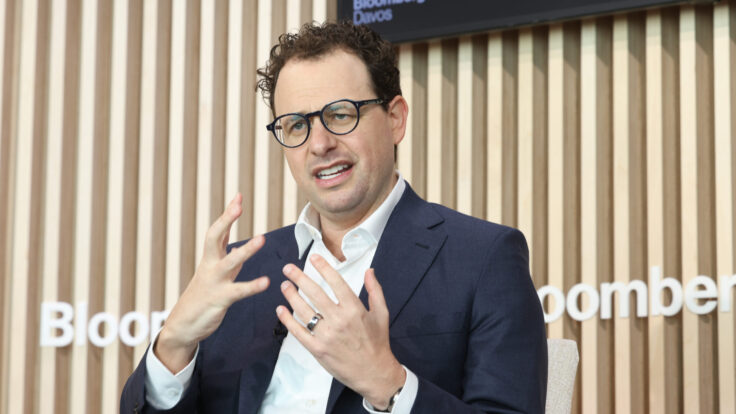
Welcome to The Hidden Layer. I’m Ian Krietzberg.
Today, I’ve got a fun
story that’s been months in the making. As I’ve been reporting, there’s been extremely little transparency surrounding how much water and electricity are actually being consumed by all the data centers being built to train and run A.I. systems. It’s an environmental issue, of course, but also a total economic mystery.
So I embarked on a mission to track down the numbers. We’ll leave the energy side of this equation for another day; today, we’re talking about water, and a little
town in Washington that’s using a lot of it.
Also discussed today: Elon Musk, Nvidia, xAI, Geoffrey Hinton, Deloitte, Microsoft, Patrick Haley, Alex Ybarra, Shaolei Ren, and many more…
Let’s get into it… |
- Nvidia’s
growing investment web: Bloomberg reported that Elon Musk’s xAI is planning to increase the size of its current funding round to a grand total of $20 billion. (Yes, Musk said just last month that his company isn’t raising money at the moment…) The round features a combination of equity ($7.5 billion) and debt ($12.5 billion), packed into a special purpose vehicle that will purchase chips from Nvidia and rent them out to xAI. Nvidia will reportedly invest as much as $2 billion into the special purpose vehicle, but not xAI directly. Nvidia declined a request for comment.
It’s the latest in a slew of oddly designed, circular deals between
Nvidia and the major A.I. players—including OpenAI, and the major cloud companies—that look an awful lot like vendor financing. Anyway, what’s a few more billion bucks changing hands? - Radiology’s last exam: Back in 2016, Geoffrey Hinton, the “godfather” of A.I., predicted that deep learning models would put radiologists out of work. “It’s just completely obvious that within five years deep learning is going to do better than
radiologists,” he said. We’re now well past the deadline, and while image classification models have made impressive progress, they’ve neither replaced nor outperformed radiologists. In fact, we’re facing a shortage of radiologists—which one radiologist, of course, attributed to predictions that the profession was destined for
automation.
A recent study set out to establish a benchmark to assess how off-the-shelf generative models perform in what the authors called “real-world radiology”—which, as it turns out, is often far more complex than the scenarios available in public datasets. The team tested OpenAI o3 and GPT-5, as well as Gemini 2.5 Pro, Grok 4, and Claude Opus 4.1, all set to “thinking mode.” Among these
models, GPT-5 had the highest score on the 50-case benchmark, with a 30 percent accuracy rate. Meanwhile, board-certified radiologists scored, on average, 83 percent on the benchmark test, and radiology trainees averaged 45 percent.
Now, the study has its fair share of limitations—reproducibility is nearly impossible with these types of systems, for instance—but it underscores that A.I. radiology systems still have a long way to go. It also points to the idea that augmentation, rather
than automation, is the more likely outcome for A.I.’s widespread role in society, which seems more likely every day given the inconsistency and unreliability of generative systems in high-stakes scenarios. But you knew that already.
|
Hallucination of the
Week
|
Deloitte recently
repaid around 20 percent of the $290,000 fee it had charged to the Australian government after admitting it had used generative A.I. to help assemble a recent (error-ridden) report. The report
included academic references that didn’t exist and a quote referencing a federal court judgment that wasn’t real. I guess lawyers aren’t the only ones susceptible to overreliance on these systems.
And now for the main event… |
|
|
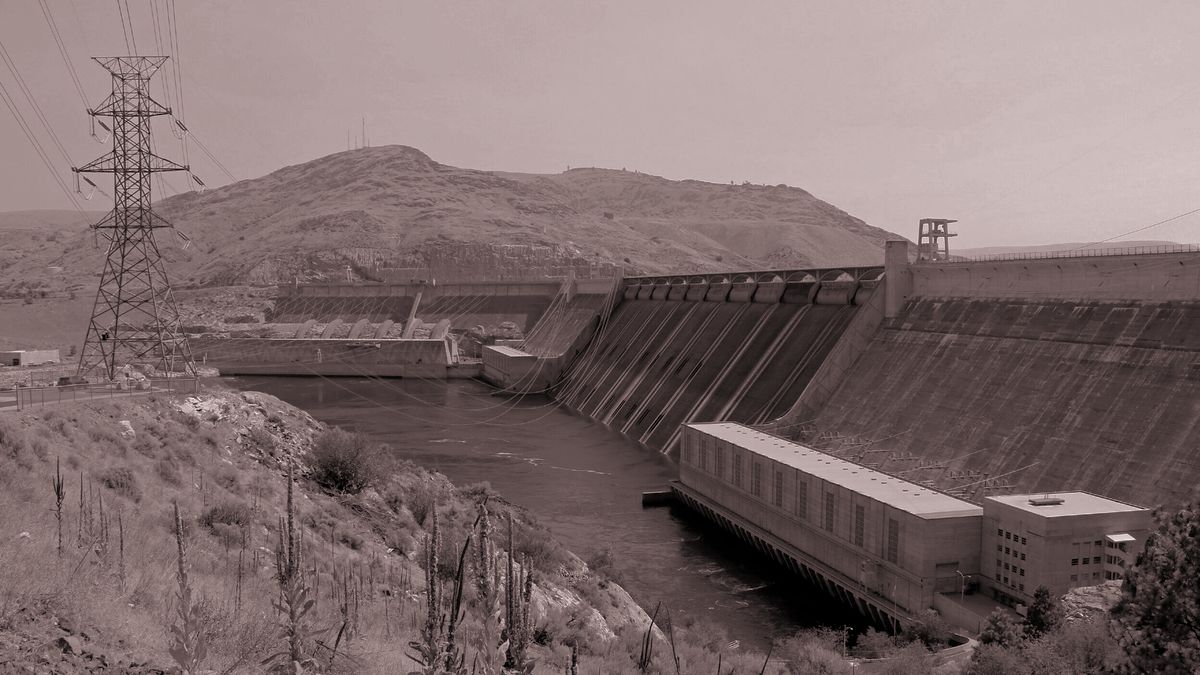
Ever heard of little ole Quincy, a small city on the Columbia River? Well, it’s home to a
Microsoft mega-facility, a BlackRock-backed A.I. firm, and a handful of other entities that are harvesting its natural gifts—including its water supply—into a mini economic miracle. |
|
|
Earlier this summer, as OpenAI, Google, Meta, and xAI announced another $100 billion of investments in data
centers across the United States, I embarked on a quixotic project of my own. One of the great enduring mysteries of the A.I. boom is just how much water each of these “superclusters” consume. After all, data centers can require tens of millions of gallons per year to cool the huge numbers of G.P.U.s required to train and operate A.I. systems. And yet, information around the environmental impacts of the industry is generally closely guarded.
So over the last several months, I filed dozens
of Freedom of Information Act (FOIA) requests with municipalities across the country—specifically targeting areas with a high concentration of data centers, as well as areas that have suffered from drought—asking for any documents pertaining to water consumption associated with nearby data centers. Administrative offices from most cities—including Los Angeles, San Antonio, Dallas, Atlanta, and Chicago—demurred, generally suggesting that there weren’t records to satisfy my requests. Offices from
a few others—Phoenix, Sacramento, Austin, and Columbus—responded that they couldn’t share any information “since it may contain sensitive customer account information.”
Then I heard back from Quincy, a small city just east of the Columbia River in Washington State, with a population of roughly 8,000. Despite its size, Quincy has become something of a Big Tech boomtown. In the early 2000s, firms like Microsoft began to build server farms in the area, perhaps seduced by the cheap
cost of its hydroelectric energy. Other companies, including Yahoo, soon followed. Sure, city officials told me, they’d be happy to share how much water they were using. |
The city wasn’t able to provide any information about electrical consumption or carbon emissions, but they
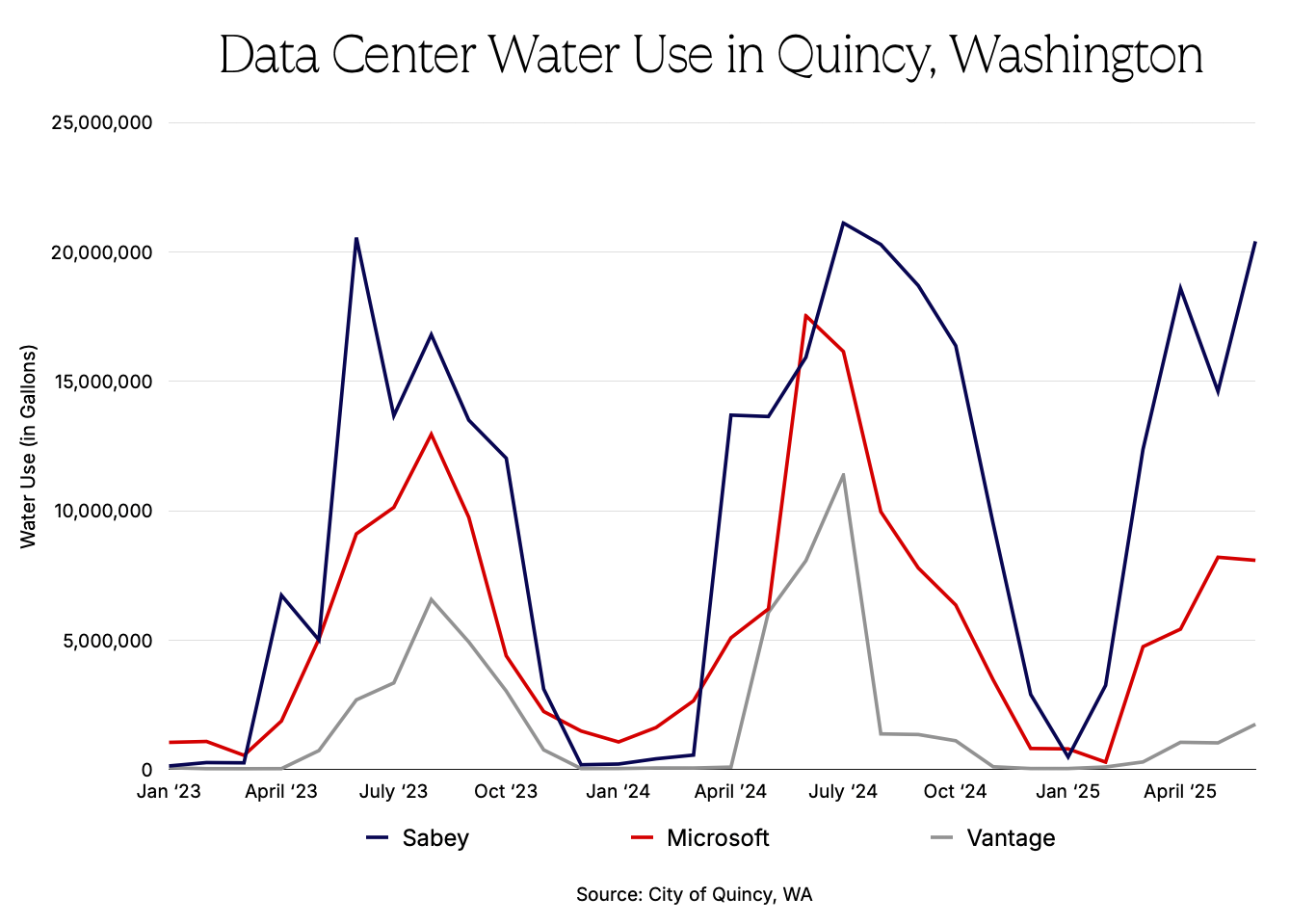
did send me 27 pages of records detailing the water withdrawal, between January 2023 and July 2025, of the data centers served by Quincy’s water utility. The operators included Microsoft, Sabey, Vantage, H5, CyrusOne (which is owned by BlackRock), NTT Data, and Hyscale. Not all of the data centers in Quincy use water for cooling. Some, as city administrator Patrick Haley told me, use air cooling techniques instead. And three of them—H5, Hyscale, and CyrusOne—used barely any
water during that time period. But the other operators used far more.
All told, the relatively small handful of data center operators in Quincy withdrew nearly 180 million gallons of water in 2023, 248 million gallons of water in 2024, and 116 million gallons (through July) in 2025. Last year, according to Quincy’s figures, about 12 percent of the city’s total water consumption went toward data centers. On average, Haley told me, they use around 10 percent of Quincy’s potable water, while 57 percent goes to food processors. In 2024, Sabey withdrew more than 130 million gallons, up from 92 million the year before. Microsoft, the second-largest consumer, increased its water use in 2024 to 78 million gallons, after using 60 million gallons in 2023. Vantage withdrew 30 million gallons last year. |
Yes,
persistent drought has plagued Washington State. But according to state representative Alex Ybarra, Quincy benefits from its geography: The city is part of the Columbia
Basin Project, where water from the nearby Columbia River flows through miles of canals, one of which runs right through town. “There’s so much water in the Columbia River that we’ve got plenty of water in our canals to keep our farms full of water,” Ybarra told me.
The city worked with the irrigation district, and the federal government, to funnel some of that canal water to its data centers. While there might be enough supply for now, a 2022
report found that, over the next 20 years, climate change could impact the amount of water in the Columbia River Basin, which could threaten all those who currently rely on its water. Haley told me that when they access that irrigation water during the summer months, “potable usage is reduced to 5 percent.”
The data center operators,
Ybarra told me, are pretty happy with the arrangement. The water provided by the water utility is drawn from a series of wells spaced around town, and contains a high enough concentration of metals to potentially damage their highly sensitive, enormously expensive systems; the canal water, by contrast, is relatively pure. The arrangement has also, apparently, worked out well for the town: 20
percent of the population is employed by local data centers. “Quincy is really unique. I can imagine a town that doesn’t have the same water resources as Quincy, and could have some issues with another company coming in that needs more water—doesn’t have to be a data center,” Ybarra said. “Quincy … has a lot of good resources, and especially water resources. It’s not infinite or anything like that, but we made solutions where we needed to.”
It’s unclear what type of workloads the Quincy
data centers run, or whether they’ve been outfitted with mostly C.P.U.s, as are found in traditional server farms, or G.P.U.s, the more specialized, power-hungry chips that power A.I. None of the data center operators returned my requests for comment on this specific question, although several—CyrusOne, Vantage, Sabey, and NTT—advertise their ability to host A.I. workloads.
When I reached out to Microsoft for more specific information about their Quincy data center, they told me the
campus consists of 21 buildings. It also has three additional buildings in East Wenatchee, Washington, with plans to build three more, as well as one in Malaga, Washington, with plans to build two more. On average, each building employs roughly 50 people, and by the end of next year, Microsoft expects to employ 670 people full-time, along with 500 service vendors. The company said it pays upfront for all the infrastructure costs associated with powering its data centers, and plans to eventually
transition its on-site, gas-powered backup generators to renewable biofuels, at least in Washington—though timing on that remains unclear.
Microsoft also pointed to a number of water replenishment projects it operates in the area, and affirmed that most of the water used by its Quincy data centers comes from the Columbia Basin Project. A spokesperson said that “every data center building has undergone significant evolution over the past 20 years. Each is distinct, and they have become
increasingly efficient over the years.” |
For the uninitiated, it might be unclear, exactly, how these data centers actually use all this
water. But it falls into two categories: direct and indirect usage. The first refers to water used on site—the data I gathered from Quincy lands in this bucket—which is used to cool and extend the lifespan of the chips contained within the data center. When it comes to the G.P.U.s that power A.I., cooling is much more of a challenge, since the chips run incredibly hot. In fact, depending on the model, some G.P.U.s
reach operating temperatures of around 200 degrees Fahrenheit. And considering the scale of these data centers—imagine hundreds of thousands of little chips assembled in massive clusters—air cooling systems aren’t often up to the task.
The predominant cooling method is called a closed-loop system, in
which the same water is repeatedly cooled, heated, and cooled again. But even with these systems, water still gets lost to evaporation, which explains their constant need for new water. For regions experiencing drought—according to a recent Bloomberg
investigation, two-thirds of new data centers are being built in water-stressed areas—this can be problematic. “It’s hard to add new fresh water to our system,” said Shaolei Ren, an associate professor at UC Riverside who has
extensively studied the climate impact of data centers. “The total amount of fresh water is more finite, and it’s increasingly unevenly distributed.”
Indeed, a recent Ceres report found that, as more new data centers come online, the growth of data centers “could increase water stress in already strained basins by up to 17 percent annually—with even higher spikes in peak seasons.” The peak seasons, of course, refer to warmer months, when operators need a lot more water to keep their chips cool (you can see this trend at play in the chart above). This issue, in particular, has sparked anti-data-center protests around the world, in places
including the Netherlands, Mexico,
Spain, and recently, St. Charles, Missouri, and
Caledonia, Wisconsin.
But the bigger problem, according to Ren, is indirect water consumption, which refers to the water consumed off-site to produce the electricity that powers these data centers. Indirect usage can make up as much as 80 percent, or more, of an A.I. data center’s total
consumption. Sustaining this rate of consumption can involve expanding local infrastructure, which also raises questions about which party is ultimately responsible for bearing the brunt of that cost.
Obviously, the debate about the true environmental impact of A.I. is far from settled. Google has said that the “median” Gemini response uses 0.26 milliliters of on-site water consumption, while OpenAI has claimed that the average ChatGPT response uses “one-fifteenth of a teaspoon” of water.
Without more information about how the companies are defining those terms, or what assumptions they make, it’s almost impossible to extrapolate their true cost.
But what’s undeniable is the scale of water consumption. Google’s data centers consumed 6.1 billion gallons of water in 2023, a 17 percent year-over-year increase, and 8.1
billion gallons in 2024. Google has said that the majority of its freshwater withdrawals come from areas with a low risk of water scarcity—which still means that billions of gallons are consumed in areas that are at risk of water scarcity. As climate change worsens, and more data centers come online, that risk is only going to continue going
up. |
An A.I. “band,” which apparently based its music on the alt-rock group Holding Absence, has
surpassed the original band’s popularity on Spotify. It took them about two months. The artificial group name-dropped their inspiration on YouTube, which alerted Holding Absence’s lead singer to the situation. [Lucas Woodland] Insurance companies are reportedly balking at the idea of providing comprehensive coverage to the major A.I. players, like OpenAI
and Anthropic, considering the scale and variety of their legal risks (costly copyright litigation, wrongful death lawsuits, etcetera). Both companies are considering using investor dollars to protect themselves instead. [Financial Times] |
That’s all for today. I’ll see you next week. Ian |
|
|
Join Emmy Award-winning journalist Peter Hamby, along with the team of expert journalists at Puck, as they let you in on the
conversations insiders are having across the four corners of power in America: Wall Street, Washington, Silicon Valley, and Hollywood. Presented in partnership with Audacy, new episodes publish daily, Monday through Friday. |
|
|
Unique and privileged insight into the private conversations taking place inside boardrooms and corner offices up and down Wall
Street, relayed by best-selling author, journalist, and former M&A senior banker William D. Cohan. |
|
|
Need help? Review our FAQ page or contact us for assistance. For brand partnerships, email ads@puck.news. You received this email because you signed up to receive emails from Puck, or as part of your Puck account associated with {{customer.email}}. To stop receiving this newsletter and/or manage all your email preferences, click here. |
Puck is published by Heat Media LLC. 107 Greenwich St, New York, NY 10006 |
|
|
|