 |
|
Hi you,
A shorter prologue this week as I finish the promotional marathon for the season finale of my PBS series, America Outdoors. In this last episode, we feature Maine and ask how and why people embrace cold weather relationships with nature. Check out the show and the digital companion series, and let me know what you think.
I’d also like to plug my Puck partner Julia Ioffe’s excellent podcast miniseries all about the origins of Vladimir Putin, About a Boy. The first two chapters are available now, and there’s another dropping later this week. I promise the first episode will change your understanding of World War II.
Oh, and a shout-out to reader Alison Mason, in New York City. A few weeks ago, I wrote about Apple’s new environmental bragging rights ad featuring Octavia Spencer as a pleased Mother Nature. Alison pointed out that Chiffon margarine pulled off a similar stunt decades ago.
Alright, on to the main event, a topic that’s been on my mind a lot lately. Thoughts/feelings/feedback? Message me at baratunde@puck.news, or simply hit reply to this email.
|
 |
| Catch-404 |
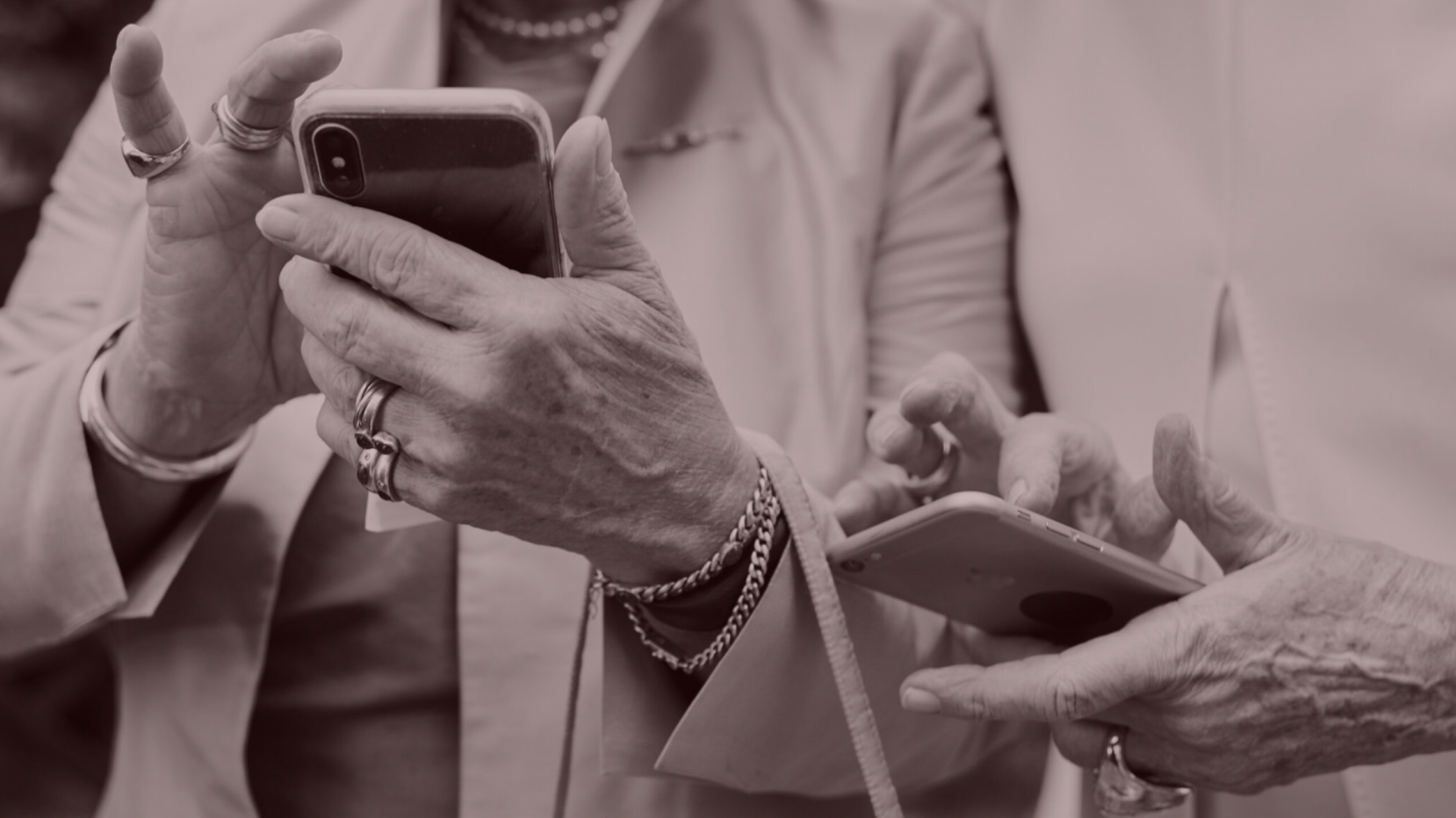
| The digitization of our lives and livelihoods is leaving millions of Americans—particularly the elderly—on the wrong side of the digital divide. Is it possible to age-proof Silicon Valley? |
|
|
|
| I spend a lot of time in airports—such is the life of a Puck writer/TV host/public speaker—and recently found myself sitting at an ersatz Japanese restaurant in Newark International Airport. (Yes, it’s actually nice now.) As I prepared to eat, I noticed an older woman sitting across from me, in her 60s or early 70s, staring at the table with a frustrated expression. I immediately recognized her pain.
Moments earlier, after all, I had the same look on my face as I struggled to navigate a slow and poorly-designed digital menu and payment process that could have been easily bypassed with the simplest human interaction. But the woman across from me didn’t have a smartphone. Sure, she was comfortable enough with the modern world to acquire a plane ticket, and had managed to traverse the gauntlet that is TSA. But when it came to meeting her basic need for sustenance, the QR codes at Newark had her stumped. Eventually, a few of us sitting around her flagged down an elusive employee.
There’s nothing new about humans struggling with technology, but that moment has stuck with me because it involved public embarrassment and a failure to satisfy one of our most basic human necessities. It felt inhumane and dystopian. Both the customers and employees were forced to interact with machines rather than each other, and when that process didn’t work as planned, we were all put in an awkward position through no fault of our own. The fault lay with the speed and manner with which we are thoughtlessly deploying new technology across an increasingly wide swath of our lives.
Remember the ’90s when our entire society was really excited to get online? We called it “the information superhighway,” and the goal was mass adoption. AOL physically spammed us with CD-ROMs, Microsoft built Internet Explorer into Windows, and I did my part too. As a college student between 1995 and 1999, one of my many campus jobs was to onboard students to the campus network and provide tech support. Things going wrong with technology literally helped me pay for my degree.
Around that same time, many of us began ringing the alarm about the digital divide, a growing chasm between haves and have nots in our newly connected world. I was personally sensitive to this point, especially when it came to low income and Black communities. (In fact, during the first decade of the 2000s, statistics showed how much more online certain marginalized communities were, and how much mobile and social media usage skewed to Black and brown communities (hello, Black Twitter!).) Over the last decade, of course, our focus has turned to concerns about screen time, mental health, data exploitation, and misinformation. The conversation about the digital divide faded into the background. But the problem didn’t go away, and it should worry us now more than ever.
As more facets of our lives move online, the way we live is changing, too. For many of us, riding this wave of change is fun and exciting, with only occasional moments of frustration and anger. But for others, especially (but not exclusively) for the elderly, that ratio is reversed. Like many people of my generation, I’ve come to expect that every interaction with my parents-in-law won’t start with us talking about golf or gardening or their grandkids, but with some kind of tech support request. Almost every time, I get frustrated, not at my in-laws, but at an industry which too often imposes changes without regard for the people being left behind.
At this juncture in history, as new technologies continue to be introduced at a head-spinning rate, I want to pause for a moment to analyze the cost of this rapid change, who bears it, and what we can do about it. To help me think through these challenges, I posed an open question on my Instagram account and got literally hundreds of responses, many of which have informed this piece. |
|
|
| For all of us, constantly changing technologies can be frustrating. For seniors experiencing cognitive challenges or physical limitations, it can feel nearly impossible to keep up. Menu systems are reconfigured multiple times within a few years inside the same product. Two-factor authentication for security introduces compounding layers of activity, and involves switching from text messages to additional authenticator apps. And then, of course, there’s the predatory scammers taking advantage of all this confusion, who use text and email to literally rob people. As Amadi commented on my post, “I don’t mind being the built-in Genius Bar for my mom because most of her problems are fairly easy to solve, and sometimes she just needs to ask Siri to help her navigate things and I’m teaching her to do that first. What I do mind is trying to help her navigate scam emails and texts and all of the lowlifes spoofing her friends on Facebook.”
Stepping back, it’s stunning how quickly every part of life now involves some digital or online interaction, and how haphazard the rollout has been. My wife regularly helps her parents navigate the online portal they are forced to use in order to access their increasingly complicated healthcare needs. Even shopping in-person, offline, has become an e-commerce experience as a result of self-checkout machines. “I hate those f*cking things,” wrote Karen on my Instagram post. “It makes me so angry to see older people who may be struggling with sight or cognitive challenges forced into using them, often while a staff member watches because their job is now supervisor of the robot interacting with the human, instead of being the one interacting with and helping the human.”
The burden has thus shifted to those of us already connected to people in need. Family members get conscripted into Geek Squad service to help with photo organizing, food ordering, TV operating, and more. The fact that we live in a decreasingly intergenerational society means we are often asking for, or providing, assistance from a distance, which adds further complexity to our relationships. I once had to help my in-laws fix their television by having one of them hold up the iPad with her shaking hands so I could use it as a remote camera to see the TV screen that I needed my father-in-law to plug new information into. We got it done, but all three of us needed a nap afterward!
When there’s no family available, the burden falls to other institutions. Melissa, who works for an agency that serves aging populations, commented, “A bulk of our older clients are poor or have little resources and not a large (if any) social circle. We get calls from people asking how to do things like fill out online-only apps for services such as transportation or groceries and other necessities.” The main problem, she continued: “My agency is not set up to address tech issues for individuals. We are mostly social services oriented. We will continue to see issues with older and the older poor not being able to access vital services because everything is online now.”
One organization that is set up to offer this type of assistance is the public library. God bless libraries and librarians. I serve as a member of the Board of Trustees for the Brooklyn Public Library and have seen firsthand the efforts this institution has implemented to help people with technology, from “Surfing Senior” sessions to loaner hotspots to “Technology for All” trainings that help folks use tech to gain access to essential services such as housing lotteries. But there’s only so much these institutions can do to fill a gap created by rapidly changing tech requirements. I recently spoke with a Brooklyn Public Library employee who expressed frustration that even government programs designed to subsidize the cost of home broadband require you to apply online, with no fallback option available for people who are not already online.
We have to do better in every way, from the way we build technologies, to the way we regulate them, to the way we organize our society to ensure we are including everyone. |
|
|
| Some of the tech fixes I can imagine are very simple. In fact, simplification is the premise of senior-friendly hardware such as GrandPad, a tablet optimized for seniors, or Jitterbug, a simplified Android-based smartphone. But what if we didn’t force people to use completely segregated sets of products? What if, instead, we offered people a way to remain inside popular ecosystems run by companies like Apple, Google, and Amazon, while opting out of the constant, disorienting user interface updates?
Imagine you find out that the home you’ve lived in for years suddenly got an “upgrade” to make it cleaner, safer, better. When you wake up, you find all your furniture rearranged, the light switches moved, and your kitchen range changed from gas to electric. This is what happens on our digital devices every few months, from phones to cars, and it’s overkill. We should be able to choose something like “stability mode” or “don’t move my damn buttons mode” where technical updates don’t introduce dramatic interface changes. And if the interface does undergo major changes, companies should have to walk users through it as part of the update.
Another capability I’d love to see is a remote human assistance mode built into screen-based devices. Anyone who’s worked in a corporate or campus environment is familiar with the screen sharing and screen-controlling capabilities built into software like Zoom, which allow your I.T. department to remotely operate your machine for you. We are long overdue for a similar capability that comes native with the dominant screens of our era: smartphones, tablets, and televisions. I’m already in a family plan and iCloud relationship with my in-laws. We share App Store purchases and photo albums with each other. I should be able, with their permission, to remotely view or operate their mobile devices. This would save us both time, and help me help them.
But we also need to question the assumption that moving everything towards a digital-only ecosystem, with no alternatives and no human support, is inherently a good thing. An Instagram user named Peppermint shared an infuriating example of this: “My mother has to deposit money onto a laundry card to wash her clothes at her apartment building instead of just using quarters. To do that she has to download two apps, a banking app and the laundry app.” It’s hard to see this as anything but a step in the wrong direction: instead of simplifying the process for her mother, it’s only become more complicated and worse.
I can see generative artificial intelligence playing a positive role here. Having a digital companion guide people through their technology, so they get what they actually need from the interaction, would be a game changer. Imagine how much time this request would save: “Siri / Alexa / Google / ChatGPT, make a photo album featuring pictures of me and my daughter. Find the best quality version of today’s NFL game. Show me how to send a group text.”
Of course, we have rules around disability access in public spaces—and those should be extended to the virtual accommodations we increasingly inhabit. After all, when we make systems accessible to those with disabilities, we end up helping everyone. Those sidewalk ramps aren’t just benefiting people with wheelchairs, but also people with strollers and shopping carts. We should expand our digital rights to cover universal usability and accessibility, and move toward some kind of requirement for offline, human-based troubleshooting systems as a backup. Assuming everyone has access to technology (and the literacy to navigate it) is guaranteed to leave people behind, which hurts us all.
But changes at the corporate or policy level are just part of the solution. Our culture needs to shift, in terms of how we value relationships across generations. There’s something beautiful about grandkids helping grandparents with technology, and tech training sessions, whether run by siblings for their parents or teenage volunteers at the local library, gives us a chance to re-establish human connections. Susanna offered a simple suggestion: Be kind and empathetic toward all who are trying to make sense of this new world. Say something like, “I’m proud of you for learning these news technologies that you didn’t grow up with, and I’ll be there to help if you need me for anything.” It can be hard to feel like you’re the one doing something wrong, or that you aren’t smart or savvy enough to navigate an ever-changing world.
I set out to write about how the rapid pace of technological change was affecting older people, a rant on behalf of my in-laws and older diners at airport restaurants and anyone who has felt left behind by a world that is moving on at an accelerating pace. I knew I wasn’t alone, and turned to my own online community to see who else was dealing with these challenges. What I found were scores of people sharing their frustrations, and bountiful possibilities for creating a world that is truly accessible to all.
What’s become clear to me is that keeping up with technological change is a major challenge for more than just older folks. My own mother only made it to 65 years old, but as a former computer programmer, she was excited about new gadgets and new capabilities. I like to imagine she’d be crushing it as an elder tech influencer on TikTok if she were alive today. But we are deploying tech with a speed and thoughtlessness that is leaving behind many in society: older people, those with physical disabilities or learning disabilities, neurodiverse folks, those for whom English isn’t a first language, and those who aren’t digitally connected at all. The digital divide is alive and very unwell, and continuing to exclude people will impose a heavy price on our entire society if we don’t take steps to address it. |
|
|
|
| FOUR STORIES WE’RE TALKING ABOUT |
|
|
|
|
|
 |
|
|
|
Need help? Review our FAQs
page or contact
us for assistance. For brand partnerships, email ads@puck.news.
|
|
You received this email because you signed up to receive emails from Puck, or as part of your Puck account associated with . To stop receiving this newsletter and/or manage all your email preferences, click here.
|
|
Puck is published by Heat Media LLC. 227 W 17th St New York, NY 10011.
|
|
|
|