 |
|
Happy Tuesday, and welcome to the Stratosphere, live from San Francisco.
In tonight’s edition, what happens to Nikki Haley if more donors than voters want her to stay in the race? And what happens when you put Marc Andreessen in a room with Ron DeSantis and 15 tech execs? All of that, and more, below the fold.
But first, a scoop…
- R.F.K. campaign loses its finance director: Kennedy, the fringe independent candidate for president, may have whiffed his pitch to the Libertarian party, as my partner Peter Hamby reported yesterday, but he’s still hot on the money trail. R.F.K. Jr. has a fundraising reception at a Denver crypto conference on Saturday, followed by a Las Vegas fundraiser on March 8 hosted by gadfly investor Jay Bloom, where a $6,600 check gets you a spot as a “Camelot co-host.” And then there’s a March 15 dinner and reception in Austin, hosted by a hack-your-life influencer named David Bayer that promises to be a “very special gathering limited to 30 guests consisting of business leaders, entrepreneurs, leading podcast hosts, media personalities, celebrities and industry influencers.” No, these events aren’t exactly geared to the Paul Singer crowd, but there’s plenty of time for Kennedy’s fundraising operation to mature.
Or, alternatively, time to regress. I’m told by sources that Sheila Creal, the experienced Democratic bundler who joined the R.F.K. campaign as its national finance director, quietly left the campaign in mid-January. I was surprised that someone of her caliber and experience, who worked on the Biden 2020 campaign, would sign on with R.F.K. Creal declined to get into the details, but confirmed to me on Tuesday that she’s out: “I am not with the campaign.”
|
| Q&A: The Battle for the Bird |
|
| If you walked into the Recode offices in San Francisco, circa 2017, you’d find me, Kara Swisher, and Kurt Wagner. I regret to say that I am the only one of us who does not have a new book out this week.
Kurt, who is now a tech reporter at Bloomberg, just published Battle for the Bird: Jack Dorsey, Elon Musk, and the $44 Billion Fight for Twitter’s Soul, which I devoured over the last week. (My penance after initially telling him that this was a bad idea for a book. Joke’s on me!) There is no shortage of scholarship about the Twitter deal, but this is the definitive business book about what happened between Jack and Elon. And it touches on a lot of recurring themes of this newsletter: extraordinary wealth, corporate infighting, and the red-pilling of Silicon Valley leaders in the Biden era. Our conversation has been lightly edited for length. |
|
|
| Teddy Schleifer: I read this book wanting to understand how the politics espoused by Jack—the guy who wore “Stay Woke” T-shirts and marched at Ferguson—now seem pretty indistinguishable from Elon’s. To ask the same question I did about Andreessen: What happened?
Kurt Wagner: I think it’s important to understand that Jack is constantly evolving—his hobbies, his beliefs, and even his physical appearance are changing quite regularly. There are a bunch of moments that stand out to me and feel like they had an influence on Jack’s politics and worldview. In the summer of 2018, he spent a ton of time speaking with conservative politicians and media types: folks like Sean Hannity, Charlie Kirk, and Candace Owens. I think he took issue with the fact that so many conservatives were upset with Twitter’s content policies, and I imagine that summer opened him up to a lot of new ideas.
Twitter’s role in policing Covid misinfo and banning Trump also really bothered him. I think he walked away from both of those situations very uncomfortable with the power of Big Tech, and also the power of government. I feel like some people started noticing a change with him around that time.
The distinction between Jack and Elon feels more personal to me. Elon believes he’s doing what’s best for humanity, but I often feel he overlooks the impact that decisions can have on individual people. Jack was more sensitive to those things. He seemed to care more about the actual people, and not just the ideas.
I wrote a story last June about some of the blowback Jack was getting at Block for his endorsement of R.F.K. Jr., when he said he hadn’t “paid attention” to his embrace of conspiracy theories.
The Jack-R.F.K. romance never made sense until reading your book. I don’t think I realized how much Jack’s life now also revolves around Bitcoin—and now that I cover R.F.K. a little, how much Kennedy has cultivated the crypto community. He appears to have a bad case of tunnel vision with both passions.
It’s hard to overstate how bullish Jack is about Bitcoin. “I don’t think there is anything more important in my lifetime to work on,” he said in 2021. This was while he was running both Square and Twitter, I might add. I think the tunnel vision idea is pretty fair. I really believe his passion for Bitcoin is what pushed him away from Twitter. He could keep doing Bitcoin work at Square, but at Twitter, Bitcoin was a distraction. He’s really passionate about decentralization and what Bitcoin represents there, and that’s also visible when you consider what he was trying to do with Bluesky.
Do you still admire Jack? I know he didn’t talk to you for the book, which surprised me for a few reasons. But I can almost feel your disappointment running through the progression of pages.
I don’t know if I ever “admired” Jack, but I’ve certainly always found him really interesting. And I think I used to feel that he was a little under-appreciated, and I respected the way he treated his employees and seemed to genuinely care about Twitter’s place in the world. From what I’ve heard, he’s got a great sense of humor, and I think he’d be fun to grab a drink with.
You’re right that he didn’t talk to me for the book, and I was disappointed. But I think I was more disappointed with how he treated Twitter’s employees at the end of this Elon saga. Jack doesn’t owe me anything, of course, but I felt like he owed employees more than he gave them. I definitely don’t dislike Jack, but I don’t see him in the same way that I did when I started this project, either. |
 |
| Haley’s Endless Principles & More Andreessen |
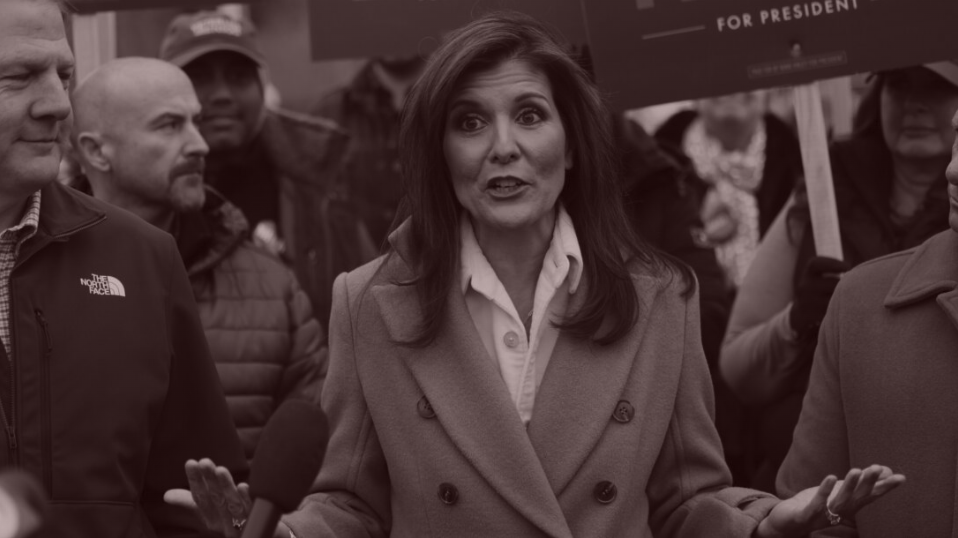
| Nikki Haley is facing zero donor pressure to drop out of the race, but where does this end? Plus, a few new details on Marc Andreessen’s “radicalization” and lunch with Ron DeSantis. |
|
|
|
| The central parlor game among Republican donors and fundraisers, in the wake of the South Carolina primary, revolves around a simple, agonizing refrain: How long will Nikki Haley do this? Of course, in their heart of hearts, nearly every conservative megadonor would prefer the Republican nominee to be Haley, who seems to demolish Biden in head-to-head polling and is facing 91 fewer felony charges than Donald Trump. Alas, the pesky G.O.P. base disagrees. While Haley has pledged to fight on through Super Tuesday, even some of her most ardent supporters tell me they now believe this demonstration of principles is unnecessary.
Undeterred, Haley has embarked on a 10-event fundraising swing this week, according to invites I’ve seen, part of a last-ditch effort to maintain her financial viability. Many of these pit stops have been organized to maximize the amount of money she can raise with the least amount of travel—for instance, holding a brief, hour-long fundraiser at the same venue where she later takes the stage. On Sunday, she held a fundraiser before her rally in Oakland County, Michigan, and she did the same on Monday before her rally in Grand Rapids. That same day, she held a 5 p.m. fundraiser before a 6:30 p.m. rally in Minneapolis. “Guests will be offered V.I.P. access to the rally immediately following,” these invites read.
Everywhere Haley goes, she appears driven by a sense of urgency. She began today with a donor event in Denver where hosts included members of the Coors family. Her fundraiser tomorrow in Provo, Utah, is hosted in part by Abby Cox, the wife of Gov. Spencer Cox, and his No. 2, Lt. Gov. Deidre Henderson. On Thursday it’s on to Virginia, where Haley has a $10,000-a-seat reception in Richmond followed by a sure-to-leak event in McLean, attended by what looks like half of the D.C.-area G.O.P. establishment.
Names that caught my eye for that confab include Barbara Comstock, the former congresswoman; Chad Sweet, the chairman of Ted Cruz’s 2016 campaign, who later turned on him; Kurt Volker, the Bush-era NATO ambassador who later got swept up in the Trump-Ukraine scandal; and the Kilberg and Malek families, both major G.O.P. bundler clans. On Friday and Saturday, Haley is in Charlotte and Raleigh for more “V.I.P. Receptions.” Her final of the 10 fundraisers is in Needham, Massachusetts, where hosts include New Balance’s billionaire owner Jim Davis, who has put $3 million into the Haley super PAC over the past year.
What then? If the aphorism is that candidates will run as long as they have the money to fly commercial, Haley will likely be able to run her campaign, or some version of it, until the Republican convention, if she really wants to. She’s not running out of money. But she’s not exactly raking it in, either. Haley’s super PAC, SFA Fund, has spent about $80 million on independent expenditures this cycle, but its purchases in the Super Tuesday states so far appear fairly modest—just about $500,000 in Michigan, and small buys elsewhere.
I’m told that SFA is doing fine—not raising at the same clip as in December, but occasionally hitting seven figures per day—and that the PAC hosted a bunch of excited donors for a reception after the polls closed on Saturday night in South Carolina. But it’s notable that they’ve shifted spending this week to turnout programs, rather than big TV buys in Texas or California. If Haley had won New Hampshire or South Carolina, the group would probably have been able to afford that.
Indeed, the PAC ended the month of January with just $2 million on hand. The last big money disclosed came from people like the Stephens family of Arkansas, who together gave $1 million to the group in the week after New Hampshire; and from V.C.-turned-songwriter Tim Draper, who gave three-quarters of a million the week before. But it’s hard to imagine why anyone would do that again at this point. She has zero momentum. But this is America, and there’s always one or two anti-Trump billionaires who can be convinced to try and try again. “There’s a lot of people who understand how long the odds are, but they have no intention of going to Trump anyways. So it’s not a big deal,” said a top Haley fundraising source. “There’s still a lot of people who are cutting checks. They’re just not as big as they would be otherwise.”
Surmising what Haley truly wants, though, is less a question of politics and more of psychology. Just because she could keep running doesn’t mean she should. That’s obviously what the Koch network saw when they decided the other day to stop spending money on behalf of their candidate and focus down-ballot. That’s surely what Ken Griffin saw, too, when his team put out a statement this weekend that he was “focused on actively supporting exceptional candidates” like Larry Hogan in Maryland and Tim Sheehy in Montana.
So what now? I expect to spend much of my next few months focusing on third-party candidates and the donor consolidation around that phenomenon. Trump vs. Biden was the dream scenario for Nancy Jacobson and No Labels: If they can find an appealing candidate to front their ticket, Rob Stutzman will have no trouble getting rich people to part with their money to fund the group’s super PAC, New Leaders 2024. “We are continuing to build the infrastructure to support the ticket. Including message testing and developing targeting,” Stutzman told me. “We see demand for an alternative to a Trump v. Biden horror show continuing to grow.” But as a few people argued to me, the big money will only flow to No Labels once they have a candidate (and, really, only if it’s a top-tier one). It makes no sense for a sophisticated donor to sponsor a concert headlined by “T.B.D.” |
| More Andreessen D.C. Dish |
|
| A few sources wrote in with their impressions and feedback from last week’s edition on the political metamorphosis of Marc Andreessen just as the man’s eponymous venture capital firm goes big into politics itself. And there are a few new nuggets that came in over the transom that will interest anyone who read the story.
I quoted a friend of Marc’s in my piece who argued that Andreessen had been “radicalized” in large part due to his experience on the board of Facebook after 2016. “He felt the company was trying to be liberal and constantly getting punished,” the pal told me. Someone else who has spoken with Andreessen expanded on that, saying that he frequently tells people about some friend of his wife, Laura, who would bother the couple incessantly after Trump had won, blaming Facebook and encouraging the board member to take a stand. Apparently, my source told me, that backfired. It ended up being something of a formative moment for him in his evolution.
I also reported that the Andreessen policy team, led by Colin McCune, and the DeSantis campaign policy team, led by Dustin Carmack, had met last year to discuss a16z’s “American Dynamism” thesis and ways the two organizations could work together and workshop ideas. I heard a few days later that, actually, the relationship went up to the principal level: Andreessen himself hosted a lunch for DeSantis in Silicon Valley early last year at his home, during the Florida governor’s clandestine trip to the Bay Area to lock down support. (I’m also told he visited with a Sequoia partner. The trip, as I reported last year, also featured a dinner organized by David Sacks.)
The purpose of the lunch was essentially to introduce DeSantis to more leading figures in the Valley—it was attended by about 15 prominent tech executives, and featured the Florida governor talking about his views on tech alongside his standard stump speech, I’m told. Andreessen didn’t vocally back DeSantis during the primary, but his willingness to play emcee for the candidate confirms what lots of his friends in politics surmise: He was a DeSantis voter, privately.
One last thing: I heard from a few Marc friends who pushed back on the characterization of him as a red-pilled conservative, arguing that his views are more eclectic. One person who talks politics with Andreessen described his views as “conventionally libertarian”—to which I pointed out that, publicly at least, he seems particularly agitated by cultural progressivism as of late. The friend’s point was that Andreessen is not a Trumpy populist. Fair enough.
One theme of my reporting is that Marc is focused on the atmospherics of the political culture more than day-to-day news. That said, as a friend of his noted, Andreessen did become unusually invested in special counsel John Durham’s report on the origins of the F.B.I.’s Russia investigation. “He’s not ideologically a Trump guy,” the friend said, “but he sort of has these right-wing instincts.” |
|
|
|
| FOUR STORIES WE’RE TALKING ABOUT |
 |
| R.F.K. Shrugged |
| An audit of Kennedy’s grueling audition for the Libertarian ticket. |
| PETER HAMBY |
|
 |
| Cafe Milano |
| Show notes and deal chatter from the sidelines of Milan Fashion Week. |
| LAUREN SHERMAN |
|
 |
| MLB’s Pantsgate |
| The stupid and increasingly serious micro-scandal defining baseball preseason. |
| JOHN OURAND |
|
 |
| Spulu Agony |
| Could the D.O.J. kill the Disney-Fox-WBD sports streamer? |
| ERIQ GARDNER |
|
|
|
|
|
 |
|
|
|
Need help? Review our FAQs
page or contact
us for assistance. For brand partnerships, email ads@puck.news.
|
|
You received this email because you signed up to receive emails from Puck, or as part of your Puck account associated with . To stop receiving this newsletter and/or manage all your email preferences, click here.
|
|
Puck is published by Heat Media LLC. 227 W 17th St New York, NY 10011.
|
|
|
|