{{ 'now' | timezone: 'America/New_York' | date: '%b %d, %Y' }} |
|
|
|
Welcome back to The Best & The Brightest. I’m Peter Hamby, in Los Angeles, where
my rarely used mailbox is overflowing with glossy flyers and attack ads before next Tuesday’s primary election.
Tonight, my state of play on the California governor’s race, which, for Democrats, is coming down to an expensive and nasty feud between billionaire progressive Tom Steyer and normie Democrat Xavier Becerra. Democrats aren’t exactly thrilled with their choices—and both men have plenty of political flaws—but whoever wins more votes next Tuesday
will head to the general election as the big favorite to succeed Gavin Newsom in Sacramento.
And speaking of big states with big primaries: Tomorrow, my colleague Abby Livingston will be right here with a definitive and richly reported readout from her native Texas, where the Republican Senate runoff election is going down tonight between incumbent John Cornyn and Ken Paxton.
One more programming
note: My podcast, The Powers That Be, is now on YouTube! Head over to our channel and subscribe to watch our brilliant colleagues bring you the best of Puck’s reporting—now in video every day.
Also mentioned in this issue: Trump, James Clyburn, Bill Ferguson, Wes Moore, Mike
Collins, Derek Dooley, Brandon Phillips, Matt Lauer, Alex Latcham, Joe Biden, Susan Rice, Xochitl Hinojosa, Steve Hilton, Dan Newman, and many more. |
|
|
|
UnitedHealth Group is expanding access to doula support to make maternity care easier to
access and navigate. Over 7 million people across the country could qualify for the doula support offering by 2027. Learn more. |
|
|
|

| Leigh Ann Caldwell
|
|
- Georgia on everyone’s
mind: In the week since the Georgia Republican primary went to a runoff between Rep. Mike Collins and former football coach Derek Dooley, the race has gotten even uglier and more intense. But last
Friday, it turned downright nasty. Collins fired his campaign advisor, Brandon Phillips, for sending a now-deleted, over-the-line tweet about the wife of one of Dooley’s consultants, who wrote a book about being assaulted by former NBC Today host Matt Lauer. (Phillips is no longer employed by Collins’s House office, either, a person
familiar with his employment said.)
The Republican establishment was thrilled that Collins jettisoned his longtime aide, who people considered a liability given his history of run-ins with the law and the fact that he’s facing an ongoing House Ethics inquiry from his time as Collins’s House chief of staff. Senate Leadership Fund executive director Alex Latcham posted on X that Collins has “$44 million reasons” to get rid of Phillips, insinuating that the group might not fulfill its $44 million ad reservation. (A Collins spokesman did not respond to this claim.)
Of course, Collins hasn’t won yet. The runoff is June 16, but Republican strategists tell me that the tweet was a great excuse to get rid of Phillips. (If Phillips is no longer employed by the House, the Ethics Committee loses jurisdiction of the investigation.) Will all
this change Trump’s mind about endorsing in the primary? Probably not. - The redistricting whiplash is not over: Earlier today, a federal court threw out Alabama’s new gerrymandered maps. “Ultimately, we cannot see our way clear to requiring Alabamians to cast their votes in the 2026 elections under a districting plan tainted by intentional race-based discrimination,” the three-judge panel wrote while issuing a preliminary injunction.
(An appeal is expected—if it hasn’t been filed already.) Meanwhile, the South Carolina Senate defied President Trump and rejected new maps that would have eliminated the only plurality-Black district in the state, held by Rep. James Clyburn. Naturally, I received plenty of texts today from Democrats buoyed by the news.
These are the latest two in a deluge of redistricting developments across the country. Bill Ferguson, the Maryland Senate
president and former staunch opponent of mid-decade redistricting, who blocked the legislature and Gov. Wes Moore’s attempts to draw a new map, also recently suggested that he would allow a redraw. “The rules have changed,” he said. While it’s likely too late for this cycle, those remarks are a sign that Maryland could redistrict in 2028. The redistricting wars are nowhere near over.
|
|
|
|
And now, a close look at the California governor race… |
|
|
|
Among Democratic professionals in California, the prevailing sentiment about the governor’s
race is a depressed shrug and a question: How did we end up with Becerra and Tom Steyer as Newsom’s most likely successors? |
|
|
|
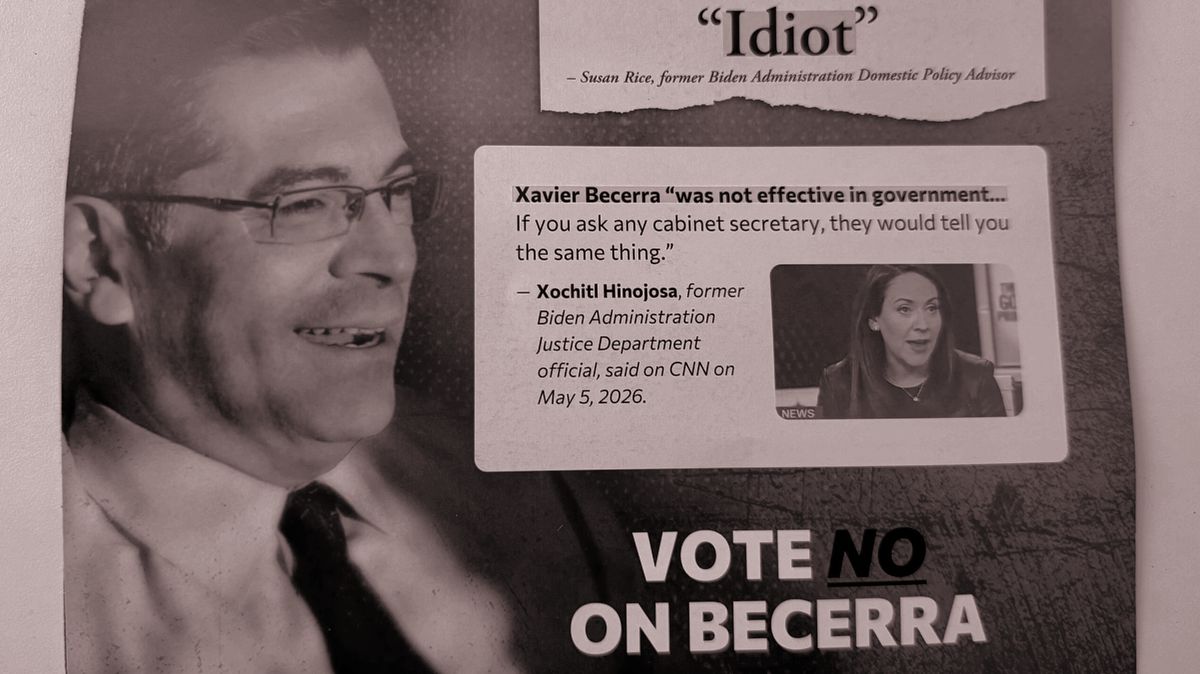
A scorcher of an attack ad landed in my mailbox over the holiday weekend—paid for, natch, by billionaire
Democrat Tom Steyer. Steyer has spent a record-breaking $200 million of his own money on his run for California governor, and he’s shelling out more cash in the final weeks before next Tuesday’s primary to savage the frontrunner, Xavier Becerra, rendering him as an establishment stooge, bought and paid for by the corporate interests who really run Sacramento.
In California, mail pieces are common in local races
but mostly rare in an expensive statewide race usually fought over the airwaves. But Steyer has the money to spend—on TV, on streaming, on digital, and apparently on influencers who post friendly content that is only sometimes disclosed. But in any race, mail pieces are where campaigns typically deliver their harshest attacks. “Mismanagement. Scandal.
Incompetence. Xavier Becerra is part of the problem,” the four-page mailer reads. “Becerra accepts money from big oil, big tobacco, and big utilities.”
That’s not all. The piece attacks Becerra’s record as secretary of Health and Human Services under President Biden, when the agency failed to safeguard thousands of unaccompanied migrant children who crossed the border in 2021 and 2022. It quotes former Biden officials—and there are many—who think Becerra was an empty
suit. Susan Rice called him an “idiot” on X. Former Biden official Xochitl Hinojosa said on CNN that Becerra was “not effective in government.” Both comments are splashed across the mailers. |
|
|
|
Health care can be confusing. UnitedHealth Group is making it simpler with Avery, a new
generative AI companion. Avery helps patients understand coverage, schedule appointments, estimate costs and more. Learn more |
|
|
|
Despite the onslaught of attacks, Becerra is still winning, and polls suggest he’s primed to advance to the
general election next week, likely facing Trump-endorsed Steve Hilton in November, unless Steyer can stop him. Becerra’s late momentum, though—much like the governor’s race overall—is still a little confusing and hard to explain, given the choices on the ballot, even for the savviest insiders. The prevailing sentiment about the campaign among Democratic professionals in California is a depressed shrug and a question: Is this the best we can
do? “I hear there’s a growing consensus to just call it off and restart to see if we can do it properly,” joked Democratic consultant Dan Newman, who is not working for any of the candidates.
Kamala Harris took a pass. So did Alex Padilla. That left a bunch of second-round draft picks gunning to replace Gavin Newsom. There was Steyer, who started dropping his
megabucks on the airwaves last year. Former Los Angeles Mayor Antonio Villaraigosa never took off, maybe because he’s 73 years old. Katie Porter, the Elizabeth Warren protégé, was in the hunt until videos leaked last year showing her berating staffers and a reporter. She never recovered, and neither did her fundraising. San Jose Mayor Matt Mahan jumped in the
race as a moderate, promising pragmatic solutions to crime and homelessness, with the backing of Silicon Valley donors. But the centrist, pro-business, tech-friendly lane in the open primary was more of an access road than an actual lane, and Mahan never broke through.
After that, along came Eric Swalwell, who popped in the polls for a few months peddling anti-Trump #Resistance libslop, until multiple women went public accusing him of harassment and
abuse, ending his campaign. (Swalwell denies the most serious charges.) What happened next? Well, not much of anything. Voters looked around, saw Becerra, moved his way, and just kinda stayed there. “The race has been frozen in amber since Swalwell imploded,” one Bay Area Democrat told me. “My basic take is that voters have given up on the race.” |
A Head
Choice, Not a Heart Choice
|
But why Becerra? Last month, as I was driving to a Pod Save America interview about the campaign, a
Democrat operative called me with a theory that has quickly become conventional wisdom. Becerra represents what Joe Biden offered Democrats in the 2020 primaries—a final, safe choice after they shopped around and just settled on a steady hand to guide the ship. A head choice, not a heart choice. And, like Biden, Becerra has a long résumé: congressman from the Los Angeles area for more than two decades, then California attorney general during Trump’s first term, then Biden’s pick for H.H.S. He’s
been on the ballot before and enjoys precious statewide name ID, which is hard to come by in California unless you have Steyer money.
As with Biden in 2020, Becerra also appeals to nonwhite constituencies—namely, Latinos, who make up more than 30 percent of the California electorate. His first TV ad, which began airing just as Swalwell was collapsing and voters were tuning in to the news, opened by mentioning that his parents were immigrants. If elected, Becerra would be the state’s first
Latino governor. He’s landed endorsements from the heavily Latino SEIU, the legendary activist Dolores Huerta, and scores of Latino elected officials in Washington and California. “California is on the verge of breaking out of the demographic cul-de-sac national Democrats have driven themselves into,” said G.O.P. strategist Mike Madrid, who studies Latino voting trends. “What looks like a sleepy, boring race may actually herald
a return to the multiracial working class voters that have been abandoning them.”
But despite Becerra’s long résumé, it’s not hard to find critics in Washington, especially among those who worked alongside him in the Biden administration. What’s harder is finding Democratic critics who are willing to put their name on the record criticizing Becerra, because he seems on pace to become the next governor. “Overall, there was a sense in the Biden White House that he didn’t come prepared to
meetings with the president, he wasn’t strategic, and he didn’t move quickly,” one White House staffer told me, while calling out his handling of the migrant crisis and the pandemic response.
Another senior Biden official called Becerra “a modern-day Chauncey Gardiner,” the hapless lead character in the movie Being There. “He’s had some great jobs because he was in the right place at the right time, but he never had any idea why he was there,” the official told me. “He
would be an accidental governor who would be quickly overtaken and overwhelmed by events.” In response to these claims, Ron Klain, a Becerra supporter who was Biden’s chief of staff at the time of the migrant crisis and the pandemic, told me that Becerra was “one of the most effective Cabinet members” in the administration. “His record was exceptional,” Klain told me, pointing to his work bringing down the cost of prescription drugs and insulin. “The president enjoyed working
with him. Xavier was always a passionate advocate with the president for keeping these children coming over the border safe and protected under very difficult circumstances. It’s easy to criticize, but Xavier was on top of it.” |
|
|
|
Still, in debates this year, Becerra sounded vague when pressed for details about his plans for regulating
artificial intelligence, housing, or tax policy. During a CBS California debate in San Francisco this month, Porter, a self-styled policy wonk, held up a whiteboard at Becerra and asked pointedly, “What is Mr. Becerra’s revenue plan?” Becerra responded by attacking Steyer for being a billionaire—and then pointing to some items he liked in Newsom’s proposed budget.
If Porter is attacking Becerra on his thin policy brief, Steyer is calling attention to all the corporations and California
power brokers who are backing him. Silicon Valley giants like Meta, Uber, and Airbnb—along with real estate developers, medical organizations, power utilities, and oil companies like Chevron—have all been steering cash to Becerra and outside groups supporting his campaign. With the help of some of Newsom’s consultants and staffers, Becerra has positioned himself as the business-friendly liberal in the race, even though Newsom himself has stayed out of the contest as he prepares for a possible
2028 presidential run.
One of the Biden officials who criticized Becerra said Newsom should keep a watchful eye on Sacramento if Becerra wins. “You want to leave your state in the best position possible if you’re running for president,” this person told me. “Cost of living will still be an issue. Trump is going to target California. If it’s a state that’s in chaos when you are running for president, it is not a helpful proof point.” |
The California Democratic Party—which, like most state parties, professes to remain neutral in primaries—has
also boosted Becerra’s chances. Months ago, when it seemed somewhat possible that two Republicans, Steve Hilton and Riverside County Sheriff Chad Bianco, might advance to the general election under California’s top-two primary system, the state party began releasing its own public polls as a warning to Democratic voters as well as the campaigns. Then Trump endorsed Hilton, helping him consolidate the Republican vote, which more or less eliminated the G.O.P.
lockout threat. But the California Democratic Party continued to release polling on the primary, which showed Becerra gaining and Steyer stalling. For a state with many millions of high-information voters who are easily influenced by polls, including many that are expressing uncertainty about their choices, the surveys have been a boon to Becerra. Their latest tracking poll, released last week, showed Hilton making the runoff with 22 percent, followed by Becerra at 21 percent. Steyer was stuck
at 15 percent in their poll, barely budging from the previous month.
Steyer’s ceiling is also a little confounding, given the money he’s poured into his campaign. He is running as an unabashed progressive in a deep-blue state, with an assist from the media consultants who helped lift next-gen populists like Zohran Mamdani and Graham Platner up from obscurity. Steyer wants to enact a single-payer healthcare system, break
up big electric utilities, and tax landlords and the uber-wealthy, which explains why so many corporations and utilities are funding pro-Becerra and anti-Steyer campaign ads.
Lately, Steyer has used the attacks to hone his messaging, portraying himself as the populist renegade versus Becerra, the status quo corporate Democrat. But, as one veteran California strategist told me on Tuesday, Steyer might have miscalculated by running as a tax-the-rich progressive. California is probably more
liberal than leftist, this person told me, even if Democratic primary voters are in an angry, populist mood.
Bernie Sanders and Alexandria Ocasio-Cortez—both of whom say billionaires should not exist—have kept their distance from Steyer’s campaign, even as he apes their rhetoric. Steyer’s clunky branding was on display in a recent interview with Zeteo’s Mehdi Hasan, who asked whether
progressive voters should be comfortable with a billionaire standard-bearer. “Of course, people don’t want a billionaire,” Steyer was forced to admit. But, he argued, Becerra is the real candidate of the billionaire class. “I am the only billionaire on the ballot, but I am far from the only billionaire in the race. There are corporations and billionaires putting tens of millions into this race, and they are doing it against me.” |
|
|
|
Join Puck’s chief political columnist, John Heilemann, as he roams the corridors of power and influence in America on this
twice-weekly interview show, taking you beyond the headlines with the people who shape our culture: icons and up-and-comers, incumbents and insurgents, moguls and machers in the overlapping worlds of politics, entertainment, tech, business, sports, media, and beyond. The conversations are rich and revealing, unrehearsed and unexpected… and reliably impolitic. A Puck-Audacy joint, new episodes drop every Wednesday and Friday. |
|
|
|
Need help? Review our
FAQ page or contact us for assistance. For brand partnerships, email ads@puck.news.
You received this email because you signed up to receive emails from Puck, or as part of your Puck account associated with {{customer.email}}. To stop receiving this newsletter and/or manage all your email preferences, click here.
|
Puck is published by Heat Media LLC. 107 Greenwich St., New York, NY 10006 |
|
|
|
|