|
Welcome back to Wall Power, let’s all gather around the Inner Circle campfire. I’m Marion Maneker.
Tonight, I’m going through the data from New York’s midseason sales, which took place last week. Bottom line: The sales were good, but not great. Most important, though, they weren’t terrible. And there were plenty of good-news moments. For now, that’s enough to be positive news. Of course, there’s a fair bit more to say, and we’ll get into all that below.
But first…
|
- Sotheby’s Modern & Contemporary Evening Sale = £62.5 million: Yesterday, Sotheby’s London crew fought back against a confused market, and the shadow hanging over their own firm, to sell 38 of 41 lots on offer and beat the estimates. Led by Tom Eddison and Ottilie Windsor, the sale was assembled to establish, or continue, certain narratives. For example, Lisa Brice’s After Embah, from 2018, was backed by an irrevocable bid. But that was just chum in the waters. Six bidders chased the work to a final selling price of £5.4 million. That’s $6.8 million, or more than twice the price achieved four years ago for a near duplicate painting. Nothing else by the artist sold at auction comes even remotely close to these two prices.Yoshitomo Nara’s Cosmic Eyes (in the Milky Lake), from 2005, also outperformed the £6 million estimate to make a little more than £9 million with fees. That comes to $11.5 million, which is the 12th-highest auction price for the artist and nothing to sneeze at. Somewhat under the radar, Alberto Burri’s Sacco e Nero 3, from 1955, was estimated conservatively at £2.5 million, but sold for £4.9 million with fees. Édouard Vuillard’s La soirée familiale, from 1894-95, was also priced low, at £1 million, but sold for £2 million with fees. There were a number of other near-misses in the sale, which I’ll try to get into with the data next week.
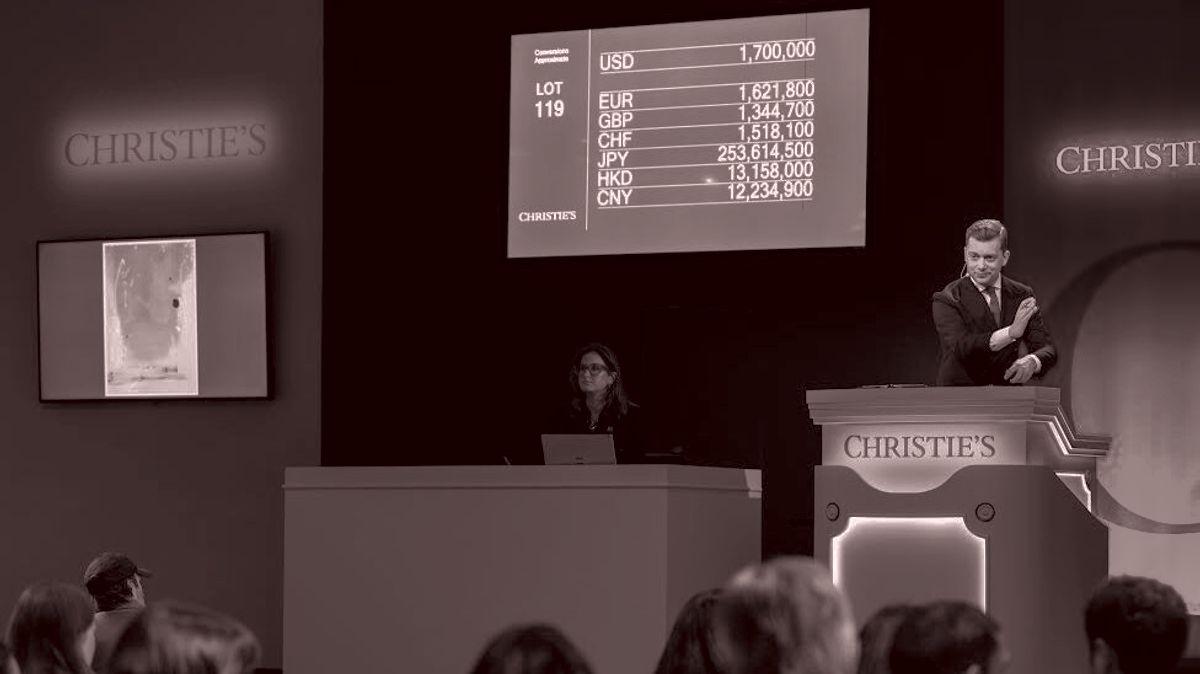
- Christie’s 20th/21st Century London Evening Sale = £82 million: Christie’s withdrew four lots and locked in a slew of last-minute third-party guarantees just before tonight’s sale. The initial run of works by sought-after artists Danielle Mckinney, Justin Caguiat, Sanya Kantarovsky and Emmi Whitehorse all exceeded their estimates by some multiple. A restituted Egon Schiele from the heirs of Fritz Grünbaum made £3.3 million; a small Amedeo Modigliani portrait fetched nearly £6.3 million; and a Jean-Michel Basquiat work on paper brought in £3.8 million. Michael Andrews’ painting School IV: Barracuda under Skipjack Tuna sold for £6 million; it was estimated at £3 million. Works by Eduardo Chillida and Howard Hodgkin doubled their estimates to sell for £1.25 and £1.13 million, respectively.
- Blum appoints Yoshitake Mika as senior curatorial director: Blum will announce tomorrow that Yoshitake Mika is joining the gallery as senior curatorial director. The gallery is putting the finishing touches on the Tribeca opening of a show she curated, Written with a Splash of Blood. The show first debuted in Los Angeles to celebrate the gallery’s 30th anniversary; it covers multiple phases of Japanese art since the 1950s, including Gutai, Mono-ha, New Wave, and post-Superflat. “The presentation in New York carries forward the thesis of its sister exhibitions in Los Angeles and Tokyo by reflecting back on key milestones in postwar Japanese art,” Mika explains, “but will introduce new visionary artworks and artists that contemplate the threshold of creative destruction resonant with the current era.”
|
Bonhams’ £1.5M Bridget Riley
|
|
Bridget Riley, Myrrh (1985), estimated at £1.5 million
|
|
Bonhams has announced a 1985 Bridget Riley painting, Myrrh, for its 20th/21st Century Art Evening Sale on April 2. The 93-year-old artist is still making work, but this painting comes from an earlier series based on her use of a so-called Egyptian palette. The piece carries an estimate of £1.5 million, in line (after fees) with the auction range for mid-1980s Riley paintings in this size and format. Another 1985 work, Cupid’s Quiver, sold in 2021 for $3 million. Delos, from 1983, sold for $2.6 million in 2022. Praise I, from 1981, sold for $2.4 million in 2022; Cool Edge, from 1982, sold for $2.4 million in 2020. And, Midi, from 1983, with colors closer to Myrrh, sold for $2.3 million in 2019.
|
|
Now, let’s get to the data…
|
|
|
|
Buyers remain wary and sellers are greedy, but the latest New York sales hint at a new reality: We’re still far away from the 2022 boom times, sure, but palmy days lie ahead.
|
|
|
|
The art market has begun to heal. That’s the main takeaway from last week’s sales in New York, where $50.6 million worth of art works were sold for an average price of $95,000. In the end, 73 percent of the 530 lots offered were sold, with just under a quarter selling at prices above the estimate range. Meanwhile, about one-third had to be sold at compromise prices, where the consignor did not get bids to their estimates.
The hammer ratio for these sales, however, was a weak .93, which suggests the market still has a ways to go before gaining real momentum. (A hammer ratio above 1.00 is one sign of an advancing market.) Still, it’s worth pointing out that the low sell-through rate probably had a greater impact on the hammer ratio than overall weakness in bidding. There are still signs that sellers’ expectations are out of line with buyers’ interest—27 percent of lots failed to find a buyer (or the consignors would not lower their reserves), and a third of the sold lots went for prices below the estimate. In other words, consignors are overvaluing their property and need to lower their threshold for getting cash out of their art.
Before we get further into last week’s numbers, let’s look at how these top-line metrics compare to previous years. We’ll start with the average price. In 2022, the last boom year for the art market, the New York midseason sales had approximately the same number of artworks on offer, but the average price of a work sold was $132,000. In 2023, the average price for a work fell to $92,000; in 2024, it bottomed out at $71,500. (In 2023 and 2024, there were significantly more works of art available in these sales as consignors rushed in, hoping to cash out before the good times came to an end. Alas…) The return to a lower number of works offered, and a higher average price, is a good sign for the market. But there’s still a large gap between this year’s 73 percent sell-through rate and the 90 percent sell-through of 2022.
|
|
The hammer ratio for these sales charted a similar trajectory. In 2022, the hammer ratio was a blazing hot 1.23; in 2023, it fell to 1.02; and then in 2024, it bottomed at an unsustainable .77. The .93 hammer ratio achieved last week is a big improvement over the previous year, but still less than ideal.
One final year-over-year comparison: If we look at the ratio of the value of the top 10 lots sold against the overall value of the sales, some other telltale signs emerge. When the value of the top 10 lots increases as a proportion of the overall sale value, it indicates concentrated bidding on a few works, as opposed to a broader-based interest. In 2022, the top 10 lots accounted for 25.5 percent of the value of the entire sales; in 2023, the proportion was the same; in 2024, it fell to 21 percent. This year, the top 10 lots comprised almost 31 percent of the value of the entire sales.
The sample size here is too small to extrapolate to the broader market. But, just in the context of these New York midseason winter sales, the higher proportion of value concentrated in fewer lots suggests buyers are ready to spend again for specific works by specific artists—in other words, an isolated willingness to spend. But I would not go so far as to call it market leadership.
|
|
Let’s look at those top 10 lots. The names are mostly well-established, historical artists: Joan Mitchell, Helen Frankenthaler, Jean Dubuffet, Louise Bourgeois, Jean-Michel Basquiat, and Richard Diebenkorn. As I’ve noted here before, we’re well past the time in the cycle when we should be seeing more demand for historical work. The other names in the top 10 list are Richard Estes, George Condo, and Ed Ruscha, all living artists whose work is recognized as having a place in art history.
Of the 10 works at the top of the price scale, only the two Basquiats were sold below the estimates; three works (Estes, Condo, and Mitchell) were sold within the estimate range; and the remaining five works were all bid above their estimates. The Bourgeois and Frankenthaler works were subject to dynamic bidding that drove the hammer price to levels more than three times the estimate. The Bourgeois is the only work that appears on both lists of top 10 works: by price and by hammer ratio.
|
|
If we switch to the top 10 lots by hammer ratio—which should indicate the work that is sought after by collectors and advisors—we see mostly low-value pieces below $100,000. Yu Nishimura and Olga de Amaral join Bourgeois in seeing their work get bid up aggressively to six-figure sums. The De Amaral work achieved her fourth-highest price at auction (the auction record was set just last May), but $444,000 is in line with her prices over the last five years. The Nishimura was a record for the artist, more than doubling the previous high. But only a handful of his works have ever come to the auction block. When we see a higher proportion of the top 10 works by hammer ratio sell for prices in the six figures—quite a high price point for these sales—it will be an indicator of market momentum.
|
My friend Lock Kresler, a senior director at Helly Nahmad, recently sent me a note about the gallery’s new show in London, Painting in the Round. The Cork Street space is filled with some of the gallery’s big-name artists— René Magritte, Joan Miró, Lucio Fontana, Alberto Burri, Juan Gris, Georges Braque, Giorgio Morandi—but this time the focus is not only on the front of the paintings. Nahmad wants you to appreciate when a painting has “good back,” as one collector called it many years ago.
Real auction and gallery pros appreciate the wealth of information and history contained on the back of a painting. But let me step aside so the gallery can make its case: “The backs of these works—often covered in annotations, labels, signatures and other inscriptions—tell stories of ownership, conservation, and artistic process. Some reveal sketches or unfinished compositions, while others bear the marks of time and movement through collectors’ hands and museum storerooms.”
Lock was thoughtful enough to FaceTime me so he could walk me around the show, which has a Picasso painted in Fontainebleau that bears an
image of the gates of the house where he was staying—for only three months—while he made the two versions of the famous Three Musicians and about 80 other works. The painting on the back, The Gate, hardly looks like a Picasso at all. The back of a Braque painting features a sketch he made of a Picasso painting when the two were working side by side. On the back of a painting by contemporary artist Alexis Ralaivao, there’s a fragment of a story. Since his works will likely never be displayed together again once they’re sold, the story is never whole. There’s something comforting about that.
If you’re in London this week, you should also look at Omer Tiroche’s show of Egon Schiele drawings. If you see either of these shows, send me a note or text me at 917.825.1391. Let me know what you thought.
Until Friday,
M
|
|
|
|
Puck founding partner Matt Belloni takes you inside the business of Hollywood, using exclusive reporting and insight to explain the backstories on everything from Marvel movies to the streaming wars.
|
|
|
|
The ultimate fashion industry bible, offering incisive reportage on all aspects of the business and its biggest players. Anchored by preeminent fashion journalist Lauren Sherman, Line Sheet also features veteran reporter Rachel Strugatz, who delivers unparalleled intel on what’s happening in the beauty industry, and Sarah Shapiro, a longtime retail strategist who writes about e-commerce, brick-and-mortar, D.T.C., and more.
|
|
|
Need help? Review our FAQ page or contact us for assistance. For brand partnerships, email ads@puck.news.
You received this email because you signed up to receive emails from Puck, or as part of your Puck account associated with . To stop receiving this newsletter and/or manage all your email preferences, click here.
|
|
Puck is published by Heat Media LLC. 107 Greenwich St, New York, NY 10006
|
|
|
|


,%20Myrrh.%20Oil%20on%20canvas,%20165%20x%20138.7cm.%20Estimate_%20%C2%A31,500,000%20-%20%C2%A32,500,000_01JNKH857E3T37BHDY9Q3QBA20.jpg)

.001_01JNM91YB79X8R1ZQM905K1NSF.png)
.002_01JNM91YPSW15M9F7RR8VGJ64E.png)
.003_01JNM91Z06DZ5N8Y9GEBSR7C2Z.png)