Welcome to The Varsity, your essential read on the sports business. I’m John Ourand, coming to you tonight from our nation’s capital.
Over the weekend, my social feeds were dominated by that clip of Kevin Durant learning about his trade to the Rockets while onstage, and Tom Brady and Eli Manning wrestling each other. Both viral moments (and dozens more) came from Fanatics Fest, the sports industry’s version of Comic-Con. The three-day event, held in New York, sold 125,000 tickets at $60 a pop—up from 70,000 in 2024, its debut year. ESPN will run a special on the festivities on July 7. It’s truly an accomplishment to have an event like this become part of the sports business zeitgeist in only its second year.
Elsewhere in the sports business world, people are still scratching their heads over last week’s announcement that Netflix is partnering with French broadcaster TF1. Why does the world’s biggest streaming company need an old-school network? Julia Alexander explains it all in today’s must-read issue: It’s a demonstration of Netflix’s desire to compete against Prime Video and YouTube for aggregator supremacy. Remember, you can only read Julia’s stories if you’re an Inner Circle member, so click here to upgrade. It’s well worth it.
Now, here’s Julia…
|
That’s the number of fans who turned out for the match between South Africa’s Mamelodi Sundowns and South Korea’s Ulsan HD in Miami during the opening week of FIFA’s new, $1 billion Club World Cup tournament. Sure, no one was expecting the game to draw 80,000 people, like Paris Saint-Germain’s recent match against Atlético de Madrid at the Rose Bowl. And yes, it’s swampy this time of year in Miami, where fans have become accustomed to watching Lionel Messi. But it’s still pretty depressing that they couldn’t eclipse 5,000 people.
As soccer continues its inexorable, decades-long march toward middling popularity in the U.S., it’s clear that American fans value big stars—the huge talents we all get to know during the World Cup, who inevitably play for the major European clubs (like… PSG’s Khvicha Kvaratskhelia and Atlético’s Julián Alvarez). Viewership for last June’s Euros tournament was up 29 percent compared to 2021, and the English Premier League audience hit a three-year high in 2024, per Nielsen. For FIFA, the question is whether the Sundowns–Ulsan HD game drove engagement in South Korea and South Africa, both countries that the organization sees as prime growth territory. If so, they can take that as a silver lining.
|
- YouTube’s youthquake: As I’ve previously reported, streamers have been trying to convince advertisers that their smaller, yet younger, audiences give them an advantage over traditional broadcast networks and their larger, older cohorts. Amazon touted this supposed strength when talking about the NFL at its upfront, and trotted it out again when announcing its latest sports bet, on NASCAR.Neal Mohan, the C.E.O. of YouTube, is going the same route. Last week, John noted that Mohan used an appearance in Cannes Lions to discuss how his teenage son’s sports infatuation helped persuade him to cut his company’s historic deal with the NFL. During the same conversation, with The Ankler’s Janice Min, Mohan also claimed YouTube had “aged down” the NFL, pointing to its ability to host the game alongside “all the … creator-driven fandom.” One outstanding question, however, is whether Roger Goodell would rather have his programming sit adjacent to 60 Minutes or MrBeast.
- Can Vice play ball?: Vice, the down-on-its-luck media destination of choice for Bushwick-adjacent twentysomethings circa 2012, has tried on several hats in the past few years—gonzo journalistic cosplay, Millennial News Corp., etcetera. Now, it wants to be a sports network. New C.E.O. Adam Stotsky, who spent years at NBCUniversal and Dick Clark Productions, has his hands full running a network whose primary accomplishment is that it still exists. This past weekend, Vice carried a BKB Bare Knuckle Boxing match, a Big3 basketball tournament, and an Arena Football One semifinal, according to Sportico.While featuring a smattering of random, super-niche sports is an interesting strategy, it’s unlikely to persuade the 40 million or so households that still have Vice TV access to rediscover a channel they likely haven’t visited in a decade, if ever. As more consumers move to streaming for their sports, and as more specialty leagues look to major distributors like YouTube to help them find their global audience, Vice TV’s approach here feels like a long shot. Absent wildly popular on-air personalities on the level of Stephen A. Smith or Charles Barkley, what happened in Bushwick may end up staying in Bushwick.
- ESPN’s bizarre streaming mentality: Frankly, for most cord-cutters, watching the NBA Finals wasn’t as easy as it should have been at this point in the streaming evolution. Disney’s coverage of the finals only appeared on ABC and ESPN… until Game 7, which the company made available on ESPN+. (Obviously, subscribers to YouTube TV and Fubo were able to watch it.) The deciding game, which saw Oklahoma City’s Shai Gilgeous-Alexander outplay Indiana’s Pascal Siakam after the devastating loss of Tyrese Haliburton in the first quarter, peaked at 19.2 million viewers, with an average of 16.35 million. The whole series averaged 10.3 million viewers due to that Game 7, which is much better than things looked a week ago. That sound you hear is Adam Silver exhaling.So… why did ESPN wait until the final game to throw a bone to its roughly 25 million ESPN+ subscribers? With less than 75 days until NFL kickoff, ESPN is making a concerted effort to ensure people are aware of how important its streaming component will be for those who want to watch sports, but don’t want cable. But this was a weird way to prove the point.
|
|
|
|
Netflix’s ultimate goal is to transcend its dominant streamer status and simply become TV, itself. That grand plan is now playing out with sports at its center, and a new partnership with France’s TF1.
|
|
|
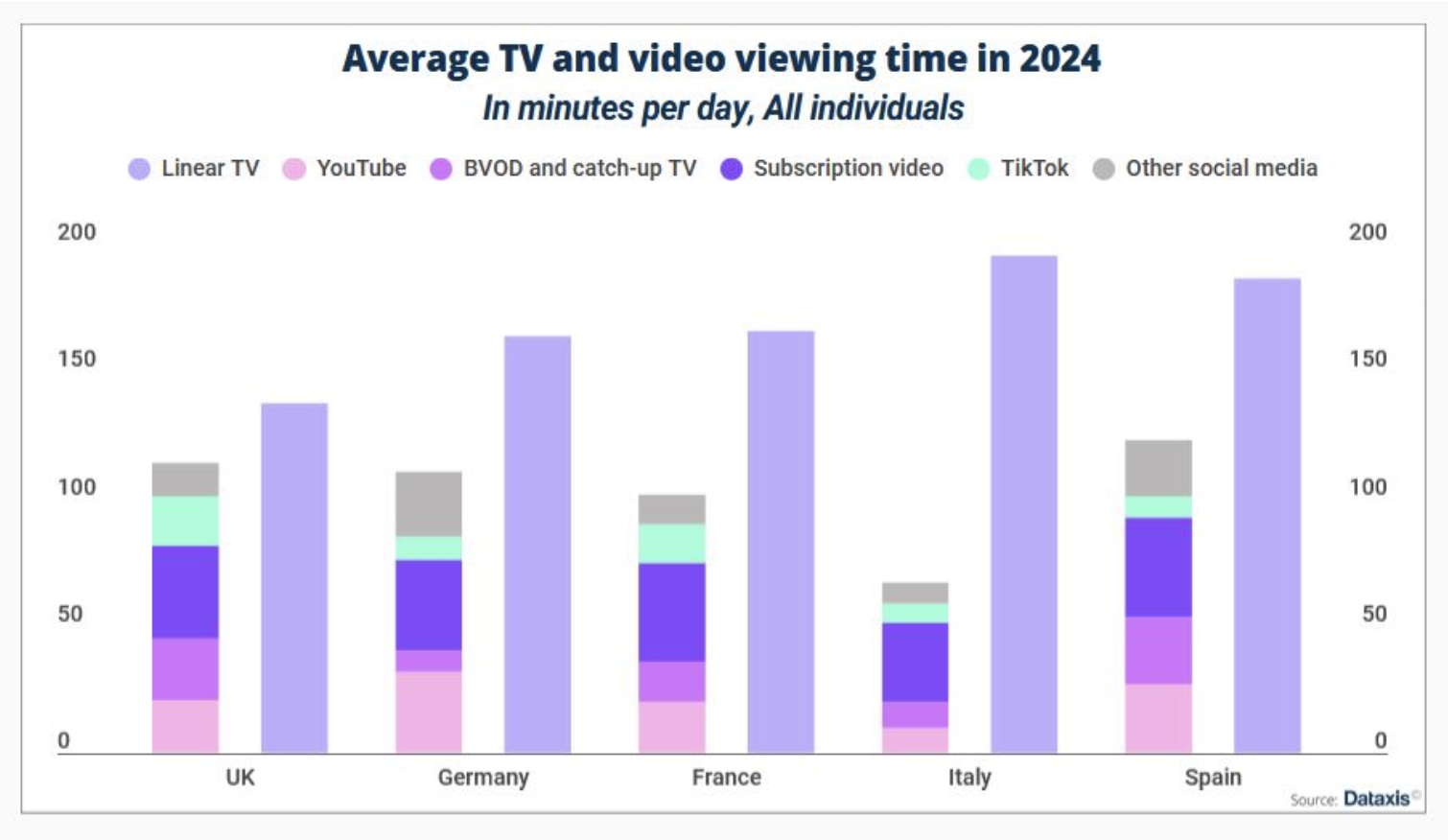
Over the past few years, Netflix co-C.E.O. Ted Sarandos, who isn’t exactly known for keeping his thoughts to himself, has hammered on one talking point above all others: TV is Netflix, and Netflix is TV. And that’s certainly become more and more true with each passing year. The company’s latest move, which fellow co-C.E.O. Greg Peters touted as a “first of its kind partnership,” will offer live television content from France’s TF1 free-to-air linear channels to Netflix subscribers in the country for no additional fee. For Netflix, which reported more than 10 million French customers in 2022, but hasn’t disclosed country-level growth since, this is a meaningful engagement play for existing subscribers and a customer-acquisition tool for new ones in a market where linear TV still accounted for 60 percent of all viewing in 2024, per Dataaxis.
This new deal will be especially transformative for Netflix’s sports business in the country. The streamer currently offers weekly WWE matches and two NFL games each year to subscribers in France, where interest in both leagues is growing at a gingerly pace. Now, however, Netflix will also become home to the French national team soccer matches, French men’s and women’s International Basketball Federation games, the UEFA Women’s Euro 2025, and the 2025 Women’s Rugby World Cup—all available to stream through its partnership with TF1. In France at least, Netflix really is about to become TV.
Netflix’s deal also comes at a time when cord-cutters in the U.S. are growing impatient with v.M.V.P.D.s like YouTube TV, Fubo, Hulu+Live TV, and Sling. A subscription to a major v.M.V.P.D. in the U.S. costs an average of $70 per month, up roughly 30 percent from 2021. But the offerings for sports fans, who represent the largest cohort of subscribers, are only getting thinner.
Sure, accessing the four major sports networks (ESPN, CBS, NBC, and Fox) through a v.M.V.P.D. is likely cheaper than signing up for multiple streaming services—and it’s certainly cheaper than a traditional cable package, particularly one that includes an R.S.N. on a premium tier. But more and more local sports are partnering with over-the-air broadcasters, or launching their own independent streaming services, and v.M.V.P.D. executives have shown middling interest in offering, say, Victory+, a service that carries Dallas Stars games (among other teams) for free. If customers no longer see the benefit in paying an increasingly exorbitant monthly fee for access to less sports content, the big streamers have a chance to fill the void and become more efficient centralized hubs.
Indeed, the TF1 deal seems like the start of a new paradigm for Netflix—partnering with broadcasters in regions where there’s room for streaming engagement to increase and where complementary programming can be offered as a perk, thus further cementing Netflix as the first option, every time. There’s also the boost in advertising revenue, decreased churn, and all that extra audience data to help refine programming strategy.
|
|
Unsurprisingly, others are pursuing a similar strategy. Last week, Fox Sports announced it was acquiring Caliente TV, a popular sports network in Mexico with 2.1 million subscribers. Caliente TV’s sports offerings include top Liga MX soccer clubs (widely regarded as some of the most valuable sports rights in the country), the Premier League, Concacaf Champions Cup, and the UEFA Champions League, giving Lachlan Murdoch’s streaming business a super-solid foothold in the country even before launching Fox One.
|
Everyone Wants to Become TV
|
|
Peters and Sarandos aren’t the only ones who want to become TV. Amazon, Google, and Roku (to some extent) are all pursuing the same goal through an alternative strategy: offering other services, often niche, on their platforms in exchange for a share of advertising and sub revenue.
Amazon has shifted its marketing strategy away from Prime Video originals toward trying to become the home of all TV. Meanwhile, YouTube C.E.O. Neal Mohan has started talking more publicly about ambitions in the subscription space with add-ons to YouTube and YouTube TV. Sunday Ticket, which costs Google $2 billion a year, is available through YouTube Primetime Channels as a way to encourage more signups. Even if the path is slightly different from Netflix’s seemingly replicable playbook of partnering with foreign linear services, the goal is the same: to become the aggregator before becoming the aggregated.
This is all happening at a particularly fraught time. Free streaming is capturing a larger share of attention, while paid services have seen shrinkage: Netflix’s share of total time spent watching TV has fallen by a percentage point year to date, and Prime Video, Paramount+, and HBO Max have all remained stagnant, per Nielsen’s Gauge Report. In the meantime, v.M.V.P.D.s are shedding customers at a far higher rate than at this time last year. More than 1 million customers dropped their TV lite subscriptions in Q1, up more than 50 percent from the year prior, according to new analysis from research firm MoffettNathanson. Even more concerning is the safety net conversion rate: Of those who canceled their traditional pay TV cable packages, only 13 percent then signed up for a virtual option, down from 28.3 percent last year. On the flip side, an industry in need of reinvention is more up for grabs than ever.
|
|
Thanks, Julia! See you Thursday.
John
|
|
|
|
Puck sports correspondent John Ourand and a rotating cast of industry insiders take you inside the executive suites and owners boxes where the decisions that shape the entire sports business are made. You’ll hear interviews with players, network execs, and everyone in between. The Varsity is an extension of John’s private email for Puck by the same name. New episodes publish every Wednesday and Sunday.
|
|
|
|
Ace media reporter Dylan Byers brings readers into the C-suite as he chronicles the biggest stories in the industry: the future of cable news in the streaming era, the transformation of legacy publishers, the tech giants remaking the market, and all the egos involved.
|
|
|
Need help? Review our FAQ page or contact us for assistance. For brand partnerships, email ads@puck.news.
You received this email because you signed up to receive emails from Puck, or as part of your Puck account associated with . To stop receiving this newsletter and/or manage all your email preferences, click here.
|
|
Puck is published by Heat Media LLC. 107 Greenwich St, New York, NY 10006
|
|
|
|