 |
|
Hello, and welcome back to The Best & The Brightest, your Tuesday foreign policy edition.
The D.C. bureau of Puck is busy preening and prepping to throw our second-annual First Amendment party at the French ambassador’s residence tomorrow evening, hosted by the gracious Laurent Bili. I, for one, am excited to drink champagne, see old friends and sources, and, of course, my colleagues who are flying in from New York and L.A.
Tonight, some thoughts on all the talk about the Alexey Navalny prisoner swap that wasn’t, Bibi doth protesting too much, and the presidential “elections” in Russia.
But before we get into it, here’s the great Abby Livingston, reporting on the Hill…
|
| Johnson’s Small Victory & Porter’s Mea Culpa |
|
On the cusp of a two-week recess, Capitol Hill appears to be in the middle of a genuinely productive week. Congressional leadership and the White House just announced a deal to keep the government funded through the end of the fiscal year. Here’s what the chattering classes were chattering about today…
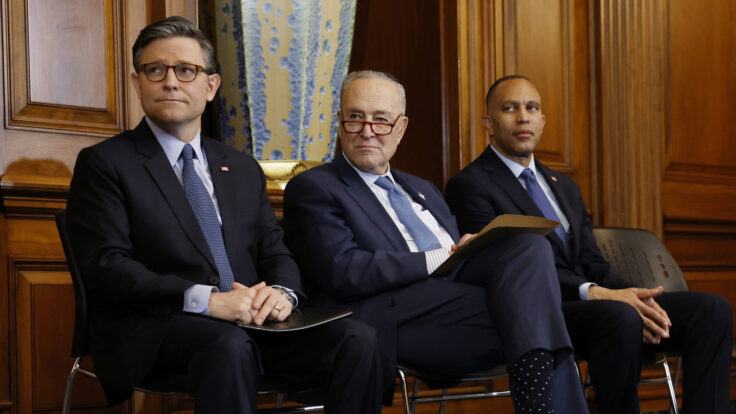
- Johnson’s small win: You can almost hear the collective exhale: Congress and the White House appear set to move on a deal that will fund the government through September. Should the House and Senate pass the agreement, it will mark the first time in six months that an imminent shutdown threat hasn’t loomed over the 118th Congress.
Of course, funding the government is the most basic of all congressional responsibilities. But that hasn’t been the case since September, when Kevin McCarthy walked the plank in order to secure passage of his own short-term funding deal. There are times when Mike Johnson does not seem to have a firm grasp on his conference, but this potential accomplishment is a significant achievement within the context of never-ending House G.O.P. dysfunction.
- Young at heart: Most Republican senators who’ve blatantly crossed Trump (without repenting in the aftermath) have either lost reelection or retired. But the senior senator from Indiana, Todd Young, has been an exception. “I’m tired of having my vote taken for granted,” he told columnist Dave Bangert in a story published today, announcing that he will not even vote for the former president.
Young, who worked for the late Sen. Dick Lugar, has repeatedly defied Trump during his tenure. When he helmed the N.R.S.C. in 2020, the Senate G.O.P’s campaign arm put out a memo discouraging candidates from defending Trump; more recently, he tauntingly refused to endorse the former president this cycle. But Young has yet to pay a political price: When he was up for reelection in 2022, Young cleared Indiana’s G.O.P. primary, and did so without a Trump endorsement.
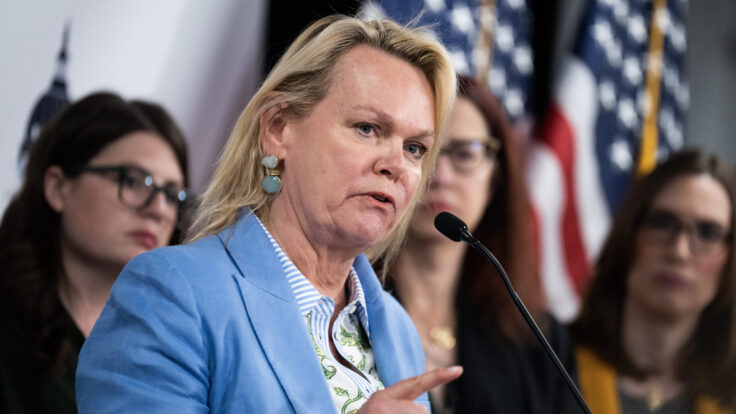
- Porter regrets: California Rep. Katie Porter enraged pretty much every Democrat on the planet last week when she called Adam Schiff’s two-front rout of her Senate campaign “rigged.” But this week she demonstrated something increasingly rare in politics: remorse.
“I wish I had chosen a different word,” she told Jon Favreau of the Pod Save America podcast. “I want to really make clear that at no time, in no way would I ever suggest that there’s anything other than a careful, thoughtful, amazing election system that actually should be the model for a lot of the country, in my opinion,” she said of California’s election system. Now juxtapose that with the lack of G.O.P. officeholders who are willing to push back against the efforts of Trump, and their colleagues, to rewrite the history of the January 6 insurrection — let alone reject disproven allegations of electoral malfeasance in 2020.
|
 |
| The Navalny Prisoner Swap Deal That Wasn’t |
| Notes on the frustrations and fixations of the Georgetown set: a Russian hostage exchange mystery, the irony of Netanyahu’s foreign meddling, and the tragedy of Putin’s comical election. |
|
|
|
| Late Sunday night, Vladimir Putin decided to speak to his supporters after he successfully stole a fifth term as Russian president. He talked about his “victory” and also did something unexpected: For the first time, he publicly mentioned by name the late Alexey Navalny—a cruel irony, since Putin refused to do this while Navalny was alive. But Putin also caused a bit of a kerfuffle in the Russian opposition. “A few days before Mr. Navalny passed away, some colleagues, not members of the administration, some people there told me that there was an idea to exchange Mr. Navalny for some people who are in prison in Western countries,” Putin said. “The person who spoke to me had not yet finished the sentence, I said: ‘I agree!’”
He went on to call Navalny’s death “sad” but unremarkable. “We’ve had other occurrences when people left this life in places of deprivation of freedom,” Putin continued, using the Soviet-esque bureaucratese for “dying in jail.” “Has this never happened in the United States? It has!” (A Jeffrey Epstein reference, perhaps.)
These comments were immediately seized upon by Team Navalny because they seemed to confirm the allegations of Maria Pevchikh, the investigative journalist affiliated with his camp, that a prisoner swap involving Navalny, Journal reporter Evan Gershkovich, and Paul Whelan in exchange for convicted murderer Vadim Krasikov, currently serving a life sentence in Germany, had been agreed to—and, in fact, it was only Navalny’s murder in a penal colony that prevented its fruition. Pevchikh and some on Team Navalny gloated on social media, demanding an apology from all sorts of “scum,” including their favorite liberal enemy, Echo of Moscow editor-in-chief Alexei Venediktov, who had earlier said Pevchikh’s allegations were untrue.
That’s when Dmitry Peskov, Putin’s long-serving, mustachioed spokesman, issued a denial. “President Putin did not confirm that there were negotiations,” Peskov said. “He said that an idea was proposed by someone about exchanging Navalny, to which he potentially agreed and immediately told this to the person who proposed this idea. Putin did not say that there had been negotiations on this point.” (The “person,” in Pevchikh’s account, is oligarch Roman Abramovich, who has also been a liaison between Moscow and Kyiv.)
Normally, Peskov’s job is to lie with abandon, but this time, I had to pause. What he said comported with my own reporting from last month, when Pevchikh first made the allegation. At the time, I reached out to several senior Biden administration officials, each of whom told me the exact same thing: There was an idea to include Navalny in a Krasikov swap, but it never materialized beyond that point by the time he died. “There were nascent discussions to that effect, but a formal offer had not been extended,” one of the administration officials told me. “[Pevchikh is] not wrong in that it was being kicked around and [we were] hoping it would work, but no formal offer had been made. It just wasn’t quite there.”
The administration’s account pretty much lines up with what Putin and Peskov said: There was an idea, people were into it, and then Putin, for whatever reason—to clear the deck ahead of the “elections,” to send a definitive fuck you to the West—killed Navalny. But, regardless, no exchange was imminent.
Then, on Monday afternoon, National Security Advisor Jake Sullivan, speaking from the White House podium, poured even more cold water on the idea. “We have not heard a Russian official raise Navalny as part of a prisoner swap in any of those conversations,” Sullivan said. “So, if this is something they were interested in, it certainly sounds like they’re coming to it quite late—in fact, too late, obviously, since he’s no longer alive—because we did not hear that from them before.”
I’ve spoken to some colleagues who also report on Russia and, though most are reluctant to say it publicly, most of them agree that Team Navalny, for whatever reason, exaggerated how close their leader had been to freedom. I won’t speculate as to why they’re doing this, but I did want to correct the record. |
|
|
| There was quite a firestorm ignited by Chuck Schumer’s speech last week, in which the Senate majority leader, the most senior elected Jewish official in the country, called for new elections in Israel “once the war starts to wind down.” Bibi Netanyahu, the target of Schumer’s speech, shot back in an interview with CNN’s Dana Bash over the weekend. “I think what he said was totally inappropriate,” Netanyahu fumed. He then once again chastised America for meddling in Israeli politics, which has been a favorite Bibi complaint of late.
Ironically, of course, just last week, Bibi was scheduled to keynote the Senate G.O.P. retreat—until he suddenly discovered a “scheduling conflict” and canceled. This is par for the course for Netanyahu, who has made his preferences quite clear when it comes to American political parties—and it’s not the one Joe Biden leads. During Obama’s presidency, Bibi infamously accepted then-speaker John Boehner’s invitation to address Congress about his opposition to the Iran nuclear deal—a key Obama policy and legacy item. The Biden administration is staffed at its most senior levels by Obama alums, and they have never forgiven that slight, nor Israel’s relentless and strident attempts to (unsuccessfully) tank the deal. (Donald Trump eventually pulled out of the deal.)
Moreover, members of Bibi’s cabinet—including Itamar Ben-Gvir, whose views border on ethno-fascism—have been quite open about their preferences in the American election of 2024. In a recent interview with The Wall Street Journal, Ben-Gvir said he’d really like to have Trump sitting in the White House because he wouldn’t be pressuring Israel about pesky things like respecting international law and making sure Gaza doesn’t descend into famine. “Instead of giving us his full backing, Biden is busy with giving humanitarian aid and fuel [to Gaza], which goes to Hamas,” said Ben-Gvir. “If Trump was in power, the U.S. conduct would be completely different.”
So when I talk to senior Biden administration officials about Bibi’s admonitions, the sentiment in the White House is one of, almost literally, Go fuck yourself, Bibi. Everyone I spoke to wanted to stay off the record, but that was both the feeling and the lexicon. “It’s pretty rich, coming from him,” said one senior Biden campaign source.
Speaking from the podium on Monday after Biden and Bibi’s first phone call in a month, Sullivan said as much, but far more politely. It was “an interesting irony,” he said. “You have the prime minister speaking on American television about his concerns about Americans interfering in Israeli politics, and then your question is, ‘Should Americans be speaking into Israeli politics?’ which, in fact, we don’t do nearly as much as they speak into ours,” Sullivan said. “Just an observation.”
And while Sullivan made news in announcing that Netanyahu had agreed to Biden’s request to send an “interagency team” to Washington to discuss Israeli strategy in Rafah and beyond, what went unnoticed was the critique Sullivan offered of the Israeli government. “When the president visited Israel on October 18th, … he said both privately and publicly that the United States has learned a vital lesson over the course of several wars: A military plan cannot succeed without an integrated humanitarian plan and political plan,” Sullivan said. “And the president has repeatedly made the point that continuing military operations need to be connected to a clear strategic endgame. The president told the prime minister again today that we share the goal of defeating Hamas, but we just believe you need a coherent and sustainable strategy to make that happen.”
This public statement reflects what I’ve heard privately from various administration officials—a mounting frustration that there is no strategy in Jerusalem and no endgame, only confusion on the ground, lack of discipline, crossed wires, and the like. Until recently, administration officials have told me, their only strategic objective was the unattainable goal of “eliminating Hamas.” The Israeli government has since revised that downward to the much more realistic objective of degrading Hamas militarily. Still, when I ask Biden administration officials about the Israeli government’s strategy going forward, including for the day after the war ends, they usually tell me they don’t really know what it is—if they even have one.
Another point: With all the focus on Bibi, it’s easy to lose sight of the fact that the prime minister is not totally wrong when he says he’s doing what the Israeli people want. The war is popular in Israel, and a two-state solution, which Biden so heavily favors, is not. “I don’t think you could find 10 percent in Israel to support a two-state solution,” one Biden official told me recently. The intransigence isn’t just coming from Bibi, as another observed, it’s also the sentiment of the Israeli public. |
|
|
| And now, for the most boring and predictable news of the week: the outcome of the Russian presidential “election.” Putin clocked in for a fifth term with an absolutely comical 87 percent of the vote, which places him among the Saddam Husseins and the Kim Jong Uns of the world. But because the result of the so-called election was pre-determined—the three parties fielding candidates to run against Putin are all, quite literally, on the Kremlin payroll—it was important for government spin doctors to show public support, and thereby confer legitimacy, in another way: turnout.
The people, they said, turned out en masse and thereby signaled their agreement with Putin’s continued reign and his policies. Kremlin officials charged with choreographing this whole charade let it be known that their target turnout was between 70 and 80 percent. And, like a true Stakhanovite nation, Russia fulfilled its quota. Turnout over the three days of “voting” was 77 percent.
One reputable statistical analysis of the results from Novaya Gazeta found that about half the votes cast in this election were likely fake. On the other hand, the independent Levada Center, a Russian polling organization, released a survey today that had been conducted during the electoral campaign (by law, Levada was not allowed to release the poll until after the election, lest it influence the vote), and its numbers hewed closely to the official results: 78 percent of those polled said they intended to vote and, of those, 87 percent said they would vote for Putin. That said, there are well-known issues with polls in repressive environments such as today’s Russia, and it is far harder—for obvious reasons—to get dissenters to participate. They have too much to lose in explaining their discontent to a stranger over the phone.
About that discontent: On Sunday afternoon, thousands and thousands of people, both in Russia and outside of it, heeded Yulia Navalnaya’s call to come out at exactly noon and vote for anyone other than Putin—or to spoil their ballots. This “Noon Against Putin” (an alliteration in Russian) was supposed to demonstrate the massive opposition to the Russian king. People turned out all over Russia, especially in Moscow, but even there, some people told me it wasn’t all that crowded. One friend in St. Petersburg went to their polling place at noon on Sunday and said there were only a handful of people. Another friend, who lives in the countryside outside the capital, saw all the photos of lines in Moscow but encountered all of two voters when they went to vote at their local precinct. “That was Moscow, but here in the village, there wasn’t anyone,” the friend said. “Neither for nor against. No one gives a shit.”
Another friend in Moscow told me he didn’t vote, but that most of his friends did—and they all voted for Putin. These white-collar professionals, many of them lawyers, participated in the 2011-12 pro-democracy protests but had turned into ardent Putinists because, they felt, the West had turned against them in 2022. Indeed, looking at the lines in Moscow, it was impossible to tell who was there to vote for Putin and who was there to register their hatred of him. The clearest demonstrations of the latter were the people throwing Molotov cocktails into polling stations and pouring ink into ballot boxes. But a few dozen incidents in a country of 140-some million people is not enough.
The “Noon Against Putin” protest was much more successful abroad. There were huge lines in London, in Tel Aviv, in Berlin (where Navalnaya went to vote), and all the other places to which over a million Russians fled when their president launched a full-scale invasion of Ukraine. If I were Putin, I would have been thrilled to see all those people, tens of thousands of them, lining up to hate me—outside my borders. Denis Volkov, who heads the Levada Center, told me recently that, in Russia, there’s a lot of talk these days about a “cleansing” or “self-cleansing” of society. It began, doubtless, when the people who most actively disagreed with Putin and his policies fled en masse, removing themselves from the field of play. They fled real danger to their lives and liberty, but in so doing, they also helped Putin expunge from Russian society those who don’t like what he’s done to it.
Ironically, Sunday’s protest action abroad showed Putin not how many people disagree with him, but how successfully he neutralized them. |
|
|
| That’s all from me this week, friends. I’ll see you back here next Tuesday, rain or shine. In the meantime, good night. Tomorrow will be worse.
Julia |
|
|
|
| FOUR STORIES WE’RE TALKING ABOUT |
 |
| Reality Bites Bravo |
| Penetrating the lawsuits threatening the essence of reality TV. |
| ERIQ GARDNER |
|
 |
| Pitaro Murmurs |
| News and notes on the Iger succession bake-off. |
| JOHN OURAND |
|
 |
|
 |
| Teenage Riot |
| Would a TikTok ban affect Biden’s reelection bid? |
| PETER HAMBY |
|
|
|

|
 |
|
|
|
Need help? Review our FAQs
page or contact
us for assistance. For brand partnerships, email ads@puck.news.
|
|
You received this email because you signed up to receive emails from Puck, or as part of your Puck account associated with . To stop receiving this newsletter and/or manage all your email preferences, click here.
|
|
Puck is published by Heat Media LLC. 227 W 17th St New York, NY 10011.
|
|
|
|