|
Welcome back to Dry Powder. I’m Bill Cohan.
There are few places more delightful than Paris in the spring. Last week, while I was visiting, I stopped by the new Lazard headquarters—a few blocks from the old headquarters, at 121 Boulevard Haussmann, where I worked on deals a few decades ago as a banker for the firm—to check in with Jean-Louis Girodolle, the C.E.O. of Lazard’s investment banking group, and Lazard C.E.O. Peter Orszag, who Zoomed in from London.
Among other things, our fascinating conversation touched on how the Europeans have been thinking about Trump’s Liberation Day, how corporate C.E.O.s are responding to this painful new economic reality, and what it all means for our country’s role as a global economic leader.
But first…
|
- Building an A.I. analyst: Surely, you will remember Rogo, the A.I. company with a mission to serve the investment banking community that I wrote about a few months ago? It’s run by Gabe Stengel, who used to be an analyst at Lazard and happens to be the son of former Time editor and State Department official Rick Stengel. (Rick, who is a director at Snap, is also a friend.) Anyway, Gabe just announced that Rogo has raised $50 million at a $350 million valuation. The new round was led by Thrive Capital, the venture firm founded by Josh Kushner, Jared’s brother, and included such participants as J.P. Morgan Growth Equity Partners, Tiger Global, and Positive Sum Ventures. Rogo’s original investors include Khosla Ventures, Box Group, and AlleyCorp, among others. “We’re still very early,” Gabe wrote in the press release accompanying the announcement. “While today’s models are slowly mastering routine tasks, we’re still miles from our ultimate vision of a true A.I. analyst. Yet, the early results our clients are seeing are profound.”Gabe said that the new capital would be used to accelerate Rogo’s “investment in next-generation, secure financial reasoning models and autonomous agents—intelligence that seemed impossible only a few years ago.” Good luck, Gabe!
- Saks’ summer staycation: A quick word on the meeting that Saks Global management had with bondholders on Monday… Possibly in anticipation of what might be said during that meeting, the company’s 11 percent, $2.2 billion, five-year bond traded down into the 50-ish cents on the dollar range for the first time, to yield well in excess of 20 percent. But the market must have been reassured somewhat by the meeting; afterward, the bonds traded up to around 60 cents on the dollar. Not great, but a modest vote of confidence, given that the executive team claimed in a subsequent statement to be “actively managing liquidity with rigor.” The company also claimed that it still had $400 million of “liquidity”—possibly the remaining availability in its $1.8 billion line of credit to buy inventory. The statement noted that Saks Global is “working diligently to ensure we have the capital needed to meet our financial obligations, invest in our transformation and operate our business.”The big question hanging over Saks remains whether the company will make the first interest payment on the bonds of roughly $120 million at the end of June. Anyway, now that I have a copy of the original bond prospectus, I’ll have more for you on Sunday regarding some of the claims the company made about its “transformation” when it sold the bonds to investors last December. By the way, those investors, if they bought at par when the bonds were sold, have lost around 40 percent of their investment in four months. As usual, this is not investment advice.
|
|
|
|
News and notes on the Trump II economy—whether the tariffs can actually work, America’s role as world leader, the current market volatility—in a conversation with Lazard’s C.E.O. Peter Orszag and co-head of European investment banking Jean-Louis Girodolle.
|
|
|
|
I’ve been in Paris for the past week, and so I decided to pay a visit to my old stomping grounds, Lazard, the Grand Dame of French high finance. In particular, I wanted to check in with Jean-Louis Girodolle, the C.E.O. of Lazard’s investment banking group in France and the co-head of its investment banking group in Europe. I had never met Girodolle before—after holding several finance-related posts in the French government, he came to Lazard in 2007, 12 years after I left—but he was cordial and talkative, and very French.
We met at Lazard’s new offices at 175 Boulevard Haussmann, a few blocks and a world away from the old headquarters at 121 Boulevard Haussmann, where I would hole up for weeks at a time while working on deals such as the restructuring of EuroDisney or the sale of MGM, back when Crédit Lyonnais owned it. That old office was right out of a Stendhal novel: a maze of rabbit-warren offices, the inescapable odor of stale cigar smoke, and a parade of heavy-lidded men—all men. But the best French food I’ve ever had was in that dining room.
|
|
|
|
A MESSAGE FROM GOLDMAN SACHS
|
Trade, tariffs, monetary and fiscal policy: dive deep into the forces driving the global economy today.
What to expect: Market-by-market, region-by-region, sector-by-sector analysis from our specialists on the trading floor to our independent research desks.
Explore our macro insights.
|
|
|
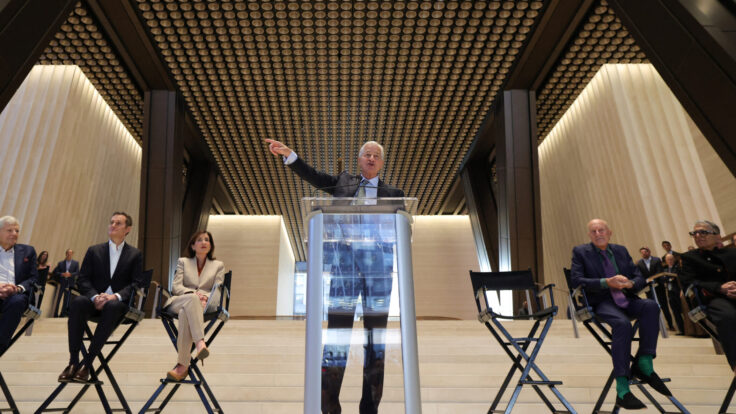
The new Lazard offices, to the contrary, are light-filled, airy, highly polished, welcoming, and capped off with a sumptuous outdoor deck overlooking tout Paris. During my visit, I spied a group of deep-pocketed bankers dining al fresco on the sunny spring day. The top floor features a large conference room with an intricate glass sculptural ceiling, the only one like it on Haussmann. Obviously, things have changed at Lazard since I was last in the Paris offices in the early 1990s. I’m told, though, that the outstanding French chefs remain.
Lazard C.E.O. Peter Orszag, Zooming in from London, joined my conversation with Girodolle. Last week, Lazard announced first-quarter net income of $60 million, beating analyst expectations, thanks in large part to the performance of its asset management business. But Orszag warned of choppy waters ahead amid the tariff uncertainty. “The drivers for M&A activity remain strong,” he told Wall Street analysts on Lazard’s earnings call. “But there is an overhang of uncertainty right now.” Lazard’s stock is down 23 percent since the start of the year, and flat over the past year.
I’ve been wondering a lot lately about how the Europeans have been grappling with the heavy economic cake that Trump II has dumped on them in the wake of Liberation Day. My curiosity was piqued, in particular, by my recent conversation with Jay Pelosky, my friend and Duke classmate and the founder of TPW Advisory, about the ongoing emergence of the so-called “tri-polar world” of the U.S., Europe, and Asia. As Tara Davies, the co-head of Europe at KKR, told the Financial Times this week, “Europe is undergoing a bit of a renaissance.” Indeed, as Jay and others have pointed out, the smart money has for some time been rotating their money into long-dormant European equities and away from the overpriced U.S. market, a bet that seems to be paying off.
For the first time in a long time—since before the 2008 financial crisis—the equity markets have favored the Europeans this year. The European stock markets were up a cumulative roughly 9 percent in the first quarter of 2025, while the U.S. stock markets were down a cumulative more than 4 percent, according to an April presentation that Orszag shared with me. The S&P 500 alone, though, is down nearly 8 percent over Trump’s first 100 days in office, with only Gerald Ford (down 12 percent) faring worse in his first 100 days. That’s been beneficial for the investors who decided the time had come again for European equities. But what effect, I asked Orszag and Girodolle, has all the Trump sturm und drang had on the European investment banking business and cross-border M&A deals (which used to be a thing back when I was at Lazard)?
The message among corporate C.E.O.s the world over, according to Jean-Louis and Peter, is one of caution, as they continue to digest the Trump tariff mishegas. “I’ve been calling it watchful waiting,” Peter told me, noting that most “larger-scale decision-making” is “paused” while C.E.O.s bide their time amid Trump’s 90-day “pause.” But, he added, the clock is ticking (only 70 days to go!), so it’s crucial for Trump to show some progress somewhere on the trade front, whether that be actual signed trade deals, or even a few memoranda of understanding toward trade deals, “so that you have a sense of what ‘getting to yes’ looks like,” Peter said. Understandably, he continued, “there’s some confusion about what would work” to satisfy Trump.
|
|
But whether new trade deals are announced in the coming weeks or not, there is still the looming question of what Trump’s policies mean for the leadership role of the United States in the global economy. For example, Peter said, new concerns have cropped up about the U.S.’s status as a “safe haven,” and the dollar’s function as a reserve currency. When corporate executives from overseas start bringing burner phones into the U.S., as has been reported, you know things are changing, and not for the better. “These are all small indicators of that underlying concern about the U.S. role in the world, which I think there’s uncertainty about,” Peter said. “Part of that will persist, even if there are a set of trade deals.”
I asked Peter, an economist and director of the Office of Management and Budget during the Obama years, whether tariffs can achieve Trump’s goals as a form of economic policy. He answered diplomatically, pointing out, correctly, that there was “a lot of frustration and anger” in the American populace leading up to the 2024 election, and that “life expectancy” for two-thirds of the country was “flat to down.” In other words, there were legitimate concerns that 77 million Americans thought Trump could—and would—address. “You have to start there,” he said, “and recognize that whatever we have been doing has not worked as well as one would have hoped.” He said that while he would have offered a different solution to those underlying problems, Trump won the election convincingly, and had campaigned as the pro-tariff candidate. So no one should have been surprised when he implemented them with such fervor.
|
|
|
|
A MESSAGE FROM GOLDMAN SACHS
|
What trends are emerging today that will shape the markets tomorrow?
Hear in-depth discussions with bankers, traders, investors, and researchers at the center of capital markets on the Goldman Sachs Exchanges podcast.
Listen now.
|
|
|
As a blueprint of sorts for Trump’s approach to tariffs, Peter mentioned Stephen Miran’s November 2024 essay “A User’s Guide to Restructuring the Global Trading System.” Miran, of course, is now the chairman of Trump’s Council of Economic Advisers. “He lays out the case for higher tariffs,” Peter told me, “and highlighted the potential for significant market volatility if this were rolled out or implemented in the wrong way.” In the essay, Miran argued that tariffs should be introduced through a process of “gradual implementation” and “forward guidance,” neither of which, of course, describes the approach Trump has taken. (According to the Financial Times, a recent meeting Miran had at the White House with big bond investors did not go particularly well. One participant told the FT that Miran was “in full-scale retreat” from the ideas in his November paper.)
Add to that the Trump administration’s apparent misinterpretation—you’ll remember that bizarre mathematical formula of Greek letters that appeared suddenly on “Liberation Day”—of Harvard Business School professor Alberto Cavallo’s research on reciprocal tariffs. Cavallo posted on X in early April that “the elasticity of import prices with respect to tariffs is closer to 1. If that figure were used instead of 0.25 [ i.e., the figure used in the administration’s formula], the implied reciprocal tariffs would come out about four times smaller.” Following that, confidence in the process deteriorated further.
|
|
The 90-day “pause,” said Peter, has given the administration an opportunity to “cool the temperature” around tariffs, and powerful corporate leaders, many of whom supported Trump’s reelection, an opportunity to express to the president their hopes for either a “course correction” or a “clarification” of the policy. “It’s still early, and we have to see how this plays out,” Peter said.
With regard to the hoped-for M&A resurgence in the wake of Trump’s reelection, Girodolle told me that strategic conversations among corporate C.E.O.s have not been “abandoned” but seem to be “frozen for the time being.” While cross-border M&A may be on hold, Girodolle did point to a growing number of intra-European and U.S. domestic deals—attributing the former, in part, to the loosening of the tough European regulatory environment. Lazard just advised Clayton Dubilier & Rice, the buyout firm, on its acquisition of a division of the pharmaceutical giant Sanofi, despite some opposition. Girodolle said the regulatory approval took only 10 days, compared to what had been a three-month approval process for a different, earlier deal.
Several new geographic regions, such as the Gulf states, are more interested in M&A-related conversations, Girodolle noted. (Lazard just opened a new office in Abu Dhabi, partly to focus on that part of the world.) Activity is also building among private equity firms, he said, who have portfolios bulging with companies that need to be sold in order to provide frustrated limited partners with some liquidity. “There are lots of sell-side mandates that are being awarded currently,” Girodolle said. “We’ll see whether they go through. There’s this ‘wait-and-see’ mode in terms of very big transactions—especially transatlantic ones—but it’s not a crash.” Assuming the tariff situation “stabilizes” and “clarifies,” said Girodolle, European C.E.O.s know they still have to do business in the world’s largest market—the U.S.
Girodolle said the Europeans also have some wood to chop in explaining to the world just what Europe means these days, from an economic point of view. “The question is, What exactly do you access when you access Europe?,” he continued. “Are you accessing a really integrated, single market with the ability to amortize your investment, to access consumers everywhere, etcetera, without frictional cost, or are you accessing one country and then one other country? So this is where Europe has to do their job.” He said this exact issue came up recently in talks with Chinese companies.
With that, it was time to go. I found myself back out in the warm late April sun, on one of the most beautiful streets in Paris, and off to 85 Haussmann and the Au Chat Bleu—the Blue Cat—reputed to have the best chocolate in town.
|
|
|
|
Join Emmy Award-winning journalist Peter Hamby, along with the team of expert journalists at Puck, as they let you in on the conversations insiders are having across the four corners of power in America: Wall Street, Washington, Silicon Valley, and Hollywood. Presented in partnership with Audacy, new episodes publish daily, Monday through Friday.
|
|
|
|
A professional-grade rundown on the business of sports from John Ourand, the industry’s preeminent journalist, covering the leagues, players, agencies, media deals, and the egos fueling it all.
|
|
|
|
|
|
ERIQ GARDNER & MATTHEW BELLONI
|
|
|
Need help? Review our FAQ page or contact us for assistance. For brand partnerships, email ads@puck.news.
You received this email because you signed up to receive emails from Puck, or as part of your Puck account associated with . To stop receiving this newsletter and/or manage all your email preferences, click here.
|
|
Puck is published by Heat Media LLC. 107 Greenwich St, New York, NY 10006
|
|
|
|



_01JRGGCSKE7Y6NTXW19CTZCHN7.jpg "Goldman Sachs")
_01JRGGCW01GBR7YC6AZDSKZ890.jpg "Goldman Sachs")
_01JRGGD20X5B11VKWR16A6DM24.jpg "Goldman Sachs")
_01JRGGD0G4VBTJ6NXC5Z3WF7JV.jpg "Goldman Sachs")