Hello and welcome back to Dry Powder.
Thanks for being a part of Puck, our new media company covering the intersection of Wall Street, Washington, Silicon Valley, and Hollywood. And thanks for reading Dry Powder. Today I'm sharing my lunch conversation with Morgan Stanley C.E.O. James Gorman, about his Wall Street rivalries and the succession question, among others.
Enjoy, Bill

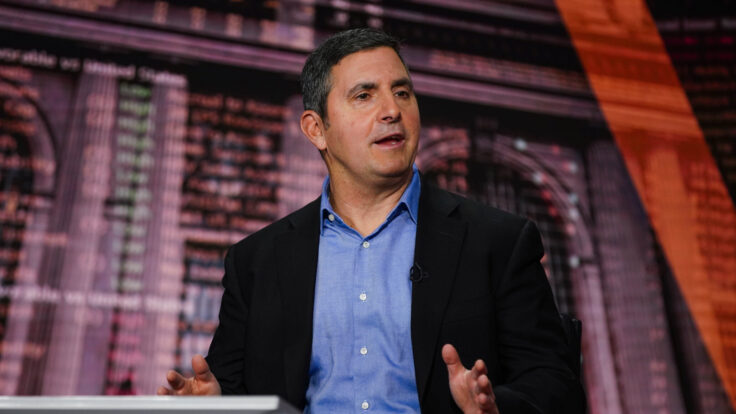
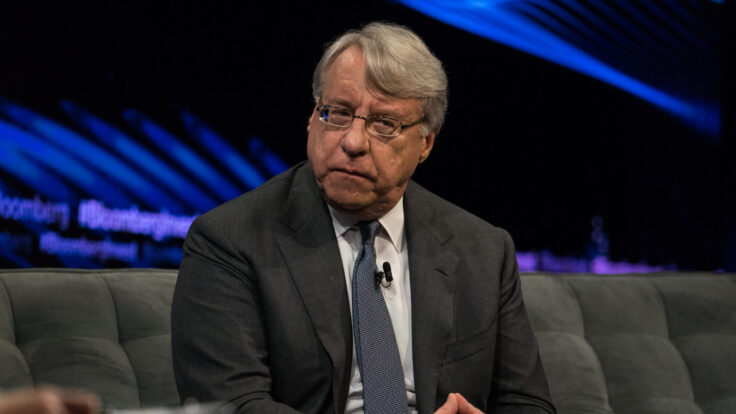
The C.E.O. of Morgan Stanley dishes on Goldman and succession, among other topics, over bespoke sushi. A few weeks ago, before the recent Omicron spike, James Gorman invited me to lunch, high atop Morgan Stanley’s headquarters, just north of Times Square in Manhattan, for a conversation about his firm, the markets, what’s worrying him these days and when he’ll name his successor. Gorman, the 63-year-old Aussie C.E.O. of the firm, had the sushi. I had a Caesar salad with grilled shrimp. He seemed in fine fettle, and chatty, after a long, challenging, and highly successful year.
Gorman and I have a little history together. We both graduated from Columbia Business School in the class of 1987, five months before Black Monday wiped out nearly 23 percent of the value on the Dow Jones Industrial Average. Having been elected class speaker by my peers, I headed to GE Capital, to finance leveraged buyouts, and then to Lazard, Merrill Lynch and JPMorganChase, as an M&A banker. Gorman, for his part, joined McKinsey, where eventually he became a senior partner. It was an incredible accomplishment for a young man whose father had both grown up in the Outback and been homeschooled until he was a senior.
And, of course, it was only the start of his stratospheric ascent. One of Gorman’s most important clients at McKinsey was Merrill Lynch, the once independent investment bank that would eventually get sucked into Bank of America during the 2008 financial crisis. In 1999, Gorman left McKinsey for Merrill, in the newly created position of chief marketing officer and as a member of the firm’s management committee. (I had left Merrill by then.) Two years later, Gorman headed up Merrill’s brokerage business, known as the “Thundering Herd” on Wall Street. He was a big success at Merrill.
In February 2006, Gorman joined Morgan Stanley as president and chief operating officer of the bank’s wealth management business, its version of the Thundering Herd. In 2009, he advocated for, and then engineered, the two-step merger between Morgan Stanley’s wealth management business and the giant Smith Barney brokerage that was then part of Citigroup, which had been sent reeling during the financial crisis. Gorman bet that the kinds of recurring revenue that a wealth management business generates would be increasingly important on Wall Street, post Dodd-Frank, because risk-taking inside the Big Banks was going to be greatly curtailed. He was right. From there, Gorman was on a rocket ship to the top of the firm.
Gorman and I didn’t know each other at Columbia, or at all really, until he became the C.E.O. of Morgan Stanley, in January 2010. By then, I had been relieved of my Wall Street career and had decided to return to journalism, writing books and articles about finance, among other topics. His arc, both of his career and also his emergence in Morgan Stanley’s august, 86-year history, has always fascinated me. He took over the firm soon after the dust had started settling on the worst of the financial crisis, which almost certainly would have dragged Morgan Stanley with it had the investment bank, along with Goldman Sachs, not been allowed to convert itself into a bank holding company, giving it access to the Fed’s borrowing window. Soon thereafter, Morgan Stanley obtained a $9 billion investment from Mitsubishi UFJ Financial Group, in exchange for preferred stock convertible into 21 percent of the fully diluted Morgan Stanley shares. (The Mitsubishi investment has become legendary on Wall Street. The Japanese bank remains by far the largest shareholder in Morgan Stanley.) During Gorman’s tenure atop Morgan Stanley, its market capitalization has increased to around $175 billion, from around $40 billion, leaving longtime competitor Goldman Sachs—market cap around $125 billion—in the dust, much to Gorman’s delight.
Over lunch, Gorman told me that he couldn’t care less about Goldman Sachs these days. “Somebody asked me one morning, ‘You must get out of bed every day and think about Goldman Sachs,’” he recalled. “I said, ‘I don't.’ They said, ‘How could you not? They're a major competitor.’ I said, ‘Because I get out of bed every morning and think about Morgan Stanley.’ We’re here to win.” He also noted that Morgan Stanley has added $100 billion more to its market cap since he took over Morgan Stanley than Goldman has added to its market cap in the same nearly twelve-year time period. Morgan Stanley is winning.
Gorman was also pleased to report that with some $4.5 trillion in assets under management—an increase of $300 billion in 2021 alone—Morgan Stanley’s wealth management business is finally at scale, producing $26 billion in annual revenue, at a pre-tax profit margin of 28 percent, making some $5 billion of net income a year. He figures that business alone is worth nearly $100 billion. It’s an agglomeration of Morgan Stanley’s brokers with other, once-prominent Wall Street firms including the aforementioned Smith Barney, as well as EF Hutton; Shearson Lehman; Robertson Humphrey; Kidder Peabody; Legg Mason; Reynolds & Co; and, Dean Witter. “Those firms are all now part of Morgan Stanley,” he told me. “Think about all those firms when they were separate. They all had fixed costs. They've all had branches and branch management, compliance management. In good markets, they operated with margins of ten percent; in bad markets with margins of minus five percent. For Morgan Stanley, being subscale was not an option.” The firm’s massive scale in wealth management has eliminated tremendous overhead bringing its pre-tax margins up to nearly thirty percent.
No surprise, the former McKinsey consultant has done the thorough analysis. He asked rhetorically where and how people accumulate wealth and answers that it’s through their workplace, their retirement accounts and their stock plans. They often use some sort of trusted individual—accountant, financial advisor or broker—to help them do it. “We wanted to be the monster in the provision of financial advice—the traditional financial advisor channel,” he said.
Morgan Stanley has also bought Solium, a tech company with 300 programmers, who are focused on building a workplace wealth management platform. But many people, especially younger people, are managing their wealth themselves online. To tap into that market, Gorman bought E-Trade for stock valued at nearly $13 billion. Morgan Stanley is currently number two in the market offering financial services in the workplace, behind Fidelity, and number three online, behind the newly merged Schwab Ameritrade and Fidelity. “However one deals with their money, whether it's at work, through the Internet, or through a financial advisor or through some hybrid of all three, our goal was to be in the top three of each channel,” he continued. He allowed that if Morgan Stanley’s wealth management business was valued at the same multiple of assets under management as Robinhood, Morgan Stanley would be worth more than Amazon, Google, Apple and Facebook combined. Alas, it isn’t.
We got to talking about the institutional side of Morgan Stanley’s business—the part of the firm that we think of when we think of an investment bank, the part that trades securities, that underwrites stocks and bonds and that advises corporate C.E.O.s on M&A transactions. When it comes to these skills, Morgan Stanley is also in the top tier of banks worldwide along with both Goldman Sachs and JPMorganChase, as it has always been. Gorman said that there aren't any investment banks anymore—ignoring, for a moment, the advisory boutiques—there are only banks that do investment banking. “Our strategy is very simple,” Gorman continued. “It's to be, if you put it in one sentence, the conduit of capital between those who have it and those who need it. That's what we do. ...Whether you're buying a muni bond as a global pension fund or you're buying it for your family, it's effectively the same trade. All it is, is capital flowing from one side to the other, and you've got to help facilitate those flows.” He said it is also important to be global to be able to compete effectively and to be an industry leader.
Gorman said he is not worried about the competitive threat from the DeFi crowd, which has done a number of things more efficiently than the Big Banks. Morgan Stanley, after all, is not in the credit card business, or the payments business, or the consumer lending business, “We, and the entire industry, are adapting and will adopt the efficiency these changes are bringing,” he continued. Which is why Morgan Stanley is not in those businesses I say, before he can. “At Morgan Stanley we have tried to focus our business on the segments of the industry that are the least likely to be disrupted,” he agreed.
He’s also glad not to be lending money to most consumers. As the old saying goes on Wall Street, firms such as Morgan Stanley are in the business of “lending rich people their own money.” The wealthy don’t want to sell their stocks and bonds to buy a house, for instance. They would rather take out a loan against those assets to buy the house. And that’s a place where Morgan Stanley can make money. The combination of Morgan Stanley’s wealth management business and institutional client businesses and the fact that it’s a well-capitalized global player means it’s nearly insurmountable. “We believe the business model is stable, has clear moats around it, and has a clear growth trajectory,” Gorman said. He predicts the firm will make “north of” $12 billion in profit in 2021. And that it was inconceivable to him that the firm would ever make less than $2 billion a quarter anytime soon. “It would take a sustained, significant market shock,” for that to happen, he continued. “Five years ago, we’d be thrilled to make $1 billion a quarter.” (By contrast, JPMorganChase, which has many more business lines than Morgan Stanley, will make around $40 billion of net income in 2021 and has a market cap of around $460 billion.) “I'll bet you a decade from now we're in a much stronger place than we're in now,” he said.
It’s time for coffee and petit fours. That’s when Gorman confessed that he does worry about a few things. He’s one of those many Wall Street executives I speak to who is increasingly anxious about President Biden’s leadership and whether he’s up to the job. (He’s no Trump fan, by the way.) More fundamentally, though, he worries that America is just not in a great place right now. “It's always been sort of deeply imperfect, but it comes from a place of such goodness,” he said. “Just look at the level of philanthropy in this country.” He pointed to the Marshall Plan that rebuilt Europe after World War II and the help America gave Japan after the war to help rebuild that country too. (Of course, we did drop two nuclear bombs on it.) He noted that even our recent “foreign exuberances” come from a fundamentally altruistic place. “But now, it's just troubling,” he continued. “The rhetoric is so nasty and unpleasant, and the fact that it's played into this whole vaccine debate. This is a well-educated, intelligent, incredibly well-resourced, stunningly beautiful, wonderful country.”
We talked about Jay Powell and his recent reappointment as chairman of the Federal Reserve. Gorman knows Powell well, just as he knows well his two immediate predecessors Janet Yellen, now the Treasury Secretary, and Ben Bernanke. For four years, he served on the Federal Advisory Council, which is composed of representatives from the 12 districts that comprise the Federal Reserve banking system. He was president of the council for a year. “I have enormous respect for Jay,” he said. He’s also pleased that the Fed has finally acknowledged the seriousness of the inflation threat. Gorman noted that Powell removed the word “transitory” from his comments about inflation soon after he was renominated—“I felt that was the right thing to do,” he said—and that interest rates will start heading up in 2022.
Inevitably, our conversation turned to succession, which we agreed is the most important decision that a C.E.O. makes, together with the Board of Directors. “You get to make a couple of big decisions every year, maybe four, and you've got to get them right,” he said. “You can get maybe one or two wrong over a decade, but you can't get one or two wrong a year.” In May, Gorman seemed to set up a race between Ted Pick, 52, who runs the bank’s investment banking businesses, and Andy Saperstein, 54, who runs the wealth management business. At the time, Gorman gave Pick the additional responsibility for the firm’s international businesses and gave Saperstein the additional responsibility to oversee the firm’s global marketing. The firm also promoted Jon Pruzan, to be chief operating officer, and Dan Simkowitz, to be co-head of strategy alongside Saperstein. (An interesting Wall Street fact: Pruzan’s brother, Robert, is the co-founder of Centerview Partners, one of the most successful M&A advisory boutiques.)
Gorman has said he would leave the corner office around when he turned 65, which would be in about two years. “It could be longer,” he told me. “I'm 63. I'm not going to be here for five years. If you stay too long, the next generation I believe gets pushed out or wiped out or aged out, and then you're down to a much younger generation. We have a number of senior executives who are highly skilled and could be the next C.E.O. of Morgan Stanley, and the Board will determine who that is at the right time.” I suspect Gorman will be at Morgan Stanley for another three years or so, suggesting he’ll leave the corner office before both Jamie Dimon and Brian Moynihan, the C.E.O. of Bank of America, who have indicated they will still be around for between another five to seven years, respectively.
He’s clearly enjoyed his time as the C.E.O. of Morgan Stanley and how he’s been able to transform the firm for the better—with minimal controversy—during his tenure. He says he’s loved the difficult moments the best. Once a McKinsey consultant, always a McKinsey consultant, I guess. “It's clearly a challenging job,” he concluded. “But part of the fun is to figure out how to manage the complexity.”
FOUR STORIES WE'RE TALKING ABOUT 
Stallone is just the latest star to cash out, via some clever financing, on his life's work. MATTHEW BELLONI 
Joe Biden's staggering unpopularity among younger voters suggests that Democrats don't have any idea what matters to their kids. PETER HAMBY 
Notes on Silicon Valley's Biden beef, the latest tech industry gossip, fundraising, and political power plays. TEDDY SCHLEIFER 
Notes on the next fiscal crisis, Gorman’s return-to-office pivot, meme SPAC mania, and a ‘Succession’ shout-out. WILLIAM D. COHAN 
You received this message because you signed up to receive emails from Puck.
Was this email forwarded to you?
Sent to {{customer.email}}
Puck is published by Heat Media LLC.
For support, just reply to this e-mail. For brand partnerships, email ads@puck.news |


SHARE