|
Welcome back to Dry Powder. I’m Bill Cohan.
The irrepressible hedge fund manager Bill Ackman has never been shy about his desire to be mentioned in the same breath as his hero Warren Buffett, the Berkshire Hathaway chairman and perhaps the greatest investor of all time. This week, I called up Bill to discuss his latest deal proposal—to turn the Howard Hughes Corporation, a fairly successful real estate developer that he’s owned a big stake in for years, into his own version of Berkshire Hathaway—and how he’s hoping to earn his place alongside Buffett on Wall Street’s Mount Rushmore.
But first…
|
- The Harris-Roberts détente: I knew there was something going on behind the scenes during the Commanders-Titans game on December 1. You’ll recall that Josh Harris, the principal owner of the Washington Commanders and one of the co-founders of Apollo Global Management, invited me and my two sons to enjoy the game in one of his suites at Northwest Stadium, in Maryland. The game was pretty much over after the first quarter, with the Commanders blowing out Tennessee. So I passed the time catching up with several of Josh’s partners in the Commanders, including David Blitzer, Mark Ein, and Mitch Rales, each a legendary investor in his own right.At halftime, my boys and I were ushered into the main owner’s suite, where the real action was taking place. I said my hellos to Josh and his family; caught a glimpse of Roger Goodell, the NFL commissioner; had a long chat with Adam Silver, the NBA commissioner (and a fellow Duke grad); and spied Muriel Bowser, the mayor of Washington, D.C. Alas, I didn’t see Jay Powell, the chairman of the Federal Reserve, who was there decked out in Commanders merch. I also didn’t see Brian Roberts and Mike Cavanagh, the two top executives of Comcast, who were at the stadium somewhere but not in the owner’s suite, at least when I was there.
I understood why Silver and Goodell and even Bowser were in tow. But what were Roberts and Cavanagh doing watching a Commanders game in early December, instead of back in Philly watching the Eagles? Well, now we know. Shortly after the Commanders beat the Buccaneers on Sunday night, Josh flew to Philly from Tampa Bay to attend an early Monday morning press conference, where he, Roberts, and Cavanagh announced that they had buried the hatchet.
As my readers may know, Roberts had been harboring some resentment toward Josh ever since the latter purchased the Philadelphia 76ers from Comcast in 2011 for a mere $250 million or so. (These days, the team is valued around $5 billion.) He was also unhappy with Josh’s proposal to leave the Wells Fargo Center, the Comcast-owned arena where the Sixers play, for a new stadium. Thankfully, all that was behind them on Monday morning. At the press conference, the men announced that they had reached an agreement for the Sixers to remain at the Wells Fargo Center for the foreseeable future. Moreover, they’d be partners on the construction of a new stadium in the same location, to be completed by 2031.
The two sides agreed to work together to try to purchase a WNBA team, too. They also announced, ironically, that Comcast would buy a small minority stake in the Sixers, at a much higher valuation (obviously) than the price at which Josh bought the team 14 years ago. (Neither Comcast nor Josh would disclose the amount that Comcast invested in the Sixers, or at what valuation.) This was quite the development, considering the Philadelphia city government had pretzeled itself getting Josh a deal to build a new stadium in the more depressed Market Street neighborhood. That won’t be happening now, although Josh and Comcast agreed to form a 50-50 joint venture to invest in the neighborhood’s “revitalization.” (Some City Council members in Philly are plenty pissed.) “This is a great day for Philadelphia and the fans of our storied sports franchises,” Roberts said on Monday.
I’m told Adam Silver was behind the détente, a process that began, or at least accelerated, during that Commanders game I attended in December. After all—thanks to the $2.5 billion that Comcast is about to start paying the NBA on an annual basis—Comcast and the NBA are now big-time partners, and Silver couldn’t have one of his partners feuding with one of his important owners. So the very charming Silver brought them all together in Landover, on a balmy early December afternoon, to commence the peace talks that led to the Monday morning announcements. How good is it to be Josh Harris right now, even if Magic Johnson wouldn’t let him get a word in edgewise after the Commanders’ big win on Sunday?
- Rowan’s succession plan: In other Apollo-related news, Apollo C.E.O. Marc Rowan—who got the job over Harris—announced his succession plan for the firm this morning. Faithful readers will recall that the succession issue at Apollo leaped to the fore last month, when Marc briefly flirted with the idea of becoming Trump’s treasury secretary. It didn’t happen, for all the obvious reasons—Marc is much smarter and richer than Trump, and not prone to fabrication—but it did raise the question of who would’ve succeeded Marc at Apollo if he had left. This morning, the firm announced that Marc is staying put as C.E.O. for at least the next five years, after which he’ll be 67—that’s a year younger than Jamie Dimon, who still ain’t going anywhere. It was also announced that Jim Zelter (once Adam Silver’s Duke roommate) would be promoted to president of the firm, in line to take over from Marc should the need unexpectedly arise. Additionally, Scott Kleinman and John Zito were named as co-presidents of Apollo’s equity and credit investing businesses, with Zito stepping into Zelter’s role after Zelter’s promotion.
The only mystery remaining at Apollo, at least on the personnel front, is who will be the new chairman of the board of directors. That job currently belongs to Jay Clayton, the chair of the S.E.C. under Trump I. Clayton, of course, has been named by Trump II to be the powerful U.S. Attorney for the Southern District of New York, a role he should be taking up any moment now. That means Clayton will be exiting the Apollo board. Will he be replaced as chairman by another member? Someone from the outside? Or will Rowan also take the title of board chairman, as so many C.E.O.s in America do? We should know soon enough.
|
|
|
|
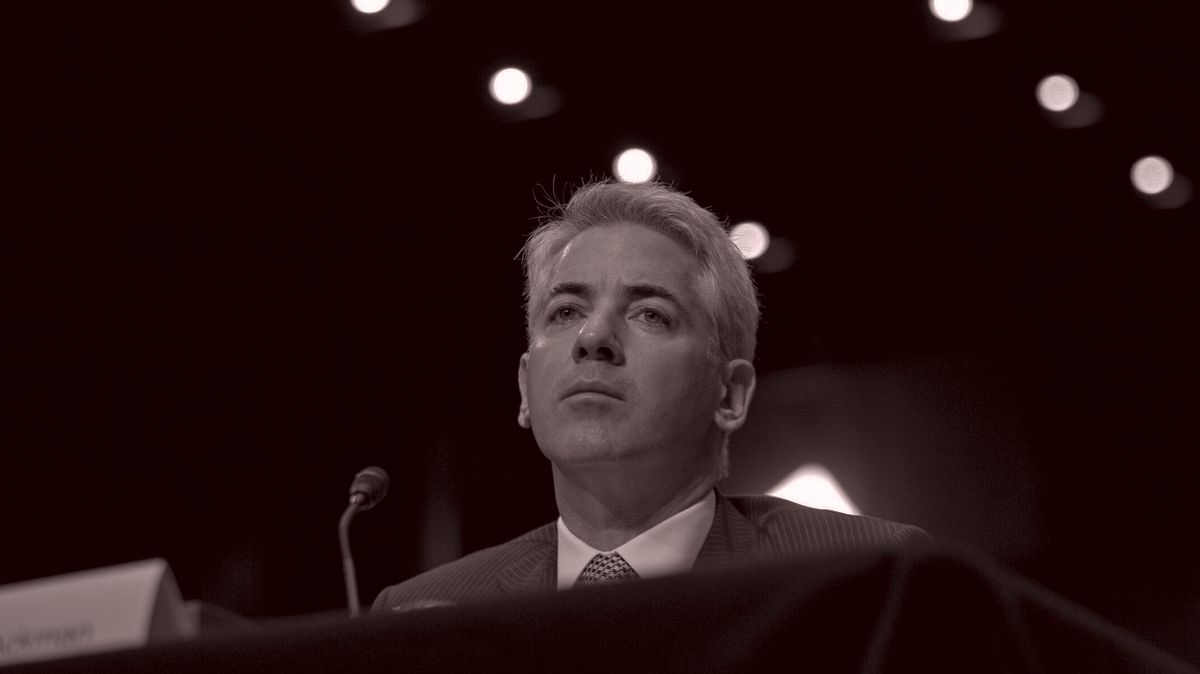
Bill Ackman, the prolific X poster and hedge fund billionaire, has proposed a deal to position himself as his generation’s answer to Warren Buffett—his latest attempt to secure a place on Wall Street’s Mount Rushmore.
|
|
|
|
Ever since I met the flamboyant hedge fund manager Bill Ackman 12 years ago, in his office above the Brooklyn Diner on West 57th Street—fresh off his infamous CNBC feud with Carl Icahn—he’s touted his admiration for, and similarity to, the legendary investor Warren Buffett. Of course, the comparison was more than a little off. But Bill is Bill, with no shortage of ego. At 58, he still thinks of himself as his generation’s Buffett, who is still kicking it at 94 with a net worth of $140 billion—more than 300 positions above Ackman on the Bloomberg leaderboard.
Lately, I’ve been wondering what motivates Bill to keep pressing his advantage. He’s worth about $8 billion these days. He’s been a fiend on X, where he’s more prolific than ever. He’s all in on the Trump-Elon show. He’s taken the wood to Business Insider over what it wrote about his wife, Neri Oxman. Last year, he took down Claudine Gay, the president of Harvard, his alma mater, and gets some credit for taking down three other Ivy League presidents, to boot.
Then, on Monday, Bill announced his most explicit effort yet to turn himself into the Gen X Buffett. Naturally, I called him up to discuss what turned out to be a somewhat convoluted, rather diabolical deal proposal. Simply put: Bill wants to turn the Howard Hughes Corporation—a publicly traded real estate developer in which Ackman and his affiliated entities own a 38 percent stake—into his own version of Berkshire Hathaway, Buffett’s publicly traded investment vehicle which was once a forlorn textile company. Howard Hughes, Ackman told me on Monday, is “a lot better than a crappy textile company, right? It’s actually a really good business. And it’s going to become a lot more cash-flow positive over the next decade, and we can just redeploy that capital.”
Ackman’s idea is to increase his stake in Howard Hughes to at least 61 percent (but not more than 69.2 percent) through a combination of a new $1 billion investment from himself and his partners, and a simultaneous $500 million corporate share repurchase plan. That would make Howard Hughes a publicly traded company that’s able to do what Berkshire Hathaway does: acquire other companies, public and private; buy stakes in other companies, public and private; issue new debt and equity securities as needed to bolster his access to capital (though Buffett does not issue new equity); and harvest what Bill hopes will be the output of Howard Hughes’ cash-generating machine. He’s offering to bolster his stake from existing shareholders for $85 per share, which he claims is a 38 percent premium to the “unaffected” share price of Howard Hughes, before he started making noise about doing something with the company. Shareholders can either take their pro rata share of the $85 in cash, or hold on to their stock and join the Bill Ackman sleighride.
It’s not all that dissimilar to what the Ellisons and RedBird Capital have proposed in their still-pending acquisition of Paramount Global: getting control of the company but leaving it public, and giving investors a choice to cash out (at least in part) or stick around as the company goes in a new direction. Of course, the Ellisons and RedBird’s Gerry Cardinale aren’t making a bid to claim the crown of the Oracle of Omaha.
Bill told me that he came up with his devilish idea while sitting on the beach over Christmas, and that he started writing his 14-page offer letter to the Howard Hughes board of directors this past Saturday at 4:55 a.m. Over the past few days, the Hughes board has set up a special committee to consider Ackman’s offer, and hired legal advisors and Morgan Stanley to evaluate the proposal. His first communication with the special committee was on Monday.
|
|
In our conversation, Bill told me that the Howard Hughes proposal was born out of his frustration with how the company has performed in the public markets ever since he spun it out 14 years ago from another company he owned—General Growth Properties—and on which he made a killing, buying its distressed bonds and converting them into equity in the company. He kept hoping Howard Hughes would trade better as a public company, even as he kept narrowing its focus. At one point, in 2019, he ran a process to sell the company, but no one showed up to buy it.
Howard Hughes used to own the South Street Seaport, for instance. Bill thought, when he spun off that landmark property last year, that the company’s stock would trade up. Instead, it traded down. “We really worked hard to refine it and make it into an amazing, interesting business,” he told me. “And I think it really is an amazing and interesting business, but it’s never caught on in Wall Street land.”
The disconnect between Bill’s appraisal of the stock and the market’s valuation of it got him thinking. As he explained last year on Lex Fridman’s podcast, “Most of what I’ve learned in the investment business I’ve learned from Warren Buffett. He’s been my great professor of this business.” And the number one lesson Ackman took from his idol: “When the lemmings are running over the cliff, that’s the time where you’re facing the other direction and you’re running in the other direction. … You have to get excited when things get cheaper.”
Anyway, given all the cash Bill made from owning General Growth, he’s really just been playing with house money with Howard Hughes. So he decided he should just buy the rest of the company. Last August, he filed a 13D to telegraph his intentions. He hired Jefferies, the investment bank, and talked to the other investors in the company. He said they told him, We kind of wanted to invest with you in this thing, and you’re taking it private. Is there any way you could leave part of it public, so we can go along for the ride? That’s when he hatched the plan to keep Howard Hughes public but take greater control of it, and use it as his new, shiny, Berkshire-like investment vehicle. (He says he hasn’t spoken with Buffett about his proposal.)
Ackman’s plan would leave existing Howard Hughes management in place at the operating level, and create a holding company above it to redeploy the cash generated by Howard Hughes in the way Bill wants. He’d be C.E.O. of the holding company, and put his hedge fund’s management team in place around him to sift through investment opportunities and manage that business.
He won’t be working for free, of course. He intends to charge Howard Hughes an annual management fee, paid quarterly, of 1.5 percent of the company’s equity value. Right now, with Howard Hughes’s market value at $4 billion, Ackman’s annual fee would be $60 million. That number would increase along with the company’s equity value. At that price, Bill thinks, the company would be getting him at a bargain.
|
|
Bill told me he’ll never sell his stake in Howard Hughes if he pulls off this new deal. I wondered how committing up front not to sell would work out for him and his investors. After all, Bill does need liquidity. Not surprisingly, however, it turns out he has a master plan, and the Howard Hughes deal is part of it.
Back in June, you’ll remember, Bill sold a 10 percent stake in Pershing Square Capital Management, his management company, for $1.05 billion, valuing the company at $10.5 billion. Among the new investors were Arch Capital Group and Menora Mivtachim, an Israeli insurance company. The management company is owned by Bill (44 percent), 17 of his partners at Pershing (another 46 percent), and the new outside investors. His intention is to take Pershing Square Capital Management public this year, with the hope that it will increase in value. He’d continue to own his big chunk of Howard Hughes, along with a big chunk of Pershing Square Holdings—his publicly traded European investment vehicle—as well as his U.S. hedge fund and its equity investments in a variety of companies. If he needs (or wants) liquidity, he can sell more of the newly-public management company, which he’s calling Pershing Square Inc.
Meanwhile, the Howard Hughes deal is far from done. The special committee has to do its thing and then recommend the deal (or not). At least one investor, Jonathan Boyar, has written to the board opposing Ackman’s takeover. “[T]he chutzpah required to propose such a lowball offer, while positioning it as a benefit to shareholders, cannot be ignored,” he wrote, urging the special committee to reject the offer.
Howard Hughes stock was up 10 percent on Monday after Bill announced his deal. “The other fun thing here is, we’re not starting out with a $100 billion market cap or a $25 billion market cap,” he told me. “We’re starting out with a company with a $4 billion market cap, right? It’s a lot easier to compound $4 billion into a very big number. Buffett complains about all the money he’s lugging around. That’s why [he’s] got $350 billion sitting in cash.”
Bill pines for the day he might be mentioned in the same breath as the Oracle of Omaha. “It’s fun,” he said. “When I launched Gotham Partners, my first fund, I said, ‘My goal is to have a better record than Buffett.’ Each year, he keeps extending out the record. Each year, I’ve got to work again. He keeps moving out the horizon.” In the meantime, Bill will keep up the chase.
|
|
|
|
Puck sports correspondent John Ourand and a rotating cast of industry insiders take you inside the executive suites and owners boxes where the decisions that shape the entire sports business are made. You’ll hear interviews with players, network execs, and everyone in between. The Varsity is an extension of John’s private email for Puck by the same name. New episodes publish every Wednesday and Sunday.
|
|
|
|
Puck’s daily political newsletter from Washington—featuring Tara Palmeri, Julia Ioffe, Peter Hamby, Tina Nguyen, Abby Livingston, and chief political columnist John Heilemann—on what’s really happening in this town, from the White House to the Pentagon to Capitol Hill, K Street, and the campaign trail.
|
|
|
Need help? Review our FAQ page or contact us for assistance. For brand partnerships, email ads@puck.news.
You received this email because you signed up to receive emails from Puck, or as part of your Puck account associated with . To stop receiving this newsletter and/or manage all your email preferences, click here.
|
|
Puck is published by Heat Media LLC. 107 Greenwich St, New York, NY 10006
|
|
|
|