|
Welcome back to Dry Powder. I’m Bill Cohan.
I finally got my hands on the prospectus for Saks Global’s $2.2 billion bond offering that facilitated its merger with NMG, the parent company of Neiman Marcus and Bergdorf Goodman, last December. As my Puck partner Lauren Sherman and I have been reporting, Saks Global is facing significant headwinds as it tries to reassure creditors it will be able to repay them, and calm agitated vendors who haven’t been paid. Below, I’ll take you through the prospectus, and explore why maybe this deal should never have been done in the first place…
But first, a couple updates from my partner Dylan Byers…
|
|
|
 |
Dylan Byers |
|
- Amazon-Punchbowl C.Y.A.: Relentless Capitol Hill chronicler Jake Sherman and his Punchbowl colleagues sent Amazon executives scrambling this week after reporting that the e-commerce giant intended to show consumers how much Trump’s tariffs were increasing the price of each product. When White House Press Secretary Karoline Leavitt was asked about the report hours later, at Tuesday’s press briefing, she chastised Amazon for its “hostile and political act.” Meanwhile, Trump called Jeff Bezos personally to complain about the move. Amazon spokesperson Tim Doyle eventually came out and denied the report, saying the company had only considered such a move for Amazon Haul, its discount retail service, and that it was not going to implement it. In the process, Amazon shares dropped 2 percent, then recovered.During the course of this fracas, I’m told, Amazon pulled its sponsorship from Punchbowl’s newsletters. The “presented by Amazon” branding that appeared at the top of Tuesday morning’s newsletter—where the news was first reported—was conspicuously absent from the rest of the week’s newsletters, which were published without a sponsor. As for who’s at fault here, we can only assume that if Punchbowl’s initial report were truly inaccurate, Amazon wouldn’t have waited until Trump and Leavitt put them on blast to correct it.
- Skipper out at Meadowlark: Meanwhile, former ESPN president John Skipper is leaving Meadowlark Media, the podcast and documentary studio he launched with Dan Le Batard in 2021. I’m not yet privy to exactly what happened here, but the conventional wisdom is that this simply wasn’t Skipper’s strong suit. “Tough to go from buyer to seller,” one sports media executive texted. “Story as old as time. Very few can do both.”
|
|
|
|
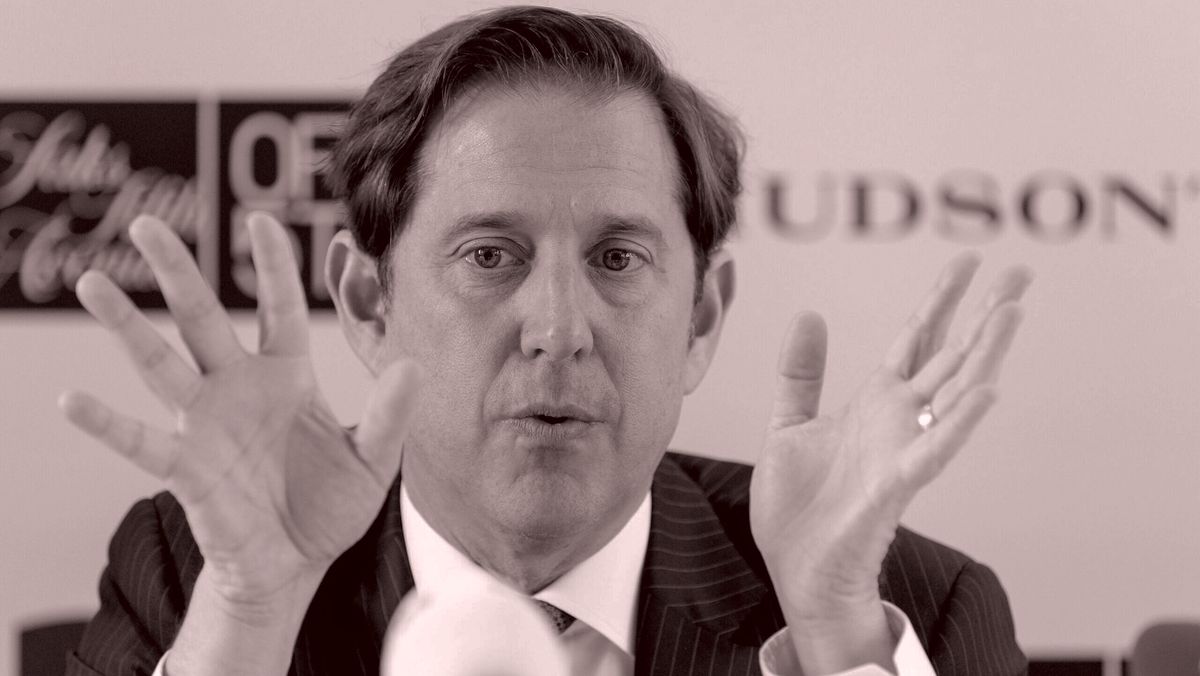
Since Saks acquired Neiman Marcus Group for $2.7 billion, Wall Street has been trying to figure out why the deal got done in the first place. A deep dive into the 400-page bond prospectus reveals some very creative accounting, including my new fave: “Pro Forma Run-Rate Adjusted EBITDA.”
|
|
|
|
Sometimes you just have to marvel at the ability of Wall Street bankers to sell something that probably should never have been sold in the first place. That’s essentially what happened with Saks Global, the $2.7 billion roll-up of luxury retailers Saks Fifth Avenue and NMG, the parent company of Neiman Marcus and Bergdorf Goodman. One of the many remarkable features of the deal was the now-infamous $2.2 billion, 11 percent senior secured five-year bonds that Saks raised last December to help pay for NMG. I recently got a copy of the bond prospectus, and it’s a bruiser. At more than 400 pages, it tells quite a tale of hope over experience.
This merger was the brainchild of Richard Baker, a New York real estate developer who already owned Saks Fifth Avenue and the Hudson’s Bay Company, which was founded in Canada in 1670 and is one of North America’s oldest retailers. To make the deal work, Baker spun off Saks from HBC and merged it with NMG, which had come out of bankruptcy a few years earlier, and was owned by its creditors, including Davidson Kempner Capital Management, Sixth Street Partners, and PIMCO. HBC has since filed for the Canadian equivalent of bankruptcy and is in the process of being liquidated.
|
|
|
|
A MESSAGE FROM GOLDMAN SACHS
|
Analysis. Outlooks. Perspectives.
The Briefings newsletter from Goldman Sachs brings you the latest perspectives from our leaders, economists, and investors around the world.
Subscribe to Briefings now for the sharpest insights from Goldman Sachs.
|
|
|
Saks and Neiman Marcus announced that they had signed a merger agreement on July 4, 2024. Both were private companies, so no shareholder vote was required. But the deal did have to be approved by the Department of Justice and the Federal Trade Commission, then headed by the notoriously persnickety Lina Khan. Anyway, for whatever reason, the deal sailed through with the regulators, without even a “second request,” which is one way the government signals its concerns about a deal.
On August 19, 2024, the waiting period expired without a peep, effectively removing any regulatory hurdles to the deal barely six weeks after it was announced. My partner Lauren Sherman reported this past week that while the merger was pending last summer, Baker bragged that he had the deal in the bag, saying, “The dogs were in the White House.” (She also reported that a source close to Baker “roundly denied” that he said such a thing.)
In short order, with government approval secured, it was time for Saks to raise the money needed for the $2.7 billion cash purchase price. The biggest component of that financing would be in the form of the $2.2 billion senior secured five-year bonds. You will recall from my previous reporting that demand for the 11 percent yield was so strong last December—in the wake of Trump’s victory, and expectation of renewed glory days on Wall Street, all quaint in retrospect—that the issue was upsized from $2 billion to $2.2 billion.
|
“Pro Forma Run-Rate Adjusted EBITDA”
|
|
Saks had turned to Jefferies, as the lead underwriter, to raise the debt financing, and I have to tip my hat to Jefferies C.E.O. Rich Handler and his team of bond salesmen who got that deal done. Handler, of course, comes by his high-yield salesman bona fides naturally. After graduating from Stanford Business School in the spring of 1987, Handler worked directly for Mike Milken in Drexel’s Los Angeles office, starting one month before the market crashed and just as the firm was starting to blow up. Still, Handler did well at Drexel. Milken gave him some of the toughest accounts; he sold them junk bonds with aplomb. He’s been the C.E.O. of Jefferies since 2001, making him one of the longest-serving C.E.O.s on Wall Street.
Selling the Saks bonds in December 2024 was truly a marvel of investment banking prowess, especially when you dig deep into the prospectus. First of all, the combined company would be carrying a ton of debt—the $2.2 billion bond issue; a $1.25 billion commercial mortgage-backed security, secured by the Saks flagship department store on Fifth Avenue; and a $1.8 billion asset-based lending facility, of which the company said $678 million would be drawn at closing. That adds up to more than $4.1 billion of debt at closing, a number which is probably more like $4.8 billion now, given that the company told bondholders on Monday that it still has $400 million of liquidity—implying, to me anyway, that some $1.4 billion of the $1.8 billion ABL line has already been drawn.
Of course, whether a company has too much debt or not is a function of whether it has the EBITDA to service that debt. It’s the ratio between the debt and the EBITDA—rather than the absolute amount of debt—that’s important. In the bond prospectus, Saks effectively promised investors that it would have $7.8 billion in revenue and $707 million in EBITDA for 2025. If Saks could make good on that $707 million EBITDA promise, the ratio of debt to EBITDA would be in the vicinity of 6x—leveraged, yes, but not scarily so. S&P rated the bonds B at issuance while Saks Global was rated CCC+, not the worst of the worst.
Loyal readers know of my disdain for the increasingly popular, non-GAAP metric of “adjusted EBITDA.” So you can imagine my reaction to seeing Saks take that to the next level in the bond prospectus, with something it was calling “Pro Forma Run-Rate Adjusted EBITDA.” It wasn’t $707 million of EBITDA, it was $707 million of “Pro Forma Run-Rate Adjusted EBITDA.”
Wait ’til you get a load of how they got to that $707 million. According to the prospectus, for the year ended August 3, 2024, the combined companies had an actual net loss of $768 million, and an actual EBITDA loss of $40 million. It’s pretty hard to sell $2.2 billion of high-yield bonds based on those numbers. So Saks got creative.
|
|
|
|
A MESSAGE FROM GOLDMAN SACHS
|
Trade, tariffs, monetary and fiscal policy: dive deep into the forces driving the global economy today.
What to expect: Market-by-market, region-by-region, sector-by-sector analysis from our specialists on the trading floor to our independent research desks.
Explore our macro insights.
|
|
|
First, you have to add back all sorts of one-time, non-recurring, non-operational expenses—I won’t bore you with them—which brings us to an “adjusted EBITDA” of $198 million. Then, as you will recall from a previous missive, Saks adjusted the EBITDA upward by another $127 million for the so-called “inventory flow adjustment,” a questionable theory whereby Saks argued that it would have made another $127 million in profit if only more inventory had been available in the previous year or so. (For what it’s worth, I would have made for a great lottery pick in next month’s NBA Draft if only I could shoot and play defense like Cooper Flagg.) That nifty piece of financial jujitsu got Saks up to $325 million, not even halfway to the goal of $707 million.
This is where every dealmaker’s favorite word comes into play: synergy. In the prospectus, Saks projected that it could achieve $500 million of “potential cost synergies” from the deal, of which $345 million would be achieved in the first 24 months “driven by redundant corporate infrastructure and operating expenses.” Some $231 million of the $500 million was slated to come from cuts in the combined workforce, and Saks did announce recently that it was laying off 450 people by closing a fulfillment center in Tennessee. In the prospectus, the full $345 million of synergies to be achieved in the first 24 months gets added into the “Pro Forma Run-Rate Adjusted EBITDA” calculation, getting us to $670 million.
The final $37 million comes from three amorphous items—$5 million from “headcount adjustment,” which is somehow different from whatever layoffs are included in the “synergies”; $15 million for “other management adjustments,” related to professional fees, renegotiation of some third-party contracts, and “minor items” (gotta love that); and $17 million from an “adjustment of independent subsidiaries,” which relates somehow to two Saks Global businesses that are not part of the security package for the bonds. Et voilà, $707 million of EBITDA (or “EBITDA”). It’s just that easy.
|
|
What also becomes clear from the prospectus is that Saks itself—apart from Neiman and Bergdorf—has struggled financially for at least the past two years, generating negative EBITDA of $261 million for the year ended February 2024, and negative $316 million of EBITDA for the previous year ended February 2023. The half-year ended August 2024 also resulted in an EBITDA loss of $211 million, up from the EBITDA loss of $139 million for the same six-month period a year earlier. These are not good numbers. Fortunately, NMG made $190 million of EBITDA for the year ended August 2024. So, you know, maybe the combined company would—what?—make $707 million in EBITDA in the first year?
Some 52 pages of the prospectus—more than 10 percent—were given over to “risk factors,” in effect warning investors of all the things that could prevent Saks from paying back the $2.2 billion it borrowed, and from making the $242 million in annual interest payments. To Jefferies’ credit, the word “tariff” appeared 15 times… in December! Lots of ink devoted to risk factors is standard for any prospectus, whether equity or debt, and that’s for the legal protection of the borrower. You can’t say you weren’t warned!
None of this seemed to faze investors back in December. Under Handler’s 24 years of leadership, Jefferies knows how to sell junk bonds—and sell them it did. The issue was a blowout, and not just because of the yield, or the EBITDA promises, or Jefferies’ marketing prowess. Another attractive part of the Saks offering was the security of a real estate collateral package it valued at $4.34 billion, or roughly twice the value of the $2.2 billion of bonds. That’s comforting, I guess, as long as Saks Global doesn’t go the way of HBC. Liquidation sales rarely generate the values found in a prospectus.
In any event, four months later, the story has progressed. In February came word that Saks Global was stretching its payables to 90 days, from 30 days, and that it was considering closing the Neiman Marcus store in downtown Dallas; that it had closed a Saks store in San Francisco; and that it was closing the Tennessee fulfillment center. As my partner Lauren reported, the intermediaries who buy and sell Saks receivables, known as “factors,” are charging more for their services related to Saks purchases. My sources tell me that the Saks’ EBITDA for 2025 is looking like it will be closer to $55 million than $707 million.
On Monday, leading up to the Saks’ management call with bondholders, the Saks Global bond traded down to around 53 cents on the dollar, meaning that since last December, the bonds have lost nearly half their value. After the call, Saks put out a statement asserting the company is “capturing significant synergies” and “actively managing liquidity with rigor,” with some $400 million of “liquidity” available to it. The company said it was “optimistic” about its “ability to drive momentum.” Other than the mention of the $400 million of available liquidity, there were no specifics from the bondholder meeting.
Will Saks be making the first interest payment of roughly $120 million on the bonds next month? The company did not address that question, which is hanging over the market like a sword of Damocles. But maybe things are looking better. After the bondholder meeting, the bonds traded up to 60 cents on the dollar, and then to 62 cents, but still were yielding more than 20 percent—a big red flag. Having spent two years of my life back in the 1990s working on the extraordinary Chapter 11 filing of Allied/Federated—the parent company of Bloomingdale’s, Ann Taylor, and Brooks Brothers back in the day—I know trouble when I see it. But I could be wrong. Still, I’m haunted by what one smart distressed debt investor emailed me last week: “Saks was an obvious short. Deal never should have gotten done.”
|
|
|
|
An essential, insider-friendly Hollywood tip sheet from Matthew Belloni, who spent 14 years in the trenches at The Hollywood Reporter and five before that practicing entertainment law. What I’m Hearing also features veteran Hollywood journalist Kim Masters, as well as a special companion email from Eriq Gardner, focused on entertainment law, and weekly box office analysis from Scott Mendelson.
|
|
|
|
Join Emmy Award-winning journalist Peter Hamby, along with the team of expert journalists at Puck, as they let you in on the conversations insiders are having across the four corners of power in America: Wall Street, Washington, Silicon Valley, and Hollywood. Presented in partnership with Audacy, new episodes publish daily, Monday through Friday.
|
|
|
Need help? Review our FAQ page or contact us for assistance. For brand partnerships, email ads@puck.news.
You received this email because you signed up to receive emails from Puck, or as part of your Puck account associated with . To stop receiving this newsletter and/or manage all your email preferences, click here.
|
|
Puck is published by Heat Media LLC. 107 Greenwich St, New York, NY 10006
|
|
|
|



_01JRGGCSKE7Y6NTXW19CTZCHN7.jpg "Goldman Sachs")
_01JRGGCW01GBR7YC6AZDSKZ890.jpg "Goldman Sachs")