{{ 'now' | timezone: 'America/New_York' | date: '%b %d, %Y' }} |
|
|
Hello and welcome back to The Best & The Brightest. I’m Leigh
Ann Caldwell, on my way to the book party that Puck is hosting for my colleague Julia Ioffe to celebrate the launch of Motherland, her new, highly acclaimed feminist history of Russia. It’s a chronicle you don’t want to miss.
Tomorrow, I’ll be sitting down with Republican Sen.
Mike Rounds of South Dakota for our latest Puck Power Breakfast, at the Riggs, to talk about A.I. policy and the newest developments in the government shutdown. We might have a few seats left—just respond to this email if you’d like to attend.
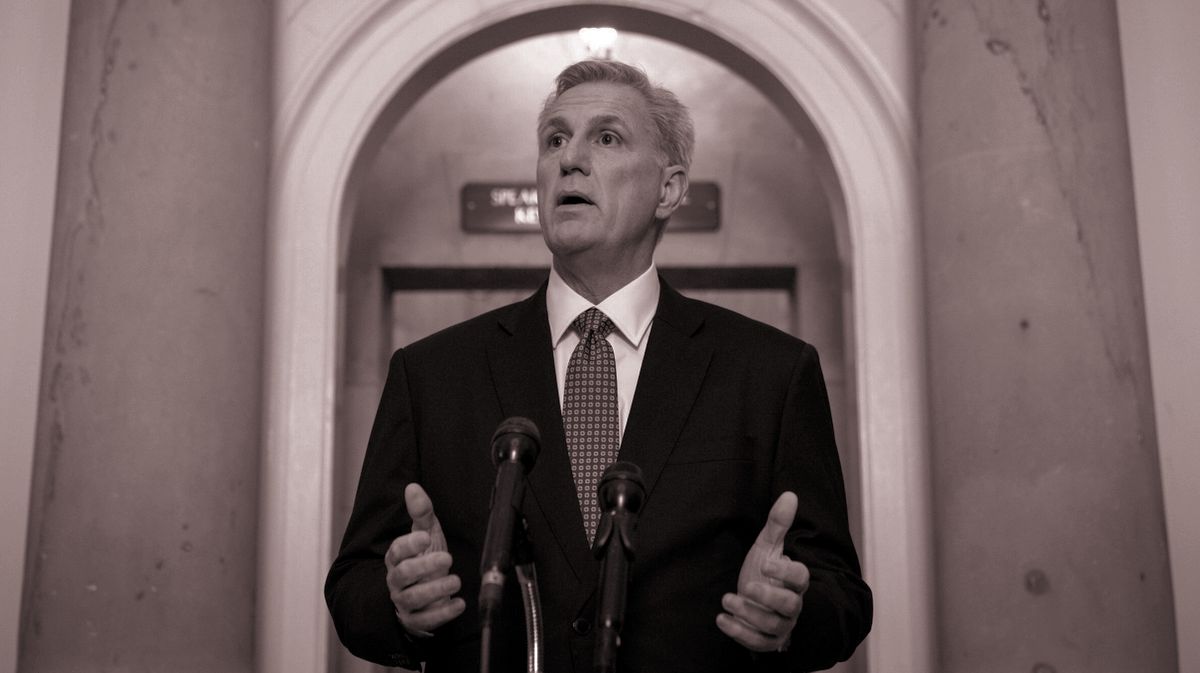
Today, my colleague Abby Livingston is asking: Where in the world is Kevin McCarthy? The former House speaker was expected to fight the Democratic redistricting
ballot measure in California, but his efforts have largely fallen flat, and he seems to have given up. So what happened? Abby has all the details below.
But first… |
-
Another talk-a-thon: Oregon Democratic Sen. Jeff Merkley spoke on the Senate floor for 22 and a half hours to “ring the alarm bells” on what he called Trump’s authoritarianism. As for the reaction from the other side: “It was 22 hours that can only be described as rubbish,” Republican Whip John Barrasso said afterward. The speech’s length was impressive because Senate rules prevent a member from stepping off the floor
(for instance to eat or use the restroom) during a floor speech. It fell short of Sen. Cory Booker’s 25-hour, five-minute record for the longest floor speech in Senate history. But it is the longest floor speech by an Oregon senator, breaking the previous record held by Sen. Wayne Morse, who himself broke the filibuster record in 1953 with a speech that also lasted more than 22 hours. (Nota bene: Wayne Morse seemed like an
interesting guy.)
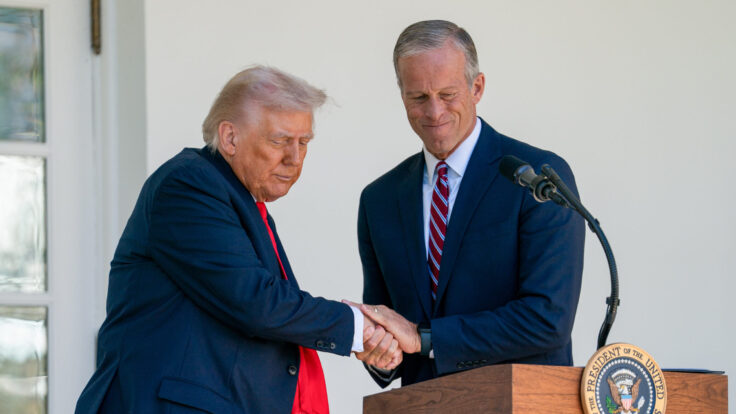
- An uninterested Trump: Meanwhile, we’re 22 days into the government shutdown, there’s no movement toward resolution, and the president is still disengaged from the process. When it came time to speak about the shutdown at a White House luncheon with Senate Republicans yesterday, Trump read from his notes,
a sign that the notorious rambler has very few thoughts on the issue.
In an interview, Rep. Tom Cole, the chairman of the House Appropriations Committee, praised Trump for staying out of the congressional stalemate and letting Congress work it out. (Although, obviously, Congress is doing very little in that regard.) But Cole also gestured at why Trump might not be getting involved. The president won “most of what he wanted in the Big Beautiful Bill, including what he
wanted in appropriations over the next four years for border security and for national defense,” Cole told me. “He hasn’t asked anything in exchange for signing a C.R. [continuing resolution] or appropriation [bills].”
|
|
|
A MESSAGE FROM OUR SPONSOR |
Hospitals are here when you need us most – but hospitals across America are at risk of closure. |
|
|
- An expanded Republican map: The North Carolina Senate voted today to adopt a new congressional map that targets the district of Democratic Rep. Don Davis. In North Carolina, as elsewhere, Trump has been publicly pressuring the Republican-led legislature to redistrict; State Sen. Phil Berger quickly started pushing that effort to expand the number of Republican-held seats from 10 to 11 out of 14 total (in a state where Trump won 51
percent of the vote in 2024).
Berger, a Senate leader, has his own political considerations. He’s facing perhaps his most difficult primary challenge in his more than two-decade-long career, from Rockingham County Sheriff Sam Page, and there’s much speculation in the state that he’s vying for Trump’s political help. So perhaps that’s why Berger has not been subtle about his
willingness to help the president’s gerrymandering efforts, tagging Trump on most of his social media posts about redistricting. It’s also notable that he switched his position on Medicaid expansion for the third time, to support cuts to the program during the crafting of the One Big Beautiful Bill. Or maybe he’s just a huge Trump supporter. - The great congressional choke-off: After restricting press access to the Pentagon, the Defense
Department is now trying to limit communications with Congress. In a memo, first reported by Breaking Defense and which I also confirmed, Secretary Pete Hegseth has instructed that all communications with congressional staff go through the Pentagon’s office of legislative affairs. That’s a big deal, since congressional staffers who work on agency issues often rely on their own contacts within the Pentagon—outside the legislative affairs office—to find out what’s really happening
on the inside.
The chance to connect with unofficial agency staff has been especially important during the Trump administration, which, as I reported in May, has restricted multiple agencies (including H.H.S. and State) from providing information, briefings, and communications with Congress. For that story, I spoke with staffers who told me
that, amid the information blackout, staffers relied on their contacts inside the agencies to glean any shred of information. (Of course, that’s not a substitute for official communications.)
|
And now for the main event… |
|
|
The Republican campaign to prevent Democrats from redrawing California’s
congressional lines seems, increasingly, like a losing effort—and insiders are angrily pondering the whereabouts of former House Speaker Kevin McCarthy, who stirred hopes of raising $100 million to save the map. |
|
|
Back in August, during the early days of the California redistricting battle, the fight
looked destined to come down to a familiar mix of vengeance and money. California Democrats Gavin Newsom and Nancy Pelosi had responded to the radical, Trump-instigated, mid-decade redraw of the Texas congressional map with remarkable speed and determination, offering up a plan to reconfigure their own state map and send as many as five Republicans into early retirement. Under siege, California Republicans were encouraged when their
former leader, ex-House Speaker Kevin McCarthy, entered the fray.
At the time, McCarthy was quoted as saying he would raise $100 million for the effort to defeat the Democratic redraw, an astonishing sum. But some 10 weeks later, nowhere near that kind of money has come through, and a source
familiar with his comments says he was misquoted—that he never said he would raise that amount, only that the overall price tag to win would be $100 million. |
|
|
A MESSAGE FROM OUR SPONSOR |
Hospitals need your help to stay. Protect 24/7 care—because when the doors close, it is too late |
|
|
But whatever he intended, McCarthy raised the expectations for a knock-down, drag-out
spending fight. With the vote less than two weeks away, the Democrat-backed coalition in favor of redistricting has raised an estimated $97 million and maintains a slight edge in the polls, while the Republican-aligned group has raised just $42 million. Meanwhile, McCarthy is “nowhere to be found,” a G.O.P. consultant working on the midterms told me. According to
Politico, the former speaker has contributed only $7 million himself. (A McCarthy source countered that he has been hosting fundraisers, and that he’s indirectly brought in a substantial chunk of the money via allied groups run by his former lieutenants.)
Republicans are frustrated, in
part, because Prop 50 seems winnable with the right resources. Early polling showed that just under half of California voters intended to vote with the Democrats—a sufficiently narrow margin to boost optimism among Republican strategists in the state, particularly given Latino voters’ rightward drift. If party strategists could isolate the redistricting argument away from the Texas redraw, and narrow it specifically to California, Republicans felt they could assemble a formidable
coalition.
The strategy has worked, in part: Former Governor Arnold Schwarzenegger emerged as a serious, vocal opponent of Prop 50, and Charles Munger Jr. eagerly put more than $30 million into the No campaign. But that early momentum has stalled out. Several California Republicans argued to me that if they just had more money, they could keep this fight competitive. “What I understand in the tracking is, it’s still beatable, but it would take resources
on par with the Yes side at this point,” said Rob Stutzman, a California Republican consultant.
The return on investment could have been sizable. With five Republican seats on the line, as well as the possible control of the House, some Republicans were surprised more money didn’t come through. “It’s about the House. It’s not about Prop 50,” said a California Republican strategist. “What would five competitive districts cost? Five seats, that’s a lot of dough. It’s
certainly worth $7 million to $10 million each.” |
|
|
McCarthy has plenty to gain if the No vote prevails. In January, he had set up a
new public affairs firm, Watchtower Strategy, alongside several longtime Republican operatives, including Jeff Miller, the busiest lobbyist in town. (Lockheed is reportedly a client, and one should assume there are many more.) The redistricting fight was an opportunity for McCarthy to flex his political muscles after his departure from the House at the end of 2023, following his ouster as speaker. But McCarthy has consciously chosen to be more of a background player in a campaign that could demolish what’s left of the delegation he once led. |
Among state and national Republicans who are working on the referendum, there are two theories for
McCarthy’s underperformance. For one, of course, it’s harder to raise money once you leave office, as many ex-governors and former senators have discovered. Moreover, there were competing fundraising priorities, such as locking down those new Texas seats. But the source close to McCarthy offered a third explanation, arguing that he never actually intended to be hands-on with the redistricting campaign. Even so, this person said, the ex-speaker had made both direct and indirect contributions:
Beyond the money he raised, McCarthy also deployed his political capital in more intangible ways, like leveraging his alumni network to build campaign infrastructure. “He’s encouraging as much money into the system as possible, irrespective of where it goes,” the McCarthy source said.
Yet state Republicans clearly struggled to get national donors excited about investing in a ballot initiative. McCarthy may have been a lifeline for California Republicans as an on-the-move congressman, but
his state has not been relevant in national Republican politics in more than 20 years. With its myriad and expensive media markets, California remains the costliest place to run a statewide campaign. Meanwhile, many of the big California Republican billionaires, who might ordinarily have been interested in the campaign, have left the state, and there was very little concerted effort to rally money among Republican House members.
It would be an unfortunate coda for McCarthy if the
California Republicans with whom he served in Congress—Ken Calvert, an appropriations cardinal; Darrell Issa, a former Oversight chairman; Doug LaMalfa, an old-guard fixture; and Kevin Kiley, the state G.O.P.’s rising star—all lost their jobs on November 4. But the reality, according to many Republican operatives, is that the power center of the G.O.P. is indisputably at the White House, and the president appears far more
interested in winning newly drawn districts in places like Texas, Missouri, and North Carolina, where seats are cheaper and easier to capture. “Trump is looking at numbers, not members,” said a House G.O.P. operative. “They’re expendable.” |
|
|
Join Emmy Award-winning journalist Peter Hamby, along with the team of expert journalists at Puck, as they let you in
on the conversations insiders are having across the four corners of power in America: Wall Street, Washington, Silicon Valley, and Hollywood. Presented in partnership with Audacy, new episodes publish daily, Monday through Friday. |
|
|
Unique and privileged insight into the private conversations taking place inside boardrooms and corner offices up and
down Wall Street, relayed by best-selling author, journalist, and former M&A senior banker William D. Cohan. |
|
|
Need help? Review our FAQ page or contact us for assistance. For brand partnerships, email ads@puck.news. You received this email because you signed up to receive emails from Puck, or as part of your Puck account associated with {{customer.email}}. To stop receiving this newsletter and/or manage all your email preferences,
click here. |
Puck is published by Heat Media LLC. 107 Greenwich St, New York, NY 10006 |
|
|
|