 |

|
|
Happy SOTU night, and welcome back to The Best & The Brightest.
|
|
I’m Tara Palmeri, trying to catch my breath as we close out a big week in U.S. politics. It started with the news that the Supreme Court was keeping Trump on the ballot in Colorado, followed by his Super Tuesday sweep, which I watched from Mar-a-Lago. (For my behind-the-scenes commentary with Marc Caputo, check out my podcast Somebody’s Gotta Win, here and here).
We’ll have more later this week on Biden’s State of the Union, arguably one of the biggest nights of his presidency, given the persistent grumblings about his age and ability to harness the bully pulpit. Congrats on getting through it all—there will be many more weeks like this en route to November.
As a programming note, I’ll be on Real Time With Bill Maher on Friday. The rest of the lineup is very low-key, just Oscar nominee (he’s already got two) Robert De Niro and New York Times bestseller Max Brooks.
(P.S.: 📩 Got Oscars questions? My partner Matt Belloni, author of What I’m Hearing and host of The Town, will be doing a pre-Oscars Q&A on Puck’s Instagram Stories. Submit a question by visiting Puck’s Stories here, and Matt will answer it in video format tomorrow around 12:00 p.m. PT / 3:00 p.m. ET.)
In tonight’s issue, we start with fresh reporting from Tina on the latest machinations from the H.F.C., then move into Abby’s always-stellar Capitol Hill Cafeteria Report, and finally my latest feature: Scenes from Trump’s post-Super Tuesday victory party, and how campaign insiders are gaming out the V.P. question.
|
| The Best-Laid Plans of The H.F.C. |
|
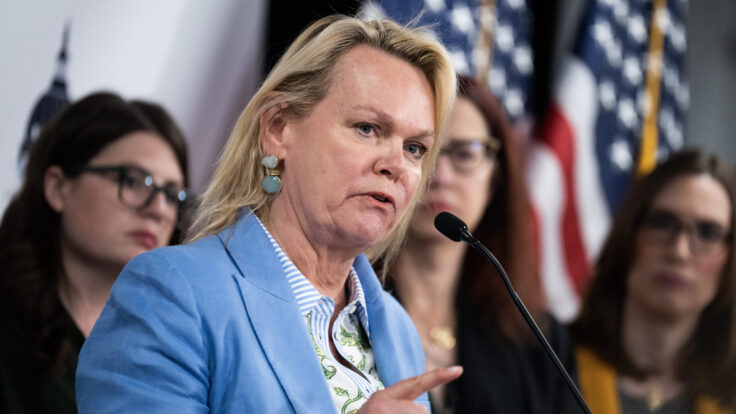
Now that the House successfully passed a “minibus”—six spending bills, worth a tidy $460 billion—on Wednesday, thereby temporarily averting a shutdown, the next order of business is the more complex tranche of bills funding the rest of the government. The House Freedom Caucus, of course, is planning to voice their opposition, though it remains to be seen how they’ll do it. (Also, let’s get this out of the way now: There will be no “motion to vacate,” which would remove Mike Johnson as speaker, unless someone in the H.F.C. wakes up one morning, decides to go postal, and convinces two other people to join in.) Instead, here are the most likely options:
- A protest vote: If you’re a Freedom Caucus guy that needs to satisfy your base, it’s hard to justify a budget that increases spending and also “punts on every single Republican policy priority,” as they put it in a press release. However, it’s not hard to simply vote “no” on the upcoming tranche, make a lot of noise about Johnson’s various conservative sins, and then revisit the fight in September, right before the election. Indeed, that’s the tack Rep. Bob Good recently advocated for in a closed-door meeting.
- The 1 percent trigger: If the rest of the budget is extended via a continuing resolution, the Fiscal Responsibility Act, written by the libertarian-leaning Thomas Massie and passed in last year’s budget, would result in an automatic 1 percent budget cut across the board. A decent segment of right-leaning Republicans, possibly up to 140 members—the number who voted for the F.R.A. in the first place—are unfazed by the prospect, arguing that it would result in a 10 percent cut to nondefense spending (i.e., the squishy social programs they’re inclined to hate) while barely touching defense spending. (Rep. Jim Jordan recently advocated this approach to me in an interview.) However, as a senior G.O.P. aide pointed out, there is a difference between a free-market fantasy dreamed up by libertarian think tanks, and reality. “I think they in theory are fine with it,” he noted. “I think once it actually got instituted, a lot of people would be like, Oh shit, what did we just do?”
- The derailment option: Never count out the right-wing’s ability to bend the rules and damn the consequences. So far, my H.F.C. sources are staying mum on whether they’ll come up with some imaginative way to hold the other half of the budget hostage, though I was told to watch how H.F.C. caucus chair Bob Good, Texas budget doctrinaire Chip Roy, and MAGA wild card Matt Gaetz will navigate the next few days. “They say they won’t derail,” a source close to the Freedom Caucus told me. “I’m not sure I believe them.”—Tina Nguyen
|
| And now, Abby Livingston’s congressional cafeteria report, live from Texas… |
|
A MESSAGE FROM META
|

|
|
Cataracts are the primary cause of avoidable blindness.
FundamentalVR and Orbis International created a VR training platform that helps surgeons practice cataract surgery.
As a result, more surgeons have access to the training they need to treat cataracts around the world.
Explore the impact of the metaverse.
|
|
|
|
|
While the Capitol prepares for Biden’s State of the Union (and Katie Porter dines out on sour grapes), Democrats in Washington are also keeping their eyes on Texas, where a genuinely competitive Senate race may just be taking shape. Yes, the party already experienced this cycle of hope and heartbreak with Beto O’Rourke, but there are a few reasons that political pros believe former NFL linebacker Colin Allred has a better shot at beating Ted Cruz… and a few reasons to think Democrats are high on their own supply.
- Allred’s advantages: Until redistricting made Allred’s Dallas district comfortably blue, he was known in Democratic parlance as a “frontliner,” the designation for vulnerable members. That means he’s familiar with call-time, voter persuasion, and has taken punches that prove his jaw’s not made of glass. (He won his seat in 2018 by defeating former N.R.C.C. chairman Pete Sessions). He also has a handle on the sophistication of competitive federal politics, a trait in short supply among Texas Democrats.
In his primary on Tuesday night, Allred performed about as well as O’Rourke did in 2018: Both registered a little over 60 percent of the vote. But Allred faced even stronger Democratic competition than Beto, and is also in a better financial position. He has a cash-on-hand advantage over Cruz, whereas O’Rourke, while similarly outraising Cruz in the year leading up to their showdown, never achieved a cash-on-hand advantage.
Allred is also more comfortable going for the jugular, and he has more material to work with. (Remember Cruz’s Cancun getaway during Texas’ deadly 2021 winter storm?) The 2018 race was also a contest between two Ivy leaguers—elite credentials that don’t exactly play well in Texas. In contrast, Allred attended Baylor, the most conservative of the large Texas schools, and he was an accomplished football player who went on to play in the pros.
- The downsides: By this point in 2018, O’Rourke was packing school gyms and had appeared in thousands of supporters’ photographs. Comparatively speaking, Allred is running a traditional campaign. Back then, anti-Trump Democrats were organically energized; now, Democrats may find that enthusiasm non-replicable. Perhaps anti-Cruz sentiment creates magic later in the cycle, but it’s simply not there right now. (I’m writing from the state’s swing county…)
O’Rourke also benefited from reverse coattails, via down-ballot state and federal candidates (like Allred) running professional campaigns, knocking on doors, and making the party’s case locally in TV ads. Newly drawn Republican maps have eliminated these competitive races, and the down-ballot situation for Democrats looks desolate in the fall. Anyway, this is a presidential election year, not a midterm. Trump has a passionate Texas base, but he has underperformed past Republican nominees in the general election. And Allred’s campaign is already positioning itself as a safe haven for Nikki Haley-type Republicans.
Democrats have also lost the element of surprise: In 2018, Republicans were in denial over O’Rourke’s viability. And despite how much Cruz enrages many, many people, he does have smart people around him (yes, including Puck protagonist Jeff Roe) and has run brilliant campaigns in the past.
|

|
Mar-a-Lago V.P. Soul-Searching
|
|
While many think Trump will select his vice president based on their appeal to voters, the emerging consensus among campaign insiders is that his choice will come down to who can perform best with wealthy donors—his greatest vulnerability.
|
|
|
|
| Among the first to arrive at Mar-a-Lago on Super Tuesday was Marjorie Taylor Greene, dressed in all black, at 4:30 p.m., when there were still just a handful of other people in the gilded ballroom. Within hours, of course, the royal court of Donald Trump had filled with red-hatted men and bleached blond women in sequins and leopard prints, who cheered as Trump pulled off a sweep (sans Vermont), essentially securing his coronation as the G.O.P.’s 2024 standard-bearer.
Over the din, Greene pitched me on why Trump ought to appoint her secretary of Homeland Security—and how she was ready to deport on day one. “My articles of impeachment were the ones that passed on the House floor, impeaching Secretary Mayorkas,” she reminded me. (Greene’s industriousness was somewhat undercut by the fact that she was one of only six members of Congress present; the rest of her colleagues were back in Washington, working to keep the government from shutting down.)
Greene then enumerated the reasons why rising star Katie Britt—the youngest Republican woman ever elected to the Senate, charged with delivering the rebuttal to Biden’s State of the Union address—isn’t MAGA enough to be Trump’s vice president. “Katie Britt, she’s a fairly new senator,” she told me, citing Britt’s underwhelming Heritage Action score (81) from memory. “Not as strong of a conservative as the base would like to see.” Perhaps there was another candidate Greene had in mind? “Of course, I’ll serve in any role that President Trump asks me to,” she said.
Trump himself spent most of the evening out on the patio, away from the applause and well-wishers, buttonholing high-dollar donors to help ease his financial troubles: a $41 million cash disadvantage relative to Biden and the D.N.C.; a deluge of campaign ads from well-funded Democratic groups; his tens of millions of dollars in legal fees, and hundreds of millions more in civil penalties. (Between the $83.3 million due to E. Jean Carroll for defamation, and $355 million plus interest owed to the state of New York, he’s on the hook for nearly half a billion dollars.) Perhaps that’s why the former president didn’t seem jubilant, exactly, when he sauntered onto the stage to deliver another “American Carnage”-style speech.
Inside, Trump’s aides explained how they’ve been able to cut campaign costs by 40 percent by being more ruthless with the budget, hosting smaller events, and hiring leaner production crews. They’re also looking forward to an overhaul of the R.N.C., whose fundraising operations are currently anemic at best. Yesterday, Lara Trump was whisked off to Houston, where she is expected to be named as the next co-chair of the R.N.C., replacing Ronna Romney McDaniel.
So while Greene seems to think that Trump will select his vice president based on their appeal to MAGA voters, the emerging consensus among campaign insiders is that his choice will come down to who can perform best with wealthy donors—the Republican constituency that still needs the most convincing before getting comfortable with another four years of Trump.
Indeed, people in Trump’s orbit have said as much, telling me that his V.P. choice will likely be a donor play, not a voter tickle. And he may have to make the selection soon: Waiting until the week before the Republican National Convention, in July, might be cutting it close in a race where the candidates and their parties are expected to spend $2.7 billion on advertising between them. “They are worried, they are calling around,” said a source. |
|
A MESSAGE FROM META
|
|
|

|
|
“VR let me practice hundreds of times before I operated on a patient.”
Dr. Baid used FundamentalVR and Orbis International's VR platform for additional training in a hands-on environment.
In the past year, Dr. Baid has performed 300 life-changing surgeries to preserve her patients' vision.
Discover other stories.
|
|
|
|
|
| Back in the Mar-a-Lago ballroom, under an ostentatious array of 15 chandeliers, the topic of conversation flowed between marveling at Trump’s performance in the primaries and amping themselves up for the general election ahead. Sources close to Trump agreed that the best V.P. pick might be a senator with “stature,” and probably a “normie” Republican—sorry, M.T.G.—who could pull in big donors via Mitch McConnell’s Senate Leadership Fund network or the American Opportunity Alliance. At the same time, said one of these people, there could be certain scenarios where the decision would almost be made for him. “If Larry Ellison said, ‘You pick Tim Scott and I’ll give you $100 million,’ then he would pick him,” said a former Trump adviser. This person added that Trump doesn’t really respect any of his primary opponents—including Vivek Ramaswamy, Ron DeSantis, and Nikki Haley—because of how poorly they performed.
Scott, who is on the financial services committee, might be able to work the S.L.F. or A.O.A. networks—but he’s never been a great fundraiser, himself. And if Scott can’t actually wring money from Ellison—who welshed on the eight-figure dowry he once promised Scott, and has always been ambivalent about Trump—then what’s the point? “Money will be the number one motivating factor; everything is about money for him right now,” the former adviser said.
But the donor heartthrob du jour is Britt, the 42-year-old former Senate staffer. The Alabama senator has fans in the A.O.A., a group of G.O.P. megadonors that includes Ken Griffin and Paul Singer, who have thus far refused to line Trump’s coffers—but might be convinced to capitulate if they see a young and normalizing rising star on the ticket. The billionaire Ricketts family, which also sat out the primary and remains an influential part of the A.O.A. network, also has a strong affection for Britt. Warren Stephens, who gave to Asa Hutchinson in the primary, likes Britt, too. But the group, which rarely comes out in support of a candidate, has yet to endorse Trump.
Of course, there are arguments to be made for everyone on the shortlist. J.D. Vance, for instance, might convince his pal, the tech billionaire Peter Thiel, to emerge from his anti-election cocoon (even though Thiel publicly said that he turned down a request from Trump for $10 million, and that his administration was “crazier than I thought”). Elise Stefanik, of New York, could bring in Wall Street donors and has strong appeal within the conservative Jewish community, where she’s now a hero. Sarah Huckabee Sanders is also popular with the business community, has a name brand, and connections to the deep pocketed Walton family in her Arkansas backyard. Relatedly, of course, Trump is worried about the abortion issue, and thinks a woman would help with that. Ironically, the woman who probably has the strongest crossover appeal with moderates and deep-pocketed donors is Haley. (Seems unlikely, but stranger things have happened…) |
|
|
|
|
| Trump, who met with Elon Musk earlier this week, is still hunting for his white whale donor—someone like the late Sheldon Adelson, who floated him a cool $100 million in 2016. But in reality, Trump needs more like ten Adelsons to catch up with Biden. Sure, Adelson’s widow, Miriam, is still in the game, and was once smitten with Mike Pence. But she has business interests now, after purchasing the Dallas Mavericks, and likely doesn’t want to be closely associated with Trump’s ever-expanding oeuvre of extremist comments.
Some Trump insiders hope that her support for Israel supersedes that—but even then, the differences between her and her late husband are not lost on anyone. “Sure, she can give $20 million, but can she give nine figures again? Probably not,” the former Trump aide said. “[Sheldon] was very political and she wasn’t. Sheldon wanted to sit around and talk about how much he hates Democrats. He was a Fox News watcher.”
But the former president may have to work harder if he wants to lock down the major donors he’ll need. Billionaire John Paulson, eying the role of Treasury secretary, is planning to hold a dinner for Trump at his house in Palm Beach, just up the road from Mar-a-Lago. In general, however, some allies close to Trump have been amazed by his unwillingness to travel for fundraisers. In the meantime, the campaign has created new fundraising apparatuses to soothe establishment Republicans who are uncomfortable donating to MAGA Inc., the primary Trump super PAC, run by Taylor Budowich and pollster Tony Fabrizio.
Within Trumpworld, there have been efforts to address these issues with another super PAC, even though it pits two Trump-blessed super PACs against each other. A longtime Trump ally, Sergio Gor, and billionaire Marvel entertainment executive Ike Perlmutter created a new super PAC called Right for America, for donors who refused to participate in primaries and would not give money to MAGA Inc. “There were five or six donors who didn’t want to give to MAGA Inc. for various reasons, and Sergio has relationships with the friends and family donors, they’re just more comfortable doing it through him,” a source close to Trump said. “Trump doesn’t care, he knows he needs more money.”
Gor and Budowich sent me a joint statement saying they had a “common mission, and those trying to sow discord are only working against the president out of jealousy.” |
|
|
|
| FOUR STORIES WE’RE TALKING ABOUT |
 |
| Jack & Bobby |
| The bizarre story of Jack Dorsey’s political flirtation with R.F.K. Jr. |
| TEDDY SCHLEIFER |
|
 |
| Fashion Deal Heat |
| A close look at the M&A buzz surrounding Summer Fridays. |
| RACHEL STRUGATZ |
|
 |
|
 |
|
|
|

|
 |
|
|
|
Need help? Review our FAQs
page or contact
us for assistance. For brand partnerships, email ads@puck.news.
|
|
You received this email because you signed up to receive emails from Puck, or as part of your Puck account associated with . To stop receiving this newsletter and/or manage all your email preferences, click here.
|
|
Puck is published by Heat Media LLC. 227 W 17th St New York, NY 10011.
|
|
|
|