 |
|
Hello, and welcome back to The Best & The Brightest, foreign policy edition.
Before we get to the main event, I wanted to give you a brief update on Wall Street Journal reporter Evan Gershkovich, who has been held in one of Moscow’s most notorious prisons since he was detained on March 29. Unfortunately, from what I’m hearing from the Biden administration, there is no real movement in talks. That’s mostly because, they say, the Kremlin has not budged—to the point where the White House is not even sure whom the Kremlin wants in exchange for Evan (though they have their suspicions).
I’ve also heard that Saudi Arabia’s Mohammed bin Salman has been offering his services in trying to bring Evan home. Given the spate of diplomatic activity coming out of Riyadh—several countries will meet this month in Jeddah to discuss ending the war in Ukraine and Saudi Arabia has been involved in talks to release Ukrainian children kidnapped by Russia—M.B.S. is clearly trying to position himself as a power broker not just in the region, but beyond. Of course, there’s a difference between trying to put a diplomatic feather in your cap, and having any influence on a man like Vladimir Putin and people I spoke to in the administration pooh-poohed the efficacy of M.B.S.’s efforts, which, to them, seemed more about international perception than the potential for real result. “That’s true, he has,” one senior State Department official said when I asked them about the rumors that M.B.S. has been trying to get Evan out of jail. “He hasn’t made any progress, but he’s tried.”
And then, of course, there’s the irony of M.B.S. doing anything to save a journalist.
Anyway, let’s get to why we’re really here today, which is to talk about the more long-term Ukraine policy that’s taken shape in the White House and in Europe.
But first: Here’s Abby Livingston with the Hill cafeteria readout…
|
| The Capitol Hill Cafeteria Report |
|
| An utterly indispensable, high-minded, and, yes, occasionally dishy readout of what our lawmakers are really legislating behind closed doors.
By Abby Livingston
- Rodeo Clowns: Sophomore Republican Rep. Ronny Jackson was “briefly detained” after things got rowdy during a rodeo on Saturday night in his Panhandle-based Texas House district, according to a statement released by his office. In the congressman’s telling, the situation became “very loud and chaotic” when Jackson, a former presidential physician, tried to render medical aid to a fellow rodeo-goer. Curiously, the statement contained an unsolicited line: “Dr. Jackson sat in the stands during the entire rodeo, in full view of the assembled crowd, and was not drinking.”
Patrick Svitek of The Texas Tribune spoke with the local sheriff, Tam Terry, who confirmed a person was “temporarily detained” after authorities responded to calls from the rodeo. The sheriff did not release the identity of that person, saying only that the department is “reviewing the incident.” In the hours after the incident, phone lines burned up across the state.
Jackson’s fundraising escalated this past quarter to $1 million, up from his usual low-six-figures in recent cycles, catching the eye of potential rivals for statewide office in Texas. But this rodeo incident—especially after that just-inviting-more-questions statement—isn’t necessarily going away.
- Fresh Ink: Rosa DeLauro, House Appropriations Ranking Member, Dean of the Connecticut Delegation, and undisputed Tumblr Icon, recently reinforced her New Haven hipster cred by taking her just-turned-18 granddaughter out for birthday tattoos. The 80-year-old Democrat also got herself inked, with a left arm tattoo featuring a rose as a tribute to her first name, the letter ‘D’ for her last name, and a “stylized version of Italy to celebrate her deep connection to the country her father immigrated from,” DeLauro spokesman Daniel Robillard told The Hartford Courant. DeLauro herself told the Associated Press (yes, this made the AP) that more tats are likely on the way: “I have four more grandkids who still haven’t turned 18 yet… So be on the lookout for more new ink!”
- Necessary Roughness?: The Alabama delegation is crying foul after Joe Biden halted a long-planned Space Command program move from Colorado to Huntsville—just as the administration’s anger at the state’s senior senator, Tommy Tuberville, reached a boiling point. Administration officials deny the decision was in any way impacted by Tuberville’s unprecedented blockage of hundreds of military appointments and promotions on culture war grounds, but nobody’s buying the denials, including Alabama’s lone Democrat in Congress, Terri Sewell, who was steamed enough to pop off a scathing written statement describing the move as “bows to the whims of politics over merit.”
To be clear, Sewell is not the type to pop off about anything, or engage in public demonstrations of displeasure, especially toward fellow Democrats. But what’s really remarkable is how stunned everyone is that Biden could fathom taking such action: carrots, and especially sticks, is how politics used to get done on the regular.
And now on to my story about the current Blob Mind State… |
|
|
| If you’ve been anywhere near Washington in recent months and spent any time talking about Ukraine to any of its foreign policy wonks, you will have heard the term “Israel model” bandied about. The idea began circulating before NATO’s Vilnius summit last month in response to the conundrum in which the organization’s member countries now find themselves: As a bloodied Ukraine desperately knocks on their door, the alliance was torn on whether or not to open it, and when.
Should NATO let Ukraine in now, while it is at war with nuclear-armed Russia, thereby immediately getting dragged into the war itself? Or should NATO condition Ukraine’s entry upon first ending the war, thereby giving Vladimir Putin every incentive to keep the war going for as long as possible?
In the end, it became clear that NATO membership for Ukraine, while a goal for the future, is not in the offing while the war still rages—and the invitation will not be extended for a while. “We’ll agree to invite you when we agree to invite you,” said one person familiar with the discussions behind the NATO decision last month. On the other hand, as retired Ambassador Dan Fried said, “The Russo-Ukrainian war shows that gray zones are green lights for Putin. You can’t have Ukraine just hanging out in a position of strategic ambiguity. Even Kissinger recognizes it.”
That’s where the “Israel model” comes in. To put it simply, the idea is to arm Ukraine to the teeth in order to dissuade invasion by its neighbors. And it is named for its original application. Back in the fall of 1973, when Israel was recovering from yet another regional war, the U.S. decided to help rebuild the country’s armed services so that it would have what’s called qualitative military advantage over its much more populous neighbors.
In addition to arms sales (which, by law, must maintain Israel’s Q.M.E., or qualitative military edge), the U.S. also invested heavily in Israel’s domestic defense industry in order to make the country more self-sufficient. And, perhaps most crucially, it established a legal framework—a series of Memoranda of Understanding that spelled out military aid for Israel for a full ten years at a time—so that the country could know how much money was coming in, and when, and therefore could plan long term for its security. Meanwhile, the U.S. defense apparatus could also operationalize around the plan. What it did not grant Israel was the assurance that the U.S. would enter a war on its behalf.
Of course, it’s not a perfect analogy to the situation in Ukraine. “It’s a lot easier to provide Israel a qualitative military advantage over the Kingdom of Jordan,” said the person familiar with the discussions. “It’s a lot harder when the adversary is Russia.” It’s also a lot easier when Israel, unlike its neighbors, is a nuclear power. Ukraine, on the other hand, has no nukes and has been invaded by a nuclear superpower. Moreover, Ukraine “is already pretty armed to the teeth,” a senior administration official told me. “The issue is that they’re expending it at tremendous rates.”
But the idea has many benefits. In addition to stabilizing the flow of weapons and money to Ukraine and allowing them to plan ahead—right now, the Ukrainians find out what they’re getting when each new tranche is announced—this framework would give American weapons manufacturers a steady demand signal that, as I’ve written before, has been missing until now. They, too, can plan—and manufacture—for the long term. The plan also envisions Ukraine becoming more self-reliant in making their own weapons systems, which they’ve shown they can do. It spreads the financial burden between the U.S. and Europe more evenly and its proponents say it will likely get broad bipartisan support on the Hill. |
|
|
| The idea of having a legally codified security relationship with Ukraine—a close partner, but not a treaty ally—is now official U.S. policy. It was announced by the G7 at the end of the NATO conference in Vilnius and is designed to be something of a bridge until that moment in the very, very distant future when Ukraine will presumably join NATO. (Compared to the cat herding at NATO, the G7 was a far easier group for the White House to negotiate with, though the group had to scramble to get the thing done on time, according to Dame Karen Pierce, Britain’s ambassador to the U.S. She told me at Aspen that they had to crash on the statement and rush it out because everyone was so engrossed by watching the Prigozhin mutiny play out.)
A formal, broader, strategic document—a kind of umbrella agreement reinforced by a latticework of bilateral agreements between Ukraine and its partners—is now being formulated. But the story of how this idea became U.S. policy is less well-known, and it is a classic example of how the D.C. foreign policy sausage gets made: policy folks in the White House kicking the tires of an idea with outside experts—and vice versa—and the resulting dialogue becoming a testing ground for future decisions.
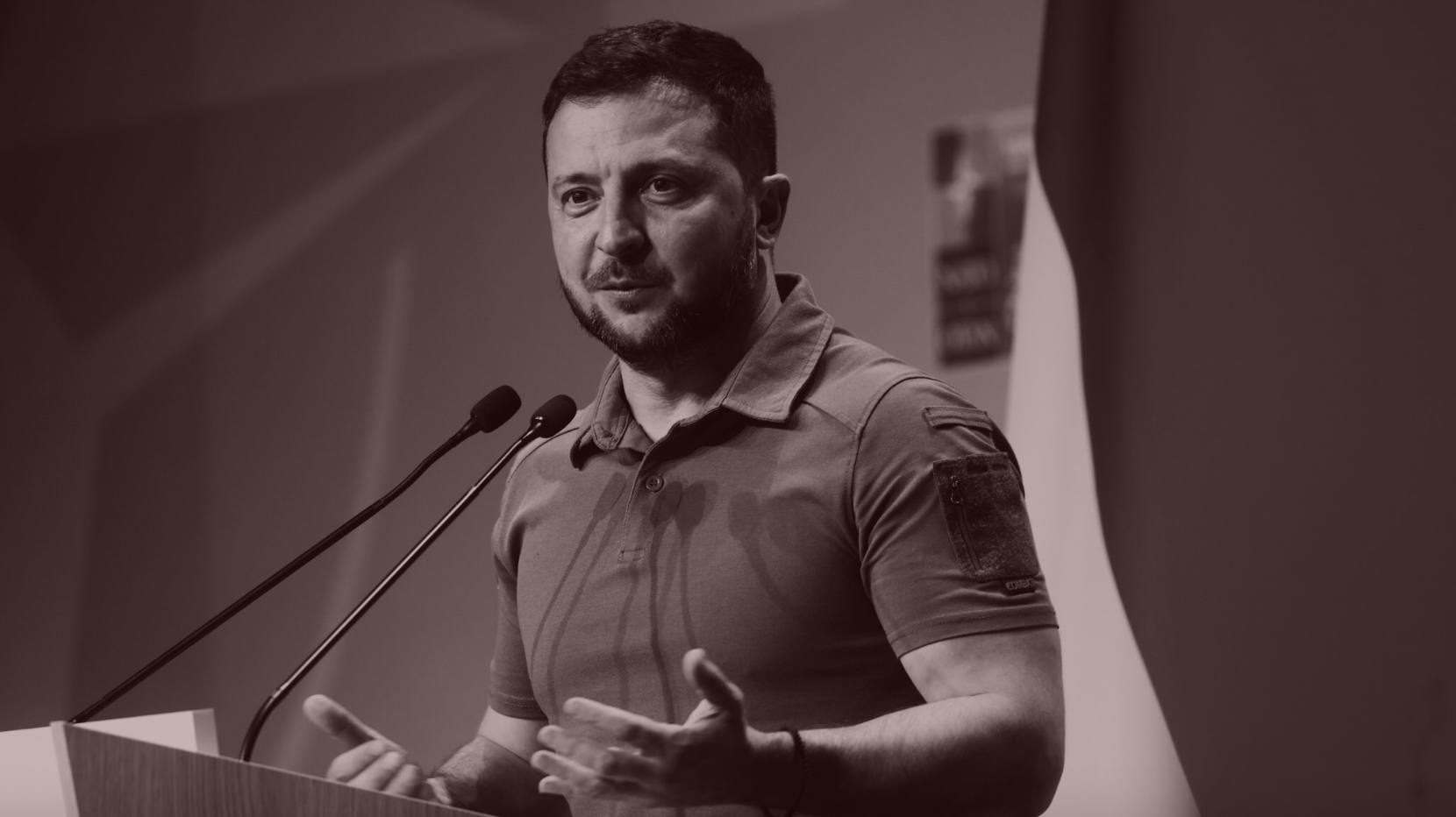
The “Israel model” started out as a proposal out of Kyiv, put forward by Zelensky’s right-hand man Andriy Yermak and former NATO secretary general Anders Fogh Rasmussen in September 2022, called the Kyiv Security Compact. Zelensky had already said that he wanted Ukraine to become “a big Israel” and Rasmussen began saying that the proposal was “partly based on the United States’ long-term military support for Israel.”
The plan, however, was swiftly overtaken by bigger events, like the mobilization of men in Russia, the first attack on the Kerch Bridge, and preparations for Russia’s winter offensive (remember that?). But the idea began to gain traction this winter, when talk in the Biden administration began to turn toward a more systematic approach to sending aid to Ukraine. As the war entered its second year, it became clear that it was not winding down, and that the ad hoc approach of using presidential drawdown authority and rushing aid packages through Congress was not sustainable in a long war.
Moreover, as right-wingers stepped up their critiques about aid to Ukraine, and as support in the U.S. softened, there were increasingly jitters not just in Ukraine but all over Europe about whether they could count on Washington to lead the coalition if Biden weren’t re-elected. Part of the goal with implementing the Israel model, which still retains remarkable bipartisan support in Congress, was not just institutionalizing and making the flow of aid to Ukraine steady and predictable. It was also about Trump-proofing it. “Ukraine will need an extra commitment because 2024 is looming,” said another person familiar with the White House discussions. “No one has ever worried that the bottom would fall out of U.S. policy toward Israel. I think the Trump factor is significant. It’s also about signaling to Russia that even if Trump is elected, he won’t be able to do a 180 on it” and suddenly shut the spigot. “It makes sense to do this even without that, but the Trump factor added urgency.”
As the White House was starting to coalesce around this idea, a Carnegie fellow named Eric Ciaramella began gathering string for a policy proposal. A former Obama National Security Council staffer, he spoke to officials in the White House who were thinking along these lines. “They were already moving in that direction,” Ciaramella told me. “They had a skeleton in mind and then I helped put flesh on the bone.” Through what Ciaramella described as “an iterative process,” he helped develop the how of adapting and implementing the model in Ukraine.
By early May, Ciaramella had a draft that he shared with the White House and other parts of the government, and the paper began to make its way around Washington. Articles about the “Israel model” also began to circulate, and in early June, Carnegie published the paper, which acknowledged Ciaramella had spoken to a number of American, European, and Ukrainian officials in compiling it. Incidentally, it served as a nice trial balloon released a month before the NATO summit in Vilnius.
The resulting policy and the G7 announcement came in for some critique. Realists like Emma Ashford criticized it for carrying hidden risks of entrapment. Neocons like Elliot Cohen slammed it for not being a hazy halfway idea. “You know it’s a decent middle-ground proposal when the restrainers are afraid of entrapment and the neocon hawks think it’s not going far enough,” said the first source familiar with the White House discussions. “This is the framework that has the most salience in D.C. and in the administration.”
Fried, who initially thought this was a dodge to get out of answering the NATO question, thinks this is a decent proposal and a way to preempt the pressure the Biden administration expects to face when the NATO summit takes place in Washington next summer, on the 75th anniversary of the alliance’s formation. “But, look, these are real problems,” Fried said. “This is hard. It’s not easy.”
The point, however, is to use the Israel model to buttress Ukraine’s security until such time—however far in the future—that it can join NATO, which, NATO members agree, is its rightful place. “If they join NATO,” a senior administration official told me, “the Israel thing goes away.” |
|
|
| That’s all from me, friends. I’ll see you back here next week. Until then, good night. Tomorrow will be worse.
Julia |
|
|
|
| FOUR STORIES WE’RE TALKING ABOUT |
|
|
|

|
 |
|
|
|
Need help? Review our FAQs
page or contact
us for assistance. For brand partnerships, email ads@puck.news.
|
|
You received this email because you signed up to receive emails from Puck, or as part of your Puck account associated with . To stop receiving this newsletter and/or manage all your email preferences, click here.
|
|
Puck is published by Heat Media LLC. 227 W 17th St New York, NY 10011.
|
|
|
|